VOL I
PLANETARY FORMATION AND GEOLOGY
1.0 INTRODUCTION: THE ANATOMY OF ORIGINS
To articulate the history of the Earth is to narrate the history of matter itself. The existence of our planet is not an isolated phenomenon but the downstream consequence of a chain of events initiated 13.8 billion years ago. Before we can discuss the coalescence of dust into rock, or rock into continents, we must first interrogate the genesis of the canvas upon which this history is written: Space-Time.
This chronicle begins not with the "World" in the terrestrial sense, but with the "World" in its most absolute definition—the entirety of existence. The transition from non-existence to existence remains the most profound transformation in the history of reality. To understand the solar system, we must first understand the forge in which its raw materials were created.
1.1 THE INITIAL SINGULARITY (T = 0)
Our retrospective journey terminates at a specific temporal coordinate: T=0. Current cosmological models, specifically the Lambda-CDM model (Cold Dark Matter), extrapolate the expanding universe back to a single geometric point. This is the Primordial Singularity.
1.1.1 Defining the Undefinable
The Singularity is often misunderstood as a "fireball" floating in empty space. This is physically incorrect. There was no "space" outside the Singularity for it to float in. The Singularity contained all of space, compressed into zero volume. It was not an explosion in space, but an explosion of space.
At this precise moment:
- Density: Infinite (∞).
- Temperature: Infinite (∞).
- Curvature of Space-Time: Infinite (∞).
In this state, the laws of physics as we know them—Standard Model particle physics and Einstein’s General Relativity—cease to function. General Relativity assumes a smooth fabric of space-time, but at the scale of the singularity, quantum mechanics dominates, turning the "smooth" fabric into a chaotic, probabilistic foam.
1.1.2 The Question of "Before"
A common philosophical and physical inquiry is: "What existed before the Big Bang?" Stephen Hawking famously compared this to asking, "What is north of the North Pole?" The question is semantically valid but cartographically meaningless. If time is a dimension that emerged alongside space at the moment of the Big Bang, then "before" refers to a time that did not exist. There was no linear causality prior to this moment.
1.2 THE PLANCK EPOCH (0 to 10-43 Seconds)
The first recognizable era of the universe is the Planck Epoch. This period spans from T=0 to 10-43 seconds (one Planck Time). This is the absolute frontier of human knowledge. No current physical theory can describe this era with certainty because it requires a unification of Quantum Mechanics (the physics of the very small) and General Relativity (the physics of the very heavy/large). This unified theory is often called "Quantum Gravity."
1.2.1 The Unified Superforce
In the cold universe of the modern era (today), we observe four distinct fundamental forces that govern all matter interactions:
- Gravity: The attraction between masses.
- Electromagnetism: The interaction of charged particles (light, electricity, magnetism).
- The Strong Nuclear Force: The glue that holds atomic nuclei (protons and neutrons) together.
- The Weak Nuclear Force: The mechanism responsible for radioactive decay and neutrino interactions.
However, during the Planck Epoch, the energy density was so extreme (1019 GeV) that these four forces were indistinguishable. They were fused into a single, master force: The Superforce. While we cannot mathematically model this force perfectly without a Theory of Everything (like String Theory or Loop Quantum Gravity), we theorize that the symmetry of the universe was perfect. There was no distinction between a quark and a lepton, or between a force carrier and a matter particle.
1.2.2 Quantum Foam and Micro-Black Holes
At this scale (the Planck Length, approx. 1.6 × 10⁻³⁵ meters), the geometry of space-time was likely subject to violent quantum fluctuations. Space did not look like a flat sheet or a smooth curve. Instead, it was likely a boiling "Quantum Foam" (a term coined by physicist John Wheeler).
In this foam, virtual particles would pop in and out of existence instantly. Microscopic wormholes may have formed and collapsed in fractions of a second. Mini-black holes may have been created by the sheer energy density, only to evaporate immediately via Hawking Radiation.
1.3 THE GRAND UNIFICATION EPOCH (10-43 to 10-36 Seconds)
As the universe expanded, it cooled. In thermodynamics, cooling often leads to "phase transitions"—similar to how water turns to ice. In the early universe, these phase transitions caused the fundamental forces to separate from the Superforce.
1.3.1 The First Break: Gravity Decouples
At 10-43 seconds, the temperature dropped slightly below the Planck Temperature (1032 Kelvin). This cooling triggered the first great symmetry breaking. Gravity, the weakest of the four forces, separated from the Superforce. This left the remaining three forces (Electromagnetism, Strong, and Weak) still fused together in a state known as the Grand Unified Theory (GUT) force.
1.3.2 The Era of Exotic Physics
The Grand Unification Epoch was a realm of physics that we cannot replicate on Earth, not even in the Large Hadron Collider (LHC). The particles that existed here were likely incredibly heavy ancestors of the particles we know today.
- X and Y Bosons: Theoretical physicists predict the existence of massive "X" and "Y" bosons during this time. These particles would have allowed for the transformation of quarks into leptons (and vice versa), a process that is impossible today.
- Magnetic Monopoles: This epoch likely produced Magnetic Monopoles—particles with a net magnetic charge (a "North" without a "South"). The fact that we do not see these today is a critical clue that leads us to the theory of Inflation.
1.3.3 The Seed of Baryogenesis
It is possible that the processes occurring in the GUT Epoch laid the groundwork for "Baryogenesis"—the creation of matter over antimatter. If the X and Y bosons decayed asymmetrically, they might have produced a slightly higher number of quarks than anti-quarks. This tiny imbalance (roughly 1 extra quark for every billion quark-antiquark pairs) is the sole reason matter exists in the universe today. If the symmetry had remained perfect, the eventual matter-antimatter annihilation would have left a universe filled only with light.
1.4 THE LIMITS OF OBSERVATION
It is important to note that everything described in Part 1 is inferred through high-energy theoretical physics and mathematical extrapolation. We cannot "see" this far back with telescopes. Light (photons) was trapped in the opaque plasma of the early universe for 380,000 years. Therefore, we use "particle colliders" as time machines. By smashing atoms together at near-light speeds, we create temperatures that mimic these early epochs, allowing us to test our theories about the behavior of the Superforce and the GUT force.
As we approach the end of the Grand Unification Epoch (10-36 seconds), the universe was roughly the size of a marble, seething with unimaginable energy, poised for the most violent event in cosmic history: Cosmic Inflation.
2.0 THE INFLATIONARY EPOCH (10-36 to 10-32 Seconds)
At approximately 10-36 seconds after the Big Bang, a cataclysmic event occurred that determined the large-scale structure of the universe. This phase is known as Cosmic Inflation. It was not merely an expansion of matter moving through space, but an exponential stretching of space-time itself.
2.1 The Inflaton Field
Standard cosmology posits that this era was driven by a hypothetical scalar field known as the "Inflaton Field." Unlike modern matter, which dilutes as space expands, the Inflaton field possessed a unique property: negative pressure.
In general relativity, positive pressure creates gravity (attraction), but negative pressure creates repulsive gravity. This repulsive force was so overwhelming that it overcame the initial gravitational pull of the singularity and drove the universe apart at a rate that defies common intuition.
2.2 The Scale of Expansion
The numbers defining inflation are staggering. In a fraction of a second (much less than a trillionth of a trillionth of a second), the universe increased in size by a factor of at least 1026 (and potentially up to 1078).
To visualize this: imagine an object the size of a single DNA molecule expanding to a width of 10.6 light-years (approx. 100 trillion kilometers) in an instant. This expansion happened faster than the speed of light. While Einstein’s Special Relativity forbids matter or information from traveling through space faster than light, it places no such limit on the expansion of space itself.
2.3 Solving the Cosmological Puzzles
Inflation is not just a fancy theory; it is a necessary mathematical tool introduced by physicist Alan Guth in 1980 to solve three critical problems with the standard Big Bang model:
- The Horizon Problem: The cosmic microwave background (CMB) radiation we see today is almost perfectly uniform in temperature (2.725 Kelvin) in all directions. Without inflation, regions on opposite sides of the universe would never have been close enough to exchange heat and equalize their temperatures. Inflation took a tiny, homogeneous patch and blew it up to become the entire observable universe.
- The Flatness Problem: The geometry of the universe appears perfectly flat (Euclidean). If the universe had just a little more matter, it would have collapsed; a little less, and it would have flown apart too fast for galaxies to form. Inflation stretched space-time so taut that any initial curvature became undetectable, effectively "flattening" the universe.
- The Monopole Problem: As mentioned in Part 1, the Grand Unification Epoch should have produced magnetic monopoles. Inflation diluted these particles so significantly that we are unlikely to ever find one in our observable patch of the universe.
2.4 REHEATING AND THE ORIGIN OF MATTER
Inflation could not last forever. If it had, the universe would be an empty, cold, rapidly expanding void. The process ended via a mechanism called "Reheating."
As the potential energy of the Inflaton field dropped to its lowest state (a vacuum expectation value), the field decayed. This decay transferred the massive energy of the expansion into the creation of Standard Model particles. The cold, expanding universe was suddenly flooded with a hot soup of elementary particles—quarks, anti-quarks, and gluons. The universe was no longer a vacuum; it was a plasma.
2.5 THE ELECTROWEAK EPOCH (10-32 to 10-12 Seconds)
Following Reheating, the universe entered the Electroweak Epoch. At this stage, the temperature was approximately 1015 Kelvin.
2.5.1 The Separation of the Strong Force
Around 10-32 seconds, another symmetry breaking occurred. The Strong Nuclear Force (which binds quarks together) separated from the Electroweak Force. Now, three of the four fundamental forces were distinct: Gravity, Strong Nuclear, and the Electroweak Force (a combination of Electromagnetism and Weak Nuclear).
This era was dominated by radiation (photons) and a dense plasma of quarks, leptons (like electrons and neutrinos), and their antimatter counterparts. It is crucial to understand that at this high energy, particles had no mass. They moved at the speed of light.
2.5.2 The Higgs Mechanism (T ≈ 10-12 Seconds)
The end of the Electroweak Epoch is marked by one of the most significant events in physics: the Electroweak Symmetry Breaking.
As the universe cooled below a critical threshold (approx. 159 GeV), the Higgs Field—an energy field that permeates all of space—"turned on" (acquired a non-zero vacuum expectation value).
Before this moment, particles like electrons and quarks zipped around at the speed of light, mass-less. As the Higgs Field activated, these particles began to interact with it. The interaction is often compared to moving through molasses; the field "dragged" on the particles, slowing them down and giving them the property we call Mass.
Photons (light) did not interact with the Higgs field, remaining massless. However, the W and Z bosons (carriers of the weak force) gained heavy mass, which is why the weak nuclear force has such a short range today.
By 10-12 seconds, the four fundamental forces—Gravity, Electromagnetism, Strong, and Weak—were finally separated and operating as they do today. The stage was set for the formation of the first composite particles.
3.0 THE QUARK EPOCH (10-12 to 10-6 Seconds)
Following the Electroweak symmetry breaking, the universe entered the Quark Epoch. At this stage, the universe was filled with a dense, hot "soup" known as Quark-Gluon Plasma (QGP).
In the modern universe, quarks are never found alone; they are always bound together by gluons to form larger particles like protons. However, in this epoch, the thermal energy was so intense (exceeding 10 trillion Kelvin) that the binding energy of the Strong Nuclear Force was overpowered. Quarks roamed freely. It was a state of matter that we have only recently managed to recreate momentarily in heavy-ion collisions at CERN.
4.0 THE HADRON EPOCH (10-6 Seconds to 1 Second)
As the universe expanded, the temperature dropped to approximately 1013 Kelvin (roughly 2 trillion degrees Celsius). This cooling triggered a critical phase transition known as Hadronization or Confinement.
4.1 The Prison of Quarks
The Strong Nuclear Force possesses a unique property: unlike gravity or electromagnetism, which get weaker with distance, the strong force gets stronger as quarks move apart (similar to stretching a rubber band).
As the ambient thermal energy dropped, it was no longer sufficient to keep quarks apart. They snapped together in triplets.
- Protons: Formed by two Up quarks and one Down quark (uud).
- Neutrons: Formed by one Up quark and two Down quarks (udd).
These composite particles are collectively called Hadrons. For a brief moment, the universe was filled with equal amounts of matter (baryons) and antimatter (anti-baryons).
4.2 The Great Annihilation
This period witnessed the most destructive event in cosmic history. As the temperature continued to fall, the energy density of the universe became too low to spontaneously create new pairs of protons and anti-protons.
However, existing particles and anti-particles continued to collide. When a proton meets an anti-proton, they annihilate instantly, turning back into pure energy (photons).
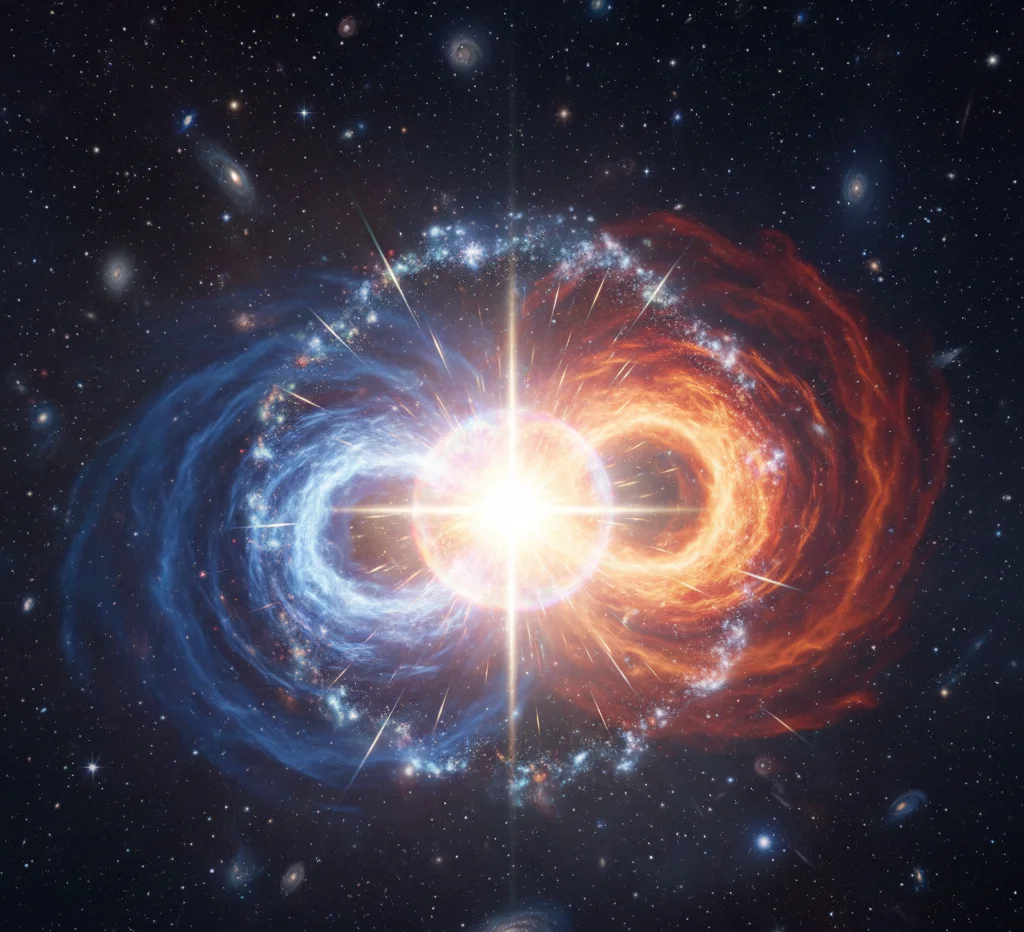
This was a war of attrition. Billions upon billions of particle pairs annihilated each other in a flash of gamma rays. If the universe had been perfectly symmetrical, every single proton would have been destroyed, leaving a universe with zero matter.
The Survivor: Due to the slight asymmetry mentioned in Part 1 (Baryogenesis), for every billion anti-protons, there were a billion-and-one protons. After the annihilation was complete, the "billion" pairs were gone (becoming the background radiation), and the "one" extra proton survived.
Note: Every atom in your body, every rock on Earth, and every star in the sky is made of these "leftover" survivors of the Great Annihilation.
5.0 NEUTRINO DECOUPLING (approx. 1 Second)
By one second after the Big Bang, the universe was still incredibly hot (10 billion Kelvin), but "cool" enough for neutrinos to stop interacting with matter.
Neutrinos are ghost-like particles that rarely interact with ordinary matter. Before this moment, the density was so high that even neutrinos were trapped. As the density dropped, neutrinos broke free and began streaming through the universe at near-light speed.
This release created the Cosmic Neutrino Background (CνB). While we have detected the Cosmic Microwave Background (light), we have not yet developed technology sensitive enough to directly map this neutrino background, though its existence is mathematically certain.
6.0 THE LEPTON EPOCH (1 Second to 10 Seconds)
Following the annihilation of hadrons (protons and neutrons), the majority of the universe's mass was gone. However, a significant population of lighter particles, known as Leptons (electrons and neutrinos), still dominated the cosmic energy budget.
During this brief ten-second window, the universe was a chaotic sea of leptons and anti-leptons constantly colliding and annihilating. Just like the hadrons before them, the leptons underwent a massive annihilation event as the temperature fell below the threshold required to create electron-positron pairs (approx. 5 billion Kelvin).
Most electrons and positrons destroyed each other, creating a fresh flood of high-energy gamma rays. Once again, due to the tiny baryon asymmetry, a small residue of electrons (about one for every billion photons) survived. This residue is crucial: without these electrons, the universe would not be electrically neutral, and atoms could never form.
7.0 BIG BANG NUCLEOSYNTHESIS (10 Seconds to 20 Minutes)
This is arguably the most critical "chemical" phase in the history of the universe. Before this moment, the universe contained only single protons (Hydrogen nuclei). There were no other elements—no helium, no carbon, no oxygen.
As the temperature dropped to roughly 1 billion Kelvin, the universe turned into a colossal nuclear fusion reactor. This process is known as Primordial Nucleosynthesis.
7.1 The Deuterium Bottleneck
The first step in building elements is fusing a proton with a neutron to create Deuterium (Heavy Hydrogen).
Reaction: p + n → D + γ (photon)
However, for the first few minutes, the universe faced a "bottleneck." Although deuterium was constantly forming, the ambient gamma rays were still so energetic that they immediately blasted the deuterium nuclei apart. This is known as the "Deuterium Bottleneck." Nucleosynthesis could not proceed to heavier elements until the universe cooled enough for deuterium to survive.
7.2 The Formation of Helium
Once the bottleneck broke (at approx. T+3 minutes), a rapid chain of nuclear reactions occurred.
- Deuterium nuclei fused to form Helium-3 and Tritium.
- These intermediate isotopes quickly fused to form Helium-4 (two protons, two neutrons).
Helium-4 is extremely stable. Once formed, it didn't easily break apart or fuse into anything else. Within just 20 minutes, the universe converted roughly 25% of its entire mass into Helium-4. The remaining 75% stayed as Hydrogen (single protons).
7.3 The Mystery of the Missing Heavy Elements
Why did the Big Bang stop at Helium? Why didn't it create Carbon, Oxygen, or Iron?
The answer lies in nuclear physics: There are no stable atomic nuclei with a mass of 5 or 8.
- If you add a proton to Helium-4 (Mass 4), you get Lithium-5, which decays instantly.
- If you fuse two Helium-4 nuclei, you get Beryllium-8, which decays instantly.
Because of this "mass gap," the primordial nuclear fusion chain hit a dead end. The universe could not bridge the gap to create Carbon. It would take hundreds of millions of years and the crushing gravity of the first stars to overcome this barrier.
7.4 The Lithium Problem
A trace amount of Lithium-7 (approx. 0.00000001%) was created. However, there is a significant unresolved issue in modern cosmology known as the "Cosmological Lithium Problem." Our calculations of the Big Bang predict about three times more Lithium-7 than we actually observe in the oldest stars. This discrepancy remains one of the few cracks in our understanding of the early universe.
8.0 THE PHOTON EPOCH (20 Minutes to 380,000 Years)
After 20 minutes, the nuclear reactor shut down. The temperature and density dropped below the threshold for fusion. The composition of the universe was now fixed:
- 75% Hydrogen
- 25% Helium
- Trace amounts of Lithium and Beryllium
8.1 The Cosmic Fog
For the next 380,000 years, the universe was an opaque, glowing fog. This state is called a Plasma.
In a plasma, electrons are not bound to atomic nuclei; they roam freely. Light (photons) interacts very strongly with free electrons. A photon trying to travel through the universe would travel only a microscopic distance before hitting an electron and scattering.
If you could teleport to this era, you would see nothing but a blindingly bright, white fog in all directions. Light was trapped. The universe was "coupled"—matter and radiation were locked together in a thermal equilibrium. Sound waves (acoustic oscillations) rippled through this plasma, creating slight density variations that would later become the seeds of galaxies.
9.0 RECOMBINATION AND DECOUPLING (380,000 Years After Big Bang)
For nearly 400,000 years, the universe was a blindingly bright, opaque plasma. Photons could not travel freely because they were constantly scattering off free electrons—a process known as Thomson Scattering. However, as the universe continued to expand, its temperature plummeted.
Around 380,000 years after the Big Bang, the temperature dropped to approximately 3,000 Kelvin (roughly the surface temperature of a red dwarf star). This thermal threshold is critical because it marks the point where the energy of the photons was no longer sufficient to knock electrons out of orbit.
9.1 The Era of Recombination
At this temperature, thermodynamics favored the formation of neutral atoms. Protons finally captured the frantic free electrons, binding them into stable orbits.
Reaction: p + e⁻ → H (Neutral Hydrogen) + γ (photon)
This phase transition is technically called "Recombination" (a slightly confusing misnomer, as they were combining for the very first time). Before this, the universe was charged; after this, it became electrically neutral.
9.2 Photon Decoupling: The Universe Becomes Transparent
Once the electrons were locked away inside hydrogen atoms, the "fog" lifted instantly. Neutral hydrogen does not scatter light in the same way plasma does. Suddenly, the photons that had been trapped for hundreds of thousands of years were free to travel in straight lines across the cosmos.
This moment is known as Decoupling. The light released at this instant is still traveling through the universe today. It is the oldest light in existence, visible in every direction we look. We call it the Cosmic Microwave Background (CMB).
When this light was first released, it was visible as a dull orange-red glow (approx. 3000K). However, over the last 13.8 billion years, the expansion of the universe has stretched the wavelengths of this light, shifting it from the visible spectrum into the microwave spectrum (approx. 2.7 Kelvin today). This "afterglow" of the Big Bang provides the most definitive evidence for the origin of our universe.
10.0 THE COSMIC DARK AGES (380,000 Years to ~150 Million Years)
Following the release of the CMB, the universe faded into black. There were no stars to shine, no galaxies to light up the void, and no quasars. There was only vast, expanding clouds of neutral hydrogen and helium gas, drifting in the dark.
This era, known as the Cosmic Dark Ages, is the "missing link" in cosmological history. It is a period of silence before the first structures began to emerge. However, in the darkness, gravity was silently at work.
10.1 The Invisible Skeleton: Dark Matter
If the universe had contained only normal matter (baryons), gravity might have been too weak to form galaxies quickly enough. The gas pressure from the hot hydrogen would have resisted collapse.
Fortunately, the universe is filled with Dark Matter—a mysterious substance that does not interact with light but has mass. Because Dark Matter does not feel "pressure" from light or heat, it began to clump together much earlier than normal matter.
During the Dark Ages, Dark Matter formed a vast, invisible network known as the Cosmic Web. It created deep "gravitational wells"—halos of invisible mass. Normal hydrogen gas, feeling this pull, began to flow into these Dark Matter halos like water flowing into a valley. This invisible scaffolding dictated where the future galaxies would form.
10.2 The Physics of the First Collapse (Jeans Instability)
How does a cloud of gas turn into a star? It is a battle between two forces:
- Gravity: Tries to pull the gas inward to a single point.
- Internal Pressure: Heat and motion of the gas atoms push outward.
For a cloud to collapse, gravity must win. The threshold for this victory is defined by the Jeans Mass. During the Dark Ages, the gas cooled down as the universe expanded. As the gas cooled, its internal pressure dropped, allowing gravity to take over.
Inside the densest nodes of the Cosmic Web, the hydrogen gas began to compress. As it compressed, it heated up again—not from nuclear fusion yet, but from the friction and gravitational potential energy. These dense pockets of gas, growing hotter and denser by the millennium, were the embryos of the very first stars.
10.3 The 21-cm Line: Listening to the Dark
Since there was no light during this era, astronomers cannot use optical telescopes to see it. Instead, they look for a specific radio signal emitted by neutral hydrogen: the 21-centimeter line.
This signal is produced when the electron in a hydrogen atom flips its spin direction relative to the proton. It is an incredibly faint, low-energy event, but considering the universe was filled with oceans of hydrogen, the cumulative signal is detectable. Detecting this faint whisper from the Dark Ages is one of the primary goals of next-generation radio telescopes like the Square Kilometre Array (SKA).
11.0 COSMIC DAWN: THE FIRST STARS (150 Million to 1 Billion Years)
After hundreds of millions of years of silence, the Cosmic Dark Ages ended not with a whimper, but with a blinding ignition. Deep within the densest halos of Dark Matter, the primordial hydrogen gas finally reached the critical density and temperature required for nuclear fusion.
The first stars turned on. This era is poetically and scientifically known as the Cosmic Dawn.
11.1 Population III Stars: The Primordial Giants
Astronomers categorize stars into three "Populations" based on their metal content (metallicity). Confusingly, the numbering is reverse-chronological:
- Population I: Modern stars like our Sun (rich in heavy elements).
- Population II: Old stars found in galactic halos (low metal content).
- Population III: The very first stars (ZERO metal content).
Population III stars were unlike anything we see in the modern universe. Because the universe contained only hydrogen and helium, these stars lacked "cooling agents" (heavy elements radiate heat efficiently, allowing gas clouds to fragment into smaller stars).
Without cooling agents, the collapsing gas clouds did not fragment. Instead, they collapsed into single, colossal objects. Theoretical models suggest Population III stars were titanic monsters:
- Mass: 100 to 1,000 times the mass of the Sun.
- Luminosity: Millions of times brighter than the Sun.
- Color: Blindingly blue-white (surface temperatures exceeding 100,000 Kelvin).
- Lifespan: Extremely short. While our Sun will live for 10 billion years, these giants burned through their fuel in just 2 to 5 million years.
11.2 The Alchemy of the Cosmos: Creating the Elements of Earth
The Big Bang provided the canvas (Space-Time) and the paint (Hydrogen/Helium), but it failed to create the complexity required for life. It could not create Carbon for our cells, Oxygen for our lungs, or Iron for our blood. This task fell to Population III stars.
Inside the crushing cores of these giants, pressures were high enough to bridge the "mass gap" that stalled the Big Bang.
- Triple-Alpha Process: Three Helium nuclei fused to form Carbon.
- Carbon Burning: Carbon fused to form Neon, Magnesium, and Oxygen.
- Silicon Burning: In their final days, they fused Silicon into Iron.
11.3 Pair-Instability Supernovae
When these massive stars died, they did not go quietly. Many likely underwent a specific, violent type of explosion known as a Pair-Instability Supernova.
The core got so hot that photons (light) spontaneously converted into electron-positron pairs. This caused a sudden drop in radiation pressure, which holds the star up against gravity. The star collapsed instantly and then detonated with such force that it left no black hole remnant behind—it blew itself entirely apart.
The Great Seeding: This explosion is the most important event for planetary geology. It scattered the newly forged heavy elements—Carbon, Oxygen, Iron, Silicon—across the pristine universe. The cosmos was no longer pure; it was now "polluted" with the dust of life. Future generations of stars (like our Sun) would be born from this enriched debris, possessing the materials needed to build rocky planets.
12.0 THE EPOCH OF REIONIZATION
The birth of these first stars had a profound effect on the surrounding universe. The Population III stars were so hot that they emitted copious amounts of high-energy Ultraviolet (UV) radiation.
This UV light slammed into the surrounding neutral hydrogen gas atoms. The energy was strong enough to kick the electrons back out of their orbits.
Reaction: H (Neutral) + UV Photon → p + e⁻ (Ionized Plasma)
This process is called Reionization. It started as small "bubbles" of ionized gas around individual stars. As more stars and the first primitive galaxies formed, these bubbles grew and merged. Eventually, the entire universe was re-ionized. The "fog" of neutral hydrogen that defined the Dark Ages was burned away, leaving the intergalactic medium transparent, as it is today.
13.0 THE ASSEMBLY OF GALAXIES
While stars were living and dying, gravity continued to pull matter together within the Cosmic Web. The first "protogalaxies" were small, messy clumps of gas and stars, nothing like the majestic spirals we see today.
Through a process of Hierarchical Merging, these small blobs collided and fused to form larger galaxies. At the center of these growing structures, gas collapsed to extreme densities, likely forming the first Supermassive Black Holes (Quasars). These hungry monsters devoured gas and shone with the brightness of a trillion suns, acting as beacons across the young universe.
By roughly 1 billion years after the Big Bang, the universe began to look recognizable. The stage was set. The heavy elements were created. The galaxies were forming. Now, we zoom in from the cosmic scale to a specific, unremarkable corner of a newly forming galaxy: The Milky Way.
14.0 THE BIRTH OF THE SOLAR SYSTEM (4.6 Billion Years Ago)
We now fast-forward roughly 9 billion years from the Big Bang. The universe has matured. Generations of stars have lived and died, enriching the interstellar medium with heavy elements. In a quiet, unremarkable corner of the Milky Way galaxy, roughly 26,000 light-years from the galactic center, the stage was set for the formation of our home.
14.1 The Pre-Solar Nebula
Before there was a Sun or an Earth, there was a vast, cold cloud of gas and dust known as a Molecular Cloud. This specific region is often referred to as the "Pre-Solar Nebula."
This cloud was not a small object; it spanned light-years across and contained enough mass to build thousands of solar systems. It was composed primarily of:
- Hydrogen (74%) and Helium (24%): Inherited from the Big Bang.
- Dust (2%): Microscopic grains of water ice, silicates, iron, and carbon compounds produced by earlier generations of stars.
For millions of years, this cloud hung in a delicate balance. Gravity tried to pull it inward, while the internal gas pressure pushed outward. It was stable. Something had to disturb this equilibrium to trigger the collapse.
14.2 The Trigger Event: A Cosmic Shockwave
Meteoritic evidence—specifically the presence of decay products of short-lived isotopes like Iron-60 found in primitive meteorites—suggests a violent origin. Iron-60 forms only in the hearts of massive stars just before they explode.
The leading hypothesis is that a nearby massive star (a Wolf-Rayet star) went supernova. The resulting shockwave slammed into our quiet molecular cloud. This impact did two things:
- It injected the cloud with fresh, radioactive heavy elements (which would later heat the interiors of the planets).
- It compressed the gas pockets to high densities, overcoming the internal pressure. Gravity won. The collapse began.
15.0 THE COLLAPSE AND THE PROTO-SUN
Once the collapse started, it was a runaway process. A region of the cloud roughly 100 AU (Astronomical Units) wide began to shrink rapidly. As per the law of conservation of angular momentum, as the cloud shrank, it began to spin faster—like a figure skater pulling in their arms.
15.1 The Formation of the Accretion Disk
The spin caused the cloud to flatten out. Material falling from the "poles" hit the mid-plane of the rotation, canceling out its vertical motion but keeping its rotational motion. The sphere turned into a flat, rotating disk known as the Protoplanetary Disk or Solar Nebula.
This shape is crucial. If the cloud hadn't flattened, all material would have fallen directly into the center, leaving nothing to form planets. The disk structure provided a stable "parking orbit" for the material that would eventually become Earth.
15.2 Ignition of the T-Tauri Sun
At the center of this maelstrom, 99.8% of the material collected. The density and pressure skyrocketed. The infalling gas released immense amounts of gravitational potential energy as heat.
The central ball of gas began to glow a dull red, then a blinding yellow. This was the Proto-Sun. It was not yet a true star; it was not fusing hydrogen. It was powered solely by the heat of its own contraction.
This phase is known as the T-Tauri Phase. The infant Sun was violent and unstable. It possessed a powerful magnetic field and blasted out intense "solar winds"—streams of charged particles moving at millions of kilometers per hour.
The Clearing of the Fog: This fierce solar wind was essential for the future Earth. It acted as a cosmic broom, blowing away the remaining light gases (hydrogen and helium) from the inner solar system. If this hadn't happened, Earth might have become a gas giant like Jupiter, suffocating life under a crushing atmosphere. The T-Tauri wind cleared the inner zone, leaving only the heavy, rocky material behind.
16.0 THE ARCHITECTURE OF THE DISK: THE FROST LINE
The Protoplanetary Disk was not a uniform mixture of materials. It was a chemical refinery governed by a strict temperature gradient. The closer to the Proto-Sun, the hotter it was; the further away, the colder.
This temperature difference created a critical boundary located roughly 2.7 to 3.5 AU (Astronomical Units) from the Sun, known as the Frost Line (or Snow Line).
16.1 Inner Zone: The Realm of Rock
Inside the Frost Line (where Mercury, Venus, Earth, and Mars currently reside), the temperature was too high for volatile compounds like water, ammonia, and methane to exist as solids. They remained in gaseous form.
Only materials with high melting points could solidify (condense) into grains. These were primarily:
- Metals: Iron, Nickel, Aluminum (condensing at ~1400K).
- Silicates: Olivine, Pyroxene (condensing at ~1000K).
However, heavy elements like iron and silicon are rare in the universe (less than 1% of the nebula's mass). Therefore, the solid building materials in the inner solar system were scarce. This is why the inner planets are relatively small; there simply wasn't enough solid "construction material" available to build giants.
16.2 Outer Zone: The Realm of Ice
Beyond the Frost Line, the temperature dropped below 150 Kelvin. Here, hydrogen compounds (water, ammonia, methane) could freeze into solid ice grains.
Since hydrogen and oxygen are vasty more abundant than iron and rock, the outer solar system was flooded with solid material. There was nearly 10 times more solid mass available here than in the inner system. This abundance allowed the planetary seeds in the outer region to grow massive very quickly.
17.0 FROM DUST TO PEBBLES: THE ACCRETION PROCESS
How do microscopic dust grains, smaller than the width of a human hair, become Earth-sized planets? The process begins with Electrostatic Accretion.
Initially, dust grains collided gently and stuck together due to weak electric forces (Van der Waals forces), forming fluffy aggregates similar to dust bunnies under a bed. These clumps grew into pebbles (centimeter-scale).
17.1 The Great Barriers
Standard physics suggests that planet formation should have failed at the pebble stage due to two major obstacles:
- The Bouncing Barrier: When pebbles reach a certain size (about 1 meter), they no longer stick when they collide; they bounce or shatter.
- The Radial Drift Problem: The gas in the disk orbited slightly slower than the solid rocks (due to gas pressure support). This created a "headwind" for the rocks. Calculations show that meter-sized boulders should have lost momentum and spiraled into the Sun in less than 100 years.
17.2 The Solution: Streaming Instability
Modern supercomputer simulations have provided the solution: Streaming Instability. As pebbles drifted through the gas, they naturally clustered together in the "pressure bumps" of the turbulent disk.
When the density of a pebble swarm reached a critical threshold, the collective gravity of the swarm took over. The entire swarm collapsed instantly.
This means planets did not grow slowly from pebble to boulder to mountain. Instead, they likely "jumped" directly from pebbles to Planetesimals—massive objects 100 to 1,000 kilometers across. This rapid collapse allowed them to bypass the dangerous "meter-size barrier" entirely.
18.0 OLIGARCHIC GROWTH AND PLANETARY EMBRYOS
Once planetesimals reached 100km in size, gravity became the dominant force. This phase is known as Runaway Growth.
A large planetesimal has a stronger gravitational pull, so it attracts more material, which makes it even larger, which increases its gravity further. It is a "rich get richer" scenario.
In the inner solar system, this chaotic feeding frenzy lasted for a few million years. Eventually, a few dozen dominant bodies emerged, having consumed almost all the smaller debris in their orbital lanes. These survivors are called Planetary Embryos (or Oligarchs). They were roughly the size of the Moon or Mars.
The Proto-Earth was one of these embryos. But it was not alone. It shared its orbit with other aggressive siblings, setting the stage for a violent game of cosmic billiards that would eventually shape the final four terrestrial planets.
19.0 THE RISE OF THE GIANTS
While the inner solar system was slowly building rocky embryos, the outer solar system—beyond the Frost Line—was witnessing a population explosion. Because ices (water, ammonia, methane) were solid here, planetary cores grew rapidly.
Within just 3 to 4 million years after the first solids formed, a specific planetary embryo reached a critical threshold: 10 Earth Masses. This body was the seed of Jupiter.
19.1 The Core Accretion Model
The standard model for gas giant formation is "Core Accretion."
- Phase 1: Solid Core Formation. The embryo rapidly consumes all nearby ice and rock, reaching roughly 10 times the mass of Earth.
- Phase 2: Critical Mass. At this mass, the gravity of the core becomes strong enough to hold onto the light Hydrogen and Helium gas from the nebula, which are usually too energetic to capture.
- Phase 3: Runaway Gas Accretion. This is the tipping point. The more gas the planet captures, the heavier it gets; the heavier it gets, the faster it captures gas. Jupiter ballooned in size, consuming roughly 300 Earth masses of gas in a remarkably short cosmic blink (perhaps roughly 100,000 years).
Saturn followed a similar path a few million years later, but by then, there was less gas available, which is why it is smaller than Jupiter. Uranus and Neptune formed even later and further out, by which time the gas disk was dissipating, leaving them as "Ice Giants" rather than true Gas Giants.
20.0 THE GRAND TACK HYPOTHESIS
For decades, astronomers believed planets formed in their current orbits and stayed there. However, modern simulations reveal a chaotic history of migration. The most accepted scenario for the early solar system is the Grand Tack Hypothesis.
20.1 The Inward Migration
As Jupiter grew massive, it created a "gap" in the protoplanetary disk. However, the interactions with the remaining gas caused Jupiter to lose orbital energy. It began to spiral inward toward the Sun.
Jupiter didn't just nudge inward; it plowed through the solar system. It migrated from roughly 3.5 AU down to 1.5 AU—right where Mars sits today.
The Great Depletion: As Jupiter traveled through this region, its immense gravity acted like a snowplow. It scattered the planetesimals in its path, ejecting some from the solar system and grinding others into dust. This explains the "Mars Problem": Why is Mars so small (only 10% of Earth's mass)?
The answer is Jupiter. Jupiter ate Mars' lunch. By migrating through that zone, Jupiter stole the material that would have allowed Mars to grow into an Earth-sized planet, leaving behind a starved, stunted embryo.
20.2 The U-Turn (The "Tack")
Why didn't Jupiter keep going and fall into the Sun (becoming a "Hot Jupiter" as seen in other star systems)? The savior was Saturn.
As Saturn grew and migrated inward, it caught up to Jupiter. The two giants locked into a specific gravitational dance known as a Mean Motion Resonance (specifically a 3:2 resonance, where Jupiter orbits 3 times for every 2 Saturn orbits).
This resonance altered the fluid dynamics of the gas disk around them. Instead of being pushed inward, the combined torque of the two planets reversed their direction. They performed a "Grand Tack" (like a sailboat tacking against the wind) and migrated back outward to their current positions (5.2 AU and 9.5 AU).
20.3 The Gift of Water
The Grand Tack was violent, but it likely saved life on Earth before it even began.
The inner solar system (where Earth formed) was originally very dry and hot. However, as Jupiter migrated outward, it passed through the outer asteroid belt (the realm of icy, carbon-rich asteroids). Its gravity flung these icy rocks inward, raining them down upon the dry inner planets.
This process delivered the first significant batches of water and organic compounds to the Proto-Earth. Without Jupiter's chaotic journey, Earth might have remained a dry, barren desert world forever.
21.0 THE SUN ENTERS THE MAIN SEQUENCE (approx. 4.6 - 4.5 Billion Years Ago)
For roughly 50 million years, our infant Sun was a T-Tauri star—violent, unstable, and powered only by the heat of gravitational contraction. However, deep within its core, the temperature and pressure finally crossed the critical threshold (approx. 15 million Kelvin).
21.1 The Ignition of Fusion
At this specific moment, the Proton-Proton Chain Reaction began in earnest. Hydrogen nuclei slammed together with enough force to overcome the electrostatic repulsion, fusing into Helium and releasing pure energy in the process (E=mc²).
The outward pressure of this nuclear energy finally balanced the inward pull of gravity. The Sun stopped shrinking. It achieved Hydrostatic Equilibrium.
This marks the entry of the Sun onto the Zero Age Main Sequence (ZAMS). Our star had officially become a G-type Main Sequence Yellow Dwarf. It was slightly smaller and about 30% dimmer than it is today, but it was stable. It would remain in this state for the next 10 billion years, providing the steady hearth fire required for life to evolve.
22.0 CLEARING THE NEBULA
The ignition of the Main Sequence Sun had a profound cleaning effect on the solar system. The solar wind—a stream of charged particles—became steady and relentless.
Over a period of a few million years, this wind stripped away the remaining "protoplanetary disk." The hydrogen and helium gas that had not been captured by Jupiter or Saturn was blown out into interstellar space.
The Significance of Timing: This "clearing phase" determined the destiny of the planets.
- If the gas had lingered longer, Earth might have accumulated a thick envelope of hydrogen, becoming an uninhabitable "Ice Giant" like Neptune.
- If the gas had been blown away sooner, Jupiter and Saturn might never have grown large enough to protect the inner solar system from asteroids.
The timing was perfect. The gas was removed just as the terrestrial planets finished their primary accretion, leaving behind a clean system of solid bodies orbiting a stable star.
23.0 THE STATE OF THE INNER SYSTEM (The End of the Beginning)
By 4.5 billion years ago, the chaotic swarm of billions of planetesimals had been reduced to a handful of survivors. The inner solar system did not yet look like it does today. Instead of four orderly planets, there were likely 5 to 10 "Planetary Embryos" orbiting between Mercury and Mars.
One of these embryos was Proto-Earth (often called Gaia). It was roughly 90% of the Earth's current mass. It was a molten, toxic ball of magma with a thin, primitive atmosphere of carbon dioxide and nitrogen. It had no large moon to stabilize its tilt.
Sharing a similar orbit was another embryo, roughly the size of Mars, which astronomers have named Theia.
23.1 Conclusion of Topic 1
We have traversed 9 billion years of history. We witnessed the birth of space and time at the Singularity, the forging of matter in the Quark Epoch, the lighting of the first stars in the Cosmic Dawn, and the miraculous assembly of dust into the Proto-Earth.
The stage is now fully set. The universe has built the house. Now, it must build the home. The next chapter of history will not be written in the language of astrophysics, but in the violent language of planetary geology. The peaceful orbit of Gaia is about to be shattered by the most cataclysmic collision in the history of our world.
Topic 1 ends here.
END OF TOPIC 1
1.0 THE HADEAN EON: THE HELLISH BEGINNING (4.54 - 4.0 Billion Years Ago)
The first geological eon of Earth is appropriately named the Hadean, after Hades, the Greek god of the underworld. If you were to stand on the surface of the Earth during this time, you would not be standing on solid ground, but on a crust of cooling slag floating atop a global ocean of magma. The sky was not blue, but likely a hazy orange-red, choked with carbon dioxide and vaporized rock.
However, the most defining event of the Hadean occurred very early—roughly 30 to 50 million years after the Solar System formed. It was a cataclysm that nearly destroyed the planet.
2.0 THE GIANT IMPACT HYPOTHESIS
As mentioned in the previous topic, the early solar system was a crowded shooting gallery. Proto-Earth shared its orbital region with a Mars-sized planetary embryo named Theia.
Gravitational interactions, likely perturbed by Jupiter's migration, destabilized Theia's orbit. It began to veer inevitably toward Earth.
2.1 The Collision
Approximately 4.5 billion years ago, Theia collided with Earth.
This was not a head-on collision (which would have likely pulverized both planets into dust). Instead, it was a "glancing blow" at a 45-degree angle.
- Velocity: Theia struck at a speed of roughly 4 kilometers per second (approx. 9,000 mph).
- Energy: The energy released was 100 million times greater than the impact that later killed the dinosaurs. It was enough to melt the Earth's entire mantle.
The iron core of Theia sank inward and merged with Earth's core, making our planet exceptionally dense and magnetic. However, a significant portion of Theia's mantle, along with parts of Earth's crust, was vaporized and blasted into orbit.
2.2 The Synestia Structure
Recent computer simulations (2017) suggest that the energy was so high that it momentarily transformed Earth into a Synestia—a donut-shaped cloud of vaporized rock spinning so fast that it flattened out completely. For a brief time, there was no surface, only a continuous fluid transition from the core to space.
3.0 THE BIRTH OF THE MOON
The debris blasted into orbit formed a ring of hot rock and dust around the Earth, similar to Saturn's rings but much hotter and denser.
3.1 Rapid Accretion
Gravity worked terrifyingly fast. Within just 100 years (a geological blink of an eye), the debris in the ring clumped together to form the Moon.
Initially, the Moon was much closer to Earth than it is today—orbiting at a distance of only 20,000 to 30,000 kilometers (compared to 384,000 km today).
The View from Earth: If you looked up from the Hadean Earth, the Moon would have appeared colossal, covering a huge portion of the sky. It was glowing red with molten lava, and because it was so close, it exerted tidal forces on Earth that were thousands of times stronger than today. These "magma tides" churned the Earth's surface, preventing the crust from solidifying for millions of years.
3.2 Why the Moon Matters
The formation of the Moon is not just a footnote; it is a prerequisite for habitable Earth.
- Axial Stabilization: Without the Moon's gravitational anchor, Earth's tilt (obliquity) would wobble chaotically like Mars, causing extreme climate swings that could prevent complex life from evolving.
- Day Length: The collision spun Earth up so fast that a day lasted only 6 hours. Over billions of years, the Moon's gravity has acted as a brake, slowing our rotation to the current 24 hours.
- Shielding: The Moon has acted as a physical shield, absorbing many asteroid impacts that might otherwise have hit Earth.
4.0 THE GLOBAL MAGMA OCEAN
Immediately following the Theia impact and the formation of the Moon, Earth was not a solid planet. It was a churning, roiling ball of liquid rock known as a Global Magma Ocean.
Calculations indicate that the surface temperature exceeded 2,000°C (3,600°F). At these temperatures, rock behaves like water. Massive convection currents circulated molten silicate material from the deep mantle to the surface and back down, moving at speeds of several meters per second.
4.1 Planetary Differentiation Completed
This liquid state was crucial for the final internal structuring of Earth. The density difference between heavy metals and lighter silicates allowed for rapid separation.
- Siderophiles (Iron-lovers): Almost all remaining iron, nickel, and precious metals (gold, platinum) sank through the magma ocean to the core. This is why gold is so rare on the surface today; most of Earth's original gold is locked 3,000 km beneath our feet.
- Lithophiles (Rock-lovers): Lighter elements (silicon, oxygen, aluminum, calcium) floated to the top to form the primitive mantle and crust.
5.0 THE GREAT COOLING AND THE FIRST ATMOSPHERE
A planet glowing at 2,000°C radiates heat into space very efficiently. Within a few thousand years, the surface temperature began to drop. However, the cooling process was complicated by the formation of Earth's Second Atmosphere.
The first atmosphere (hydrogen/helium) had been blown away by the solar wind. The second atmosphere was born from the rock itself. As the magma ocean churned, it released vast quantities of trapped volatiles in a process called Outgassing.
- Composition: Primarily Water Vapor (H₂O), Carbon Dioxide (CO₂), Nitrogen (N₂), and Sulfur compounds.
- Pressure: The atmospheric pressure was crushing—likely 100 to 200 times higher than today (similar to the pressure at the bottom of the modern ocean).
This dense atmosphere created a "runaway greenhouse effect," trapping heat and preventing the magma ocean from solidifying completely for perhaps 10 to 100 million years.
6.0 THE FIRST CRUST AND THE MYSTERY OF ZIRCONS
When did Earth become solid? For decades, geologists believed the Hadean was a continuous hellscape of lava for 500 million years. However, a tiny, nearly indestructible crystal changed everything.
6.1 Zircons: The Time Capsules
In the Jack Hills of Western Australia, scientists found crystals of a mineral called Zircon (ZrSiO₄). Zircons are incredibly durable; they can survive erosion, metamorphism, and even subduction. They act as perfect geological clocks because they trap Uranium (which decays to Lead) but reject Lead during their formation.
Dating these crystals yielded a shocking result: The oldest Zircon is dated to 4.404 Billion Years Ago.
This means that just 100-150 million years after the Earth formed, there was already solid rock crust cool enough for zircons to crystallize. The "Hellish" Earth might not have lasted as long as we thought.
6.2 The "Cool Early Earth" Hypothesis
The analysis went deeper. Scientists looked at the oxygen isotopes (Oxygen-18 vs. Oxygen-16) trapped inside these ancient zircons.
The ratio of isotopes suggested that the magma from which the zircon formed had interacted with liquid water.
The Implications: This revolutionized our understanding of the Hadean. It suggests that by 4.4 billion years ago:
- The surface had cooled below 100°C (at the high pressures of the time).
- The water vapor in the atmosphere had condensed.
- There were likely primitive oceans or at least standing bodies of liquid water on the surface of the crust.
Instead of a magma world, the Earth of 4.4 Ga might have been a quiet, dark water world with black volcanic islands jutting out of a global ocean, shrouded in a thick, orange CO₂ atmosphere.
7.0 KOMATIITES: THE LOST ROCKS
While Zircons tell us about the chemistry, we have very few actual rocks from this era. The crust that formed back then was different from today's continents. It was likely composed of Komatiites.
Komatiites are ultramafic volcanic rocks rich in magnesium. They can only form when the mantle is incredibly hot (roughly 1,600°C). Today, Earth's mantle is too cool (approx. 1,300°C) to produce them. The presence of these rocks in the oldest geological belts confirms that the Hadean mantle was significantly hotter and more fluid, driving tectonic plates (if they existed) at breakneck speeds compared to modern drift.
8.0 THE LATE HEAVY BOMBARDMENT (Approx. 4.1 - 3.8 Billion Years Ago)
After the initial chaos of formation, the solar system appeared to settle into a period of relative calm. However, looking at the craters on the Moon, Mercury, and Mars, scientists noticed a strange anomaly. Most of the large impact basins date back to a specific, narrow window of time long after the planets formed.
This event is known as the Late Heavy Bombardment (LHB) (or the Lunar Cataclysm). It was a period of intense asteroid and comet impacts that pummeled the inner solar system.
8.1 The Cause: Planetary Migration Revisited
Why did the solar system suddenly turn violent again 500 million years after its birth? The leading theory points back to the giant planets.
According to the Nice Model (named after the city in France where it was developed), the outer planets (Jupiter, Saturn, Uranus, Neptune) were originally much closer together. Over time, gravitational interactions caused them to shift orbits.
Specifically, Jupiter and Saturn entered a 1:2 orbital resonance (Jupiter orbiting twice for every one orbit of Saturn). This gravitational "kick" destabilized the orbits of Uranus and Neptune, flinging them outward into the primordial Kuiper Belt (a vast reservoir of icy bodies beyond the planets).
Disrupted by the ice giants, millions of icy comets and asteroids were scattered inward like shrapnel, raining down upon the terrestrial planets.
8.2 The Impact on Earth
Earth, being larger than the Moon, took a much heavier beating due to its stronger gravity. Mathematical models suggest Earth was hit by:
- Over 22,000 craters with diameters > 20 km.
- About 40 impact basins > 1,000 km in diameter.
- Several colossal impacts > 5,000 km in diameter.
Each of these massive impacts would have been sufficient to vaporize the oceans and re-melt huge portions of the crust. Any primitive life that might have started before 4.0 Ga would have been sterilized on the surface, surviving only if it hid deep within hydrothermal vents or the subterranean crust. This is often referred to as the "Impact Frustration" of the origin of life.
9.0 THE ORIGIN OF WATER: THE GREAT BLUE MYSTERY
One of the most defining features of Earth is its oceans. But where did all this water come from? The Hadean Earth was hot enough to boil away any primordial water. The source of Earth's water is still debated, but there are two main reservoirs:
9.1 The Exogenous Source (Delivery from Space)
For a long time, comets (which are dirty snowballs) were the prime suspects. The LHB would have delivered trillions of tons of cometary water to Earth.
However, the Rosetta mission to comet 67P revealed a problem: the "flavor" of water (the ratio of Deuterium to Hydrogen) on comets is often different from Earth's ocean water. This suggests comets might not be the primary source.
Carbonaceous Chondrites: The focus has shifted to asteroids. Specifically, carbon-rich asteroids from the outer asteroid belt contain up to 20% water locked in clay minerals. Their D/H ratio matches Earth's water almost perfectly. It is highly likely that the "Grand Tack" and the LHB bombarded Earth with these wet rocks, filling our basins with water.
9.2 The Endogenous Source (Sweating the Mantle)
Recent studies suggest Earth might have manufactured some of its own water. The mantle contains vast amounts of hydrogen and oxygen bound in minerals like Ringwoodite.
Through volcanic outgassing (as discussed in Part 2), this water was released as steam. As the planet cooled, the steam condensed. Some geologists estimate that the Earth's mantle still holds nearly 3 to 10 times the volume of all surface oceans combined.
Verdict: It is likely a combination of both. The bulk of the water may have come from wet asteroids delivered by Jupiter, while volcanic activity helped bring it to the surface.
10.0 THE FIRST OCEANS
By the end of the Hadean (approx. 4.0 Ga), the bombardment slowed, and the Earth cooled enough for the water to remain liquid permanently.
These first oceans were not like today's.
- Color: Likely green (due to high iron content, as there was no oxygen to rust it out).
- Temperature: Hot, possibly 50°C to 80°C.
- pH: Acidic, due to the high concentration of CO₂ in the atmosphere forming carbonic acid.
In these hot, acidic, iron-rich, green oceans, under a crushing atmosphere of carbon dioxide, the stage was finally set for the most complex chemical experiment in the universe: Life.
11.0 THE ARCHEAN EON: THE AGE OF CONTINENTS (4.0 - 2.5 Billion Years Ago)
Around 4.0 billion years ago, the Late Heavy Bombardment subsided, and the Earth entered a new geological eon: the Archean (from the Greek arkhē, meaning "beginning").
If the Hadean was the era of fire, the Archean was the era of water and granite. The Earth was now a water world, dotted with chains of volcanic islands. But something fundamental was changing deep beneath the waves. The planet was about to manufacture a new type of rock that would allow land to rise permanently above the sea.
11.1 The Basalt-Granite Transition
The primitive crust of the Hadean was almost entirely Basalt (black volcanic rock, similar to the modern ocean floor). Basalt is heavy and dense. When it cools, it tends to sink back into the mantle. This is why the Hadean crust was constantly being recycled; it couldn't float.
However, as the tectonic plates (or proto-plates) subducted deeper into the hot mantle, the water trapped in the basalt lowered the melting point of the rock. This "wet melting" produced a new, lighter, silicate-rich magma: Granite (specifically a primitive type called TTG - Tonalite-Trondhjemite-Granodiorite).
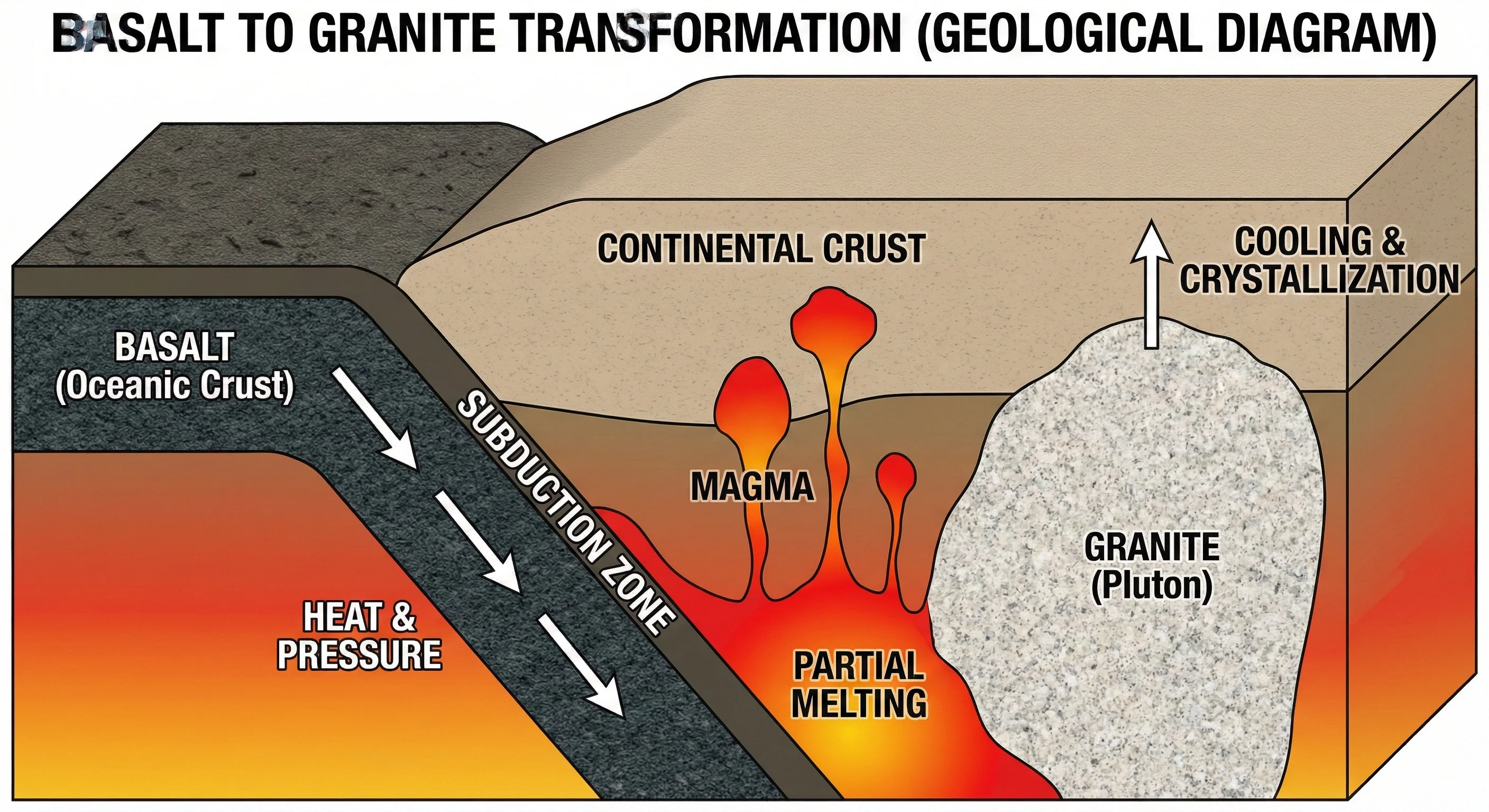
The Buoyancy Revolution: Granite is significantly less dense than basalt. Like a cork floating in water, granite floats high on the Earth's mantle. Once created, it refused to sink back down. It accumulated, thickened, and eventually breached the surface of the ocean. The first true continents were born.
12.0 THE RISE OF CRATONS
These first patches of continental crust were not the vast landmasses we know today. They were small, stable islands of granite known as Cratons (or Shields).
Cratons are the ancient "hearts" of modern continents. They are the oldest, hardest, and most stable parts of the Earth's crust. They have survived billions of years of collisions, breakups, and erosion.
- Yilgarn & Pilbara Cratons: Located in Western Australia.
- Kaapvaal Craton: Located in Southern Africa.
- Superior Craton: Forming the core of North America (Canadian Shield).
Geologists treasure these cratons because they are the only places where we can walk on Archean ground. If you stand in the Pilbara today, you are standing on rock that solidified 3.5 billion years ago.
12.1 Greenstone Belts
Surrounding these granite domes are peculiar geological features called Greenstone Belts. These are zones of metamorphosed volcanic rock (green due to chlorite minerals) and sedimentary rock.
They provide evidence of the violent tectonic style of the Archean. Unlike modern "Plate Tectonics" (where rigid plates slide horizontally), the Archean likely had "Vertical Tectonics" (or Drip Tectonics). The mantle was so hot that the crust was soft and weak. Instead of sliding, cold blobs of crust would "drip" vertically into the mantle, while plumes of magma rose up, creating a chaotic landscape of small, colliding micro-continents.
13.0 THE FIRST SUPERCONTINENTS: VAALBARA AND UR
As these micro-continents drifted across the global ocean, they inevitably collided. Although reconstructing the map of the Archean is incredibly difficult (like assembling a puzzle where 90% of the pieces are missing), paleomagnetic data suggests the existence of the first supercontinents.
13.1 Vaalbara (approx. 3.6 - 3.1 Billion Years Ago)
Vaalbara is the oldest hypothetical supercontinent. Its existence is inferred from the striking geological similarities between the Kaapvaal Craton (South Africa) and the Pilbara Craton (Australia).
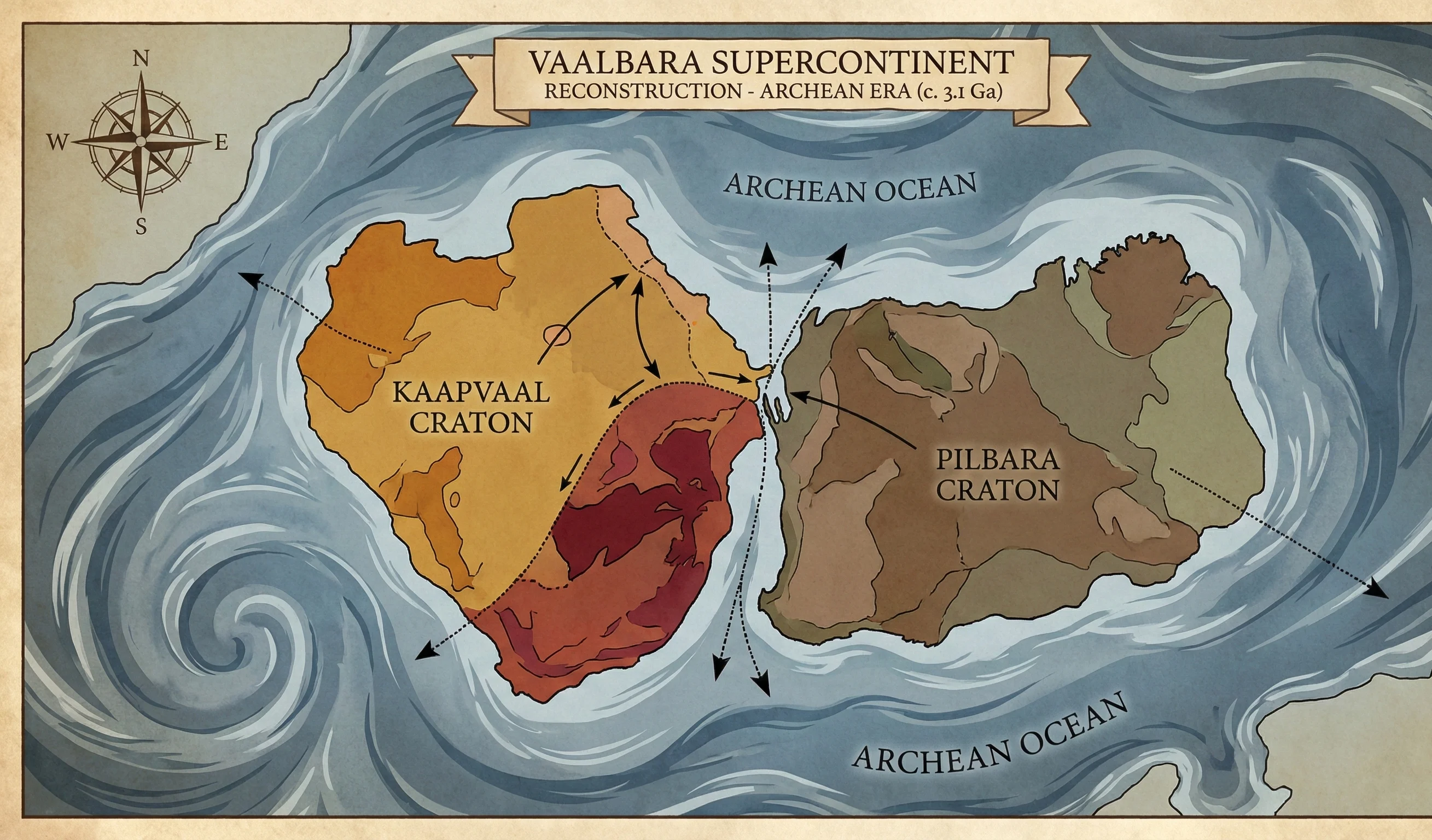
The rock sequences in these two widely separated lands match almost perfectly, suggesting that 3.5 billion years ago, they were attached as a single landmass. Vaalbara was likely small compared to modern continents—perhaps the size of India—but it was the only major land in a world of water.
13.2 Ur (approx. 3.1 Billion Years Ago)
Following the breakup of Vaalbara, another supercontinent, Ur, is believed to have formed roughly 3.1 billion years ago. Ur was composed of parts of what is now India, Madagascar, and Australia.
Remarkably, Ur remained a distinct unit for billions of years, surviving until the breakup of Pangea. It is arguably the longest-lived continental structure in Earth's history.
14.0 THE ARCHEAN ATMOSPHERE AND THE FAINT YOUNG SUN
If you could travel back to the Archean Earth (3.0 billion years ago), you would need a spacesuit. Not only was the air unbreathable, but the environment was alien.
14.1 The Faint Young Sun Paradox
Astrophysical models dictate that stars grow brighter as they age. During the Archean, our Sun was roughly 20% to 30% dimmer than it is today.
Calculations suggest that with such a weak Sun, Earth should have been a frozen ball of ice (a "Snowball Earth"). Yet, geological evidence shows liquid oceans and running water. This contradiction is known as the Faint Young Sun Paradox.
The Solution: A Super-Greenhouse. The answer lies in the atmosphere. The Archean sky was likely thick with greenhouse gases that trapped heat far more efficiently than today's atmosphere.
- Carbon Dioxide (CO₂): Released by rampant volcanism.
- Methane (CH₄): A greenhouse gas 25 times more potent than CO₂. It was likely produced by primitive methanogenic microbes living in the oceans.
This methane-rich atmosphere would have given the Archean sky a hazy, orange-pink hue, similar to the moon Titan, rather than the blue sky we see today.
15.0 BANDED IRON FORMATIONS (BIFs): THE RUSTING OF THE WORLD
The most iconic rock formations of the Archean are the Banded Iron Formations (BIFs). These are massive sedimentary rocks consisting of alternating layers of iron oxides (magnetite/hematite) and iron-poor chert (silica).
These rocks tell the story of a global chemical war.
- The State of the Ocean: The Archean oceans were dissolved with vast amounts of iron (turning the water green). Iron is soluble in water only if there is no oxygen.
- The Oxygen Whiffs: Primitive cyanobacteria (which we will cover in Chapter 2) began producing oxygen as a waste product.
- The Reaction: As soon as this oxygen was produced, it didn't enter the atmosphere. Instead, it instantly reacted with the dissolved iron in the water. Essentially, the oceans began to rust.
The "rust" (iron oxide) was solid; it rained down to the ocean floor, creating red layers of iron. When the oxygen production slowed or the iron supply increased, silica layers formed. This rhythmic deposition continued for hundreds of millions of years, creating the vast iron ore deposits that modern human civilization relies on today to build cities and cars.
16.0 CONCLUSION OF TOPIC 2
As the Archean Eon drew to a close roughly 2.5 billion years ago, the Earth was unrecognizable from the Hadean hellscape.
The magma ocean had solidified. The first granite continents had risen above the green, iron-rich seas. The Moon had retreated to a safer distance. A thick, orange haze wrapped the planet, keeping it warm despite the weak Sun. And deep in the water, the chemistry of the planet was shifting—preparing for the oxygen revolution that would eventually turn the sky blue.
We leave the Earth here: a stable, wet, rocky planet. The stage is set for the next great geological engine to start: Plate Tectonics.
Topic 2 ends here.
END OF TOPIC 2
1.0 THE DYNAMIC EARTH: A PLANET IN MOTION
For most of human history, the ground beneath our feet was considered the ultimate symbol of stability. Mountains were eternal; oceans were fixed. However, geology reveals a radically different truth: the surface of the Earth is in constant, restless motion.
Over the course of millions of years, continents drift across the globe like rafts on a pond, crashing into each other to raise Himalayan-sized mountains, and tearing apart to open new oceans. This process is driven by the engine of Plate Tectonics.
2.0 THE HISTORY OF A THEORY: ALFRED WEGENER
The realization that continents move is surprisingly recent. While early mapmakers noticed that the coastlines of South America and Africa looked like puzzle pieces that fit together, the scientific community believed continents were immovable.
2.1 The Theory of Continental Drift (1912)
In 1912, a German meteorologist named Alfred Wegener proposed a radical hypothesis. He argued that all modern continents were once united in a single supercontinent, which he called Pangaea (Greek for "All Lands").
Wegener provided compelling evidence to support his claim:
- The Jigsaw Fit: The shelves of the continents fit together almost perfectly.
- Fossil Evidence: Fossils of the freshwater reptile Mesosaurus were found in both Brazil and South Africa. Since a small reptile could not swim across the vast Atlantic Ocean, the lands must have been connected.
- Geological Match: Ancient mountain ranges in North America (the Appalachians) perfectly matched mountain ranges in Scotland and Scandinavia in terms of rock type and age.
2.2 The Great Rejection
Despite his evidence, Wegener was ridiculed by the geologists of his time. His theory had a fatal flaw: he could not explain how the continents moved. He suggested they plowed through the ocean floor like icebreakers, which physicists calculated was impossible—the friction would have crushed the continents. Wegener died in 1930 during an expedition to Greenland, never knowing that he would eventually be vindicated.
3.0 THE MECHANISM REVEALED: SEAFLOOR SPREADING
It wasn't until World War II that technology allowed us to map the ocean floor using sonar. Instead of a flat, sandy plain, scientists discovered a massive underwater mountain range running down the center of the Atlantic: the Mid-Atlantic Ridge.
3.1 Harry Hess and the Moving Floor (1960s)
Geologist Harry Hess proposed the mechanism Wegener lacked: Seafloor Spreading.
The ocean floor is not static. At the mid-ocean ridges, magma rises from the mantle, erupts, and cools to form new crust. This new crust pushes the old crust aside. The Atlantic Ocean is literally widening by a few centimeters every year.
This discovery turned "Continental Drift" into the modern, scientifically robust theory of "Plate Tectonics." The continents do not plow through the ocean floor; they are carried along with the ocean floor as if on a conveyor belt.
4.0 THE ANATOMY OF TECTONIC PLATES
We now know that the Earth's outer shell (the Lithosphere) is broken into roughly seven major plates and dozens of minor ones.
- Major Plates: Pacific, North American, Eurasian, African, Antarctic, Indo-Australian, and South American.
- The Engine: What drives them? The primary force is Mantle Convection. The Earth's core is incredibly hot. This heat causes the semi-solid rock in the mantle to rise, cool near the surface, and sink back down. These giant, slow-motion currents drag the tectonic plates above them.
Additionally, forces like "Slab Pull" (where a heavy, sinking plate pulls the rest of the plate behind it) play a crucial role in driving the speed of movement.
5.0 THE INTERACTIONS: TYPES OF PLATE BOUNDARIES
The Earth's surface is a jigsaw puzzle where the pieces are constantly shoving, tearing, and grinding against one another. The real geological drama happens not in the center of the plates, but at their edges. There are three primary types of plate boundaries, each creating distinct geological features.
5.1 Divergent Boundaries (Constructive Margins)
Here, two tectonic plates are pulling apart from each other.
- Mechanism: As the plates separate, the pressure on the mantle below decreases. This triggers Decompression Melting. Magma rises to fill the gap, cools, and forms new crust.
- Examples:
- Mid-Ocean Ridges: The Mid-Atlantic Ridge is a 16,000 km long underwater mountain range where new ocean floor is being born every day.
- Continental Rifts: The East African Rift is a modern example where the African continent is literally tearing in two. In a few million years, the horn of Africa will break off, and a new ocean will flood the valley.
5.2 Convergent Boundaries (Destructive Margins)
This is where plates collide. The result depends entirely on what kind of crust is crashing.
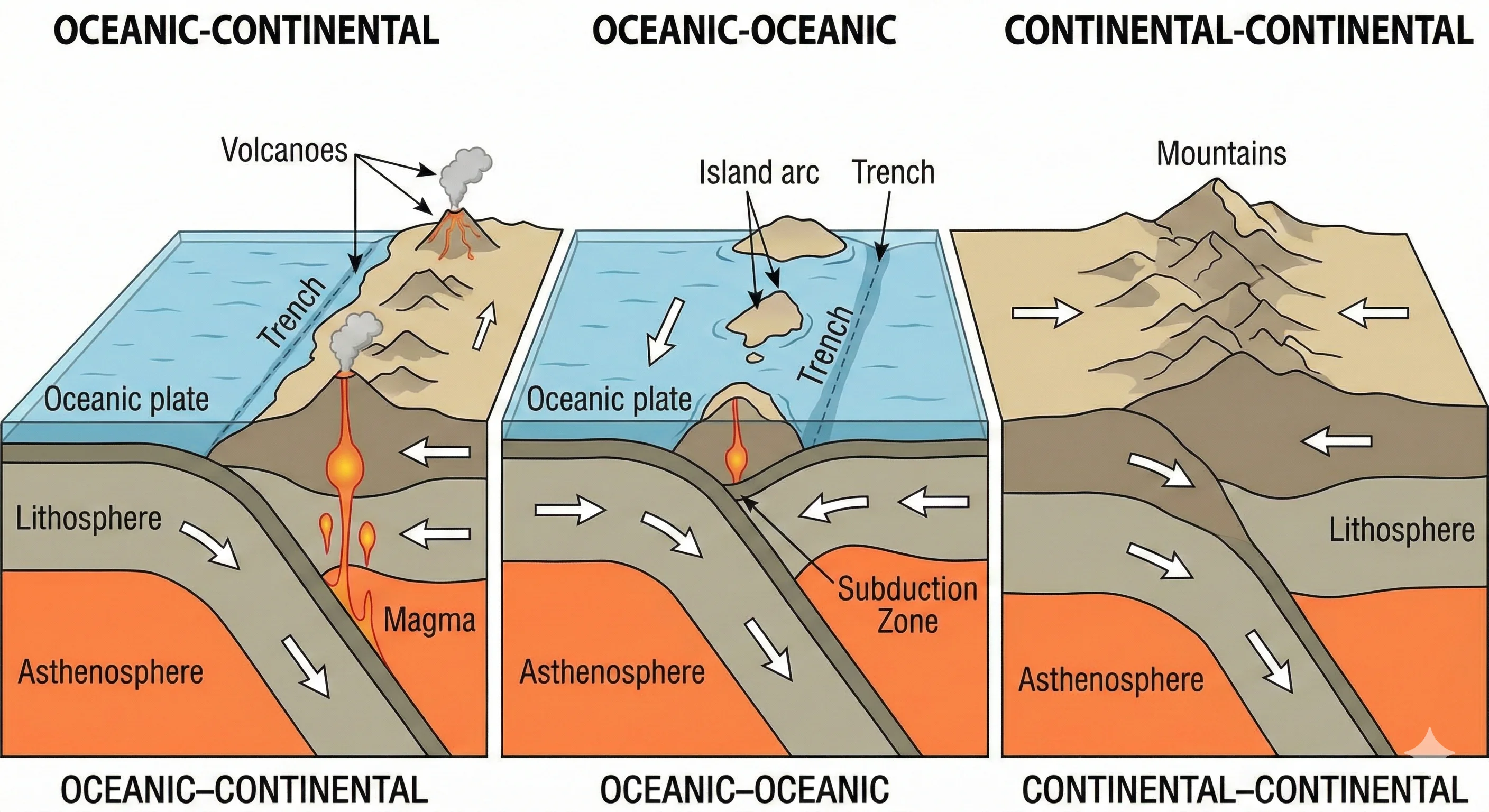
A. Oceanic vs. Continental (Subduction)
When a dense oceanic plate meets a lighter continental plate, the oceanic plate loses the battle. It is forced underneath the continent in a process called Subduction.
As the plate sinks into the hot mantle, it releases water (from hydrated minerals). This water lowers the melting point of the surrounding mantle rock (flux melting), creating magma that rises to the surface.
Result: A volcanic mountain range on land (e.g., The Andes in South America, The Cascades in North America) and a deep ocean trench offshore (e.g., the Peru-Chile Trench).
B. Oceanic vs. Oceanic
When two oceanic plates collide, the older, colder (and therefore denser) one subducts beneath the younger one.
Result: A curved chain of volcanic islands known as an Island Arc. Japan, the Aleutian Islands, and the Philippines were all built this way.
C. Continental vs. Continental (Collision)
This is a head-on crash between two massive landmasses. Since continental crust is too buoyant to subduct, neither side gives way. Instead, the rock buckles, folds, and is thrust vertically upward.
Result: Massive non-volcanic mountain ranges. The collision of India with Eurasia created the Himalayas. This process is still ongoing; Mount Everest grows roughly 5mm taller every year.
5.3 Transform Boundaries (Conservative Margins)
Here, plates slide horizontally past one another. Crust is neither created nor destroyed.
However, rock is not smooth. The plates lock together due to friction. Stress builds up for decades or centuries until the rock suddenly snaps.
Result: No volcanoes, but massive, shallow-focus earthquakes. The most famous example is the San Andreas Fault in California, where the Pacific Plate is sliding north past the North American Plate.
6.0 HOTSPOTS: THE EXCEPTIONS TO THE RULE
While most volcanic activity occurs at plate boundaries, some volcanoes mysteriously appear in the middle of a plate. These are caused by Mantle Plumes or "Hotspots."
A hotspot is a stationary jet of superheated magma rising from deep within the mantle (possibly near the core-mantle boundary). As the tectonic plate moves over this stationary blowtorch, the hotspot punches a hole in the crust, creating a volcano.
The Hawaiian Chain: The Pacific Plate is moving northwest. Millions of years ago, the hotspot created Kauai. As the plate moved, the fire cut off, and Kauai eroded. The hotspot then built Oahu, then Maui, and is currently building the Big Island of Hawaii. To the southeast, a new island (Loihi) is already forming underwater. This chain acts as a speedometer for plate tectonics.
7.0 THE WILSON CYCLE: THE EARTH'S HEARTBEAT
The movement of continents is not random chaos. It follows a predictable, cyclical pattern known as the Wilson Cycle, named after Canadian geophysicist J. Tuzo Wilson.
A complete cycle takes roughly 300 to 500 million years and consists of the opening and closing of an ocean basin.
- Embryonic Stage: A stable continent splits along a rift valley (e.g., East African Rift).
- Juvenile Stage: The rift widens, and seawater floods in to form a narrow sea (e.g., Red Sea).
- Mature Stage: A true ocean forms with a mid-ocean ridge (e.g., Atlantic Ocean).
- Declining Stage: The oceanic crust becomes old, cold, and dense. It begins to subduct, and the ocean shrinks (e.g., Pacific Ocean).
- Terminal Stage: The continents draw close, compressing the sea between them (e.g., Mediterranean Sea).
- Suturing Stage: The continents collide, the ocean disappears, and a massive mountain range is formed (e.g., Himalayas). The cycle is complete.
8.0 THE PARADE OF LOST SUPERCONTINENTS
Before the famous Pangea, Earth assembled and broke apart several other supercontinents. While the map of these ancient worlds is blurry, geological forensics allows us to reconstruct them.
8.1 Columbia (Nuna) (approx. 1.8 - 1.5 Billion Years Ago)
Following the Archean eon, the cratons finally stabilized enough to form the first massive supercontinent of the Proterozoic Eon, known as Columbia (or Nuna). It stretched 12,900 kilometers from North to South. Its breakup likely fueled a massive burst of magmatic activity.
8.2 Rodinia (approx. 1.1 Billion - 750 Million Years Ago)
Rodinia (from the Russian "Rodina," meaning "Motherland") is one of the most significant supercontinents in Earth's history.
It was a desolate, barren landmass (no plants or animals lived on land yet). Its interior was a vast desert.
The Climate Trigger: The breakup of Rodinia had catastrophic consequences. The rifting created massive amounts of fresh basalt rock. The weathering of this rock pulled huge amounts of CO₂ out of the atmosphere (silicate weathering). This cooling effect was so severe that it plunged the Earth into the Cryogenian Period—often called "Snowball Earth"—where the entire planet may have frozen over from pole to equator.
8.3 Pannotia (approx. 600 - 540 Million Years Ago)
A short-lived supercontinent that formed near the South Pole. Its breakup coincided with the "Cambrian Explosion" of life, which we will cover in Chapter 2.
9.0 PANGEA: THE LAST GIANT (335 - 175 Million Years Ago)
We finally arrive at the supercontinent most people know. Pangea assembled during the Carboniferous and Permian periods.
9.1 The Geography of Pangea
Pangea was shaped like a giant "C," straddling the equator.
- Panthalassa: The "All-Sea." A super-ocean that covered 70% of the Earth's surface, surrounding Pangea. It was the ancestor of the Pacific Ocean.
- The Tethys Ocean: A triangular ocean tucked inside the curve of the "C," separating Africa/Eurasia. It was the ancestor of the Mediterranean.
The formation of Pangea created the Central Pangean Mountains (the Appalachian/Caledonian chain), which were once as high as the Himalayas but have since eroded down to rolling hills.
9.2 The Breakup and the Modern World
About 175 million years ago (during the Jurassic period), Pangea began to rip apart.
- Phase 1: It split into a northern half (Laurasia: North America, Europe, Asia) and a southern half (Gondwana: South America, Africa, Antarctica, Australia, India).
- Phase 2: Gondwana shattered. South America tore away from Africa, opening the South Atlantic. India detached and raced northward toward Asia.
- Phase 3: The continents settled into their current positions, though the movement continues. The Atlantic is still widening, and Africa is slowly crashing into Europe.
10.0 CONCLUSION OF TOPIC 3
We have seen that the Earth is not a static stage, but a dynamic, evolving organism. The ground beneath us is recycled over billions of years, creating mountains, oceans, and the very air we breathe.
The breakup of continents changes ocean currents, alters global climate, and isolates animal populations, driving evolution. Without Plate Tectonics, Earth might be a dead Mars-like world. Instead, it is a planet that constantly reinvents itself.
Topic 3 ends here.
END OF TOPIC 3
1.0 THE THREE ATMOSPHERES OF EARTH
The air we breathe today is not the air Earth was born with. Geologists classify the evolution of our atmosphere into three distinct stages.
1.1 Atmosphere I: The Primordial Envelope
During the formation of the solar system, the Proto-Earth captured gases from the solar nebula. This first atmosphere was composed almost entirely of Hydrogen (H₂) and Helium (He).
However, Earth was too small and too hot to hold onto these light gases. The solar wind from the young T-Tauri Sun blasted this primordial atmosphere into space.
1.2 Atmosphere II: The Volcanic Haze (The Reducing Atmosphere)
As the crust solidified during the Hadean and Archean eons, volcanoes spewed out gases trapped in the mantle. This formed the second atmosphere.
- Composition: Mostly Carbon Dioxide (CO₂), Water Vapor (H₂O), and Nitrogen (N₂), with significant amounts of Methane (CH₄) and Sulfur Dioxide (SO₂).
- The Missing Ingredient: Crucially, there was NO free Oxygen (O₂). If you had traveled back in time without a spacesuit, you would have suffocated instantly.
- Appearance: Due to the high methane and CO₂ content, the sky likely appeared reddish-orange or pink, similar to the haze seen on Titan or Mars.
2.0 THE GREAT OXIDATION EVENT (GOE)
Around 2.4 to 2.0 billion years ago, the single most significant chemical change in Earth's history occurred. This event has two names, depending on your perspective: the Great Oxidation Event or the Oxygen Catastrophe.
2.1 The Biological Trigger
The culprit was a microscopic organism: Cyanobacteria (Blue-Green Algae). These primitive microbes evolved a revolutionary biological hack called Oxygenic Photosynthesis. They used sunlight to split water molecules, releasing Oxygen as a waste product.
For hundreds of millions of years, this oxygen was absorbed by dissolved iron in the oceans (creating the Banded Iron Formations we discussed in Topic 2). But eventually, the iron ran out. The "rust sinks" were full.
2.2 The Poisoning of the World
With nowhere else to go, oxygen began to flood the atmosphere.
To the anaerobic (oxygen-hating) microbes that dominated the planet for 2 billion years, oxygen was a deadly toxin. It burned their cellular structures. The rising oxygen levels triggered the first mass extinction in Earth's history, wiping out the vast majority of life on Earth. The survivors were forced to hide in oxygen-free mud or deep ocean vents, where they remain today.
3.0 THE HURONIAN GLACIATION: THE FIRST SNOWBALL EARTH
The introduction of oxygen had a catastrophic side effect on the climate.
The Archean Earth had been kept warm by a blanket of Methane (CH₄), which is a greenhouse gas 25 times more potent than Carbon Dioxide.
The Reaction: As oxygen filled the air, it reacted with the methane.
CH₄ + 2O₂ → CO₂ + 2H₂O
This reaction scrubbed the powerful methane from the atmosphere and replaced it with weaker CO₂ and water. The global "heating blanket" was suddenly ripped away.
The Consequence: Earth plunged into a deep freeze known as the Huronian Glaciation (approx. 2.4 - 2.1 billion years ago). It was perhaps the longest ice age in history, lasting 300 million years. Glaciers may have extended all the way to the equator, turning the planet into a "Snowball Earth." Life hung by a thread.
4.0 THE OZONE LAYER: THE SHIELD OF LIFE
The Great Oxidation Event did more than just freeze the world; it eventually saved it. As oxygen accumulated in the atmosphere, it began to drift into the upper stratosphere.
4.1 The Ultraviolet Problem
For the first 2 billion years, the surface of the Earth was bombarded by lethal Ultraviolet (UV) radiation from the Sun. This radiation shatters DNA. Consequently, life was strictly confined to the oceans, where water provided a natural UV shield. The land was barren, sterile rock.
4.2 The Formation of O₃
When O₂ molecules in the upper atmosphere were struck by high-energy solar UV rays, they split into single oxygen atoms. These atoms then reacted with other O₂ molecules to form Ozone (O₃).
Reaction: O₂ + UV → O + O then O + O₂ → O₃
By roughly 600 million years ago, this Ozone Layer was thick enough to absorb the most harmful UV frequencies. For the first time in history, the dry land was safe. This "UV Shield" was the golden ticket that allowed plants and animals to eventually leave the ocean and colonize the continents.
5.0 ATMOSPHERE III: THE MODERN MIX
Following the chaos of the Great Oxidation Event and the subsequent "Boring Billion" (a period of relative stasis), Earth's atmosphere settled into its third and current state.
- Nitrogen (78%): An inert gas released by early volcanoes, it accumulated simply because it doesn't react with much. It provides the bulk pressure of our atmosphere.
- Oxygen (21%): Maintained by the continuous photosynthesis of plants and algae.
- Argon (0.9%): Produced by the radioactive decay of potassium in the Earth's crust.
- Trace Gases: CO₂, Neon, Helium, Methane.
The sky turned from the hazy orange of the Archean to the vibrant blue we know today (due to Rayleigh scattering of sunlight by nitrogen and oxygen molecules).
6.0 THE SECOND SNOWBALL EARTH (The Cryogenian)
Before complex life could explode, the atmosphere dealt the planet one last freezing blow. During the Cryogenian Period (720 to 635 million years ago), the breakup of the supercontinent Rodinia triggered massive weathering that sucked CO₂ out of the air.
The Earth froze again, arguably more severely than before. Ice sheets met at the equator. The oceans were sealed under a kilometer of ice.
The Volcanic Rescue: Life survived in tiny pockets of liquid water near volcanoes. Eventually, volcanoes punched through the ice, pumping CO₂ back into the atmosphere until the greenhouse effect melted the world. The nutrients washed into the ocean by this massive melt are believed to be the fuel that triggered the sudden evolution of complex animals (the Ediacaran biota).
7.0 CHAPTER 1 CONCLUSION: THE STAGE IS BUILT
We have reached the end of the beginning.
We started at T=0, with a Singularity smaller than an atom. We watched the universe expand, stars ignite, and galaxies form. We witnessed the violent birth of the Solar System and the collision that gave us our Moon. We saw the Earth transition from a hellish magma ocean to a water world, and finally to a tectonic planet with drifting continents and a breathable atmosphere.
The geological machine is now fully operational.
The thermostat is set.
The shield is up.
The tank is full of water.
But the world is still silent. Apart from slime and microscopic bacteria, there is nothing to see. The stage is perfectly set for the greatest drama in the universe. The next chapter will not be about rock and gas, but about flesh and blood.
END OF CHAPTER 1
Planetary Formation and Geology
VOL II
THE ORIGIN OF LIFE AND EVOLUTION
1.0 THE GREAT PARADOX: DEFINING THE UNDEFINABLE
We embark now on the most complex scientific inquiry in human history: Abiogenesis. This is the study of how non-living matter (rocks, water, gases) organized itself into living matter. The transition from the Hadean geochemical world to the Archean biological world is not a single "spark" or moment, but a long, tortuous continuum of increasing complexity.
Before we can understand how life began, we must confront a formidable philosophical and physical obstacle: What exactly is life?
1.1 Schrödinger's Question and Negative Entropy
In 1944, physicist Erwin Schrödinger published a seminal book titled What is Life?. He approached biology not as a naturalist, but as a physicist. The Second Law of Thermodynamics states that the universe tends toward maximum disorder (Entropy). Energy dissipates; structures crumble; heat spreads out.
Life, however, does the opposite. A living cell is a pocket of extreme order in a disordered universe. It maintains this order by consuming energy from its environment to locally decrease its entropy (a concept Schrödinger called "Negentropy"), while increasing the entropy of the universe around it (by releasing heat and waste).
Therefore, the first requirement for the origin of life is not just "ingredients," but a continuous Free Energy Source that can drive chemical reactions "uphill"—against the natural flow of thermodynamic equilibrium.
1.2 The NASA Definition of Life
To guide our search for origins, astrobiologists use a working definition:
"Life is a self-sustaining chemical system capable of Darwinian evolution."
This definition implies three non-negotiable pillars that must have evolved from lifeless chemistry:
- Containment (The Body): A barrier (membrane) to separate the "self" from the "world" and concentrate chemicals.
- Metabolism (The Engine): A mechanism to extract energy from the environment to build and repair molecular structures.
- Genetics (The Blueprint): A polymer capable of storing information and replicating it with slight errors (mutations) to allow for natural selection.
The central debate in Abiogenesis is: Which came first? Did the container form first (Lipid World)? Did the metabolic engine start running first (Metabolism-First)? Or did the genetic code appear first (RNA World)? We will explore each of these deep-dive theories in the coming parts.
2.0 THE PREBIOTIC KITCHEN: SETTING THE STAGE
To cook a meal, one needs ingredients. To "cook" life, one needs specific chemical elements. Fortunately, as we established in Chapter 1, the Hadean Earth was rich in the "CHNOPS" elements, the six building blocks of all known life:
- Carbon (C): The backbone. Unique in its ability to form four stable bonds, creating complex chains and rings.
- Hydrogen (H): The fuel. The most abundant element, essential for water and energy transfer.
- Nitrogen (N): The code. Crucial for nucleobases (DNA/RNA) and amino acids (proteins).
- Oxygen (O): The solvent builder (water) and energy release agent.
- Phosphorus (P): The battery. Essential for ATP (energy currency) and the DNA backbone.
- Sulfur (S): The structure. Critical for stabilizing protein structures (disulfide bridges).
2.1 The "Primordial Soup" Hypothesis
In the 1920s, scientists Alexander Oparin and J.B.S. Haldane independently proposed the "Primordial Soup" theory. They suggested that the early Earth's atmosphere was Reducing—meaning it was rich in hydrogen-bearing gases (Methane, Ammonia, Hydrogen) and poor in Oxygen.
In such an atmosphere, they argued, simple organic molecules could form spontaneously under the influence of energy sources like lightning or UV radiation. These molecules would rain down into the oceans, accumulating until the water became a "soup" of organic monomers.
2.2 The Miller-Urey Experiment (1953)
This was mere speculation until Stanley Miller and Harold Urey performed one of the most famous experiments in the history of science at the University of Chicago.
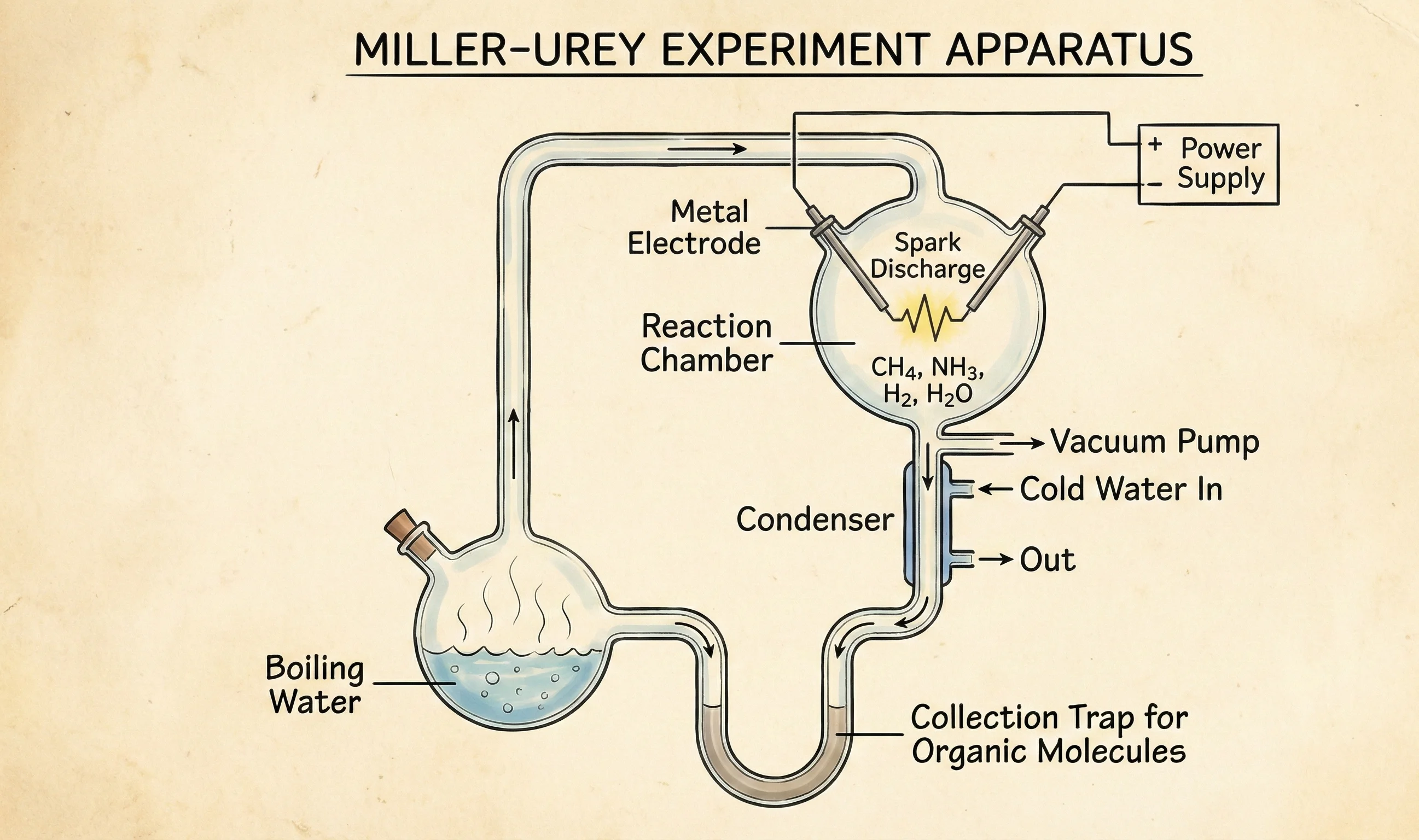
The Setup: They built a closed glass loop containing water (ocean), methane, ammonia, and hydrogen (atmosphere). They heated the water to create steam and fired electrical sparks (lightning) through the gases.
The Result: After running the experiment for just one week, the water turned pink, then deep red. Analysis revealed that the "soup" contained Amino Acids—the building blocks of proteins.
The Implication: This experiment proved that the basic building blocks of life (biomolecules) can arise from non-living matter through simple laws of physics and chemistry. No magic is required. However, creating an amino acid is easy; creating a functioning protein or a cell is infinitely harder. This gap—between the monomer and the functional polymer—is where the real mystery lies.
3.0 EXOGENOUS DELIVERY: INGREDIENTS FROM THE STARS
While the Miller-Urey experiment was a landmark success, modern geochemistry threw a wrench in the gears. Studies of ancient zircons suggest that the Hadean atmosphere was not "reducing" (methane/ammonia-rich) as Miller assumed, but likely "neutral" (dominated by CO₂ and N₂). In a neutral atmosphere, the Miller-Urey spark discharge yields very few amino acids.
If the Earth's kitchen wasn't stocked, where did the ingredients come from? The answer looked to the heavens.
3.1 The Murchison Meteorite (1969)
On September 28, 1969, a meteorite exploded over Murchison, Australia. This rock, a Carbonaceous Chondrite, became the most analyzed rock in scientific history.
Analysis revealed something staggering: The meteorite was packed with organic compounds.
- Inventory: Scientists identified over 70 different amino acids (only 20 are used by life on Earth), along with nucleobases (parts of DNA) and sugars.
- Implication: These compounds formed in deep space, likely on ice grains in the presolar nebula, long before the Earth existed.
This confirms that the universe is an "Organic Factory." During the Late Heavy Bombardment, millions of tons of these carbon-rich rocks rained down on Earth. We may be made of stardust not just atomically, but molecularly.
4.0 THE HOMOCHIRALITY PROBLEM: THE HANDEDNESS OF LIFE
Having the ingredients (amino acids) is one thing; arranging them into life is another. Here we encounter one of the deepest mysteries in abiogenesis: Chirality.
4.1 The Mirror Image Conundrum
Many organic molecules are "Chiral" (from the Greek kheir, meaning hand). They exist in two non-superimposable mirror images, just like your left and right hands.
- L-form (Levorotatory): The "Left-handed" version.
- D-form (Dextrorotatory): The "Right-handed" version.
The Racemic Rule: When you create amino acids in a lab (like Miller-Urey) or find them in a meteorite, physics dictates you get a 50/50 mixture of Left and Right versions. This is called a "Racemic Mixture."
4.2 Life is Choosy
Life on Earth violates this rule of randomness.
- Amino Acids: Every protein in your body, in a tree, or in a bacteria is built exclusively from L-amino acids. (Left-handed).
- Sugars: Every DNA and RNA backbone is built exclusively from D-sugars. (Right-handed).
This is called Homochirality. If you try to build a protein by mixing L and D amino acids, the structure collapses. It simply won't fold. Life requires purity.
4.3 Solving the Puzzle
How did prebiotic chemistry select "Left" over "Right" before life existed to make the choice?
- Theory A: Circularly Polarized Light: Neutron stars or star-forming regions emit polarized light that can selectively destroy D-amino acids in space dust. Indeed, the Murchison meteorite shows a slight excess of L-amino acids (about 5-10%). Life may be Left-handed simply because the dust that made Earth was "polluted" by a nearby star's light.
- Theory B: Mineral Templates: Certain crystals (like Calcite or Quartz) have chiral surfaces. Perhaps early chemistry happened on the face of a "Left-handed" crystal, selecting only L-amino acids.
Regardless of the cause, once the choice was made, it was locked in forever. We are all Lefties at the molecular level.
5.0 THE WATER PARADOX: THE DESTRUCTIVE SOLVENT
NASA's motto for finding life is "Follow the Water." Indeed, water is the universal solvent, essential for transport and reactions. However, for the origin of life, water poses a lethal problem known as the Water Paradox.
5.1 Condensation vs. Hydrolysis
Life is built on polymers: proteins are chains of amino acids; DNA is a chain of nucleotides. To link two amino acids together, you must remove a water molecule. This is called a Condensation Reaction.
Reaction: Monomer + Monomer → Polymer + Water
The problem is thermodynamics. In a watery environment (like the primitive ocean), the chemical equilibrium aggressively favors the reverse reaction: Hydrolysis. Water attacks the bonds, breaking polymers back down into monomers.
Trying to build a protein in the middle of the ocean is like trying to build a sandcastle under a crashing wave. The water breaks it down faster than you can build it. So, how did the first long chains form?
5.2 The Solution: Wet-Dry Cycles
The leading hypothesis suggests that life did not begin in the open ocean, but on the edges: in tidal pools, volcanic geysers, or muddy shorelines.
- Wet Phase: Chemicals mix and dissolve in the pool.
- Dry Phase: The sun evaporates the water. As the pool dries, the concentration of chemicals skyrockets. With water removed, condensation reactions become thermodynamically favorable. Amino acids link up to form chains.
- Rewetting: The tide returns. The new polymers are encapsulated or trapped in fatty acids (which we will discuss next), protecting them from breaking apart.
Repeating this cycle thousands of times acts as a "pump," ratcheting up complexity from simple molecules to long, functional strands of primitive protein or RNA.
6.0 THE LIPID WORLD: THE FIRST CONTAINER
Even if you have polymers, they will diffuse away into the vast ocean unless you contain them. Life requires a border—a distinction between "Self" and "Non-Self." This is the role of the Cell Membrane.
6.1 Amphiphiles: The Architects of Boundaries
The Murchison meteorite and prebiotic synthesis experiments reveal that early Earth was rich in Fatty Acids. These molecules are "Amphiphilic" (Greek for "loving both"):
- Head: Hydrophilic (Loves water).
- Tail: Hydrophobic (Hates water).
When you toss these molecules into water, they don't need instructions to organize. Physics forces them to self-assemble. The tails hide from the water, and the heads face the water. They spontaneously form structures:
- Micelles: Small spheres (like soap bubbles).
- Bilayers: Sheets where tails face each other (the structure of all modern cell membranes).
- Liposomes: Hollow spheres made of a bilayer.
6.2 Protocells: The Soap Bubble of Life
A Protocell is simply a liposome that has captured something inside it.
Imagine a wet-dry cycle on an Archean beach.
1. During the dry phase, polymers (RNA/Proteins) form in layers.
2. When the water returns, fatty acids spontaneously form vesicles, trapping the polymers inside.
Now you have a "body" (the lipid membrane) holding "genetic/metabolic material" inside. It is not yet alive—it can't replicate with precision—but it is a distinct physical entity separated from the chaotic environment. The membrane also possesses a crucial property: Permeability. It allows small nutrient molecules to drift in, but keeps the large, valuable polymers from leaking out.
7.0 THE CENTRAL DOGMA AND THE CHICKEN-EGG PARADOX
In modern biology, information flows in one strict direction, a principle Francis Crick called the Central Dogma:
DNA (Storage) → RNA (Messenger) → Protein (Worker)
This system creates a logical nightmare for the origin of life.
- DNA is a passive hard drive. It stores the blueprints for life but cannot do anything. It cannot build a cell wall or digest food. It relies entirely on protein enzymes (like Polymerase) to replicate itself.
- Proteins are the active workers (enzymes). They build the cell and copy the DNA. But proteins cannot reproduce themselves; they need instructions from DNA to be created.
The Paradox: You cannot have DNA without Proteins to replicate it. You cannot have Proteins without DNA to code for them. So, which appeared first? If they appeared simultaneously by chance, the mathematical odds are so low (1 in 10^40000) that it is effectively impossible.
8.0 THE RNA WORLD HYPOTHESIS
In the 1960s, Carl Woese, Francis Crick, and Leslie Orgel proposed a solution: What if there was a molecule that could do BOTH jobs?
Enter RNA (Ribonucleic Acid).
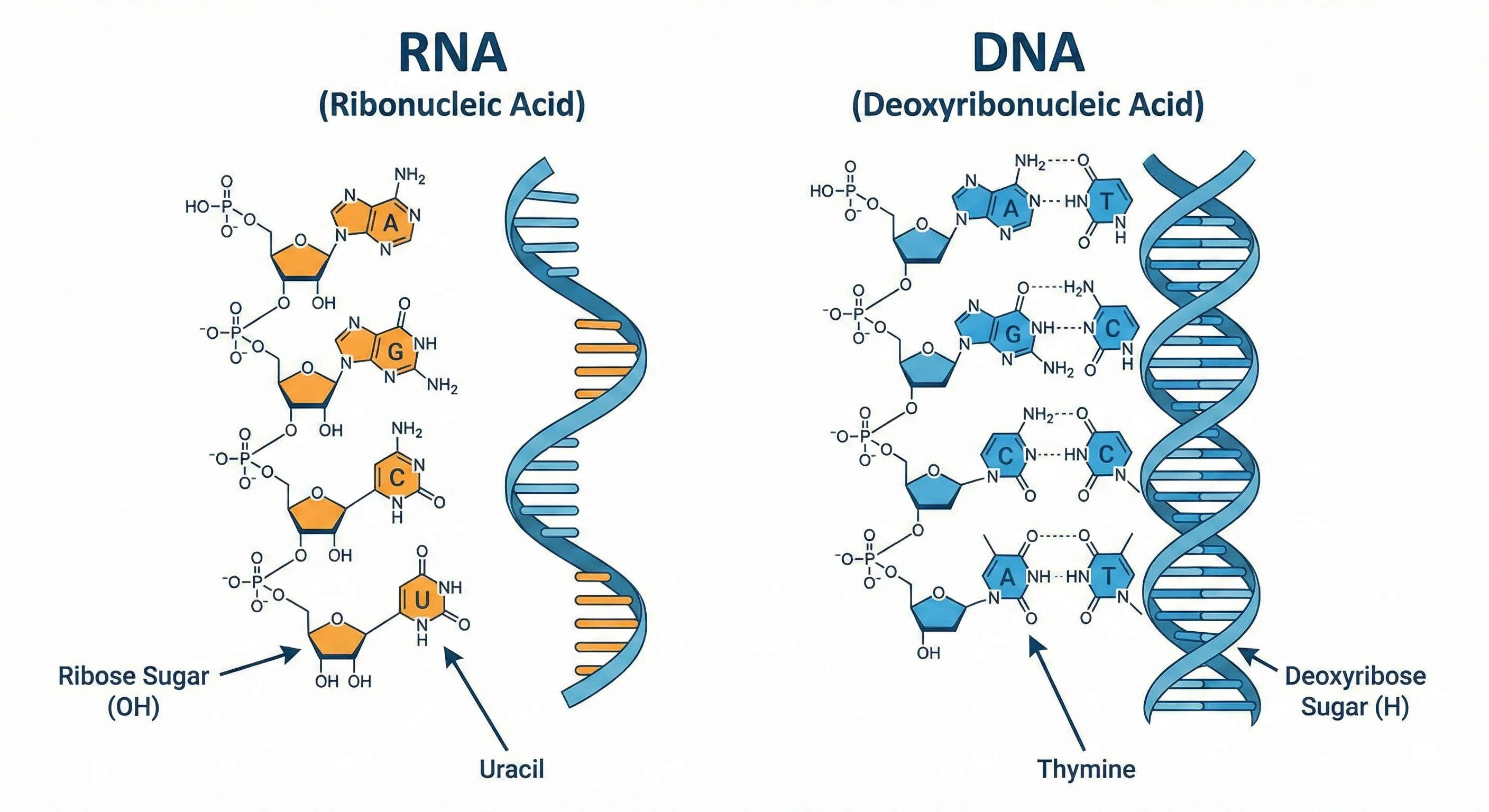
8.1 The Swiss Army Knife of Molecules
RNA is chemically very similar to DNA, but with two critical differences that change its destiny:
- Single-Stranded: Unlike the rigid Double Helix of DNA, RNA is usually a single strand. This allows it to fold up into complex 3D shapes (loops, hairpins, knots), much like a protein.
- The 2'-Hydroxyl Group (-OH): The sugar in RNA (Ribose) has an extra oxygen-hydrogen atom attached to it compared to DNA (Deoxyribose). This seemingly minor detail makes RNA chemically reactive.
Because it can store genetic code (in its sequence of A, U, C, G) AND fold into 3D shapes to act as a chemical tool, RNA solves the paradox. It is both the chicken and the egg.
9.0 RIBOZYMES: THE SMOKING GUN
For decades, the RNA World was just a nice theory. Biologists believed only proteins could act as enzymes (catalysts). That changed in the early 1980s with the work of Thomas Cech and Sidney Altman (who won the Nobel Prize for this discovery).
9.1 The Discovery
They discovered that certain RNA molecules could act as enzymes. They called them Ribozymes (Ribonucleic Acid Enzymes).
They observed RNA strands that could:
- Cut other RNA strands.
- Paste RNA strands together.
- Make copies of short sequences.
9.2 The Ultimate Proof: The Ribosome
The most powerful evidence for the RNA World lies deep inside your own cells right now. The Ribosome is the molecular machine that builds proteins.
When scientists mapped the atomic structure of the ribosome in 2000, they found something shocking. The core of the machine—the part that actually links amino acids together to make life possible—is not made of protein. It is made of RNA.
The proteins on the outside of the ribosome are just structural scaffolding. The engine is pure RNA. This confirms that at the deepest level, we are all RNA-based machines wearing a protein suit. We are living fossils of the RNA World.
9.3 The Era of RNA Domination
We can now reconstruct a plausible timeline for the "RNA World" (approx. 4.2 - 3.8 Billion Years Ago):
- Self-Assembly: Nucleotides form in the prebiotic soup (or arrive via meteorites) and link up on clay surfaces to form random RNA chains.
- The First Replicator: By pure chance, one specific RNA sequence folds into a shape that allows it to grab free nucleotides and copy itself. This is the "Eve" of all life.
- Darwinian Evolution Begins: The copying isn't perfect. Errors (mutations) occur. Some mutant RNA strands replicate faster or are more stable. Natural selection kicks in. The biological arms race has begun.
10.0 THE GREAT TRANSITION: THE INVENTION OF DNA
For perhaps 200 to 500 million years, Earth was ruled by the RNA World. But RNA has a fatal flaw that limits how complex life can get. It is chemically unstable.
10.1 The 2'-Hydroxyl Nightmare
The very feature that makes RNA so versatile—the extra oxygen-hydrogen group (OH) at the 2' position of the ribose sugar—is also its Achilles' heel.
Under alkaline conditions or simply over time, this OH group acts as a molecular saboteur. It attacks the adjacent phosphate bond that holds the RNA strand together.
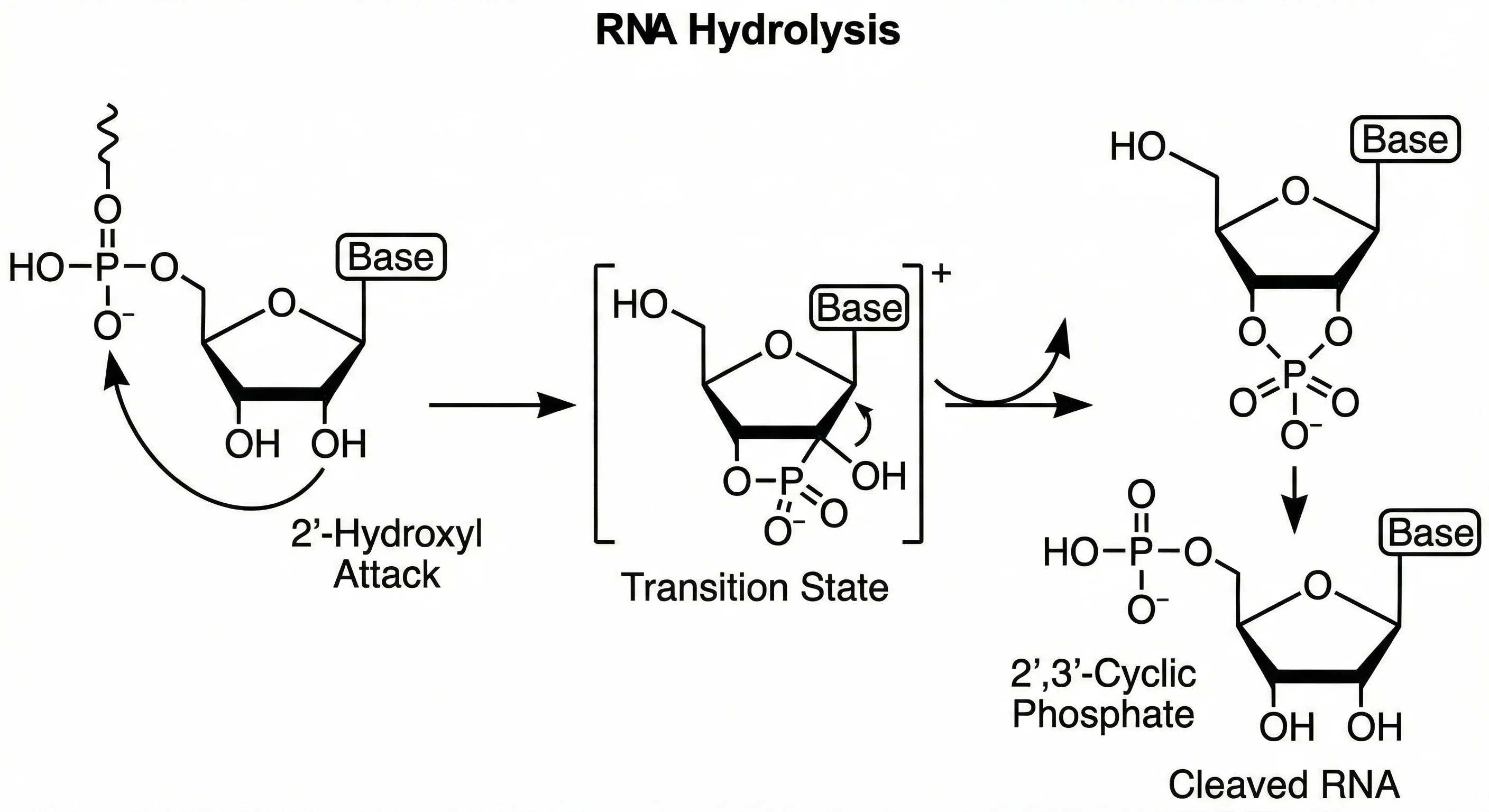
The Consequence: RNA strands spontaneously tear themselves apart (hydrolysis). This limits the size of the genome. An RNA organism can only maintain a few thousand distinct genes before the error rate and breakdown become fatal. To build a complex organism (like a human with 3 billion base pairs), life needed a more durable storage medium.
10.2 Enter DNA: The Iron Mountain of Biology
Evolution's solution was an upgrade to the hardware. By using an enzyme called Ribonucleotide Reductase, primitive life removed that troublesome oxygen atom from the ribose ring.
- Ribose became Deoxyribose ("Deoxy" means de-oxygenated).
- Result: Without that reactive OH group, the DNA backbone became chemically inert. It could remain stable for thousands, even millions of years. This stability allowed genomes to expand from kilobases to gigabases.
11.0 THE URACIL VS. THYMINE MYSTERY
If you look at the genetic alphabet, RNA uses A, C, G, U. DNA uses A, C, G, T.
Why did DNA bother to replace Uracil (U) with Thymine (T)? They pair with Adenine exactly the same way. This seems like an unnecessary change.
11.1 The Cytosine Deamination Problem
The answer lies in error correction. Cytosine (C) is an unstable molecule. It spontaneously loses an amine group and turns into... Uracil (U). This happens in your cells roughly 100 times per day.
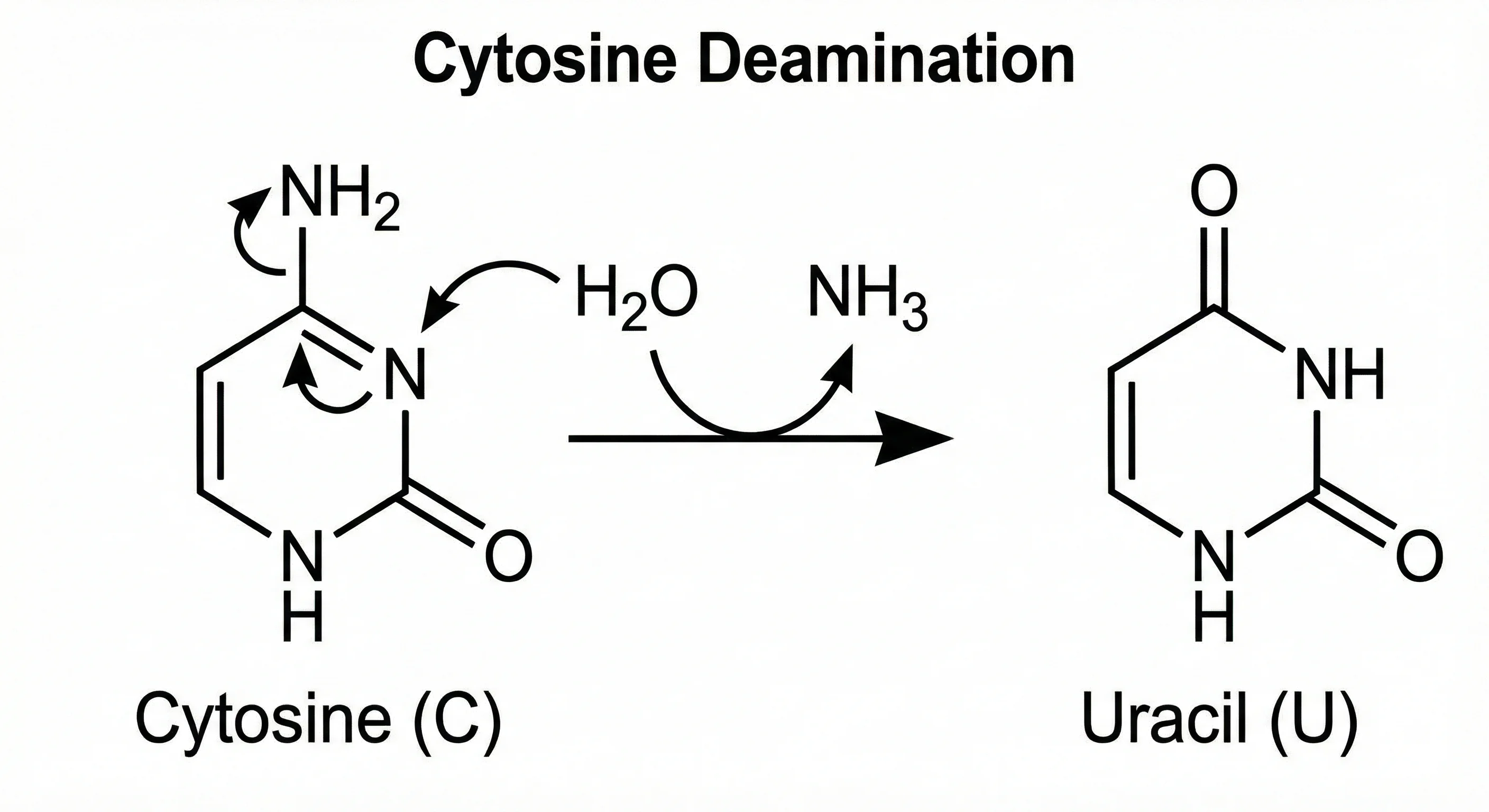
Scenario A (If DNA used Uracil): Imagine DNA used U. A Cytosine spontaneously decays into a U. Now the proofreading enzymes look at the DNA. They see a U. They have no way of knowing: "Is this a legitimate U that is supposed to be there, or is it a damaged C?" The error goes undetected, leading to a mutation.
Scenario B (DNA uses Thymine): Life added a "methyl group" tag to Uracil, turning it into Thymine (T). Now, Thymine is the legitimate partner for Adenine.
If a Cytosine decays into a Uracil in DNA, the repair enzymes instantly know: "Uracil does not belong in DNA! It must be a damaged Cytosine." They cut it out and repair it.
The invention of Thymine was the "Checksum" or "Auto-Correct" feature that allowed life to store massive amounts of data without corruption.
12.0 THE VIRAL ORIGIN HYPOTHESIS
Who invented DNA? Standard textbooks suggest early cells gradually evolved it. However, a compelling modern hypothesis proposed by virologist Patrick Forterre suggests a more dramatic origin: The Arms Race.
12.1 The Genetic War
In the RNA World, primitive cells were constantly attacked by RNA parasites (early viruses). The cells evolved enzymes to chop up the attacking viral RNA.
The Counter-Move: To protect their genetic code from being chopped up, viruses may have modified their RNA. They chemically altered it—removing an oxygen here, adding a methyl group there—to make it unrecognizable to the host's enzymes.
According to this theory, Viruses invented DNA as a stealth shield.
Eventually, the host cells "stole" this superior technology from the viruses. Realizing that DNA was far more stable and safer than their own RNA genomes, cellular life transferred its entire library into this new viral format. This explains why there are so many different types of DNA replication enzymes across the three domains of life—they may have been acquired from different viruses at different times.
13.0 REVERSE TRANSCRIPTASE: THE BRIDGE
How do you move information from the old RNA world to the new DNA world? You need a bridge. That bridge is an enzyme called Reverse Transcriptase.
Today, this enzyme is mostly famous for its role in Retroviruses (like HIV), which write their RNA code into human DNA. However, in the deep past, this enzyme was likely the "translator" that allowed early life to back up its volatile RNA hard drive onto the stable DNA cloud storage.
With DNA established as the library, RNA as the messenger, and Proteins as the workforce, the "Holy Trinity" of molecular biology was complete. The chemical evolution was over. Biological evolution could now begin in earnest.
14.0 LUCA: THE LAST UNIVERSAL COMMON ANCESTOR
After the RNA World stabilized into DNA-based cells, a diverse population of primitive microbes likely inhabited the Earth. However, of all those early lineages, only one survived to become the ancestor of everything alive today: you, a mushroom, a bacteria, and a sequoia tree. We call this organism LUCA (Last Universal Common Ancestor).
Clarification: LUCA was not the first life. It was likely the result of hundreds of millions of years of evolution. It is simply the "most recent" point where the branches of the Tree of Life converge.
14.1 Reconstructing the Ghost
Since LUCA died 4 billion years ago and left no fossils, how do we know what it was like? We use "Genomic Archaeology."
By comparing the genomes of the two oldest domains of life—Bacteria and Archaea—scientists look for genes that are present in both. If a gene exists in both a deep-sea vent archaeon and a gut bacteria, it was likely inherited from their common ancestor, LUCA.
In 2016, a landmark study identified 355 genes that likely belonged to LUCA. These genes paint a specific portrait:
- Anaerobic: It did not use oxygen (poisonous to it).
- Autotrophic: It didn't eat other organisms; it made its own food from gases.
- Thermophilic: It loved heat. Specifically, it possessed an enzyme called Reverse Gyrase, which is unique to organisms that live in extremely high temperatures (preventing DNA from melting).
15.0 THE CRADLE OF LIFE: ALKALINE HYDROTHERMAL VENTS
Based on LUCA's genetic toolkit, the consensus has shifted away from "Darwin's Warm Little Pond" on the surface. The surface was too dangerous (UV radiation, asteroid impacts). Instead, LUCA likely lived deep underwater, inside Alkaline Hydrothermal Vents (like the "Lost City" field discovered in 2000).
15.1 The Natural Proton Battery
These vents are not the violent "Black Smokers." They are gentle, white chimneys made of microporous rock.
- The Gradient: The ocean water was acidic (filled with CO₂). The vent fluid was alkaline (basic).
- The Spark: This difference created a massive Proton Gradient. Protons (H+) naturally wanted to flow from the ocean into the vent rock.
LUCA didn't need to pump protons to generate energy (like modern cells do). It simply sat in the rock pores and let the natural geology drive its metabolism. The vent was a "geological battery," and LUCA plugged itself in.
15.2 The Wood-Ljungdahl Pathway
LUCA's metabolism was likely based on the Wood-Ljungdahl pathway. This is the most ancient metabolic pathway known. It takes Hydrogen (H₂) from the vent and Carbon Dioxide (CO₂) from the ocean to produce Acetyl-CoA (cell food) and energy.
Crucially, the catalysts used in this pathway (Iron, Nickel, Cobalt) are the exact same metals found in the walls of the vent chimneys. The biology is just a mimic of the geology.
16.0 THE GREAT SPLIT: BACTERIA VS. ARCHAEA
At some point roughly 4.0 to 3.8 billion years ago, the population of LUCA split into two distinct lineages, creating the deepest divide in biology.
16.1 The Lipid Divide
The most confusing difference between Bacteria and Archaea is their skin (cell membrane).
- Bacteria: Use Fatty Acids linked by Ester bonds (like us).
- Archaea: Use Isoprenoids linked by Ether bonds (chemically very different and more heat resistant).
How could LUCA be the ancestor of both if they have totally different skins?
The Hypothesis: LUCA might not have had a modern membrane at all. It likely relied on the inorganic rock walls of the hydrothermal vent to contain it. It was "half-alive, half-rock."
When its descendants tried to leave the vent and explore the open ocean, they had to invent a portable membrane. One group invented the Bacterial skin; the other invented the Archaeal skin. They evolved independently to escape the cradle, forever separating their destinies.
17.0 CONCLUSION OF TOPIC 1
We have bridged the gap.
We started with sterile elements: C, H, N, O, P, S.
We cooked them into amino acids via lightning and delivered them via meteorites.
We saw them self-assemble into RNA on clay surfaces.
We witnessed the "RNA World" invent DNA for better storage.
And finally, deep in the dark, hot, mineral chimneys of the Hadean ocean, these systems merged to form LUCA.
The machine of life is now running. But it is microscopic, simple, and stuck in the mud. To build a human, or even a worm, life must learn to work together. The next great hurdle is complexity.
Topic 1 ends here.
END OF TOPIC 1
1.0 THE PROKARYOTIC EMPIRE (3.8 - 2.0 Billion Years Ago)
Before we discuss how complex life (like humans) evolved, we must understand the world that existed before us. For nearly 2 billion years—half of Earth's history—the planet was ruled exclusively by Prokaryotes (Bacteria and Archaea).
To the naked eye, this era would appear devoid of life. No trees, no insects, no fish. Just silent, slimy oceans and rocky coasts coated in microbial mats. But microscopically, this was a golden age of biological innovation. The biochemical machinery invented during this period—photosynthesis, fermentation, nitrogen fixation—still supports the entire biosphere today.
1.1 The Architecture of Simplicity
A Prokaryotic cell is a masterpiece of efficiency. Unlike the complex cells in your body (Eukaryotes), a Prokaryote has no internal subdivisions.
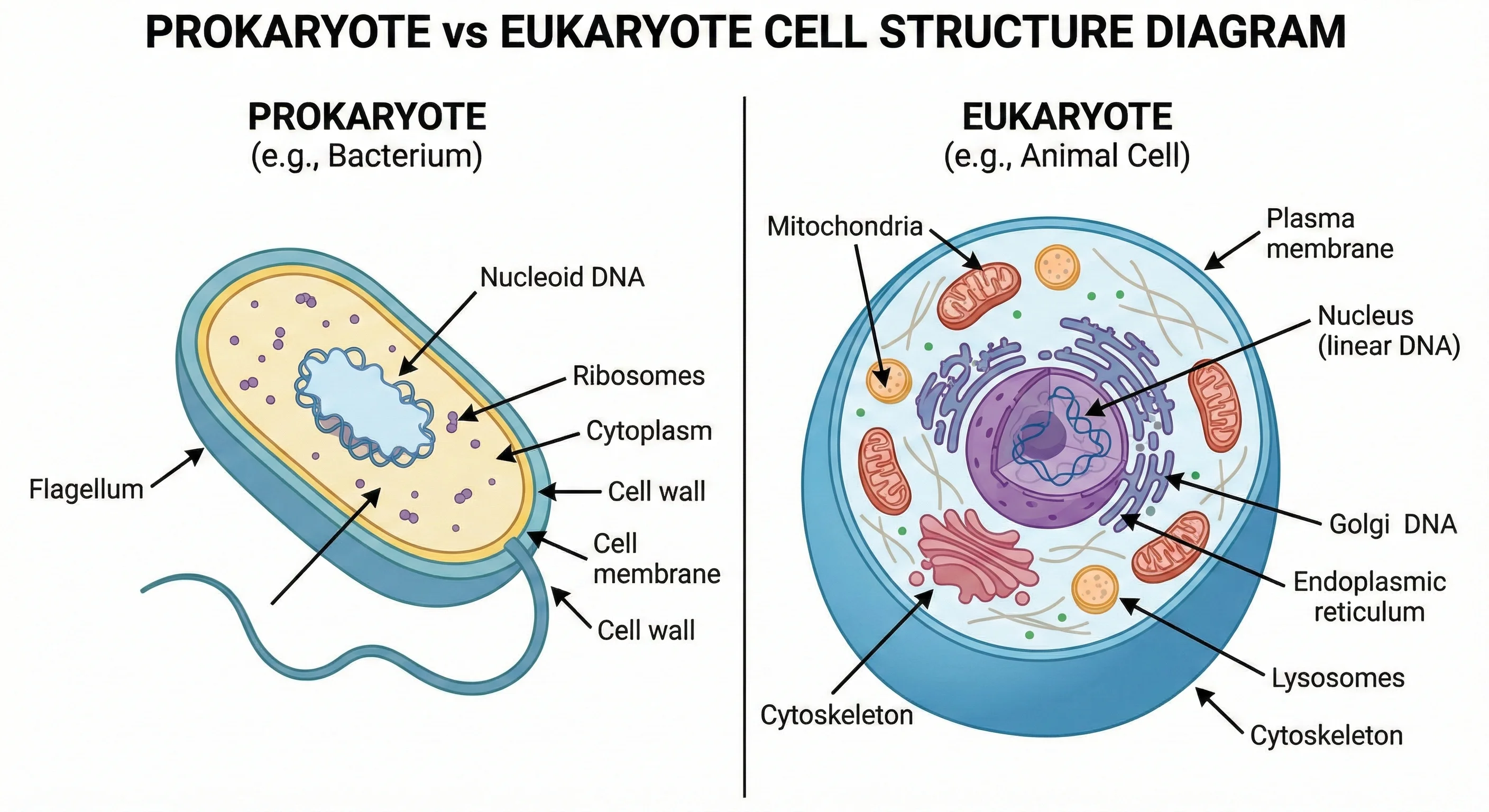
- No Nucleus: The DNA is not locked in a vault. It floats freely in the cytoplasm in a tangled loop called the Nucleoid.
- No Organelles: There are no mitochondria, no chloroplasts, no Golgi apparatus. All metabolic reactions happen directly in the cytoplasm or on the inner cell membrane.
- Size: They are tiny, typically 1 to 5 micrometers in diameter. (A human cell is 10 to 100 times larger).
This simplicity is not a weakness; it is a strategic advantage. It allows for rapid reproduction. Under ideal conditions, E. coli can divide every 20 minutes. In 24 hours, one bacterium can become 4,700,000,000,000,000,000,000 (4.7 sextillion).
2.0 THE INVENTION OF THE "INTERNET OF GENES"
If humans want to pass genes to their offspring, they must have sex and reproduce. This is called Vertical Gene Transfer (Parent to Offspring). Evolution is slow because you have to wait for a generation to pass.
Prokaryotes, however, utilize a revolutionary mechanism called Horizontal Gene Transfer (HGT). They can swap genes with their neighbors instantly, like sharing files via Bluetooth. This turned the ancient ocean into a global genetic supercomputer.
2.1 Mechanism A: Transformation (The Scavenger)
When a bacterium dies and its cell wall breaks, its DNA spills out into the environment. Other living bacteria can actively "fish" for these DNA fragments using pili (hair-like structures), pull them in, and stitch them into their own genome.
Example: A harmless bacterium finds a DNA fragment coding for a toxin from a dead dangerous bacterium. It absorbs it and instantly becomes dangerous.
2.2 Mechanism B: Transduction (The Viral Courier)
Viruses (Bacteriophages) often make mistakes. Sometimes, when a virus replicates inside a bacteria, it accidentally packages a piece of the bacterial DNA into the viral capsule instead of viral DNA. When this virus infects a new bacterium, it injects the previous host's genes.
This is an accidental "Copy-Paste" error that moves useful traits across vast distances.
2.3 Mechanism C: Conjugation (Bacterial Sex)
This is the most deliberate method. Two bacteria connect via a physical tube called a Sex Pilus. One bacterium (the donor) makes a copy of a specific DNA loop (called a Plasmid) and shoots it through the tube into the recipient.
Significance: Plasmids often carry "superpowers," like antibiotic resistance or heavy metal tolerance. Through conjugation, a colony of bacteria can upgrade its entire population's software in hours.
Because of HGT, the concept of "species" is blurry for microbes. They are not isolated lineages but a fluid network. If one microbe invents a better way to eat sulfur, soon the entire neighborhood knows how to do it.
3.0 BIOFILMS: THE FIRST CITIES
We often think of bacteria as lonely swimmers. In reality, 99% of bacteria live in complex, stationary communities called Biofilms.
A biofilm forms when bacteria adhere to a surface and secrete a sticky glue called Extracellular Polymeric Substance (EPS). This slime acts as a shield and a house.
- Division of Labor: Bacteria in a biofilm are not all the same. Those on the outside shield the interior. Those deep inside enter a dormant state to survive scarcity. They communicate via chemical signals (Quorum Sensing).
- Stromatolites: The most famous fossil evidence of the Archean are Stromatolites—layered rocks formed by ancient biofilms of cyanobacteria. These were the world's first "skyscrapers," built layer by layer over thousands of years.
4.0 THE PHOTOSYNTHESIS REVOLUTION
For the first billion years of life, microbes had to scrounge for energy. They ate sulfur, iron, or hydrogen gas. Some used primitive photosynthesis (Anoxygenic Photosynthesis) using hydrogen sulfide instead of water, producing sulfur granules instead of oxygen.
But around 2.7 to 2.4 billion years ago, a group of bacteria called Cyanobacteria (blue-green algae) hacked the system. They evolved the most complex molecular machine nature has ever produced: Photosystem II.
4.1 Breaking the Water Molecule
Water (H₂O) is an incredibly stable molecule. Breaking the bond between Oxygen and Hydrogen requires immense energy—specifically, 2.5 volts. Cyanobacteria evolved a protein complex containing a cluster of Manganese, Calcium, and Oxygen atoms that acts as a "capacitor."
Using the energy of sunlight, this machine rips electrons from water molecules to power the cell. The equation is simple but revolutionary:
6CO₂ + 6H₂O + Light Energy → C₆H₁₂O₆ (Sugar) + 6O₂ (Oxygen)
For the cyanobacteria, Oxygen was just waste—trash to be dumped outside the cell. They had no idea this "trash" would burn the world.
5.0 THE FIRST APOCALYPSE: OXYGEN TOXICITY
We tend to think of Oxygen as the "breath of life." But to the anaerobic lifeforms of the Archean Eon, Oxygen was a deadly poison, as lethal as Chlorine gas is to us.
5.1 The Molecular Assassin: ROS
Why is oxygen dangerous? It is highly electronegative (it loves to steal electrons). Inside a cell, Oxygen doesn't always stay stable O₂. It often picks up loose electrons to become Reactive Oxygen Species (ROS), also known as Free Radicals.
- Superoxide Anion (O₂⁻): Attacks iron-sulfur clusters in proteins, destroying the cell's metabolic engines.
- Hydrogen Peroxide (H₂O₂): Yes, the antiseptic you pour on cuts. It forms naturally inside cells exposed to oxygen.
- Hydroxyl Radical (•OH): The most dangerous of all. It shreds DNA strands instantly, causing massive mutations and death.
5.2 The Great Die-Off
As Cyanobacteria pumped tons of O₂ into the water, the ancient microbial empires collapsed. Obligate anaerobes (microbes that die in the presence of oxygen) were slaughtered in the trillions. This was the first mass extinction in Earth's history, driven entirely by biology, not asteroids.
The survivors were forced into exile. They retreated to the only places oxygen couldn't reach: deep mud, hydrothermal vents, and eventually, the intestines of future animals (where they still live today).
6.0 ADAPTATION: LEARNING TO EAT POISON
Evolution is an arms race. Faced with a toxic environment, a few lineages of bacteria didn't die. They evolved shields.
6.1 The Antioxidant Defense System
To survive ROS, cells invented specialized enzymes—molecular "bomb squads" that neutralize the radicals before they can damage DNA.
- Superoxide Dismutase (SOD): This enzyme catches the dangerous Superoxide radical and converts it into Hydrogen Peroxide.
Reaction: 2O₂⁻ + 2H+ → H₂O₂ + O₂ - Catalase: This enzyme takes the Hydrogen Peroxide (still toxic) and breaks it down into harmless water and oxygen gas.
Reaction: 2H₂O₂ → 2H₂O + O₂
This is why hydrogen peroxide bubbles when you pour it on a wound; the Catalase enzymes in your damaged skin cells are frantically breaking it down into oxygen gas.
6.2 Turning the Tables: Aerobic Respiration
Once cells learned to tolerate oxygen, they discovered a massive advantage. Oxygen is an incredible electron acceptor. Burning food (sugar) with Oxygen releases 18 times more energy than fermenting it without Oxygen.
This jump in energy efficiency (from 2 ATP per glucose to ~36 ATP per glucose) was the game-changer. It provided the high-octane fuel required to build larger, more complex structures. The stage was set for the rise of the Eukaryotes.
7.0 THE GREAT MERGER: ENDOSYMBIOTIC THEORY
For decades, evolutionary biology was dominated by the idea of competition ("survival of the fittest"). However, in 1967, a young biologist named Lynn Margulis proposed a radical alternative. She argued that the great leap from simple cells (Prokaryotes) to complex cells (Eukaryotes) happened not by mutation, but by Endosymbiosis—one organism living inside another.
Her theory was initially ridiculed and rejected by 15 scientific journals. Today, it is accepted as a fundamental fact of biology.
7.1 The Host and The Guest
The origin of the Eukaryotic cell (the type of cell that makes up you, me, plants, and fungi) began with a fateful encounter roughly 1.8 to 2.0 billion years ago.
- The Host (The Archaeon): Recent discoveries (specifically the Lokiarchaeota found in 2015 near deep-sea vents) suggest the host was a large, complex Archaeon. It provided the "house."
- The Guest (The Bacterium): The guest was an Alphaproteobacterium (likely related to modern Rickettsia). This bacterium had already evolved the ability to perform aerobic respiration—it could eat oxygen to generate massive energy.
7.2 The Event: Enslavement or Partnership?
How did they merge? There are two main hypotheses:
- The Phagocytosis Model: The large Archaeon tried to eat the smaller bacterium but failed to digest it. The bacterium survived inside the host's gut.
- The Syntrophy Model (The Hydrogen Hypothesis): It started as a feeding relationship. The host Archaeon fed on hydrogen produced by the bacterium. They snuggled closer and closer until the host eventually engulfed the bacterium to keep its food source secure.
Regardless of how it started, the result was a permanent bond. The host provided protection and raw nutrients; the guest provided high-octane ATP energy derived from oxygen.
8.0 THE BIRTH OF MITOCHONDRIA
Over millions of years, the guest bacterium lost its independence. It transferred most of its genes to the host's nucleus (a process called Endosymbiotic Gene Transfer) and became a specialized organelle: the Mitochondrion.
8.1 The Smoking Gun: Evidence of Bacterial Origin
Why are scientists so sure that Mitochondria were once free-living bacteria? The evidence is overwhelming:
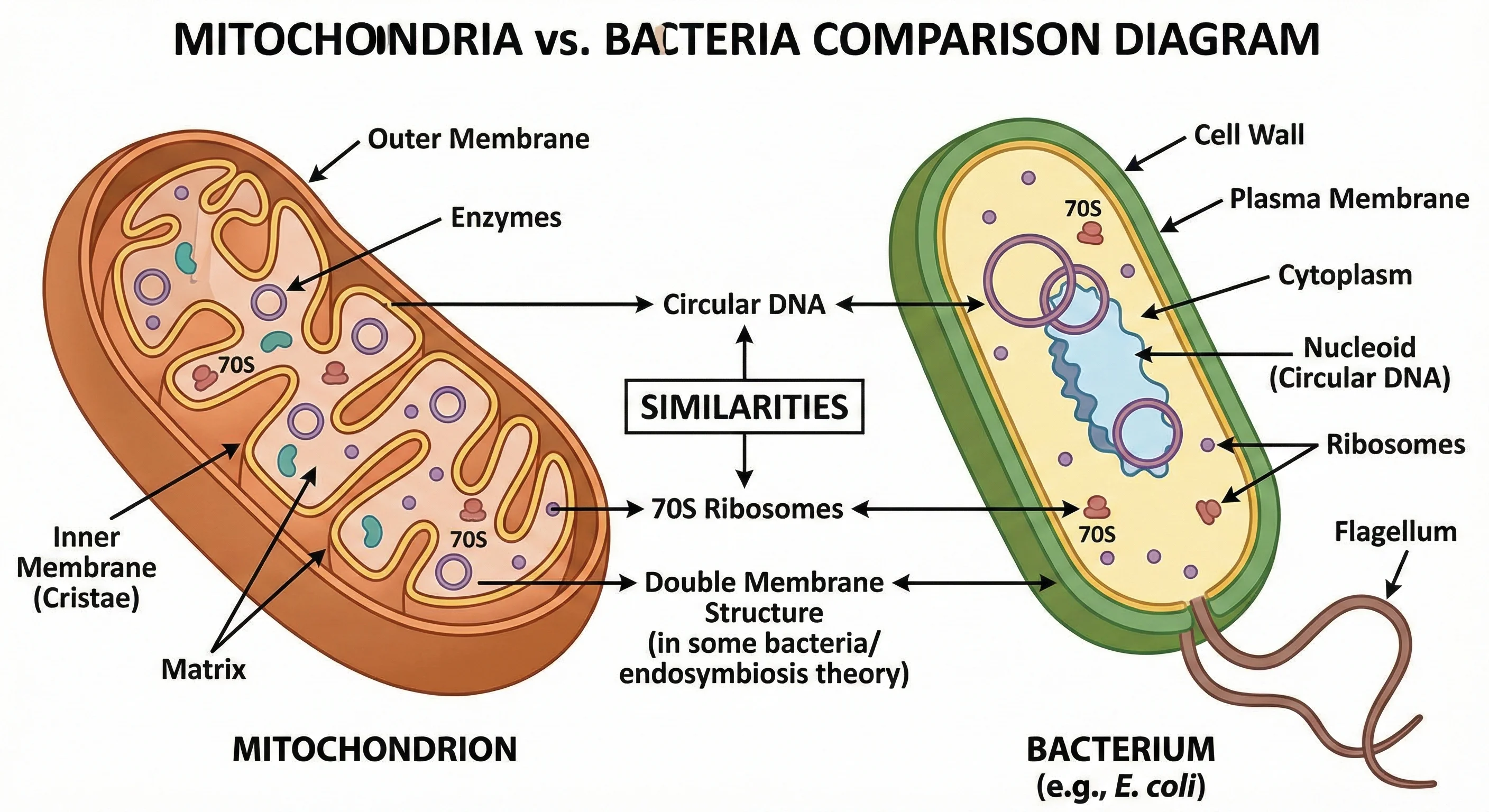
- Own DNA (mtDNA): Mitochondria have their own tiny loop of DNA, separate from the DNA in the cell nucleus. This DNA looks exactly like bacterial DNA (circular), not human DNA (linear).
- Double Membrane: Mitochondria have two skins. The inner skin matches the chemistry of bacteria; the outer skin matches the chemistry of the host cell (evidence of being engulfed).
- Reproduction: You cannot make a mitochondrion. Even if the cell has all the genes, it cannot build one from scratch. Mitochondria reproduce by splitting in half (binary fission), just like bacteria, independently of the cell division.
- Ribosomes: Mitochondria have their own ribosomes (protein builders), and they are 70S ribosomes (bacterial style), not 80S ribosomes (eukaryotic style). Antibiotics that kill bacteria can often damage mitochondria for this exact reason.
9.0 THE ENERGY REVOLUTION
This merger was the singular event that made complex life possible. Why? It comes down to energy per gene.
A simple bacterium uses its outer skin to generate energy. As it gets bigger, its volume grows faster than its skin surface area. It runs out of energy. This is why bacteria are microscopic; they hit an energy wall.
The Eukaryotic Advantage: By internalizing the "power plants" (mitochondria), Eukaryotes broke this limit. They could pack hundreds or thousands of mitochondria inside a single cell.
This resulted in a cell with 100,000 times more energy available per gene than a bacterium. With this massive energy surplus, the cell could afford to:
- Build a massive library of DNA (Genome expansion).
- Develop complex internal highways (Cytoskeleton).
- Eventually, experiment with multicellularity.
Without the Mitochondrion, life on Earth would likely still be nothing but bacterial slime.
10.0 THE VAULT: ORIGIN OF THE NUCLEUS
The defining feature of a Eukaryote (Greek for "True Kernel") is the Nucleus—a membrane-bound vault that protects the DNA. Bacteria don't have this; their DNA floats in the lobby. Why did our ancestors build a vault?
10.1 The Membrane Infalding Hypothesis
The standard textbook explanation suggests that in the proto-eukaryotic cell, the outer cell membrane folded inward (invaginated). Over time, these folds wrapped around the DNA and pinched off, forming a separate internal compartment.
This theory explains why the Nuclear Envelope is a "double membrane" directly connected to the Endoplasmic Reticulum (the cell's factory).
10.2 The Purpose: Decoupling Reading from Writing
The real advantage of the Nucleus is not just protection; it is Quality Control.
- In Bacteria: As soon as DNA is read into RNA, ribosomes jump on it and start making proteins instantly. There is no time to edit the message.
- In Eukaryotes: The Nucleus separates these two steps. DNA is transcribed into mRNA inside the vault. Then, the cell can edit this mRNA (Splicing)—cutting out junk sections (introns) and pasting together useful ones (exons)—before sending it out to be built.
This "Splicing" ability allowed complex cells to make dozens of different proteins from a single gene, exponentially increasing their biological complexity without needing more DNA.
11.0 THE SECOND MERGER: CHLOROPLASTS
For millions of years, the early Eukaryotes were heterotrophs—they swam around hunting bacteria for food. But one specific lineage of eukaryotes got greedy (or lucky) roughly 1.5 billion years ago.
11.1 Primary Endosymbiosis
A eukaryote (which already had mitochondria) engulfed a photosynthetic Cyanobacterium. Just like the mitochondrion before it, this cyanobacterium was not digested.
It survived and turned the cell into a solar-powered machine. The cyanobacterium evolved into the Chloroplast (Plastid).
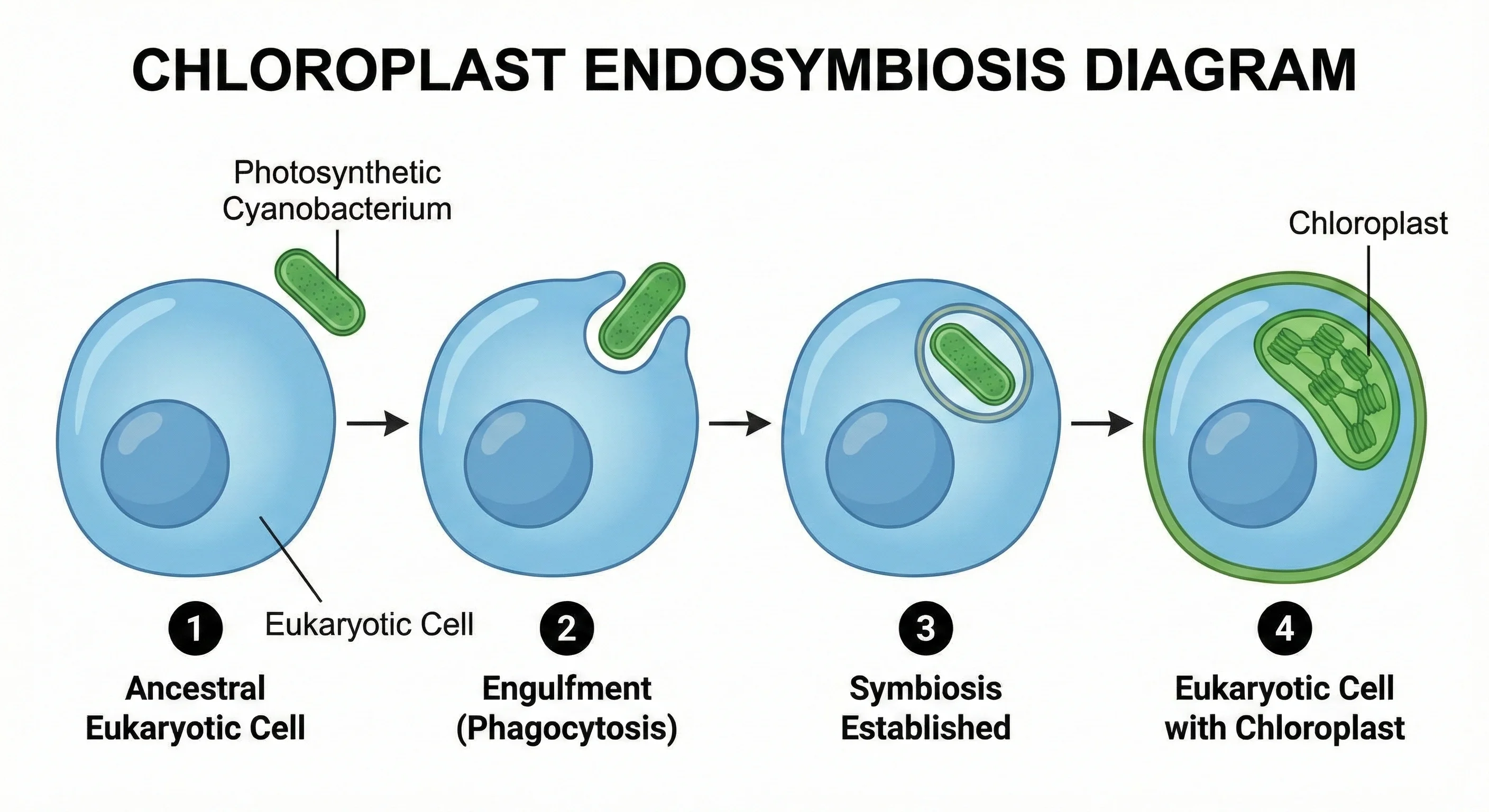
The Evidence: Like mitochondria, Chloroplasts have their own circular DNA, their own ribosomes, and a double membrane. Their DNA is almost identical to modern free-living Cyanobacteria.
11.2 The Great Fork: Plants vs. Animals
This event created the fundamental split in the tree of complex life:
- The Lineage that Ate the Cyanobacterium: Became the Archaeplastida. This group includes Red Algae, Green Algae, and eventually, all Land Plants (Trees, Grass, Flowers).
- The Lineage that DID NOT Eat it: Remained hunters. This group (Unikonta) eventually split into Fungi and Animals (including us).
So, every plant you see is essentially a "Russian Doll": A cell inside a cell (Mitochondria) inside another cell (Chloroplast).
12.0 THE INVENTION OF SEX (Syngamy and Meiosis)
Before we move to multicellularity, we must address one more invention of the Eukaryotes: Sexual Reproduction.
Bacteria clone themselves (Asexual). This is fast but risky—if a parasite unlocks your genetic code, it can kill all your clones. Eukaryotes invented a way to shuffle the deck.
12.1 The Cost and Benefit
Sex is expensive. You pass on only 50% of your genes, and you waste time finding a mate. However, the Red Queen Hypothesis suggests sex is an essential defense. By mixing genes from two parents (Meiosis), you create a unique offspring with a new genetic combination.
This makes it incredibly difficult for parasites and viruses to adapt. They are trying to hit a moving target. We have sex primarily to stay one step ahead of disease.
13.0 THE BORING BILLION: A BILLION YEARS OF STASIS?
After the excitement of the Great Oxidation Event and the invention of the Eukaryotic cell, you might expect evolution to hit the accelerator. Instead, it hit the brakes.
From approximately 1.8 billion to 0.8 billion years ago, the fossil record shows incredibly little change. The Earth settled into a long, stable, and seemingly monotonous rhythm. Geologists call this era the "Boring Billion" (or the Earth's Middle Ages).
But why? Why did complex life appear and then do nothing for a billion years? The answer lies in the chemistry of the oceans.
13.1 The Canfield Ocean Hypothesis
For years, scientists assumed the oceans became oxygen-rich immediately after the Great Oxidation Event. In 1998, scientist Donald Canfield proposed a different, darker theory.
He argued that while the atmosphere had some oxygen, the deep oceans became Euxinic (rich in Hydrogen Sulfide, H₂S).
- The Mechanism: Weathering washed massive amounts of sulfate from land into the ocean. Bacteria ate this sulfate and released Hydrogen Sulfide as waste (the gas that smells like rotten eggs).
- The Purple Oceans: This H₂S turned the ancient oceans toxic to complex life. The water was likely filled with purple sulfur bacteria, giving the oceans a distinct violet hue instead of blue.
13.2 The Nutrient Famine
This sulfidic ocean created a "Bio-inorganic Crisis." Essential trace metals—specifically Molybdenum and Copper—react with sulfur and precipitate out of the water, sinking to the seafloor as solid rocks.
Why this matters: Eukaryotes act big and tough, but they are chemically fragile. To fix nitrogen (essential for DNA) and perform complex metabolism, they need enzymes that rely on Molybdenum and Copper atoms at their core.
Because the sulfur ocean stripped these metals away, Eukaryotes were starved. They survived, but they couldn't grow large or diverse. They were stuck in a "low-nutrient trap" for a billion years, waiting for the ocean chemistry to change.
14.0 LECA: THE LAST EUKARYOTIC COMMON ANCESTOR
Just as we have LUCA for all life, we have LECA (Last Eukaryotic Common Ancestor) for all complex life (Plants, Animals, Fungi, Protists).
LECA lived during this "Boring Billion." By reconstructing its genome, we know it was already a sophisticated organism.
- Sexual Reproduction: LECA invented Meiosis. It had a full cycle of combining DNA and splitting it.
- The Flagellum: It had a "tail" (cilia) to swim. This same structure is found today in human sperm cells and in the lining of your lungs.
- Phagocytosis: It was a predator. It had a flexible skeleton (cytoskeleton) that allowed it to shapeshift and engulf prey.
14.1 The Great Diversification (The Supergroups)
During this quiet era, LECA's descendants slowly split into the five major "Supergroups" of eukaryotes that we recognize today. This is the root of the family tree for all complex life:
- Archaeplastida: The "Plant" line (Red algae, Green algae, Land plants).
- SAR Clade: A massive group of plankton (Diatoms, Kelp forests, Dinoflagellates).
- Excavata: Mostly strange parasites (like Giardia) and Euglena.
- Amoebozoa: Slime molds and amoebas.
- Opisthokonta: The "Rear-Pole" group. This is the most important one for us, because it contains both Fungi and Animals.
Yes, biologically speaking, you are more closely related to a Mushroom than a Mushroom is related to a Plant. Both Animals and Fungi belong to the same Opisthokonta branch, while Plants are on a totally different limb of the tree.
15.0 THE INVENTION OF "US": THE ORIGINS OF MULTICELLULARITY
For 3 billion years, "success" in evolution meant dividing faster than your neighbor. Suddenly, around 800 million to 1 billion years ago, cells did something counter-intuitive. They stopped dividing indiscriminately and started cooperating.
Multicellularity is not a rare accident. It evolved independently at least 25 separate times in the history of life (in plants, fungi, animals, brown algae, slime molds, etc.). This suggests that being "big" offers a massive evolutionary advantage.
15.1 The Logic of Size
Why give up freedom?
- Predation Defense: If you are bigger than the predator's mouth, you don't get eaten.
- Homeostasis: A large cluster of cells can maintain an internal environment (holding water, nutrients) that protects the inner cells from the harsh external world.
- Specialization: The most important factor. In a single cell, the same machinery must do everything (eat, move, reproduce). In a multicellular organism, cells can specialize. One group focuses purely on movement (muscle), another on thinking (nerve), and another on digestion (gut).
16.0 THE MOLECULAR GLUE: HOW TO BUILD A BODY
You cannot build a skyscraper by just piling bricks; you need cement. Similarly, you cannot build an animal by just clumping cells; you need molecular glue.
16.1 The Cadherin Revolution
The secret to animal multicellularity lies in a family of proteins called Cadherins (Calcium-Dependent Adhesion).
These proteins sit on the surface of the cell membrane like velcro hooks.
- Mechanism: When two cells meet, the Cadherin hooks on one cell bind to the Cadherin hooks on the other—but only if Calcium ions are present to lock the connection. This is why Calcium is so vital to your body; without it, you would literally fall apart into a puddle of single cells.
- The Origin: Amazingly, we find primitive versions of Cadherin genes in single-celled Choanoflagellates. They likely used them to catch prey or stick to rocks. Evolution simply repurposed this "hunting tool" into a "building tool."
16.2 The ECM (Extracellular Matrix)
Animal cells also secrete a scaffold of tough proteins—mainly Collagen—into the space between them. They anchor themselves to this scaffold using another protein called Integrin. This creates a solid tissue structure that can withstand the forces of ocean currents or gravity.
17.0 THE GRAND BARGAIN: GERM VS. SOMA
Sticking together is the easy part. The hard part is the politics. In a colony of clones, who gets to reproduce?
If every cell in your body tried to reproduce and pass on its genes, you would be a chaotic tumor, not an organism. To function, multicellular life required a strict division of labor known as the Weismann Barrier.
17.1 The Suicide Pact
The cells agreed to split into two distinct castes:
- The Germline (Immortality): These are the reproductive cells (Sperm and Egg). Their only job is to carry the DNA to the next generation. They are protected and coddled.
- The Soma (Mortality): These are the body cells (Skin, Liver, Brain). Their job is to build a vehicle to carry the Germline. They are destined to die. They do not pass their specific mutations to the offspring.
Altruism and Apoptosis: This system relies on Apoptosis (Programmed Cell Death). If a Somatic cell becomes damaged or unneeded (like the webbing between a human fetus's fingers), it commits suicide for the good of the whole. This capacity for self-sacrifice is the defining moral characteristic of multicellular cells. Cancer is simply a somatic cell breaking this ancient contract and trying to act like a single-celled organism again.
17.2 The Model: Volvox
We can see this transition happening today in a microscopic green algae called Volvox.
Volvox forms a hollow sphere of 2,000 cells. Most are small swimming cells that cannot reproduce (Soma). A few are large reproductive cells (Germ). It is a living bridge—caught perfectly halfway between a bacterial colony and a true plant. It shows us that the leap to multicellularity wasn't a sudden miracle, but a gradual negotiation of cellular rights.
18.0 THE DAWN OF ANIMALS: THE METAZOA BREAKTHROUGH
We have now arrived at the kingdom Animalia (or Metazoa). But the first animals were not hunters with eyes and teeth. They were stationary, quiet, and filtered the water.
To understand the first animal, we must look at its closest living relative that is not an animal: the Choanoflagellates.
18.1 The Sister Group: Choanoflagellates
These are microscopic, single-celled organisms found in oceans today. They have a very distinct shape:
- The Body: An ovoid cell.
- The Collar: A funnel-shaped collar made of microvilli (tiny fingers) at the top.
- The Flagellum: A long whip-like tail sticking out of the center of the collar.
The Feeding Mechanism: The flagellum whips back and forth, creating a water current that pulls bacteria into the collar, where they are trapped and eaten.
The Connection: This structure is crucial because the specialized feeding cells inside the earliest animals (Sponges) are identical to Choanoflagellates. This proves that animals evolved from a colony of these filter-feeders that decided to stop swimming and start building a permanent house together.
19.0 THE FIRST PHYLUM: PORIFERA (SPONGES)
Roughly 700 to 800 million years ago, the first true animal appeared: The Sponge.
Sponges are often mistaken for plants because they don't move. But biologically, they are 100% animal. They produce sperm and eggs, they have collagen skeletons, and they are heterotrophs (they eat others). However, they represent the absolute baseline of animal complexity.
19.1 The Living Filter
A sponge has no brain, no heart, no stomach, no mouth, and no anus. It is essentially a hollow tube made of cells.
- Ostia (Pores): Thousands of tiny holes on the outside suck water in.
- Choanocytes (Collar Cells): Lining the inside of the tube are millions of cells that look exactly like Choanoflagellates. Their beating tails generate the suction.
- Osculum: The large hole at the top where clean water is ejected.
The Spicules: To keep from collapsing, specialized cells in the sponge build microscopic spikes out of calcium carbonate or silica (glass). These Spicules act as a skeleton and a defense mechanism (making the sponge painful to eat).
19.2 The "Blender Experiment"
Sponges demonstrate how "loose" early multicellularity was. If you take a living sponge and put it in a blender (gently) to separate all its cells, they don't die. If you pour the cellular soup into a tank, the cells will find each other using Cadherin proteins, re-aggregate, and rebuild the sponge within a few days. No other animal can survive this.
20.0 THE CTENOPHORE CONTROVERSY: WHO CAME FIRST?
For a century, textbooks stated that Sponges were the first branch to split off the animal tree (the "Basal" group). It made sense: Sponges are the simplest.
However, modern DNA sequencing has thrown a grenade into this theory. Some studies suggest that the Ctenophores (Comb Jellies) might be the oldest branch, older even than sponges.
20.1 Aliens of the Deep
Ctenophores are not true jellyfish. They are gelatinous predators that swim using rows of beating "combs" (cilia) that refract light, creating rainbow colors.
The Paradox: Ctenophores are complex. They have a nervous system, muscles, and a gut. Sponges have none of these.
The Implication: If Ctenophores evolved before Sponges, we are left with two shocking possibilities:
- Loss of Complexity: The ancestor of all animals had a brain and muscles, and Sponges lost them because they chose a lazy lifestyle.
- Independent Evolution: Ctenophores invented their own nervous system completely independently from the rest of the animal kingdom. (Genetics supports this: Ctenophore neurons use different chemical neurotransmitters than ours).
This debate is currently the hottest topic in evolutionary biology ("Ctenophore-First vs. Porifera-First").
21.0 THE INVENTION OF TISSUES: PLACOZOA & CNIDARIA
Moving up the ladder, animals began to organize their cells into distinct layers called Tissues.
- Placozoa: The simplest structure. A tiny, flat animal (like Trichoplax) that crawls on rocks. It has only two layers of cells: a top "skin" and a bottom "stomach." It digests food externally by sitting on it.
- Cnidaria (Jellyfish, Corals, Anemones): The inventors of the "Stomach" and the "Weapon." They developed a blind gut (one opening for both eating and pooping) and specialized stinging cells called Cnidocytes. They were likely the first animals to move purposefully and hunt.
22.0 THE DEEP FREEZE: THE CRYOGENIAN PERIOD (720 - 635 MYA)
Just as multicellular life was trying to gain a foothold, the planet turned hostile. The Earth plunged into the most severe ice ages in its history, collectively known as the Cryogenian Period.
These were not typical ice ages. In a modern ice age, glaciers stop around London or New York. In the Cryogenian, glaciers advanced all the way to the Equator. The Earth looked like a giant white marble floating in space.
22.1 The Sturtian and Marinoan Glaciations
There were two distinct pulses of freezing:
- The Sturtian (717 - 660 MYA): Lasted for nearly 60 million years. Likely triggered by the breakup of the supercontinent Rodinia and massive volcanic eruptions (Franklin Large Igneous Province) that weathered rocks, sucking CO₂ out of the air.
- The Marinoan (650 - 635 MYA): The shorter, final freeze before the dawn of complex life.
How Life Survived: Life should have been wiped out. However, scientists believe the ice wasn't 100% solid everywhere. It may have been a "Slushball Earth" with open patches of water near active volcanoes, or life survived in the cracks of the ice and deep hydrothermal vents, hanging on by a thread.
22.2 The Great Nutrient Flush
The glaciers were actually a blessing in disguise. As massive ice sheets ground against the continents for millions of years, they pulverized the rock into a fine mineral powder.
When the planet finally warmed (due to CO₂ buildup from volcanoes), the ice melted catastrophically. This massive meltwater washed the mineral powder—rich in Phosphorus—into the oceans.
The Algae Bloom: This sudden injection of fertilizer caused a global explosion of algae. The algae pumped out oxygen on a scale never seen before, raising atmospheric O₂ levels from 1% to near modern levels. Finally, the air was ready to support big, energy-hungry animals.
23.0 THE EDIACARAN BIOTA: THE FAILED EXPERIMENT?
As the ice retreated (approx. 635 - 541 MYA), the first large, complex organisms appeared in the fossil record. They are named the Ediacaran Biota (after the Ediacara Hills in Australia).
These creatures are baffling. They look nothing like modern animals. They had no skeletons, no shells, no eyes, and mostly no mouths. They lived in a peaceful "Garden of Ediacara" where predation (eating each other) had not yet been invented.
23.1 Key Organisms of the Alien Seas
A. Charnia (The Fractal Fern)
Charnia looked like a fern frond, standing up to 2 meters tall on the seafloor.
However, it lived in deep water where no sunlight could reach, so it wasn't a plant. It had no gut, so it wasn't a standard animal. It likely absorbed nutrients directly from the water through its skin (Osmotrophy), growing in a fractal pattern where each branch was a mini-copy of the whole.
B. Dickinsonia (The Living Doormat)
An oval, flat, segmented creature that could grow up to 1.4 meters long. It crawled slowly along the microbial mats on the seafloor.
For decades, scientists argued: Was it a giant amoeba? A lichen? A worm?
The 2018 Breakthrough: Scientists analyzed organic molecules preserved on a 558-million-year-old Dickinsonia fossil. They found Cholesterol. Only animals make cholesterol. This proved, once and for all, that Dickinsonia was our distant cousin—the oldest confirmed animal in the geological record.
C. Kimberella (The Proto-Mollusk?)
Unlike the soft mats, Kimberella had a tougher, shell-like covering and a proboscis (snout) that it used to scratch food off the seafloor. Many paleontologists believe it is an early ancestor of Mollusks (snails/slugs). It is one of the few Ediacarans that shows evidence of distinct "front" and "back" ends (Bilateral Symmetry).
24.0 THE MYSTERIOUS DISAPPEARANCE
Around 541 million years ago, the Ediacaran Biota vanished. Almost none of these "soft giants" survived into the Cambrian period. Why?
- The Rise of Predators: New animals evolved teeth and jaws. The slow, soft Ediacarans were defenseless buffets.
- The Cambrian Substrate Revolution: Newly evolved worms began burrowing into the seafloor. They destroyed the steady "microbial mats" that Ediacarans lived on, churning the mud and changing the ocean chemistry forever.
The Garden of Ediacara fell, paving the way for the violent, fast-paced world of the Cambrian Explosion.
25.0 THE BILATERIAN REVOLUTION: HEADS, TAILS, AND BRAINS
The vast majority of the Ediacaran creatures were either asymmetrical (like sponges) or radially symmetrical (like jellyfish/corals, having a top and bottom but no front or back). While radial symmetry is great for sitting still and catching food from any direction, it is terrible for hunting.
Just before the Cambrian boundary, a new group of animals appeared: the Bilaterians.
25.1 The Invention of Direction
Bilateral symmetry means the animal can be divided into two mirror images (Left and Right). This seemingly simple geometric change dictated the future of all complex life.
Why was it revolutionary?
- Directional Movement: If you have a front and a back, you move forward.
- Cephalization (Head Formation): If you move forward, it makes sense to cluster all your sensory organs (eyes, smell receptors) at the front to sense the environment before your body enters it.
- The Brain: To process the data from these clustered sensors, nerve cells concentrated at the front, evolving into the first Brain.
Practically every "successful" animal today—from worms to insects to humans—is a Bilaterian. We are all tubes with a mouth at the front and an anus at the back.
26.0 THE GENETIC TOOLKIT: HOX GENES
How does an embryo know to put a head at the top and legs at the bottom? The answer lies in a cluster of master-control genes called Hox Genes (Homeobox genes).
26.1 The Universal Architect
Hox genes are the architects of the body. They don't build the eye or the leg themselves; they are the managers that shout instructions to other genes: "Build an eye HERE," "Build a wing THERE."
The Deep Connection: The most shocking discovery in developmental biology is that these genes are interchangeable.
Experiment: If you take a gene that controls eye formation in a Mouse (Pax6) and insert it into a Fruit Fly embryo, the fly will grow a perfect Fruit Fly eye at that spot.
This proves that the genetic "software" for building a body was written exclusively once, in a common ancestor (Urban Bilaterian) that lived over 550 million years ago. We are all running the same operating system, just with different user interfaces.
27.0 THE MARKER: TREPTICHNUS PEDUM
How do geologists decide exactly when the Ediacaran Period ends and the Cambrian Period begins? They look for a specific trace fossil called Treptichnus pedum.
This is not a fossil of a body; it is a fossil of a burrow. It looks like a complex, 3D branching tunnel.
The Significance: To make this burrow, an animal needed complex muscles, a hydrostatic skeleton, and a brain capable of 3D navigation. It signifies the arrival of the first "worms" that could actively alter their environment. When these burrows appear in the rock record (approx. 541 million years ago), we know the "Garden of Ediacara" is dead. The active hunters have arrived.
28.0 CONCLUSION OF TOPIC 2
We have traversed nearly 3 billion years of biological history in this topic.
We started with simple bacteria living in slime cities. We watched them poison the world with oxygen. We saw a bacterium swallow another to create the first Eukaryote. We witnessed the "Boring Billion" where life struggled in purple oceans. And finally, we saw cells learn to stick together, survive freezing ice ages, and evolve the first heads, mouths, and brains.
The fuse is now lit. The oceans are oxygenated. The body plans are drawn. The predators are hungry. The slow evolution of the Precambrian is about to be shattered by the biological Big Bang.
Topic 2 ends here.
END OF TOPIC 2
1.0 THE BIOLOGICAL BIG BANG
Around 541 million years ago, the history of life on Earth underwent a transformation so sudden and profound that Charles Darwin himself considered it the single greatest objection to his theory of evolution.
For 3 billion years, life had been microscopic or soft-bodied. Then, in a geological blink of an eye (roughly 20-25 million years), nearly every major animal body plan (Phylum) that exists today appeared simultaneously in the fossil record.
Arthropods (legs/shells), Chordates (spines), Mollusks (clams/snails), Echinoderms (starfish). They all stormed onto the stage at once.
This event is known as the Cambrian Explosion. It marks the boundary between the "Precambrian" (Hidden Life) and the "Phanerozoic" (Visible Life).
2.0 THE STAGE: GEOGRAPHY AND CLIMATE
To understand the explosion, we must first look at the map. The breakup of the supercontinent Pannotia/Rodinia was complete.
- Laurentia (North America): Sat at the equator, tropical and warm.
- Gondwana: A massive supercontinent to the south.
- The Transgression: As the supercontinents broke apart, massive mid-ocean ridges displaced water, causing global sea levels to rise dramatically. This created vast, warm, shallow continental shelf seas.
These shallow, sunlit seas were the perfect laboratory for life—warm, rich in minerals, and stable.
3.0 THE FUSE: THE SMALL SHELLY FAUNA (SSF)
The explosion didn't happen overnight. There was a "spark" before the fire. In the earliest layers of the Cambrian rock (the Fortunian and Tommotian stages), we find millions of tiny, mysterious fossils known as the Small Shelly Fauna (SSF).
These are microscopic cones, tubes, and spines made of calcium carbonate and phosphate.
Significance: These represent the first attempt by animals to build mineralized skeletons. They weren't full skeletons yet; they were likely bits of armor (sclerites) attached to soft-bodied worms (like chainmail).
The SSF proves that the genetic machinery to build "armor" evolved before the large animals appeared. The tools were ready; animals were just waiting for the right moment to use them.
4.0 THE ENVIRONMENTAL TRIGGERS: WHY THEN?
Why did this happen at 541 MYA? Why not 1 billion years ago? Scientists have identified a "Perfect Storm" of physical triggers.
4.1 The Oxygen Threshold (The Collagen Connection)
We know oxygen levels rose after the Cryogenian glaciations. But why is oxygen critical for building a body?
The answer is Collagen. Collagen is the protein "rope" that holds all animals together. It forms our skin, tendons, and the scaffold for our bones.
- The Chemistry: To build collagen, enzymes need to modify amino acids (proline and lysine) using—you guessed it—molecular oxygen.
- The Limit: Without high levels of O₂, you can't synthesize enough collagen to build a large, tough body. You remain a soft jelly.
Once the atmospheric oxygen crossed a critical threshold (perhaps 10-15%), animals could finally afford to weave the thick collagen mats required for skeletons, shells, and muscles.
4.2 The Great Unconformity (The Calcium Injection)
In many places around the world (like the Grand Canyon), there is a mysterious gap in the rock record called the "Great Unconformity," where Cambrian rocks sit directly on top of much older rocks.
The Theory: This gap represents a time of massive global erosion. The continents were scoured by wind and rain, dumping billions of tons of ions into the ocean.
- Calcium (Ca²⁺): Essential for shells.
- Bicarbonate (HCO₃⁻): Essential for pH balance.
The ocean became supersaturated with the ingredients for limestone. For the first time, building a shell wasn't metabolically expensive; in fact, animals might have built shells simply to detoxify their cells of excess calcium! The "Armor" was originally a waste dump that turned out to be useful.
5.0 THE LIGHT SWITCH THEORY: THE INVENTION OF VISION
In 2003, zoologist Andrew Parker proposed a controversial yet compelling hypothesis: The Cambrian Explosion was triggered by the sudden evolution of the Eye.
Before the Cambrian, the ocean was arguably a "tactile" world. Ediacaran creatures likely sensed their environment through touch and chemical trails (smell). A predator had to literally bump into its prey to find it. But around 543 million years ago, a trilobite ancestor evolved the first true image-forming eye.
The Effect: Suddenly, the "lights were turned on." A predator could spot a victim from a meter away. The victim, in turn, could see the shadow of the predator. This destroyed the peaceful equilibrium of the Ediacaran garden instantly. Evolution entered a hyper-speed mode where seeing and not-being-seen became the primary drivers of survival.
5.1 The Evolution of the Camera
Darwin worried that the eye was too complex to evolve naturally. However, modern simulation shows that a simple light-sensitive patch can evolve into a complex camera eye in less than 500,000 years with only a 1% improvement per generation.
- Stage 1: Pigment Spot. A patch of photoreceptor cells (Opsins) that can distinguish light from dark. Useful for knowing "up" from "down" (surface vs. deep water).
- Stage 2: Pigment Cup. The patch curves inward. This allows the animal to sense the direction of the light.
- Stage 3: Pinhole Camera. The opening narrows. This creates a crude image on the retina (like a pinhole camera), though dim.
- Stage 4: The Lens. Transparent proteins (Crystallins) fill the cup to focus light, creating a bright, sharp image.
By the Cambrian, animals had already reached Stage 4. The Compound Eyes of Trilobites, made of calcite crystals, were marvels of optical engineering, offering a nearly 360-degree field of view.
6.0 THE ECOLOGICAL ARMS RACE
With vision active, the "Red Queen" effect took over: "It takes all the running you can do, to keep in the same place."
6.1 Offense vs. Defense
The invention of predation (carnivory) forced a rapid divergence in body plans.
- The Prey's Response (Biomineralization): Soft bodies were easy meat. To survive, prey species began extracting calcium carbonate and phosphates from the water to build hard shells, spines, and plates. This is why the fossil record suddenly becomes "visible" here—shells fossilize well; soft worms do not.
- The Predator's Counter-Move: Hard shells required hard tools to crack them. Predators evolved crushing jaws, grasping claws (like Anomalocaris), and drilling tongues (radula).
- Locomotion: Passive drifting was suicide. Animals evolved muscles, fins, and jet propulsion to flee or pursue.
This feedback loop—harder shell -> stronger jaw -> spikes -> thicker shell—drove the explosion of diversity. Every new defense sparked a new offense.
7.0 THE AGRONOMIC REVOLUTION (SUBSTRATE REVOLUTION)
Another massive change happened not in the water, but in the mud. This is known as the Cambrian Substrate Revolution.
7.1 From Matgrounds to Mixgrounds
Before (Ediacaran): The seafloor was covered in thick, sticky microbial mats (the "Matgrounds"). The water above was clear and oxygen-rich; the mud below was anoxic and toxic. Animals lived on the mats.
After (Cambrian): New animals evolved the ability to burrow vertically. Worms and arthropods began digging into the seafloor to hide or find food.
The Consequence: This burrowing (Bioturbation) destroyed the ancient microbial mats. It churned the mud, mixing oxygen into the sediment ("Mixgrounds").
- The Victims: The Ediacaran creatures that relied on the mats for stability and food went extinct. They had nowhere to sit.
- The Victors: The new 3D seafloor created new niches. Animals could now live in the mud, not just on it, effectively doubling the habitable space on the planet.
8.0 THE BURGESS SHALE: A WINDOW INTO CHAOS
In 1909, a paleontologist named Charles Doolittle Walcott was riding his horse through the Canadian Rockies when he stumbled upon a slab of dark shale. He had discovered the Burgess Shale, arguably the most important fossil site in the world.
The Lagerstätte Miracle: Most fossils are just bones or shells. Soft tissues (eyes, guts, skin) rot away instantly. The Burgess Shale is different. 508 million years ago, an underwater mudslide buried an entire ecosystem instantly in oxygen-free mud. The preservation is so perfect that we can see the last meal inside a worm's stomach.
When scientists began analyzing these fossils in the 1970s (led by Harry Whittington), they realized something shocking: The Cambrian wasn't just the origin of modern animals. It was a period of wild evolutionary experimentation.
9.0 THE WEIRD WONDERS: EVOLUTION'S DISCARDED SKETCHES
Stephen Jay Gould famously called these creatures "Weird Wonders." Many fit into no known Phylum alive today. They represent entire branches of the Tree of Life that were sawed off and forgotten.
9.1 Opabinia: The Joke of the Conference
When Harry Whittington first unveiled his reconstruction of Opabinia regalis at a paleontological conference in the 1970s, the audience roared with laughter. They thought it was a prank.
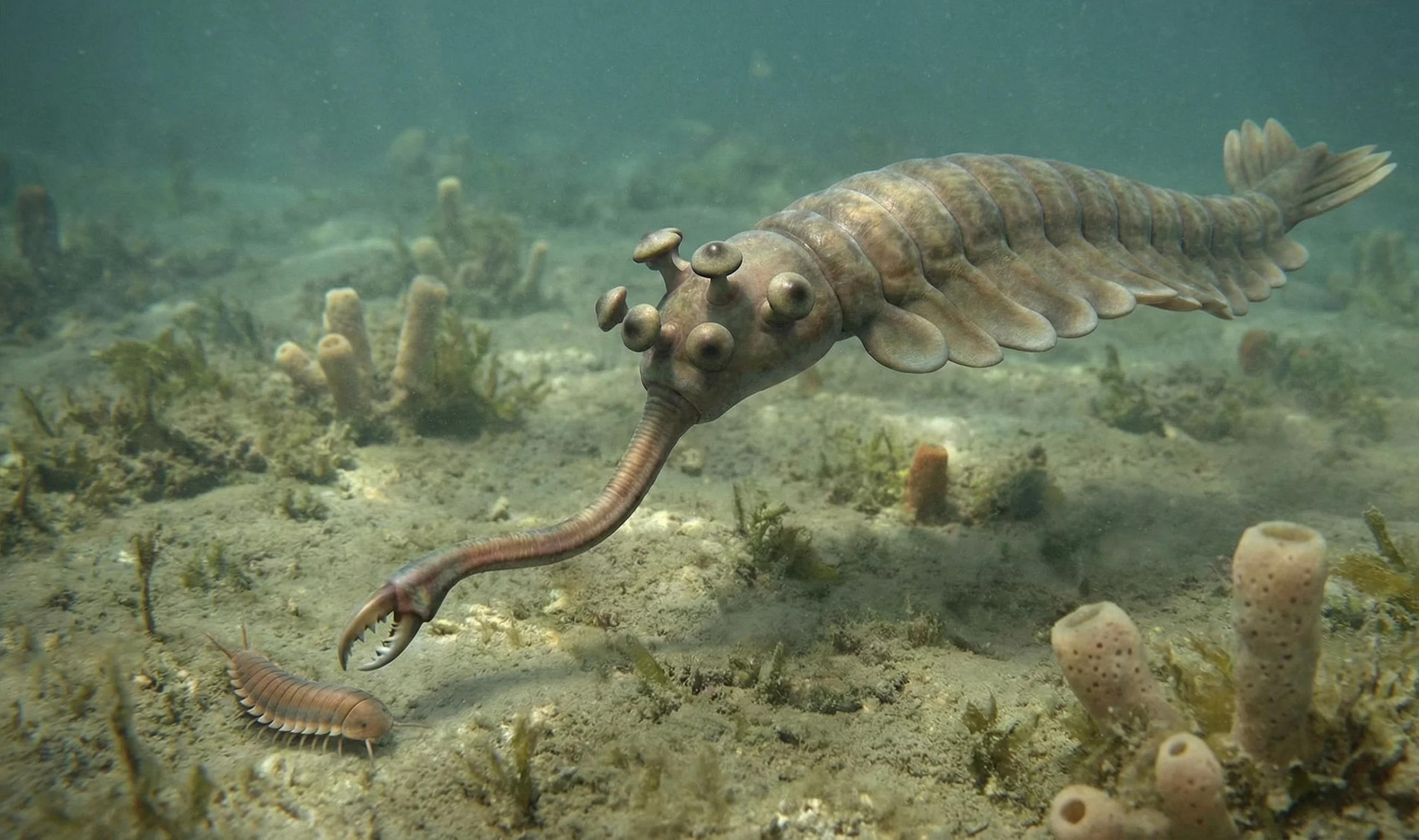
It is easy to see why:
- Five Eyes: It had five mushroom-shaped eyes on stalks. Two on the sides, two near the center, and one right in the middle. This likely gave it a 360-degree field of view to spot predators.
- The Nozzle: It had no mouth on its face. Instead, it had a long, flexible hose (proboscis) with a claw at the end. It used this hose to grab food and pass it backward to a mouth located under its head, facing backward.
- The Body: It had 15 body segments with gills on the outside.
Opabinia is the poster child for the Cambrian Explosion: a creature so alien that it defies all modern anatomical logic.
9.2 Hallucigenia: The Upside-Down Nightmare
Another creature was so bizarre that Simon Conway Morris named it Hallucigenia, because it looked like something from a drug-induced hallucination.
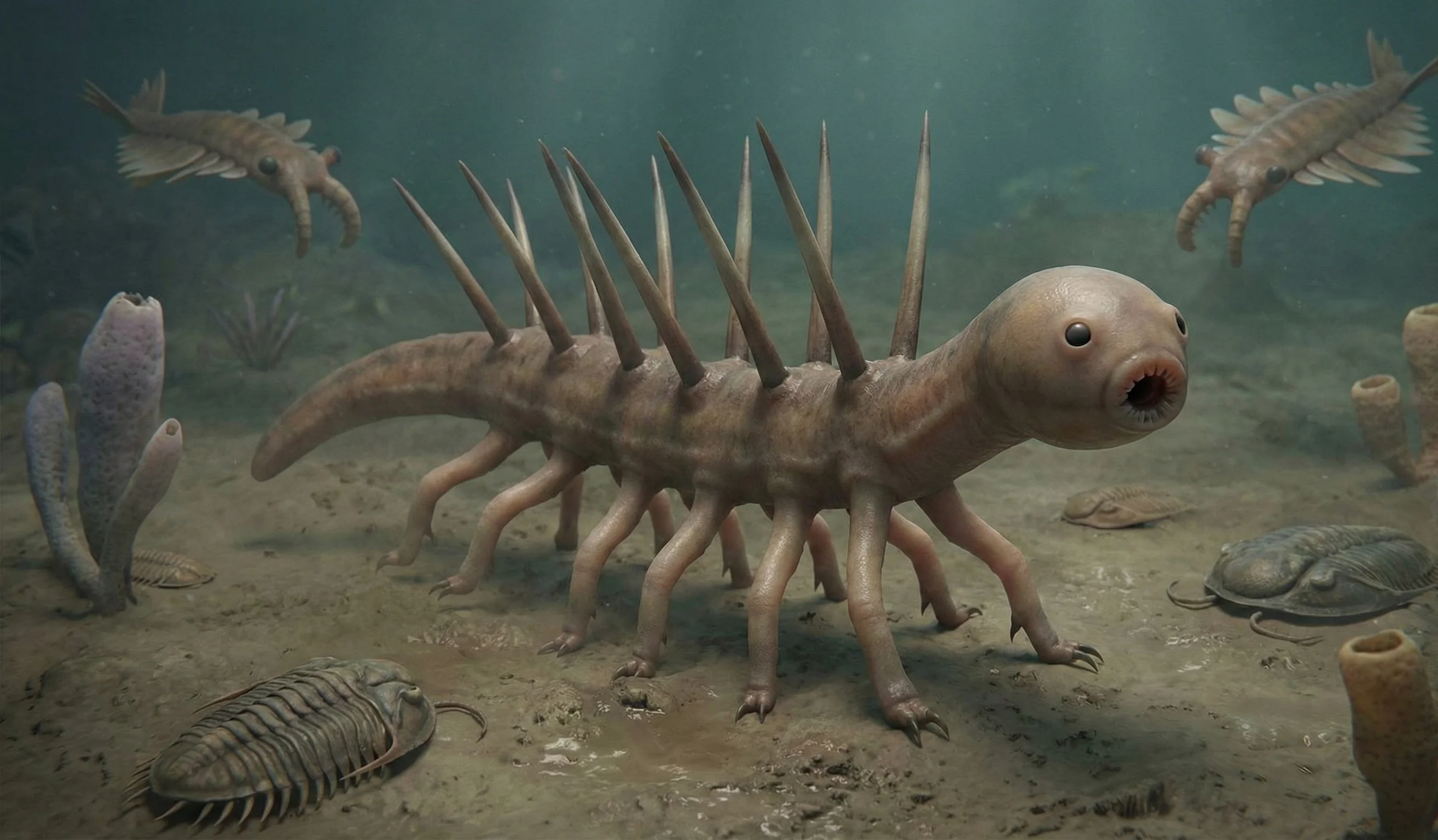
The Reconstruction Error: For decades, scientists drew it walking on seven pairs of long, sharp spikes, with seven "tentacles" waving on its back. They couldn't figure out which end was the head—one end had a blob, the other a tube.
The Correction: Decades later, with better microscopes, they realized they had the animal upside down.
1. The "tentacles" were actually legs (with claws).
2. The "spikes" were defensive armor on its back.
3. The "blob" was actually decay fluid leaking out of its anus; the "tube" was the head with two tiny eyes and teeth.
Today, we classify it as an ancestor of the Velvet Worms (Onychophora), but for years, it was a total mystery.
9.3 Wiwaxia: The Armored Slug
Wiwaxia looked like a cross between a pinecone and a slug. It was covered in scale-like armor plates (sclerites) and had two rows of long, vertical swords sticking out of its back for defense.
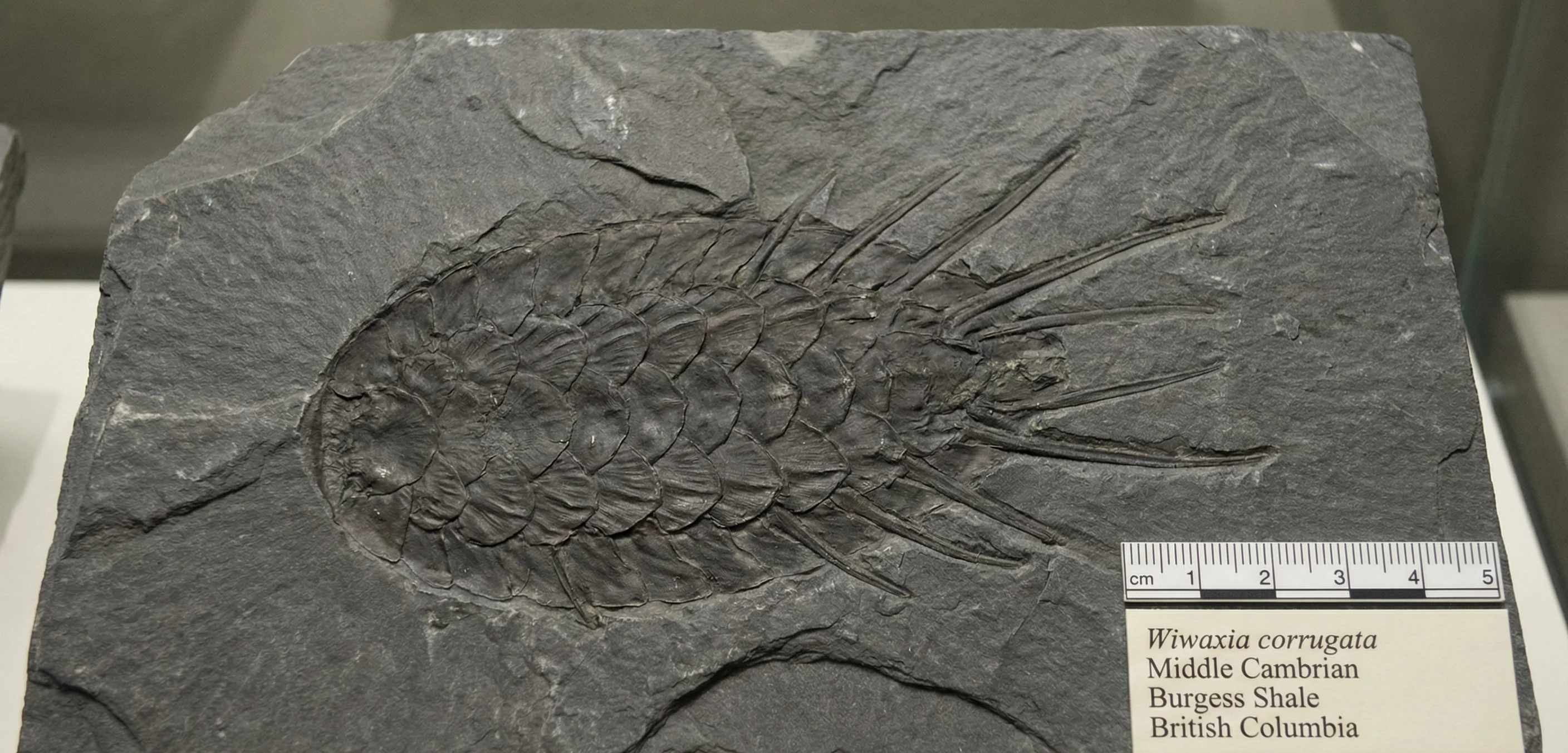
It had no eyes and scraped algae off the microbial mats using a toothed tongue (radula). It shows that the "Arms Race" was in full swing—even slow grazers needed heavy armor to survive.
9.4 Marrella: The Lace Crab
While not as famous as the others, Marrella splendens is the most common fossil in the Burgess Shale. It looked like a tiny shrimp wearing a giant, swept-back head shield with four long spikes. Despite looking like a crab, it belongs to neither the Crustaceans nor the Chelicerates (spiders). It is a "Stem-Arthropod"—an early prototype of the jointed-leg design.
10.0 THE LESSON OF THE WEIRDOS
What do these creatures tell us? Stephen Jay Gould argued for the theory of Contingency.
If you could rewind the "tape of life" to the Cambrian and press play again, the outcome might be totally different. Maybe Opabinia survives and becomes the dominant life form instead of fish. Maybe humans never evolve.
The Cambrian Explosion produced a massive range of body plans (Disparity), but mass extinctions eventually pruned them down to the few lucky winners we see today.
11.0 THE TERROR OF THE SEAS: ANOMALOCARIS
In the Cambrian seas, where most animals were the size of a finger, one creature loomed like a titan. It was Anomalocaris ("Strange Shrimp"). Growing up to 1 meter (3 feet) in length, it was the world's first Apex Predator.
11.1 The Puzzle of the Century
For nearly 100 years, scientists couldn't figure out what this animal was because they kept finding its parts separately and identifying them as different species.
- The Claw: The spiny grasping arms found in the front were thought to be the tail of a shrimp.
- The Mouth: The circular, pineapple-slice-shaped mouth was thought to be a jellyfish (named Peytoia).
- The Body: The spongy body was thought to be a sea cucumber (named Laggania).
It wasn't until the 1980s that Harry Whittington realized these "three animals" were actually parts of one giant monster.
11.2 The Anatomy of a Killer
Anomalocaris was a swimming nightmare.
- Super-Vision: It possessed two massive compound eyes on stalks, each containing 16,000 lenses (for comparison, a housefly has 3,000). It had the sharpest vision in the Cambrian ocean.
- The Mouth: Its mouth was a square box of plates that acted like a mechanical iris or a cigar cutter. While it couldn't close fully, it could crack open trilobites.
- Locomotion: It swam by undulating flexible flaps on its sides, gliding silently through the water like a modern manta ray.
12.0 THE SURVIVORS: TRILOBITES AND MOLLUSKS
While the "Weird Wonders" eventually died out, other groups established dynasties that lasted millions of years.
12.1 The Trilobite Empire
The most iconic animals of the Paleozoic Era are the Trilobites. They were Arthropods (relatives of spiders, insects, and crabs) with a distinct three-lobed body.
- Crystal Eyes: Uniquely in the animal kingdom, Trilobites used pure Calcite crystals for their eye lenses. They literally looked at the world through rock.
- Defense: To survive Anomalocaris, many trilobites evolved the ability to "enroll" (curl into a ball) like a pill bug, protecting their soft underbelly with their hard shell.
They were the cockroaches of the sea—scavenging, hunting, and surviving for 270 million years until the Great Dying (Permian Extinction) finally wiped them out.
13.0 THE CHORDATES: OUR HUMBLE BEGINNING
Amidst the giant armored bugs and hallucinogenic worms, there was a small, unassuming creature swimming in the background. It looked like a flattened eel or a slug. This was Pikaia gracilens.
13.1 Why Pikaia Matters (The Notochord)
Pikaia (and its Chinese cousin Myllokunmingia) possesses a structure that sets it apart from every other worm in the Burgess Shale: a Notochord.
- The Notochord: A flexible, stiff rod running down the length of its back. This is the precursor to the Backbone (Vertebral Column).
- Myotomes: It had zigzag-shaped muscle blocks tailored for swimming. You can still see these zigzag muscles today in a salmon fillet.
The Contingency: Pikaia was rare. In the Burgess Shale, fossils of the arthropod Marrella outnumber Pikaia by 100 to 1. If a mudslide had wiped out this small population of early Chordates, or if Anomalocaris had eaten them all, the Vertebrate lineage might have ended there. There would be no fish, no dinosaurs, no mammals, and no humans. We are the lucky descendants of a rare Cambrian survivor.
14.0 THE CHENGJIANG BIOTA: PUSHING IT BACK
For a long time, the Burgess Shale (508 MYA) was our only window. But in 1984, a discovery in Yunnan, China, opened an even older window: the Chengjiang Biota (518 MYA).
Chengjiang revealed that the explosion happened even faster than we thought.
- Haikouichthys: Found in Chengjiang, this is widely considered the first true fish. Unlike Pikaia, it had a defined head, eyes, and primitive vertebrae. It proves that the blueprint for the human body (Head + Spine) was already established 518 million years ago.
15.0 THE FORGOTTEN MAJORITY: WORMS AND SHELLS
While giants like Anomalocaris and diverse clans like the Trilobites get all the fame, they represented only a fraction of the Cambrian ecosystem. To truly understand this world, we must look at the animals that dominated the seafloor in terms of sheer numbers: the burrowers and the filter-feeders.
15.1 The Priapulid Worms (The Mud Dragons)
If you dug into the Cambrian mud, you wouldn't find earthworms. You would find Priapulids (often called "Penis Worms" due to their shape). The most famous fossil is Ottoia prolifica.
Ottoia was a nightmare for small creatures.
- The Eversible Proboscis: It hunted by turning its spiked throat inside out. It would shoot this throat out to grab prey, then retract it back into its stomach.
- Cannibalism: Burgess Shale fossils often show Ottoia individuals with smaller Ottoia inside their stomachs. It was a dog-eat-dog (or worm-eat-worm) world.
- Ecological Role: They were the lions of the mud. Their burrowing activity was a major driver of the "Substrate Revolution" we discussed earlier, churning the sediment and oxygenating the seafloor.
15.2 The Brachiopods (The Lamp Shells)
Today, if you find a two-shelled animal on the beach, it's likely a Clam (Mollusk). In the Cambrian, it was almost certainly a Brachiopod.
Although they look like clams, they are completely unrelated.
- Anatomy: A clam's shells are Left and Right. A Brachiopod's shells are Top (Dorsal) and Bottom (Ventral).
- The Lophophore: Inside the shell, Brachiopods have a complex, coiled arm structure called a Lophophore covered in tentacles to filter food.
- The Pedicle: Unlike mobile clams, most Brachiopods were anchored to the seafloor by a fleshy stalk (pedicle). They formed vast "meadows" of shells, filtering the water and creating hard surfaces for other animals to grow on.
16.0 THE WEIRD ANCESTORS OF STARFISH
The Phylum Echinodermata (Spiny Skin) includes modern starfish, sea urchins, and sea cucumbers. They are defined by Pentaradial Symmetry (five-sided symmetry). But in the Cambrian, nature was still experimenting with this shape.
16.1 Helicoplacus: The Spiral Animal
One of the strangest early echinoderms was Helicoplacus. It didn't have five arms. Instead, it was shaped like a cigar wrapped in a spiral of armored plates.
It likely lived vertically in the mud, expanding and contracting its spiral body to pump water and filter food. It had three ambulacral grooves (feeding lanes) spiraling down its body. This "spiral symmetry" was a failed evolutionary experiment; Helicoplacus went extinct without leaving descendants, proving that the five-sided plan of modern starfish was not inevitable.
16.2 Eocrinoids: The Dawn Lilies
The ancestors of modern Sea Lilies (Crinoids) were the Eocrinoids. They looked like flowers made of stone. A long stalk anchored them to the sea floor, and a "calyx" (cup) at the top held waving tentacles.
These animals were the first to build massive amounts of calcium carbonate skeletons. When they died, their stems broke apart into little discs, which piled up to form the first extensive limestone beds. They were the "coral reefs" of the Cambrian before true corals existed.
17.0 THE MOLLUSK EXPLOSION
We mentioned Wiwaxia and Kimberella as possible ancestors, but in the Cambrian, true Mollusks arrived. They diversified rapidly into forms both familiar and alien.
- Monoplacophorans: Simple, limpet-like creatures with a single cap-shaped shell. They are living fossils, thought to be extinct for 375 million years until living ones were found in the deep sea in 1952.
- The First Cephalopods: Late in the Cambrian, a snail-like mollusk learned a trick: instead of crawling, it filled the top of its cone-shaped shell with gas. This provided buoyancy. This tiny, floating cone (Plectronoceras) was the ancestor of the Ammonites, the Nautilus, and eventually the Squid and Octopus. The reign of the intelligent mollusks began here.
18.0 THE BIOMECHANICAL REVOLUTION: ENGINEERING LIFE
The Cambrian Explosion was not just a diversification of shapes; it was a revolution in bio-engineering. For billions of years, life was flaccid and drifted at the mercy of currents. In the Cambrian, life learned to fight physics.
To understand why animals evolved the way they did, we must understand the physical forces acting upon them. The evolution of large bodies required solving complex problems of Fluid Dynamics, Structural Integrity, and Leverage.
18.1 The Physics of Swimming: Reynolds Numbers
Water feels completely different depending on how big you are. This relationship is defined by a dimensionless quantity in fluid mechanics called the Reynolds Number (Re).
Formula: Re = (Velocity × Length) / Viscosity
- Low Re (The Micro World): For a tiny Ediacaran larva or a bacterium, the Reynolds number is very low. Water feels thick and sticky, like honey or molasses. Inertia does not exist here. If you stop moving your tail, you stop instantly. Gliding is impossible.
Solution: Cilia and flagella (corkscrew motion) are the only ways to move. - High Re (The Cambrian Giants): As animals like Anomalocaris grew larger (up to 1 meter), they entered a High Reynolds number environment. Here, water flows smoothly, and inertia dominates. If you flap a fin, you glide forward even after you stop flapping.
Solution: This transition allowed for the evolution of Hydrofoils (fins) and Undulation (snake-like swimming).
The Cambrian Explosion marks the moment life broke through the "Viscosity Barrier." Animals grew large enough to utilize inertia, leading to the invention of the "Chase." You cannot have a predator-prey chase in a low Reynolds number world (it's like trying to run in quicksand). Speed became possible only when animals got big enough.
19.0 THE EXOSKELETON: A NEW WAY TO MOVE
We often think of shells as just "armor" for defense. But for Arthropods (Trilobites, Crustaceans, Insects), the hard shell served a far more critical function: Locomotion.
19.1 The Lever System
Soft-bodied worms move using a "Hydrostatic Skeleton"—they squeeze water inside their bodies to extend and retract (like a water balloon). This is slow and inefficient.
Arthropods invented the Exoskeleton, which acts as a system of rigid levers.
- Internal Muscles, External Bones: Unlike us (who have muscles outside our bones), Arthropods attach muscles to the inside of their shell.
- The Pivot Point: The joints in their legs act as fulcrums. A small contraction of a muscle inside the shell translates into a large, rapid swing of the leg tip.
The Result: Explosive speed. An arthropod could scuttle, jump, or snap its claws thousands of times faster than a worm could contract. This mechanical advantage is the primary reason Arthropods conquered the Cambrian earth. They were the first biological machines.
19.2 The Fatal Flaw: Ecdysis (Molting)
However, living in a rigid box has a massive downside: You cannot grow.
To get bigger, every Arthropod must undergo Ecdysis (Molting).
- Separation: The animal grows a new, soft skin underneath the old shell.
- Resorption: It dissolves the inner layer of the old shell to recycle minerals.
- The Exit: It puffs itself up with water/air to crack the old shell open and crawls out.
- The Danger Zone: For a few hours or days, the animal is soft, blind, and helpless. It cannot use its levers (legs) effectively because the shell is too soft to pull against.
This extremely risky strategy suggests that the benefits of armor and leverage were so high that they outweighed the 10% mortality rate that comes with every molt.
20.0 BIOMINERALIZATION: THE CHEMISTRY OF STONE
Where did the materials come from? Building a shell is chemically expensive. Animals had to evolve complex "pumps" to move ions across their cell membranes against the gradient.
20.1 Calcium Carbonate (CaCO₃) vs. Calcium Phosphate
There was a "Mineralogical Divide" in the Cambrian:
- The Majority (Mollusks, Corals): Used Calcium Carbonate (Calcite or Aragonite). This was cheaper to produce because the Cambrian oceans were supersaturated with Calcium. However, it is heavy and brittle.
- The Minority (Vertebrates/Lingulids): Our ancestors (and certain brachiopods) chose Calcium Phosphate (Apatite).
Why Phosphate? Phosphate is harder and more chemically stable than carbonate. It doesn't dissolve in acidic water (like lactic acid produced by muscles). This allowed vertebrates to have active, high-metabolism lifestyles without dissolving their own skeletons.
20.2 The Taphonomic Bias
We must remember that our view of the Cambrian is skewed. Hard shells fossilize easily. Soft bodies do not.
In a normal fossil deposit, we see 95% shelled animals. But in the Burgess Shale (a rare soft-tissue deposit), we see that 85% of the animals were actually soft-bodied.
This means that for every Trilobite you see in a museum, there were dozens of worms, jellies, and swimming oddities that vanished without a trace. The "Shell Era" was real, but it was just the armored tip of a soft, squishy iceberg.
21.0 RESPIRATION: THE OXYGEN LIMIT
Getting big also created a suffocation problem.
- Surface Area to Volume Ratio: As an animal grows, its volume (needs) cubes, but its surface area (supply) only squares. A large animal cannot breathe through its skin; there isn't enough skin to feed the massive body.
The Cambrian Solution: Gills.
Animals like Opabinia and Trilobites evolved Gills—feathery, folded structures that massively increased surface area in a small space.
These gills were often attached to the legs (Biramous limbs). Every time a trilobite walked, its legs moved, which automatically waved its gills through the water. They literally "walked to breathe." This elegant coupling of locomotion and respiration was a key engineering breakthrough that supported the active lifestyles of the Cambrian predators.
22.0 THE PLANKTON REVOLUTION: BUILDING THE BASE
You cannot build a skyscraper on quicksand. Similarly, you cannot build an ecosystem of giant predators like Anomalocaris without a massive, stable foundation of food.
In the Precambrian, the food web was remarkably short: Bacteria/Algae → Rotting on the seafloor.
In the Cambrian, a crucial middle layer appeared: Meso-zooplankton. These were tiny animals (mostly arthropod larvae and early crustaceans) that grazed on the phytoplankton.
22.1 The Rise of Acritarchs
The primary producers of the Cambrian were not the diatoms we see today, but mysterious organic-walled microfossils called Acritarchs.
These microscopic algae exploded in diversity just before and during the Cambrian. They were the "grass" of the ocean. Their rapid reproduction provided the caloric fuel required to support the high-energy lifestyles of the newly evolved swimming animals.
23.0 THE BIOLOGICAL PUMP: THE FECAL EXPRESS
One of the most underrated revolutions in Earth's history is the invention of the Fecal Pellet.
The Problem: A single dead algal cell is microscopic. It sinks incredibly slowly (Stokes' Law). As it drifts down, bacteria eat it, using up oxygen in the process. This creates "Dead Zones" (Anoxia) in the water column.
The Cambrian Solution: When the new Meso-zooplankton ate the algae, they packaged the waste into dense, membrane-bound pellets.
- Speed: These pellets were heavy. Instead of taking years to sink, they sank to the bottom in days.
- The Result (The Biological Pump): This rapid transport removed carbon and organic matter from the surface waters and buried it in the mud.
1. It prevented bacteria from using up all the oxygen in the upper ocean.
2. It delivered a feast of food to the benthic animals (trilobites and worms) living on the seafloor.
Essentially, the invention of "poop" oxygenated the oceans and fed the deep-sea ecosystem.
24.0 CLEARING THE FOG: A FEEDBACK LOOP
The rise of filter-feeders (Sponges, Brachiopods, and the new Zooplankton) had another massive side effect: They cleaned the water.
24.1 The Clarity-Vision Feedback
The Precambrian oceans were likely "milky" or turbid due to suspended bacteria and dissolved organic matter. Light could not penetrate very deep.
As the Cambrian explosion unleashed armies of living filters—some sponges filtered up to 20,000 times their own volume of water per day—the oceans became crystal clear for the first time.
- Deeper Light: Sunlight could now penetrate into the Twilight Zone (Mesopelagic).
- Visual Hunting: Clearer water made eyes much more useful. If the water is foggy, an eye is useless. If the water is clear, an eye is a superpower.
This creates a perfect evolutionary loop:
More Filter Feeders → Clearer Water → Eyes become more effective → Predators evolve eyes → Prey evolve shells → Arms Race accelerates.
25.0 THE FIRST COMPLEX FOOD WEBS
With the addition of zooplankton, the simple food chain transformed into a complex Food Web (Trophic Web).
- Primary Producers: Acritarchs and Cyanobacteria (Sunlight → Sugar).
- Primary Consumers: Zooplankton, Sponges, Brachiopods (Filter Feeders).
- Secondary Consumers: Small worms, Ottoia, small Arthropods (Scavengers/Hunters).
- Apex Predators: Anomalocaris, Opabinia (The Top of the Pyramid).
For the first time, energy flowed efficiently from the sun all the way up to a 1-meter-long monster. The ecosystem had become a fully functional machine.
26.0 TAPHONOMY: THE CHEMISTRY OF THE DEAD
Paleontology is usually the study of the lucky. 99.9% of all animals that have ever lived decomposed completely, leaving no trace. To become a fossil is like winning the lottery. To become a soft-bodied fossil (like the ones in the Burgess Shale) is like winning the lottery every day for a year.
The study of this process—from the moment of death to the discovery of the fossil—is called Taphonomy (Greek taphos = burial, nomos = law).
26.1 The Lagerstätte Phenomenon
Sites like the Burgess Shale are classified as a Konservat-Lagerstätte (Conservation Storage Place). These are rare geological deposits known for the exceptional preservation of fossilized organisms, including soft tissues.
But how? If you drop a dead jellyfish on the ocean floor today, it vanishes in hours. What was different 508 million years ago?
27.0 THE BURGESS MECHANISM: A PERFECT CRIME SCENE
The preservation of the Burgess Shale fauna was the result of a catastrophic event followed by a chemical lockdown.
27.1 The Turbidity Current (The Burial)
The animals of the Burgess Shale lived on a shallow reef edge (The Cathedral Escarpment). Periodically, the unstable edge of the reef would collapse, triggering a Turbidity Current—a massive underwater avalanche of mud and water.
- Transport: The animals were swept up in this flow. They were tumbled, disoriented, and carried down into the deep, dark basin adjacent to the reef.
- Rapid Burial: This was not a slow dusting of sand. It was instant interment. The animals were buried alive or freshly dead under meters of fine silt in a matter of minutes. This prevented scavengers (like other worms) from eating the carcasses.
27.2 The Anoxic Seal (The Preservation)
The bottom of this deep basin was Anoxic (lacking oxygen).
Normally, aerobic bacteria decompose a body. In the absence of oxygen, decomposition slows down drastically, but anaerobic bacteria (sulfate reducers) usually take over. However, in the Burgess Shale, even these bacteria were stopped.
28.0 THE CLAY MINERAL HYPOTHESIS
For decades, scientists thought "no oxygen" was the only answer. But recent electron microscope analysis (specifically by Butterfield and Gaines) revealed a more complex chemical trick involving the sediment itself.
28.1 The "Magic" of Aluminosilicates
The mud that buried these animals was extremely fine-grained and rich in Clay Minerals (Aluminosilicates).
- Enzyme Inhibition: Clay minerals have a high surface area and are electrically charged. It is hypothesized that the clay particles adhered directly to the soft tissues of the dying animals.
- The Mechanism: This clay coating effectively "plugged" the digestive enzymes of the bacteria. It created a microscopic seal around the gut, the eyes, and the muscles, preventing the bacteria from liquefying the tissue.
28.2 Carbonaceous Compression (Kerogenization)
Over millions of years, the immense pressure of the overlying rock squeezed the volatile liquids and gases (water, hydrogen, nitrogen) out of the tissues. What remained was a thin, stable film of pure Carbon.
The Result: The fossils we see today are essentially 2D silhouettes made of Kerogen (a complex organic polymer) and shiny aluminosilicate minerals. They glitter on the dark rock because the carbon film is highly reflective. This allows us to see fine details like the microscopic hairs on a leg or the neural pathways in a brain.
29.0 THE SHOEHORN ERROR: WALCOTT'S BLIND SPOT
When Charles Walcott discovered these fossils in 1909, he collected over 65,000 specimens. He was a brilliant geologist, but he was a victim of his time.
The Assumption: Walcott believed in a slow, gradual evolution (Darwinian Gradualism). He could not accept that "monsters" appeared suddenly. He assumed that everything in the Cambrian must be a primitive version of something alive today.
29.1 Force-Fitting the Data
Walcott committed what Stephen Jay Gould called the "Shoehorn Error":
- He classified Anomalocaris appendages as the tail of a shrimp (Crustacean).
- He classified Nectocaris (a weird swimmer) as a primitive crustacean.
- He classified the bizarre Hallucigenia as a simple polychaete worm.
He took these "Weird Wonders" and mentally "shoehorned" them into modern taxonomic boxes where they didn't fit. As a result, the true significance of the Burgess Shale—that it represented a disparate, alien world—was buried in museum drawers for 60 years.
30.0 THE WHITTINGTON REVOLUTION
The files were re-opened in the late 1960s by Harry Whittington and his students, Derek Briggs and Simon Conway Morris, at Cambridge University.
They began dissecting the fossils using a dental drill to expose layers hidden inside the rock. As they reconstructed the animals in 3D, they realized Walcott was wrong. These weren't "primitive shrimp." They were unique body plans that fit no modern Phylum.
This realization—that the history of life is not a straight line of progress, but a bush where most branches were chopped off—changed our philosophical understanding of evolution.
31.0 THE MICROSCOPIC GIANTS: CONODONTS
If you dissolve a piece of Cambrian limestone in acid, the rock will disappear. But if you look at the residue under a microscope, you will likely find hundreds of tiny, tooth-like structures made of calcium phosphate.
These are Conodont Elements ("Cone Teeth"). They are the most abundant fossils in the world. For over a century (since their discovery in 1856), they baffled scientists. We found the "teeth" everywhere, but never the animal that owned them. It was paleontology's greatest "Where's Waldo?" game.
31.1 The "Tooth" Mystery
Were they parts of a worm? Spines of a sponge? Or parts of a plant?
The mystery was solved in 1983, when a fossil was found in Edinburgh, Scotland, that preserved the soft body of the animal with the teeth still in place.
32.0 THE ANIMAL REVEALED
The Conodont Animal was not a worm. It was a Chordate—a primitive vertebrate, a cousin to Pikaia and us.
- Appearance: It looked like a small, slender eel (4-40 cm long) with huge, bulbous eyes (indicating it was a visual hunter).
- The Mouth: The "Conodont elements" were arranged in a complex basket inside its throat. They didn't work like human jaws (up and down). Instead, some elements grabbed the prey, while others sliced and crushed it like a garbage disposal unit.
32.1 Evolutionary Significance: "Teeth First"
The discovery of Conodonts changed the history of the Vertebrate skeleton.
For years, scientists debated: Did vertebrates evolve a bony skeleton first (for protection) or teeth first (for eating)?
Conodonts provided the answer: Teeth came first.
The Conodont animal had a completely soft body (no skull, no spine bones), but it had heavily mineralized, razor-sharp teeth. This suggests that the evolutionary pressure to kill and eat was stronger than the pressure to be protected. The vertebrate skeleton began in the mouth.
33.0 THE OIL CONNECTION: COLOR ALTERATION INDEX (CAI)
While biologists love Conodonts for evolution, Geologists (and oil companies) love them for money. Conodonts are the industry standard for finding oil.
Conodont elements are made of Calcium Phosphate and trace organic matter. This organic matter changes color when heated, just like toast in a toaster.
- Pale Yellow (CAI 1): The rock has never been heated ( < 50°C). No oil here; it's too immature.
- Dark Brown/Black (CAI 2-4): The rock was heated to the "Oil Window" (60°C - 140°C). Drill here! This is where petroleum forms.
- White/Crystal (CAI 5+): The rock was cooked too much (> 200°C). The oil has burned away into gas or graphite.
By simply looking at the color of these microscopic teeth, geologists can reconstruct the thermal history of a continent and decide where to drill for millions of dollars of oil.
34.0 THE END OF THE BEGINNING
The Conodonts survived the Cambrian and thrived for another 300 million years (going extinct in the Triassic). They are the unsung heroes of the fossil record, bridging the gap between the soft-bodied Pikaia and the true bony fish that would come later.
35.0 THE LOST ARCHITECTS: ARCHAEOCYATHIDS
Today, coral reefs are the "cities" of the ocean, hosting 25% of marine life. But in the Early Cambrian, corals did not exist yet. The first great reef builders of planet Earth were a mysterious, now-extinct group called Archaeocyathids ("Ancient Cups").
35.1 The Sponge-Coral Hybrid?
Archaeocyathids are fascinating because they fit nowhere. They looked like sponges, built skeletons like corals, but had a metabolism unlike either.
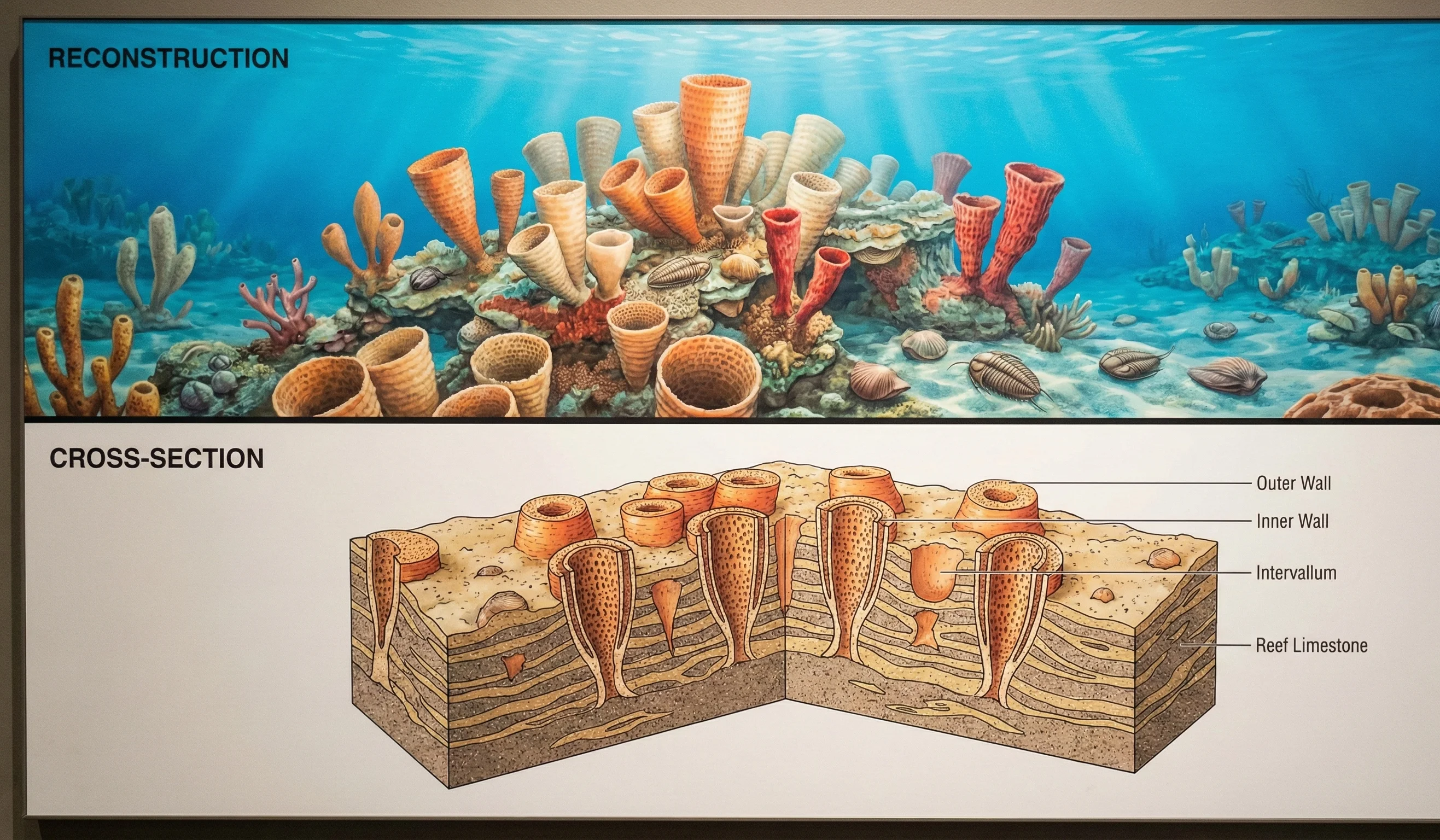
- Structure: Imagine two ice cream cones stacked inside each other (a double-walled cone), with the space between them filled with vertical walls (septa). The walls were porous, allowing water to flow through.
- Function: They were filter feeders. They pumped water through their outer wall, filtered out food in the central cavity, and ejected it out the top.
- Symbiosis: Scientists suspect they were the first animals to partner with photosynthesizing algae (symbiosis), just like modern corals. This allowed them to build massive limestone structures very quickly in shallow, sunlit waters.
35.2 The First Reefs
For 20 million years (Tommotian to Toyonian stages), Archaeocyathids dominated the tropical coastlines of Siberia and Antarctica (which were near the equator then). They built the first biological mega-structures visible from space.
Ecological Role: Just like modern reefs, these structures created complex 3D habitats. Worms, small trilobites, and brachiopods lived in the nooks and crannies of the Archaeocyathid skeletons, driving biodiversity upward.
35.3 The Great Disappearance
Then, mysteriously, they vanished. By the Middle Cambrian (before the Burgess Shale), the Archaeocyathids went completely extinct.
Significance: They hold the dubious title of being the only Phylum in the history of animals to go completely extinct. Every other Phylum (Mollusks, Chordates, Arthropods) had survivors. The Archaeocyathids left no descendants. Their reefs collapsed, and the world had to wait 40 million years for Corals to evolve and take their place.
36.0 CAMBRIAN BIOGEOGRAPHY: A DIVIDED WORLD
We often imagine the Cambrian ocean as one big uniform swimming pool. In reality, it was sharply divided into rival "Provinces." Just as lions live in Africa and tigers in Asia today, Cambrian animals were segregated by deep oceans and temperature barriers.
36.1 The Trilobite Realms
Trilobites were so diverse that scientists use them to map the ancient continents. There were two distinct "Realms":
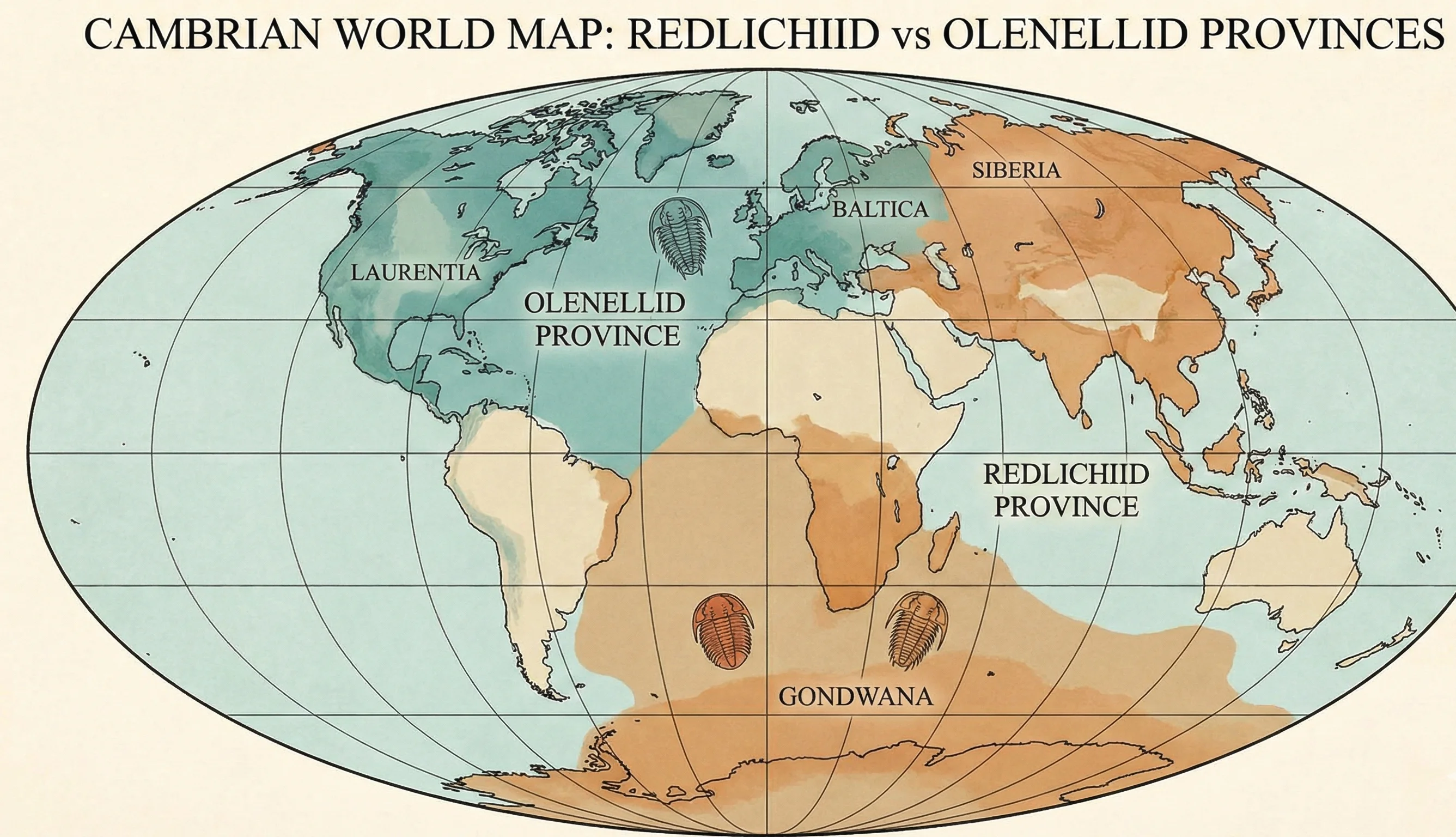
- The Olenellid Realm (Laurentia/North America): This continent sat on the Equator. It was dominated by Olenellid trilobites—primitive, spiny trilobites that lacked facial sutures (they couldn't shed their head-shell easily).
- The Redlichiid Realm (Gondwana/Asia/Australia): These waters were cooler or chemically different. They were dominated by Redlichiid trilobites, which were more advanced and often grew to gigantic sizes (some up to 70cm).
Why this matters: This provincialism proves that plate tectonics was driving evolution. As continents moved apart, populations were isolated (Vicariance), forcing them to evolve into different species. The breakup of the supercontinent Pannotia literally "broke up" the gene pool, accelerating diversity.
37.0 SIRIUS PASSET: THE FROZEN GARDEN
We talked about the Burgess Shale (Canada) and Chengjiang (China). But to get the full picture, we must visit the desolate northern coast of Greenland. Here lies the Sirius Passet Lagerstätte.
The Pioneer: Sirius Passet is older than the Burgess Shale (approx. 518 MYA, same as Chengjiang). It gives us a look at the "Frontier" of the Cambrian explosion.
37.1 Halkieria: The Missing Link?
The superstar of Greenland is Halkieria evangelista.
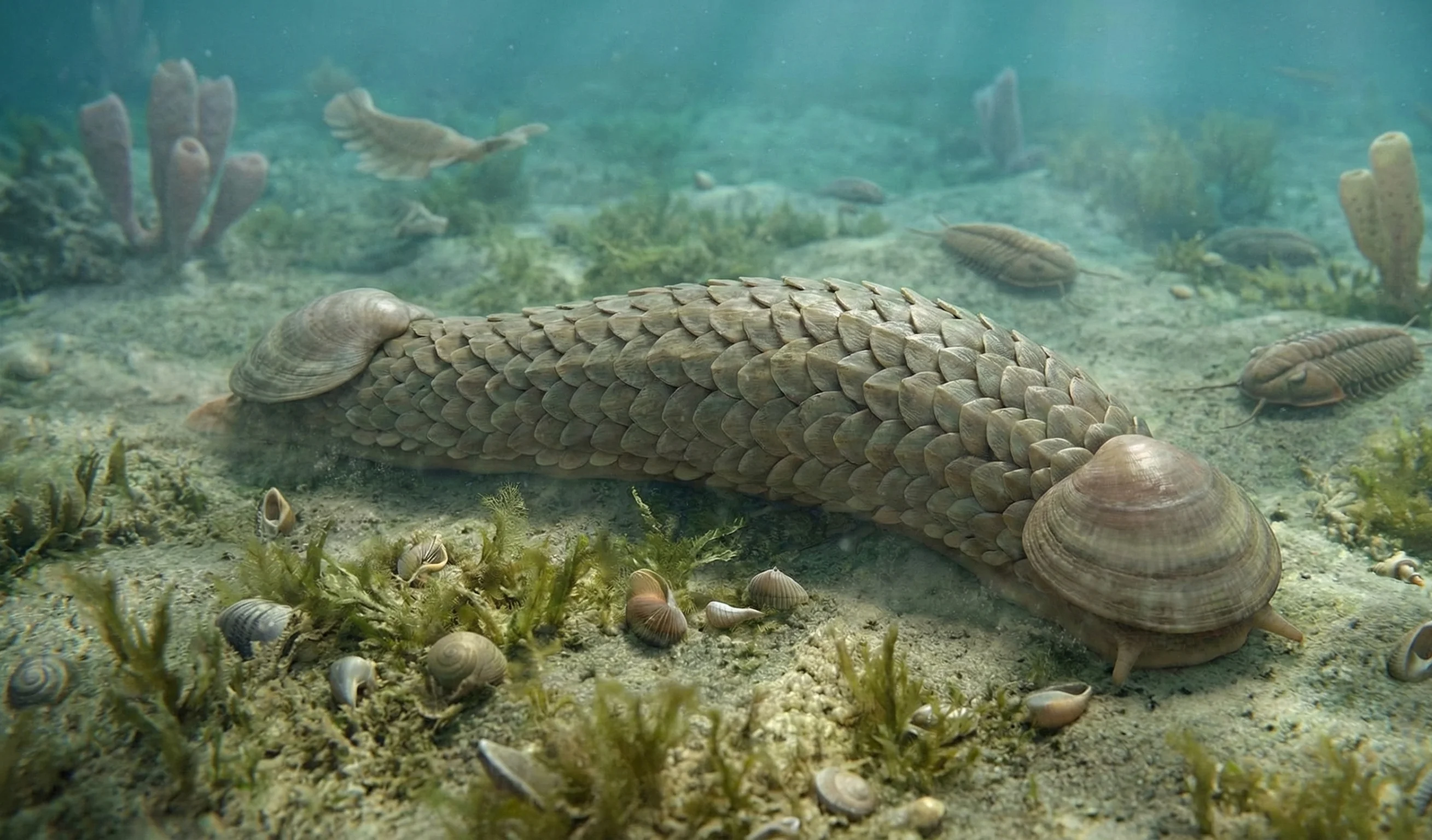
It looked like a slug covered in chainmail (sclerites), but it had two large shells—one over its head and one over its tail.
The Puzzle: It perfectly blends the features of three different groups:
1. Mollusks: The shells look like clam shells.
2. Brachiopods: The microscopic structure matches lamp shells.
3. Annelids: The body looks like a segmented worm.
Halkieria suggests that these three distinct groups (Clams, Brachiopods, Worms) all evolved from a single, slug-like ancestor covered in armor. It is a snapshot of evolution caught in the act of splitting a lineage.
37.2 The Predator of the North: Tamisiocaris
In Sirius Passet, we also found a cousin of Anomalocaris called Tamisiocaris. But instead of grabbing claws, its front appendages had evolved into massive, fine-meshed filter nets.
The Whale Shark of the Cambrian: This proves that the ecosystem had matured rapidly. Just as modern whales evolved from hunters to gentle filter-feeders to exploit plankton, Cambrian apex predators had already diversified into "Gentle Giants" only a few million years after the explosion began.
38.0 THE FIRST BUST: THE BOTOMIAN-TOYONIAN EXTINCTION
We tend to view the Cambrian Explosion as a continuous, upward trajectory of biodiversity. However, around 514 to 510 million years ago (Late Early Cambrian), the party came to a screeching halt.
This event, known as the Botomian-Toyonian Extinction, is arguably the first major mass extinction in the history of animals.
38.1 The Collapse of the Reefs
The hardest hit were the reef-builders. As we discussed in Part 10, the Archaeocyathids (sponge-corals) had built massive structures along the tropical coastlines. In a geological blink of an eye, they were wiped out.
- Total Extinction: This wasn't just a reduction. The entire Phylum Archaeocyatha vanished. They became the first major branch of the tree of life to be completely pruned.
- The Void: Their disappearance left a massive ecological vacuum. For the next 40 million years (until the Ordovician), Earth had no reef-builders. The oceans reverted to "microbial reefs" (stromatolites)—a step backward in ecological complexity.
38.2 The Trilobite Crisis
The Trilobites, the rulers of the sea, also suffered a catastrophe. The Olenellid trilobites (the dominant group in North America/Laurentia) and the Redlichiid trilobites (Gondwana) were decimated. Over 50% of all trilobite families disappeared.
This event reset the evolutionary clock for arthropods, clearing the way for new, smaller, and more mobile trilobite groups (like the Ptychopariids) to take over in the Middle Cambrian.
39.0 THE KILL MECHANISM: THE SINSK EVENT
What killed them? The evidence lies in the rocks of Siberia, known as the Sinsk Formation. These rocks are Black Shales.
39.1 Ocean Anoxia
Black shale forms only when organic matter is buried in oxygen-free conditions. The geological record shows that massive plumes of anoxic (oxygen-depleted) water rose from the deep ocean and flooded the shallow continental shelves where most life lived.
The Suffocation: The animals of the Cambrian required high levels of oxygen (remember, collagen synthesis and active predation depend on it). When the oxygen levels crashed, the highly active predators and the stationary reef-builders suffocated instantly.
40.0 THE SMOKING GUN: KALKARINDJI LARGE IGNEOUS PROVINCE
Anoxia doesn't just happen; something triggers it. In 2010, geologists identified the culprit: A massive volcanic eruption in what is now Northern Australia.
40.1 A Flood of Lava
The Kalkarindji Large Igneous Province (LIP) was a volcanic event of apocalyptic proportions. It spewed over 500,000 cubic kilometers of lava across the continent.
The Chain Reaction:
- CO₂ Injection: The volcanoes pumped gigatons of Carbon Dioxide and Sulfur Dioxide into the atmosphere.
- Super-Greenhouse: This caused rapid global warming.
- Ocean Stagnation: Warm water holds less oxygen than cold water. Furthermore, rapid warming stops ocean currents (thermohaline circulation) from mixing oxygen into the deep.
- Death: The oceans became stagnant, hot, and sour (acidic). The Archaeocyathids, made of calcium carbonate, likely had their skeletons dissolved by the acidification while they suffocated.
This pattern (Volcano -> Warming -> Anoxia -> Extinction) would repeat itself during the Great Dying (Permian) and the End-Triassic extinction. Kalkarindji was the first time animals experienced this deadly cycle.
41.0 "DEAD CLADE WALKING"
This extinction event illustrates a terrifying evolutionary concept coined by David Jablonski: "Dead Clade Walking."
Some groups, like certain primitive trilobites, technically survived the extinction event itself. However, their genetic diversity was so shattered, and their population so fragmented, that they could never recover. They lingered for a few million years as "zombie lineages" before quietly going extinct in the Middle Cambrian.
Lesson: Survival of the fittest doesn't apply during a mass extinction. It is "Survival of the Luckiest." The Archaeocyathids were perfectly adapted to their environment, but they couldn't adapt to a volcano erupting on the other side of the planet.
42.0 THE RECOVERY: THE MIDDLE CAMBRIAN LULL
Following the extinction, the Cambrian explosion slowed down. The "Middle Cambrian" (where the Burgess Shale fits in) represents a recovery phase.
The ecosystem that emerged was different. It was less experimental. The "weirdest" body plans began to disappear, and the groups that survived (Mollusks, Arthropods, Chordates) began to lock in the features that would define them for the rest of time. The wild party was over; the serious business of building the Phanerozoic Eon had begun.
43.0 THE GREAT PUZZLE: WHY DID INNOVATION STOP?
If you look at the history of life, the Cambrian Explosion looks like a burst of madness followed by a long silence.
In the Cambrian, nature invented the Chordate (us), the Arthropod (bugs), the Mollusk (clams), the Echinoderm (starfish), and dozens of other distinct architectures. Since then? Nothing. No new Phyla have appeared in the fossil record for 500 million years.
Why? Is evolution "tired"? The answer lies in the difference between Diversity and Disparity.
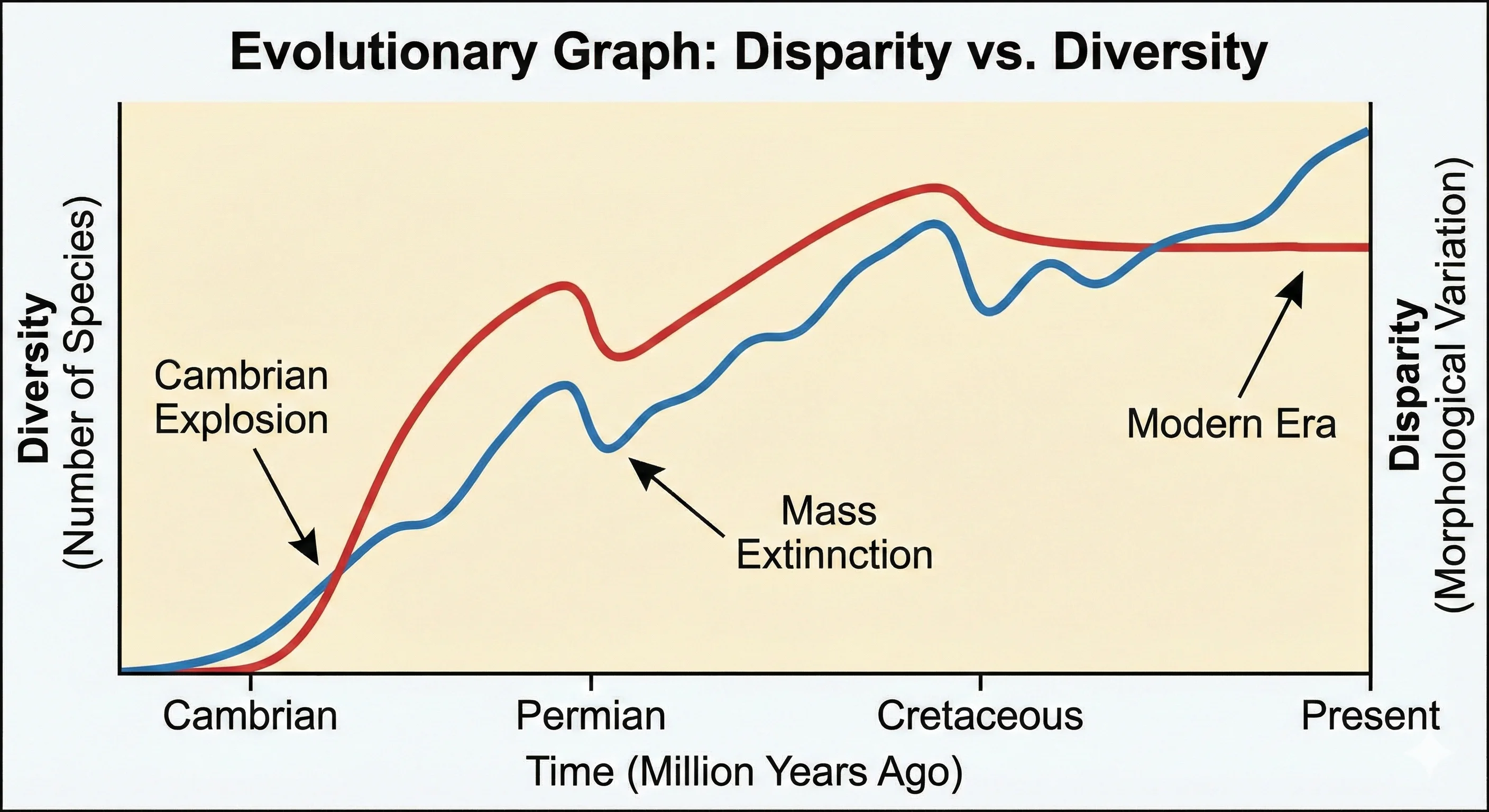
- High Disparity (Cambrian): Few species, but they looked wildly different from each other (e.g., Opabinia vs. Pikaia). The "distance" between biological designs was huge.
- High Diversity (Modern): Millions of species, but they are all variations on a theme. A hummingbird and a whale look different, but they are both Vertebrates with the exact same skeleton layout (skull, spine, 4 limbs). The innovation is superficial.
44.0 THEORY 1: GENETIC CANALIZATION (THE SPAGHETTI CODE)
The leading biological explanation is that animal genomes have become too complex to change at a fundamental level. This is known as Developmental Canalization, a concept proposed by C.H. Waddington.
44.1 The Waddington Landscape
Imagine a ball rolling down a hill full of valleys.
In the Cambrian: The valleys were shallow. The ball (the embryo) could easily jump from one valley to another, creating a totally new body plan. The genetic instructions were "loose" and modular.
Today: The valleys are deep canyons. The ball is trapped in a specific path. You can change the details (make the beak longer, the fur white), but you cannot jump out of the "Vertebrate Valley" to become something else.
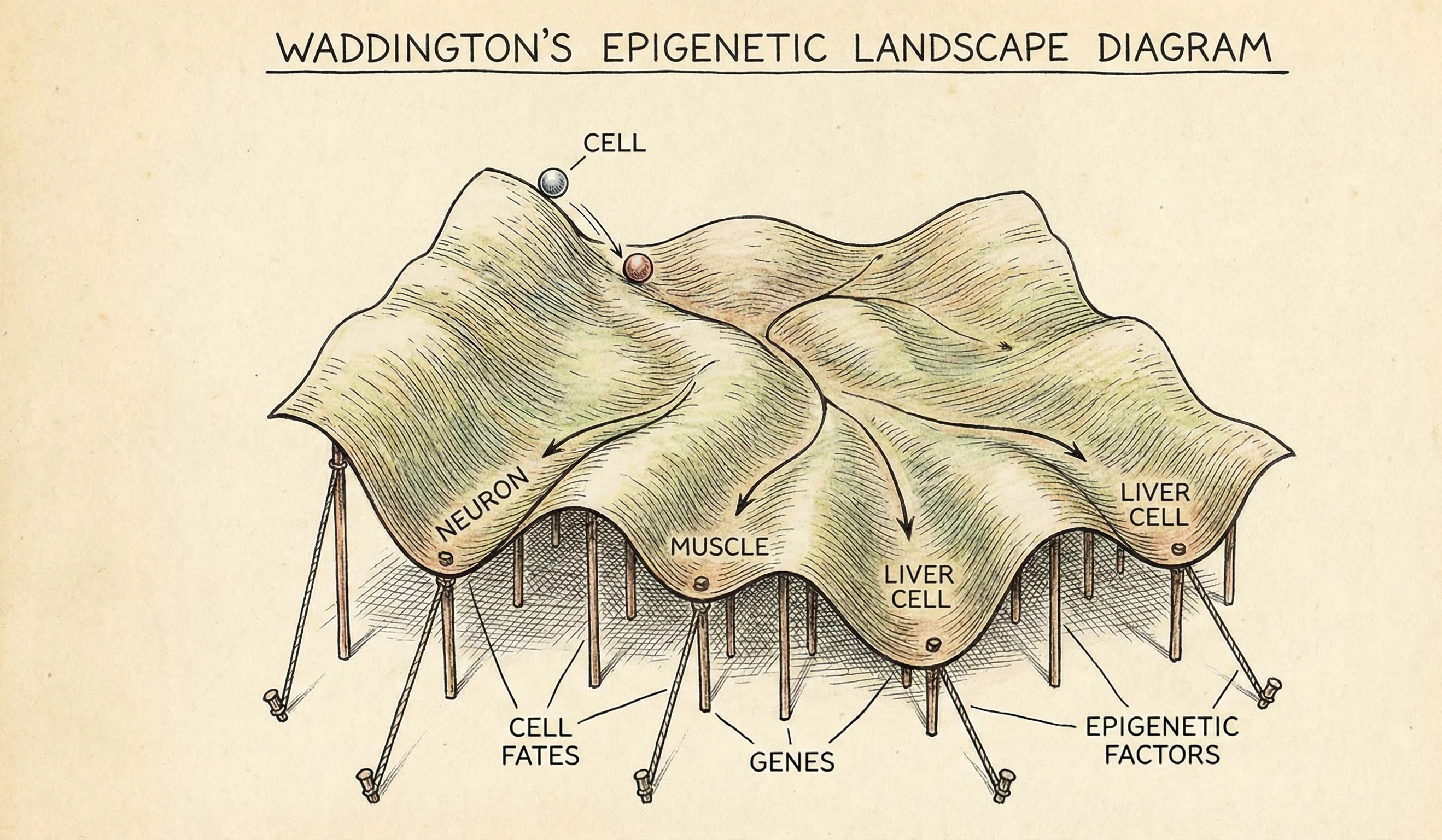
44.2 Pleiotropy and Genetic Entanglement
Why are the valleys deep? Because of Pleiotropy. This is when one gene controls multiple, unrelated traits.
The Software Analogy:
In early software (Cambrian), the code was simple. You could rewrite the "Kernel" without crashing the system.
In modern software (Humans), the code is "Legacy Spaghetti Code." The gene that controls the formation of your fingers might also control the rhythm of your heart. If you try to mutate that gene to evolve "6 fingers," you might accidentally stop the heart.
Because genes are now so interconnected (entangled), any mutation to the "Core Architecture" (Hox Genes) is almost always lethal. Evolution is forced to tinker only with the superficial genes at the edges, leaving the core untouched.
45.0 THEORY 2: ECOLOGICAL SATURATION (THE FULL BARREL)
The second explanation is not internal (genetic), but external (ecological). It is called the Ecological Saturation Hypothesis.
45.1 The Empty World vs. The Full World
In the Cambrian: The oceans were an "Empty Barrel." Niches were wide open. A weird animal with inefficient legs (like Hallucigenia) could survive because there was no competition. Nature could afford to experiment with "bad" designs.
Today: The barrel is full. Every niche is occupied by a highly optimized killing machine.
If a new, experimental body plan tried to evolve today, it would be slow and clumsy compared to the specialized sharks, crabs, and squids that already exist. It would be eaten before it could establish a foothold.
The conclusion? The Cambrian Explosion was a unique moment in time—a "perfect storm" where genetic flexibility met ecological opportunity. It can likely never happen again on Earth.
46.0 THE GOBE: THE GREAT ORDOVICIAN BIODIVERSIFICATION EVENT
While no new *body plans* appeared after the Cambrian, the *number of species* skyrocketed in the next period. This is called the GOBE (Great Ordovician Biodiversification Event).
If the Cambrian was the "Construction Phase" (building the house), the Ordovician was the "Furnishing Phase" (filling the rooms).
- Plankton Explosion: Microscopic life diversified 4x.
- Coral Reefs: True corals appeared, replacing the extinct Archaeocyathids.
- Cephalopods: The first giant armored squids (Nautiloids) appeared, becoming the new apex predators.
Life settled into a rhythm. The chaos of creation was replaced by the grind of competition.
47.0 THE RISE OF THE INTELLIGENT MOLLUSK
Late in the Cambrian, while Arthropods were busy crawling and Vertebrates were busy hiding, a humble snail-like Mollusk made a discovery that would allow it to rule the oceans for the next 100 million years. It discovered how to fly underwater.
These were the ancestors of modern Squids, Octopuses, and Nautiluses: the Cephalopods ("Head-Feet").
47.1 The First Prototype: Plectronoceras
The fossil record points to a tiny creature named Plectronoceras (approx. 500 MYA) as the grandfather of all cephalopods.
It looked like a snail with a cone-shaped shell standing upright. Unlike a normal snail that drags its shell, Plectronoceras had gas inside the tip of its shell. This gas lifted the shell up, allowing the animal to drift vertically. It was clumsy, but it was the start of something big.
48.0 THE ENGINEERING OF BUOYANCY
How do you make a heavy limestone shell float? You turn it into a submarine ballast tank. The Cephalopods invented a biological machine called the Siphuncle.
48.1 The Phragmocone System
As the animal grows, it builds a new, larger living chamber and seals off the old one behind it with a wall (septum).
- The Siphuncle: A tube of living tissue runs through the center of all the sealed chambers.
- The Osmotic Pump: The Siphuncle pumps salt out of the chamber water and into the blood. This creates an osmotic gradient. The water naturally flows out of the chamber to follow the salt, leaving a vacuum.
- Gas Fill: Gases from the blood (Nitrogen, CO2) naturally diffuse into the vacuum to fill the empty space.
Result: Neutral Buoyancy. The animal can hover in the water column without swimming, expending zero energy. This gave them a massive advantage over fish, which (at the time) had to swim constantly to keep from sinking.
49.0 THE ORTHOCONE EMPIRE
With buoyancy solved, the shell shape changed. Coiled shells (like modern Nautilus) came later. The first rulers were the Orthocones ("Straight Cones").
Imagine a traffic cone made of stone, but growing up to 6 meters (20 feet) long.
- Locomotion: They invented Jet Propulsion. By sucking water into their mantle cavity and blasting it out through a funnel (hyponome), they could shoot backward like a rocket.
- The Apex: Giants like Cameroceras (appearing in the Ordovician) became the top predators. They used their tentacles to grab trilobites and their parrot-like beaks to crush the shells.
50.0 CONVERGENT EVOLUTION: THE PERFECT EYE
The most remarkable thing about Cephalopods is not their shell, but their mind. To hunt in the 3D water column, they needed high-processing power. They evolved a Camera Eye that is eerily similar to ours, but better engineered.
50.1 Vertebrate vs. Cephalopod Eye
This is a classic example of Convergent Evolution—nature solving the same problem twice, independently.
- The Vertebrate Flaw (Us): Our eyes are wired "backwards." The nerve fibers sit on top of the light-sensitive retina, blocking some light. They have to bundle together to punch a hole through the retina to get to the brain. This hole creates a Blind Spot.
- The Cephalopod Perfection (Octopus): Their eyes form from the skin (epidermal invagination), not the brain. Their nerves sit behind the retina. They have no blocked light and No Blind Spot.
50.2 The Cost of Intelligence
Cephalopods prove that intelligence is expensive. Neurons consume massive amounts of oxygen.
Unlike vertebrates, Cephalopods use Hemocyanin (Copper-based blood) instead of Hemoglobin (Iron-based blood) to transport oxygen. Copper is less efficient than Iron. This metabolic limit is likely why Octopuses live fast and die young (rarely exceeding 2-3 years), while Whales (with iron blood) can live for centuries. They are geniuses trapped in a metabolically inefficient body.
51.0 THE RISE OF CHORDATES: THE FIRST FISH
While the Arthropods ruled the water and the Cephalopods ruled the water column, the ancestors of humans were trying to survive in the margins. The Chordates (animals with a spinal cord) had a slow start.
In the Early Cambrian (Chengjiang Biota, approx 518 MYA), we find the first true vertebrates: Haikouichthys and Myllokunmingia.
- Size: They were tiny, barely 2-3 cm long (size of a fingernail).
- The Innovation: Unlike the worm-like Pikaia, these creatures had a distinct head, distinct eyes, and primitive cartilaginous vertebrae protecting their spinal cord. They were the first creatures to put a "hard drive" (Brain) inside a "case" (Skull).
52.0 THE AGNATHANS: LIFE WITHOUT JAWS
For the first 100 million years of vertebrate history, fish lacked one crucial component: a Jaw.
These Agnathans ("No-Jaws") could not bite. Their mouths were simple, fixed openings—like a vacuum cleaner hose or a slit.
- Feeding Strategy: They were mostly bottom-feeders. They swam along the seafloor, sucking up mud, algae, and detritus. They were the "Roomba" vacuums of the Cambrian ocean.
- The Limit: Without jaws, they could not be predators. They could not defend themselves effectively. They were prey.
53.0 THE OSTRACODERMS: THE ARMORED TANKS
Being a soft, jawless snack for a giant Sea Scorpion (Eurypterid) is not a good survival strategy. So, in the Late Cambrian and Ordovician, fish evolved a radical defense: Dermal Bone.
These fish are collectively called Ostracoderms ("Shell-Skins").
53.1 The "Exoskeleton" of the Vertebrate
When we think of bones, we think of the skeleton inside our bodies (Endoskeleton). But the first bone was evolved on the outside.
- Head Shields: Ostracoderms like Arandaspis and the internet-famous Sacabambaspis were encased in massive, rigid bony shields covering their heads and gills.
- The Material: This wasn't a shell like a clam. It was true bone (Hydroxyapatite), complete with microscopic pores for blood vessels.
- Internal Softness: Inside this armored tank, the fish was still jelly. It had no internal bony spine, only a flexible Notochord made of cartilage.
Evolutionary Irony: We usually associate "Exoskeletons" with bugs. But humans started out with exoskeletons too. Over millions of years, we retreated that bone into the interior of our bodies to gain flexibility.
53.2 Sacabambaspis: The Face of Failure?
Sacabambaspis (named after the Sacabamba village in Bolivia) is famous for its goofy appearance: two eyes on the very front of its face and a permanently open, screaming mouth.
It had lateral line sensors (to detect water pressure) running down its armor. Despite its heavy shielding, it had no fins on the side, meaning it was a terrible swimmer. It likely wobbled through the water like a clumsy tadpole, relying entirely on its armor to survive the giant Nautiloids hunting it.
54.0 THE INVENTION OF PAIRED FINS
Armor is heavy. To carry it, Ostracoderms needed better engines. This drove the evolution of Paired Fins (Pectoral Fins).
This is the origin of your arms.
- Stability: Without side fins, a fish rolls over in the water (Pitch and Roll).
- Control: With pectoral fins, the fish could steer, brake, and lift.
By the end of this era, the basic vertebrate body plan was set: A head with a brain, a spine for support, armor for protection, and paired limbs for movement. The only thing missing was the Jaw. Once that evolved (from modified gill arches), vertebrates would turn from the "hunted" into the "hunters."
55.0 CONCLUSION: THE END OF THE BEGINNING
We have witnessed the single most important event in the history of animal life. In a span of just 20 to 25 million years—a heartbeat in geological time—evolution drew the blueprints for every creature that would ever swim, crawl, fly, or walk on Earth.
The Cambrian Explosion was a time of "High Stakes" experimentation. Nature threw everything at the wall to see what would stick.
- The Losers: Opabinia (5 eyes), Anomalocaris (mechanical mouth), Helicoplacus (spiral body). These designs were discarded, never to be used again.
- The Winners: The Chordate spine, the Arthropod leg, the Mollusk shell. These three designs proved to be the most efficient and adaptable, conquering the planet.
56.0 THE STATE OF THE WORLD (approx. 485 MYA)
As the Cambrian Period gave way to the Ordovician, the chaotic "wild west" era ended. The rules of the game were now set.
- The Oceans are Full: The "Empty Barrel" is gone. Every niche is filled. Competition is fierce. To survive, you must be faster, smarter, or harder than the guy next to you.
- The Genomes are Locked: The genetic code has become "canalized." It is no longer possible to invent a new body plan from scratch. Evolution shifts from "Invention" to "Modification."
57.0 THE NEXT FRONTIER: THE FORBIDDEN LAND
While the oceans teemed with monsters, the continents remained a desolate wasteland. If you stood on a beach 485 million years ago, you would see nothing but red rock, sand, and perhaps a green slime of bacteria on the wet stones.
But something has changed in the sky.
For billions of years, the sun's deadly Ultraviolet (UV) radiation sterilized the land. But thanks to the oxygen pumped out by the Cambrian algae, a protective shield has formed in the stratosphere: The Ozone Layer.
The UV radiation is dropping. The land is becoming safe.
And in the crowded, dangerous oceans, some organisms are looking at that empty, safe space with hunger. The plants will go first. The bugs will follow. And eventually, our fishy ancestors will drag themselves out of the mud.
The Age of Water is ending. The Invasion of Land is about to begin.
Topic 3 ends here.
END OF TOPIC 3
1.0 THE FORBIDDEN ZONE: WHY LEAVE THE WATER?
For nearly 4 billion years, the continents of Earth were barren. While the oceans teemed with trilobites, cephalopods, and fish, the land was a harsh, rocky wasteland reminiscent of Mars.
To understand the magnitude of "The Invasion of Land" (Terrestrialization), we must first appreciate why it was so difficult. For an aquatic organism, moving to land is not just a change of address; it is a change of physics.
1.1 The Three Horsemen of the Apocalypse (For Fish)
Any organism attempting to leave the water in the Ordovician Period faced three immediate death sentences:
- Desiccation (Drying Out): In the ocean, a cell is bathed in isotonic fluid. On land, the air sucks moisture out of cells instantly. Without a waterproof skin (Cuticle), an organism turns into a crisp in minutes.
- Gravity (The Structural Crush): In water, buoyancy (Archimedes' Principle) supports body weight. A 100-ton whale floats effortlessly. On land, buoyancy vanishes. Gravity pulls down with full force. An aquatic organism without a rigid skeleton or woody stem collapses under its own weight and suffocates.
- Radiation (The UV Burn): Water filters out high-energy Ultraviolet (UV) radiation. On land, there is no filter. Without protection, raw sunlight shreds DNA, causing massive mutations and death.
2.0 THE PREREQUISITE: THE OZONE SHIELD
Before any biological invasion could occur, a chemical shield had to be deployed. This was the work of the Cyanobacteria and Algae we discussed in previous topics.
By the Late Ordovician (approx. 450 MYA), photosynthesis had pumped enough Oxygen (O₂) into the atmosphere to allow for a critical chemical reaction in the stratosphere:
O₂ + UV Light → O + O
O + O₂ → O₃ (Ozone)
This thin layer of Ozone (O₃) acted as planetary sunscreen. It blocked the most lethal UV-C and UV-B rays. For the first time in Earth's history, the land surface was sterilized not by radiation, but simply by rock and wind. The "No-Go Zone" was officially open.
3.0 THE PIONEERS: FUNGI AND LICHENS
Textbooks often say "Plants colonized the land." This is chronologically incorrect. Before plants could take root, there had to be soil. And the creators of soil were the Fungi.
3.1 The Lichen Vanguard
The first organisms to permanently settle on the dry rocks were likely Lichens—a symbiotic partnership between a Fungus (which provides structure and holds water) and an Algae/Cyanobacterium (which provides food via photosynthesis).
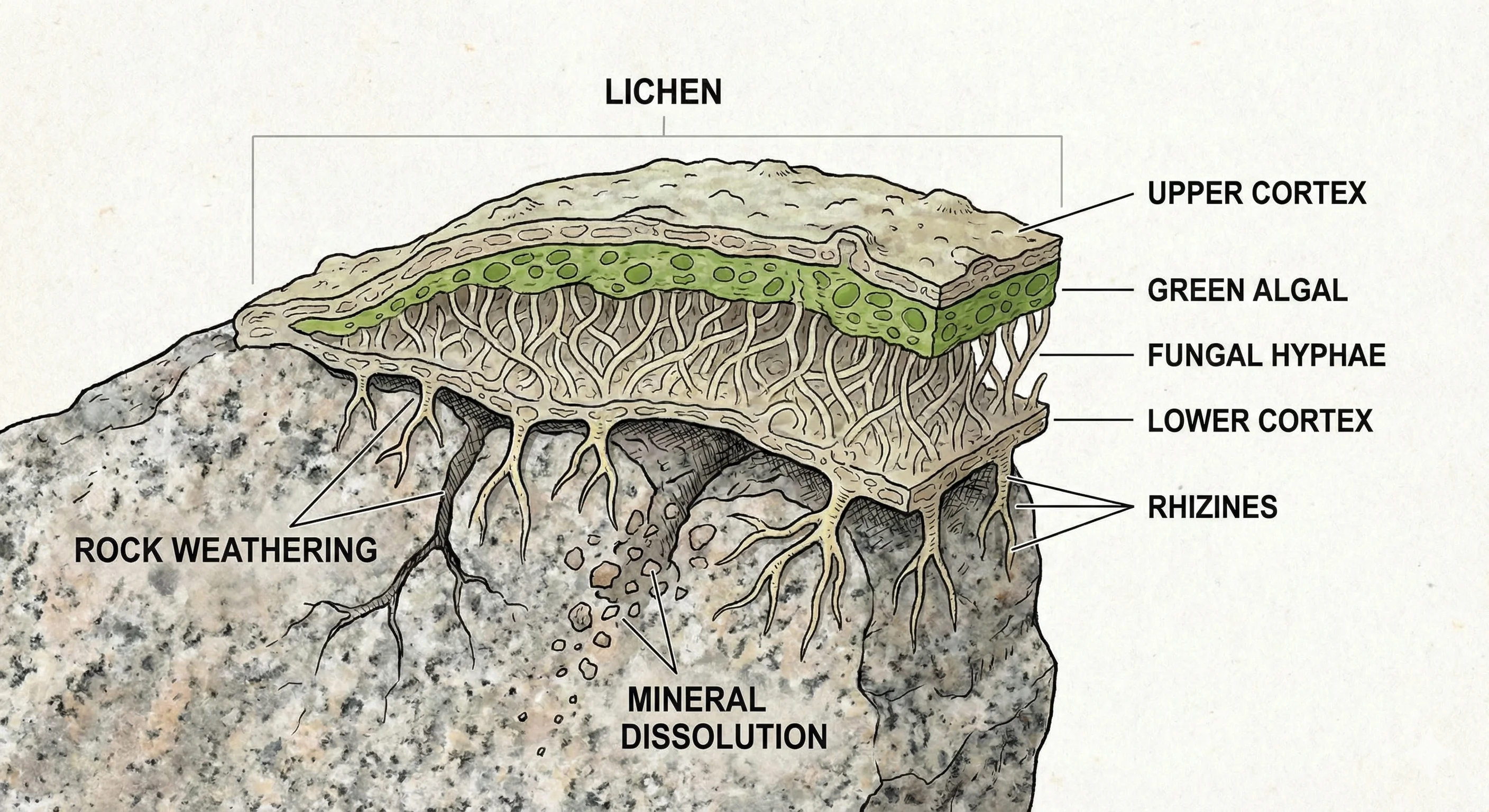
Biological Weathering: These lichens secreted organic acids (like oxalic acid) that chemically dissolved the rock surface to extract minerals (Phosphorus, Potassium). Over millions of years, this crumbling rock, mixed with dead lichen bodies, created the first thin layer of Soil.
3.2 Tortotubus: The Network
Fossils like Tortotubus (approx. 440 MYA) show us that microscopic fungal filaments (hyphae) were spreading across the barren landscape long before true plants arrived. They formed a network that bound the loose dust together, preventing it from blowing away. They prepared the bed for the plants.
4.0 THE GODZILLA FUNGUS: PROTOTAXITES
If you walked on the Earth in the Late Silurian or Early Devonian periods (420 - 370 MYA), you would see a landscape dominated not by trees, but by giant towers.
For over a century, scientists found massive fossilized trunks, some up to 1 meter wide and 8 meters (26 feet) tall. They named them Prototaxites.
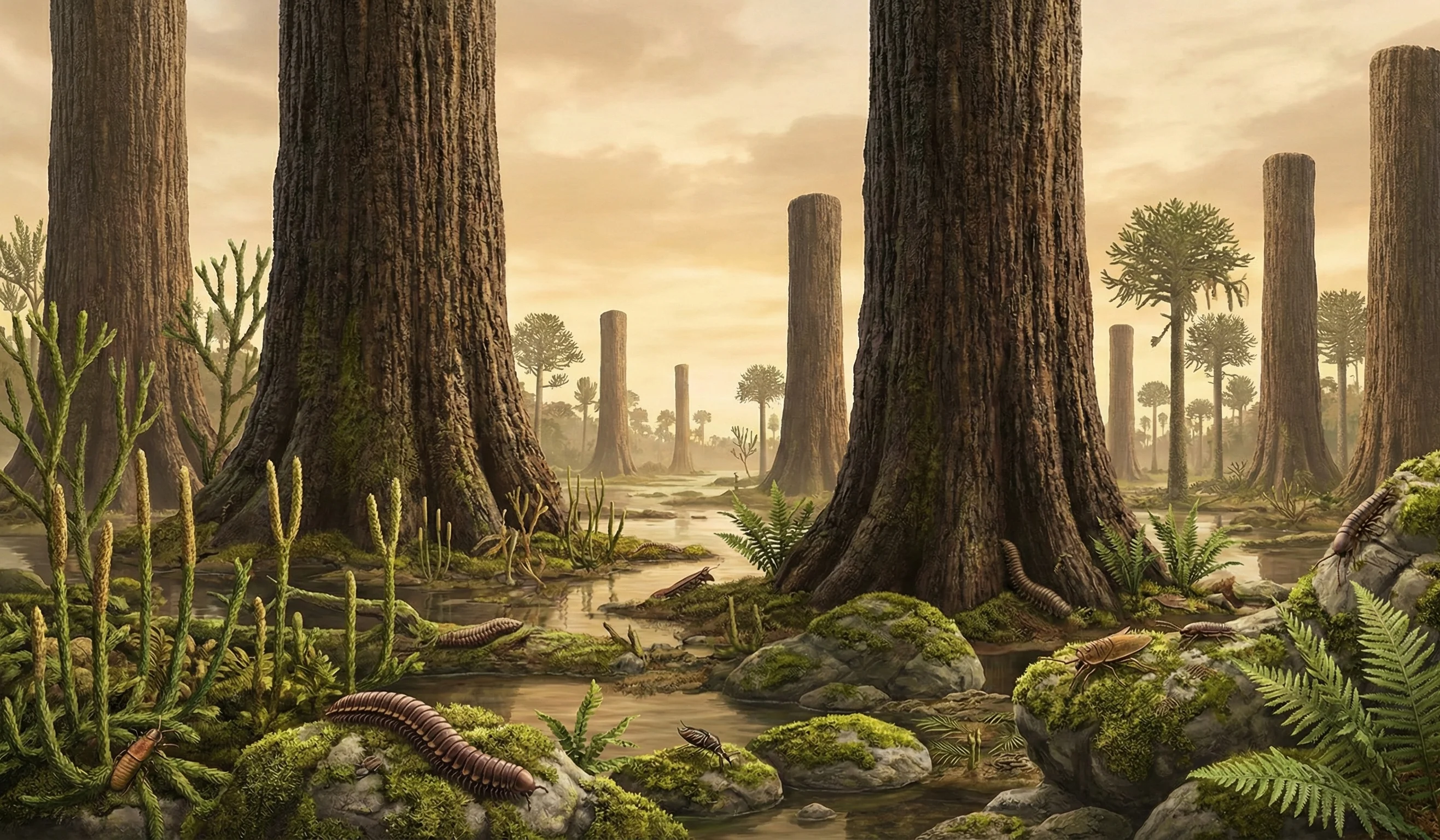
4.1 The Great Debate: Tree or Mushroom?
Initially, everyone assumed they were ancient conifer trees. But they had no bark, no branches, and no leaves.
In 2007, chemical analysis of the carbon isotopes in Prototaxites fossils revealed a shock: They were not plants. They were Giant Fungi.
The Implications:
Imagine a world where the "trees" are actually gigantic mushrooms standing 8 meters tall, and the "plants" are tiny mosses only a few centimeters high at their feet.
Prototaxites was the ruler of the early land. It likely fed on the cryptogamic soil crusts and the decaying matter of early liverworts. It represents a time when Fungi, not Plants, were the dominant architectural force on the continents.
5.0 THE GREEN BEACHHEAD: CHAROPHYTE ALGAE
While fungi were eating the rocks, the ancestors of plants were waiting in the fresh water.
Genetic analysis confirms that all land plants evolved from a specific group of freshwater Green Algae called Charophytes (Stoneworts).
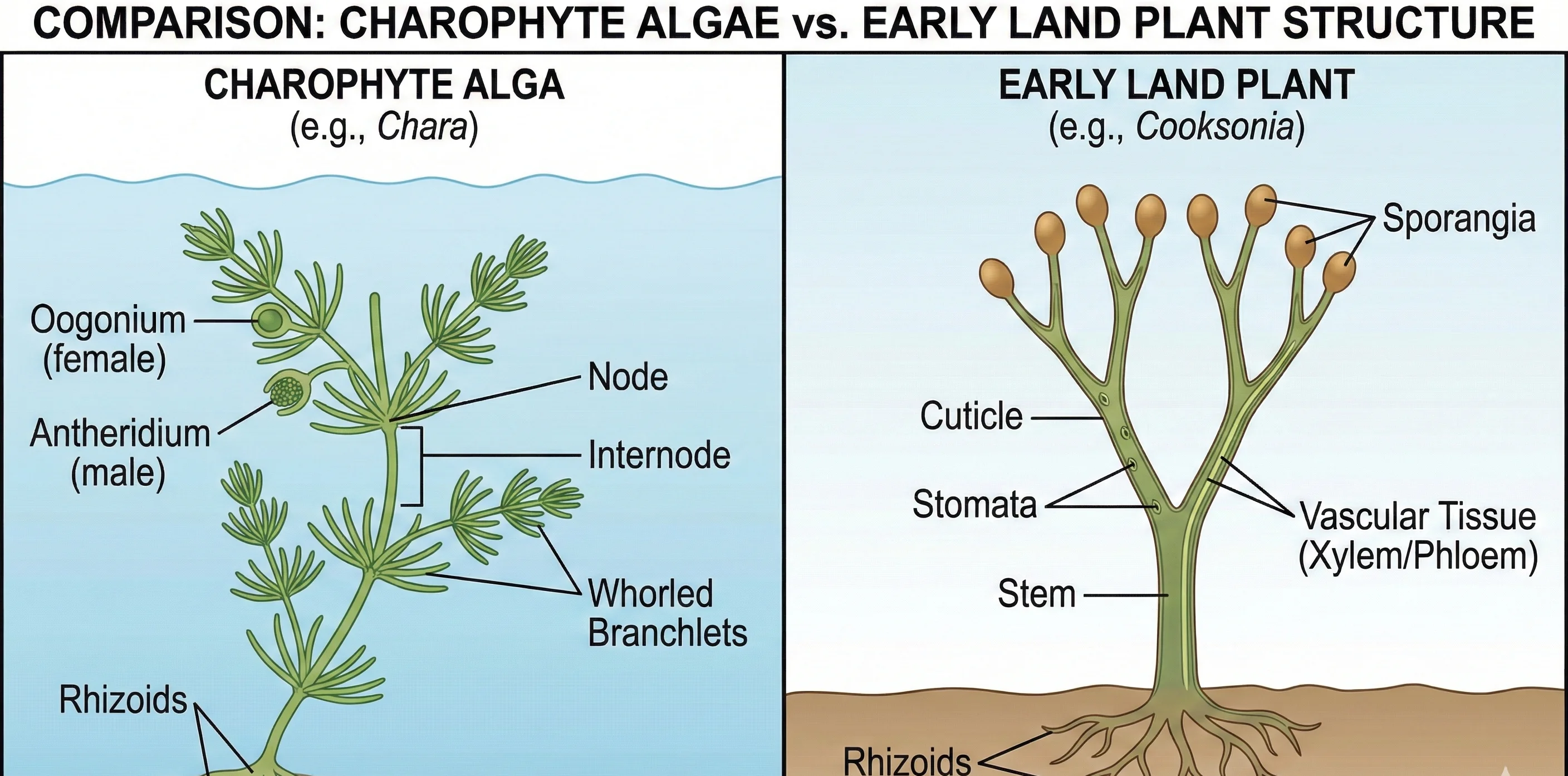
5.1 Pre-Adaptations
Charophytes live in shallow, ephemeral ponds that occasionally dry out. This forced them to evolve two critical features that would later allow them to conquer land:
- Sporopollenin: A super-tough polymer coating their zygotes (spores). This substance is virtually indestructible and protects the DNA from drying out. It is the same substance that makes modern pollen grains so tough.
- Phragmoplast: A specific way of organizing cell division that allows for complex 3D structures (stems) rather than just flat sheets.
The jump from a "drying pond" to "wet mud" was a small step for a Charophyte, but a giant leap for biology. The first true land plants—the Bryophytes—were about to emerge.
6.0 THE AMPHIBIANS OF THE PLANT WORLD: BRYOPHYTES
The first true plants to colonize the land (around 470 MYA) were the Bryophytes. Today, their descendants are the Liverworts (Ciğerotları), Hornworts (Boynuzotları), and Mosses (Yosunlar).
They were pioneers, but they were severely limited by their anatomy. They were the "Amphibians" of the plant kingdom—able to live on land, yet structurally tied to the water.
6.1 The Problem of Reproduction (Swimming Sperm)
The biggest shackle holding Bryophytes back was sex. Like their algal ancestors, Bryophytes produce flagellated sperm.
For fertilization to happen, the sperm literally has to swim from the male organ (Antheridium) to the female organ (Archegonium).
The Constraint: This means Bryophytes can only reproduce when covered in a film of water (rain or dew). If the land dries up, their reproductive cycle halts. Consequently, they could never venture far from the water's edge or deep into the dry interior of the continents. They were prisoners of the damp.
6.2 No Roots, No Pipes
Furthermore, Bryophytes are Non-Vascular. They lack internal plumbing.
Instead of true roots, they have delicate hair-like anchors called Rhizoids.
Instead of pumping water up a stem, they absorb moisture directly through their "skin" via osmosis, cell by cell.
The Height Limit: Because osmosis is slow and cannot fight gravity effectively, Bryophytes can never grow tall. They are destined to remain low-growing carpets, rarely exceeding a few centimeters in height. To conquer the sky, plants needed a pump.
7.0 THE VASCULAR REVOLUTION: TRACHEOPHYTES
Around 430 million years ago (Silurian Period), evolution produced a technological marvel: The Vascular System. Plants that possess this system are called Tracheophytes ("Tube Plants").
This was not just a biological change; it was a hydraulic engineering breakthrough. It involved the invention of two dedicated transport highways:
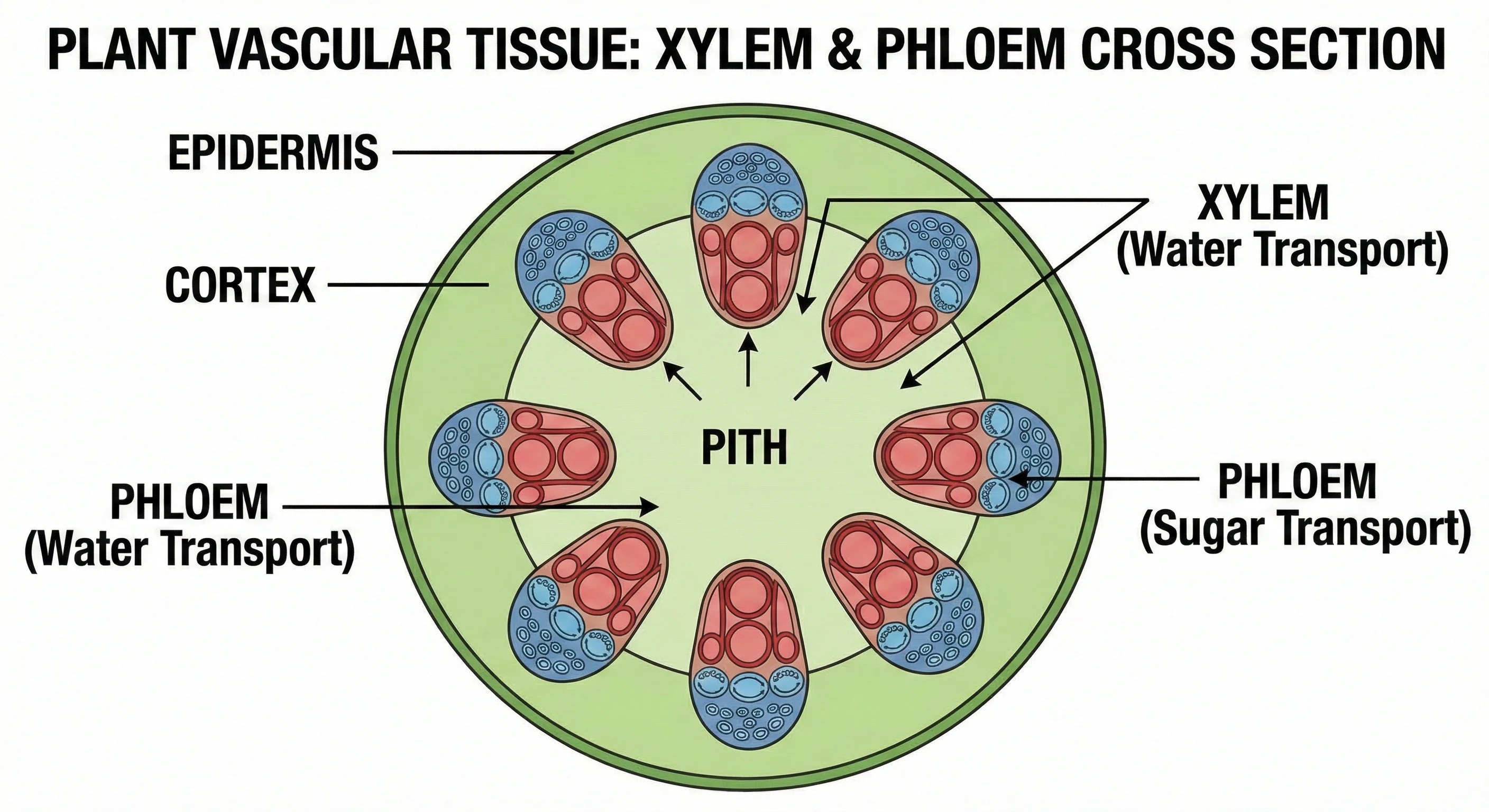
- Xylem (The Water Lift): A network of dead, hollow tubes that transport water and minerals from the roots up to the leaves. It works like a straw.
- Phloem (The Sugar Highway): A network of living cells that transport the sugars produced by photosynthesis down to feed the roots and stem.
7.1 The Physics of Xylem: How to Lift Water
How does a plant lift water against gravity without a mechanical heart pump? They use the laws of physics, specifically the Cohesion-Tension Theory.
Water molecules are "sticky" (Cohesion); they cling to each other thanks to hydrogen bonds. When water evaporates from the top of the plant (Transpiration), it creates a negative pressure (suction) that pulls the entire chain of water molecules up the Xylem tube. It is a passive, solar-powered elevator.
8.0 THE INVENTION OF WOOD: LIGNIN
However, suction is dangerous. If you suck too hard on a paper straw, it collapses. To prevent the Xylem tubes from collapsing under the immense tension of the water column, plants needed to reinforce the walls with something stronger than cellulose.
They synthesized Lignin.
Lignin is a complex organic polymer (a cross-linked phenolic polymer) that is incredibly rigid, waterproof, and chemically stable.
- Structural Support: Lignin acted as the "concrete" to the cellulose "rebar." It allowed cell walls to become hard and wood-like. With lignin, plants could finally stand up against gravity. The race for the sun began.
- Indigestibility: Lignin was so tough and chemically complex that for millions of years, nothing on Earth could eat it. Neither bacteria nor fungi had evolved the enzymes to break down lignin. This accumulation of undecayed wood would eventually lead to the Carboniferous Coal deposits (which we will discuss in Topic 5).
9.0 THE FIRST VASCULAR PLANT: COOKSONIA
The Adam of all vascular plants is a fossil named Cooksonia (approx. 433 MYA).
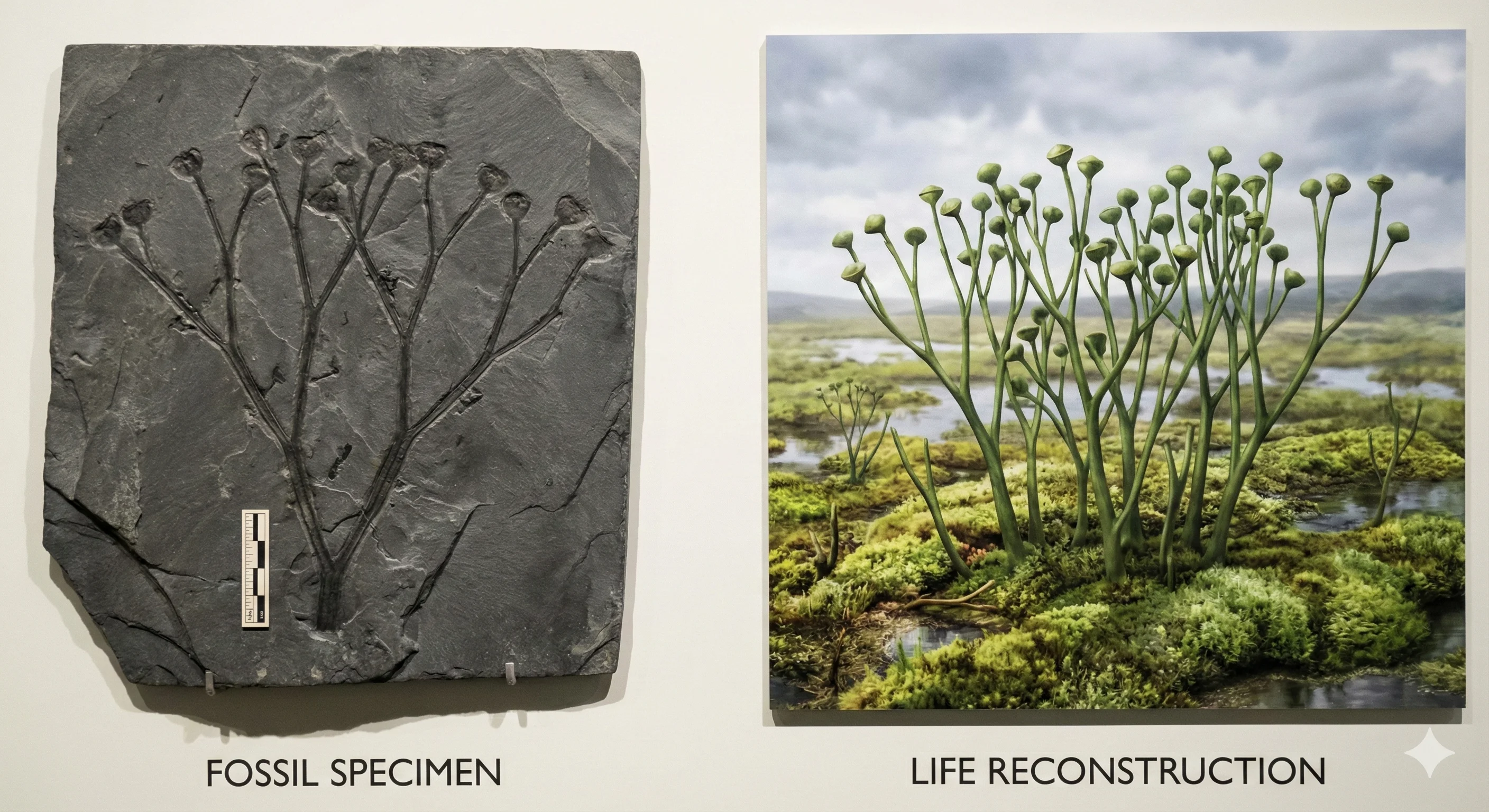
It was humble. It looked like a green matchstick branching into a 'Y' shape.
Features:
1. No leaves. Photosynthesis happened in the stems.
2. No roots. It likely still used rhizoids.
3. Sporangia: At the tip of each branch sat a cap-like structure producing spores.
Despite its simplicity, Cooksonia had the first primitive Xylem tubes with Lignin rings. It was the first organism to stand "tall" (about 5 cm) on its own power, casting the first tiny shadows on the barren rock.
10.0 THE BREATHING DILEMMA: STOMATA
Living on land presents a cruel paradox known as the Photosynthesis-Transpiration Compromise.
- To make food (Photosynthesis), a plant needs Carbon Dioxide (CO₂) from the air. To get CO₂, it must open its pores.
- But if it opens its pores, the dry air sucks out its precious water (Transpiration), and the plant dies of dehydration.
- If it seals its pores to save water, it starves of CO₂.
10.1 The Smart Valve Solution
To solve this, plants evolved Stomata (Greek for "Mouths").
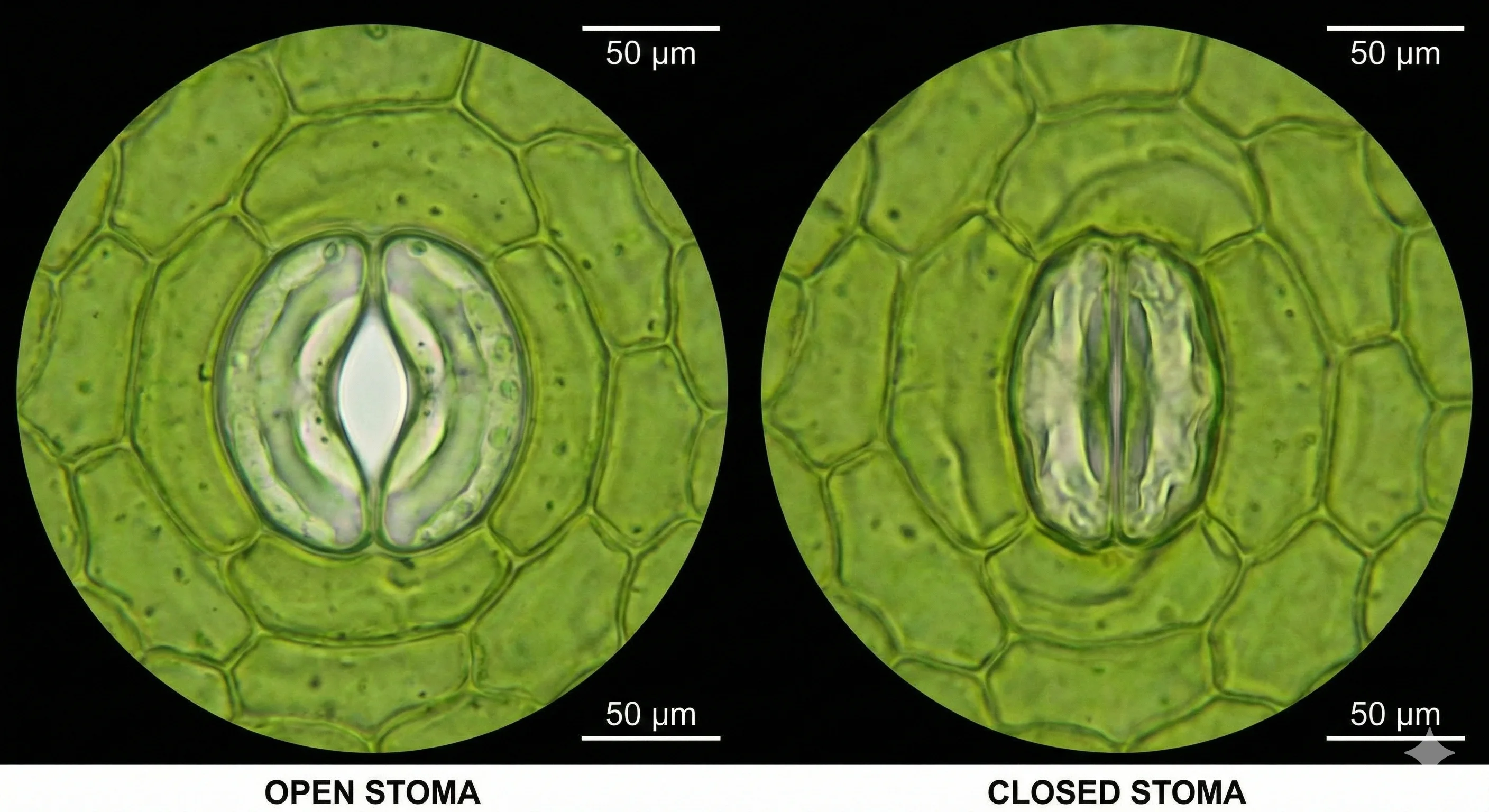
A stoma is a microscopic pore surrounded by two kidney-shaped Guard Cells. These cells act as a hydraulic valve.
- Opening: When water is abundant, the guard cells swell up (become turgid) and curve apart, opening the hole to let CO₂ in.
- Closing: When the plant is dehydrated, the guard cells lose water, go limp, and collapse against each other, sealing the hole tight to prevent water loss.
This simple yet brilliant mechanism allowed plants to balance their budget between "eating air" and "keeping water," enabling them to survive in drier environments away from the riverbanks.
11.0 THE EVOLUTION OF LEAVES
Early plants like Cooksonia were just naked stems. But as competition for sunlight increased, plants needed larger solar panels. This led to the evolution of Leaves.
11.1 Microphylls vs. Megaphylls
The fossil record shows two distinct attempts at making leaves:
- Microphylls (The Spine Leaf): Evolved by the Lycophytes (Club Mosses). These were likely just small spines growing out of the stem that eventually got a single vein of vascular tissue. Simple, small, single-veined.
- Megaphylls (The Webbed Leaf): Evolved by Ferns and Seed Plants. This was a more complex process called "Overtopping and Webbing."
Step 1: A branch system becomes flattened (Planation).
Step 2: Photosynthetic tissue grows between the branches like webbing on a duck's foot (Webbing).
Result: A broad, flat leaf with a complex network of veins, capable of capturing massive amounts of sunlight.
With Lignin for support, Xylem for water, Stomata for breathing, and Megaphylls for energy, the "Green Machine" was complete. The stage was set for the first forests.
12.0 THE INVENTION OF ROOTS: MINING THE EARTH
Before plants could grow tall, they had to solve a structural engineering problem: Anchorage. A 10-meter pole standing on a rock will fall over in the first breeze. To stand tall, you must dig deep.
Early plants like Cooksonia (Part 2) had no roots. They had Rhizoids—tiny, hair-like filaments meant only to grip the surface. They couldn't absorb much water, nor could they anchor a large plant.
12.1 The Transition to True Roots
Around the Early Devonian (410 MYA), plants evolved True Roots. This was a radical change in anatomy.
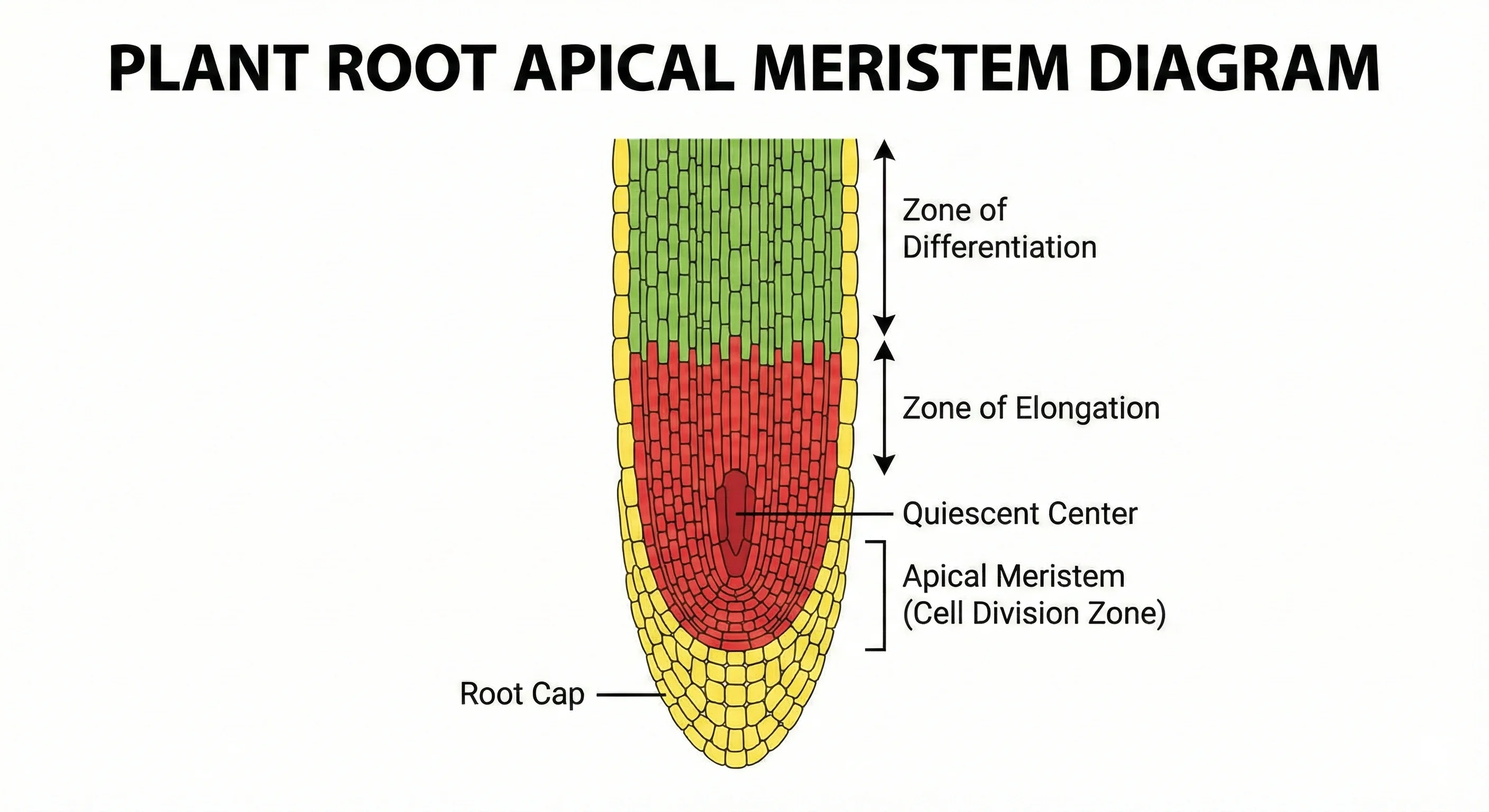
- Geotropism: The root tips evolved sensors (statocytes) to detect gravity. Unlike the stem which grows against gravity (negative geotropism), roots grow towards gravity (positive geotropism). This ensured they always dug down, seeking water.
- The Root Cap: To push through hard, rocky soil without destroying the delicate growing tip, roots evolved a "helmet" of sacrificial cells called the Root Cap. These cells secrete a slime (mucigel) that lubricates the soil, allowing the root to slide through the earth like a drill.
12.2 The Hidden Alliance: Mycorrhiza
Here is the secret that textbooks often miss: Early plants were terrible at sucking nutrients from the soil. They didn't have the surface area.
To survive, they signed a biological contract with Fungi. This is called Mycorrhizal Symbiosis.
The Deal:
1. The Plant provides Sugar (from photosynthesis) to the Fungus.
2. The Fungus uses its microscopic filaments (hyphae) to extend miles into the soil, dissolving rocks and mining rare minerals like Phosphorus and Nitrogen, which it hand-delivers to the Plant.
Fossils from the Rhynie Chert (407 MYA) show that this partnership is ancient. Plants conquered the land only because Fungi acted as their external digestive system.
13.0 THE FIRST FORESTS: THE GILBOA FOSSILS
For decades, we knew early plants were small. But in a quarry in Gilboa, New York, scientists discovered the remains of the Earth's first true forest (dating to roughly 385 MYA, Middle Devonian).
This was not a forest of oak or pine. It was an alien landscape dominated by a strange organism called Wattieza.
13.1 Wattieza: The Palm-Fern Hybrid
Wattieza belongs to an extinct group called Cladoxylopsids. It looked deceptively like a modern palm tree, standing up to 8 meters (26 feet) tall with a crown of fronds on top.
However, biologically, it was a mess of contradictions:
- No True Wood: Modern trees stand up because they have a solid core of wood. Wattieza did not. Its trunk was mostly hollow or filled with soft pith.
- The Skeleton of Strands: Instead of a solid ring, its vascular system was composed of hundreds of separate "strands" of xylem, interwoven like a basket or a bundle of cables. This provided just enough structural integrity to hold the plant up, but it restricted how wide the tree could grow.
- Reproduction: It reproduced by spores, not seeds. It was essentially a giant, tree-sized fern.
14.0 THE ENGINEERING OF "LEAF LITTER"
Wattieza introduced another new concept to the planet: Litter.
Unlike modern trees that keep their branches for years, Wattieza grew its branches cheaply and shed them constantly. As it grew taller, the lower branches died and fell off.
The Ecological Impact:
This created the first deep layer of organic matter on the forest floor.
1. Habitat: This rotting pile of debris became the perfect home for the first land invertebrates (primitive spiders, millipedes, and mites).
2. Fire: With piles of dry biological matter accumulating on land for the first time, the risk of Wildfire was born. The land was now fuel.
15.0 THE FIRST MODERN TREE: ARCHAEOPTERIS
If the Gilboa forest (discussed in Part 3) was a collection of bizarre biological experiments—giant weeds and ferns masquerading as trees—then the Late Devonian (approx. 370 MYA) introduced the finished product.
Enter Archaeopteris (not to be confused with the bird Archaeopteryx). This organism is arguably the most influential plant in the history of the Earth. It was the first organism to combine the reproductive method of an ancient fern with the wood anatomy of a modern cedar.
15.1 The Progymnosperm Paradox
Botanists classify Archaeopteris as a Progymnosperm ("Before Naked Seeds"). This classification highlights its unique evolutionary position as a "Mosaic Organism."
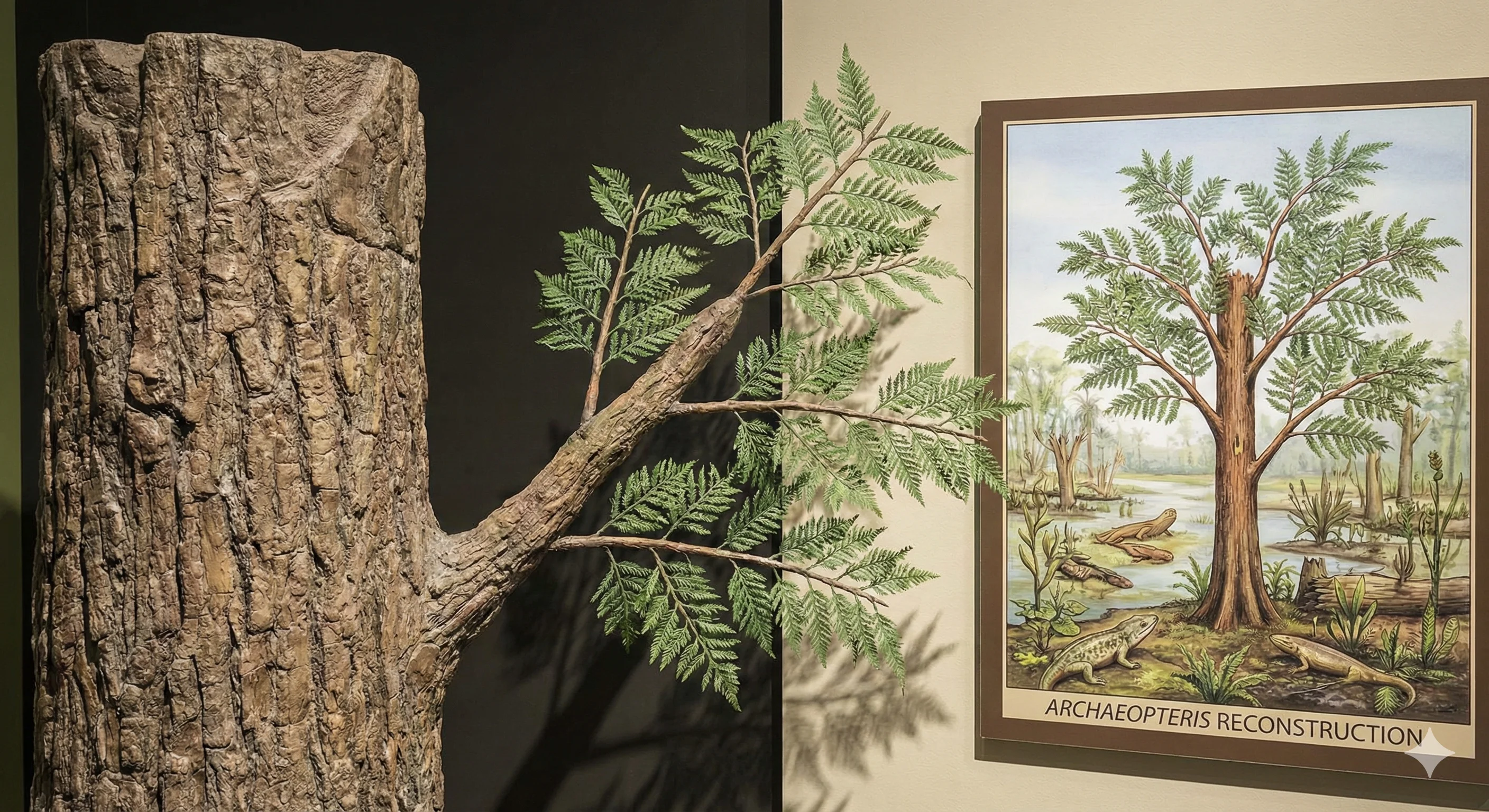
- The Ancient Trait (Leaves): Its foliage looked exactly like fern fronds. It did not have seeds. It reproduced by releasing spores into the wind, just like its primitive ancestors.
- The Modern Trait (Trunk): Its trunk was massive, reaching widths of 1.5 meters and heights of 30 meters. Biologically, this trunk was indistinguishable from modern conifer wood.
This combination allowed Archaeopteris to dominate the planet. Unlike Wattieza, which was restricted to swamps, Archaeopteris could grow in drier soils, forming the first extensive, canopy-forming forests that spanned continents.
16.0 THE INVENTION OF SECONDARY GROWTH
How did Archaeopteris achieve such massive size compared to the spindly plants before it? The secret lies in a revolutionary biological invention called the Bifacial Vascular Cambium.
To understand why this is important, we must distinguish between two types of growth:
- Primary Growth (Height): This happens at the tips of the shoots and roots (Apical Meristems). It makes the plant taller. All plants do this.
- Secondary Growth (Girth): This happens in the stem. It makes the plant wider. Before Archaeopteris, plants could not effectively do this.
16.1 The Magic Ring: The Cambium
The Vascular Cambium is a thin cylinder of stem cells running through the trunk, just beneath the bark. It is a factory that works in two directions simultaneously ("Bifacial"):
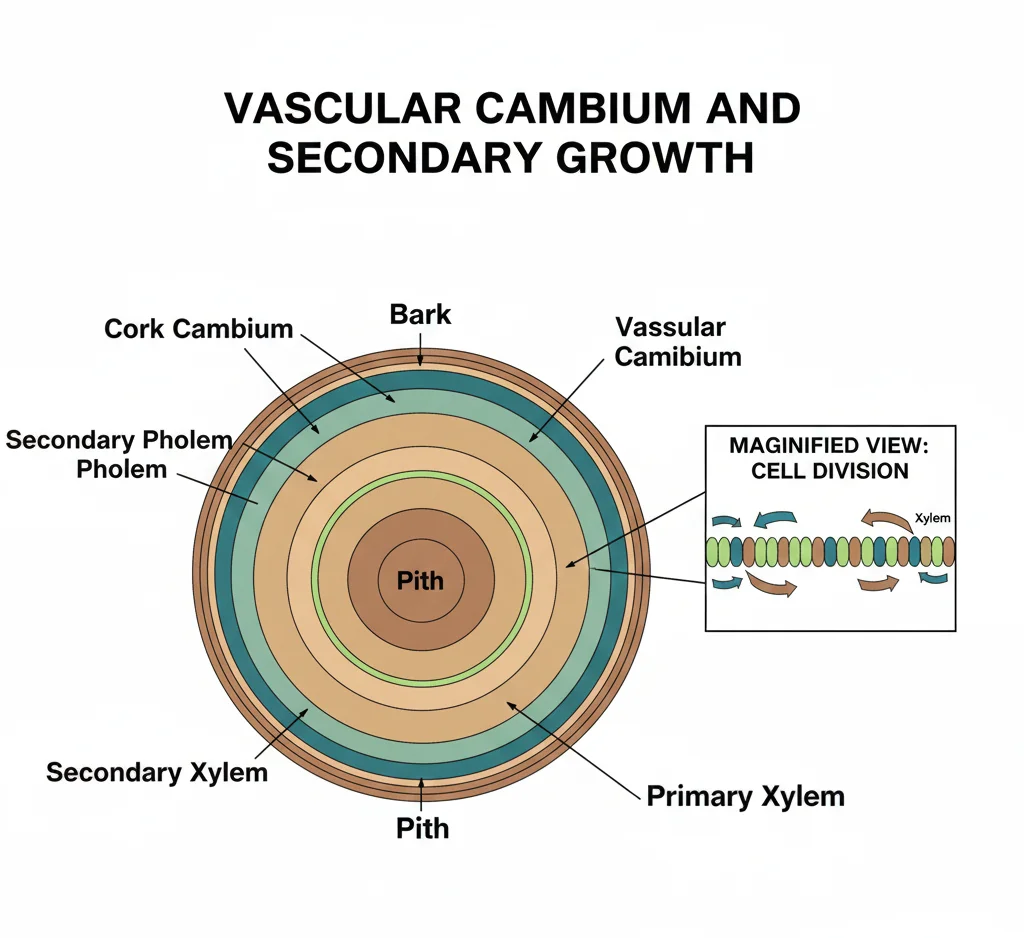
- Inward Production (Wood): The cambium cells divide and push new cells inwards. These cells die, lignify (harden), and become Secondary Xylem (Wood). This provides the structural pillar that holds the tree up.
- Outward Production (Bark): The cambium cells divide and push new cells outwards. These become Secondary Phloem and eventually bark, protecting the tree and transporting sugars.
The Infinite Expander: Unlike the Wattieza, which had a fixed number of vascular strands (like a bundle of wires), the Cambium of Archaeopteris was a continuous ring that could expand indefinitely. Every year, it added a new layer of wood. This allowed the tree to get thicker and thicker as it got taller, preventing it from buckling under its own weight. This is the mechanism that allows a modern Sequoia to grow 100 meters tall. It was invented here, 370 million years ago.
17.0 THE ANATOMY OF WOOD
The wood produced by Archaeopteris was the first true "Timber."
Tracheids and Pits: The xylem cells were elongated tubes called Tracheids. Their walls were reinforced with thick lignin. To allow water to flow between these waterproof tubes, they evolved complex valve structures called Bordered Pits. These microscopic valves could close if an air bubble formed (cavitation), preventing the air from blocking the entire water transport system. This safety mechanism is crucial for tall trees where the water tension is enormous.
Growth Rings: Fossils of Archaeopteris wood show distinct rings. This tells us two things:
1. The tree lived for many years (decades or centuries).
2. The climate had seasons (wet/dry or hot/cold). The tree grew fast in the spring (wide ring) and stopped in the winter (dark line).
18.0 THE GEOLOGICAL FORCE: DEEP ROOTS
While the trunk conquered the air, the roots of Archaeopteris conquered the bedrock.
Early plants had shallow rhizomes. Archaeopteris had thick, woody, branching roots that penetrated meters deep into the substrate. This had a profound effect on the geology of the Earth, specifically on rivers.
18.1 The Invention of Meandering Rivers
Before the Devonian, rivers were "Sheet Braided." Without deep roots to hold the banks together, rivers flowed in wide, shallow, chaotic sheets that constantly shifted.
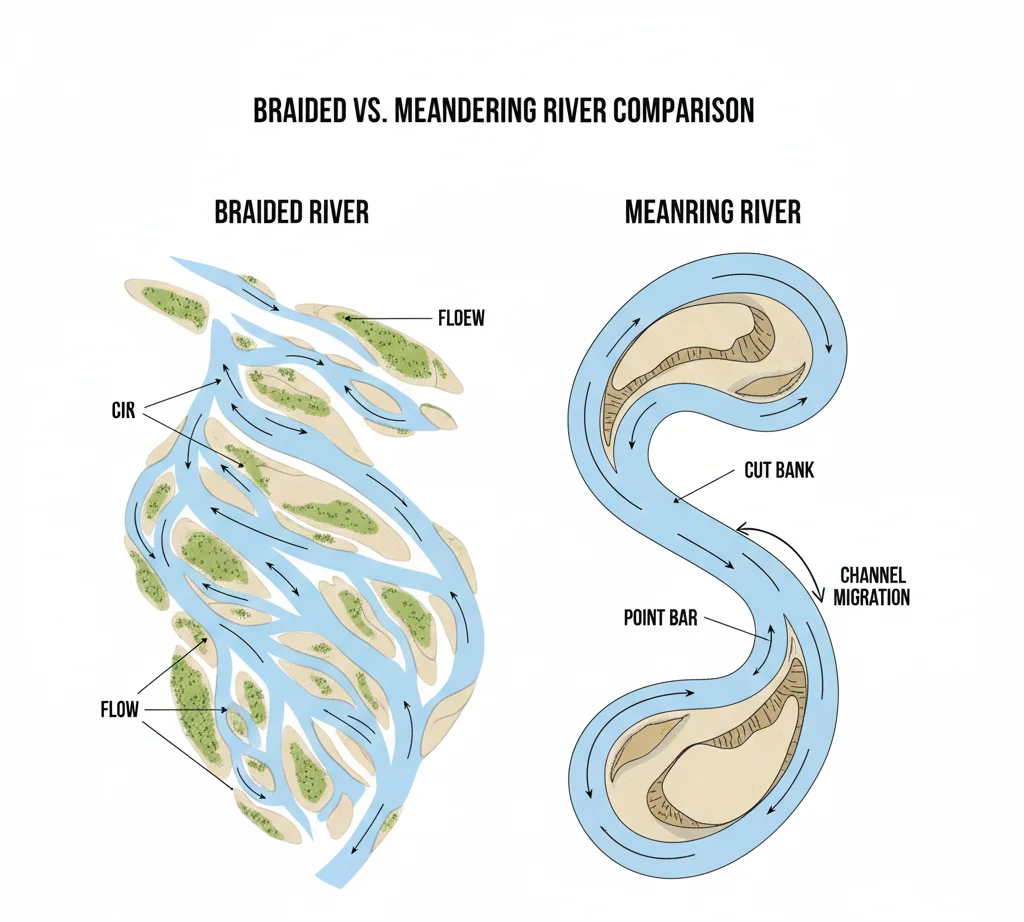
With the arrival of Archaeopteris forests along the riverbanks, the soil was locked in place by root systems.
The Result: Rivers were forced into single, deep channels that snaked across the landscape (Meandering Rivers). This created stable freshwater habitats—oxbow lakes, deep pools, and shaded banks—that became the perfect evolutionary laboratory for freshwater fish (and our ancestors) to evolve.
19.0 THE DEVONIAN PLANT HYPOTHESIS: HOW TREES ALMOST KILLED THE WORLD
The rapid spread of Archaeopteris forests had a catastrophic side effect. This is known as the Devonian Plant Hypothesis.
Trees are chemical reactors. By digging deep roots and secreting acids, they dramatically accelerated Chemical Weathering (the dissolving of rocks).
Silicate Rock + CO₂ + Water → Bicarbonate + Clay + Nutrients
19.1 The CO₂ Crash (Global Cooling)
As trees broke down silicate rocks, they pulled massive amounts of Carbon Dioxide (CO₂) out of the atmosphere. Simultaneously, they buried tons of organic carbon (Lignin) in the soil which did not decay.
The Result: Atmospheric CO₂ levels plummeted by 90%. The greenhouse effect collapsed. The Earth plunged into a severe ice age (The Famennian Glaciation).
19.2 The Nutrient Flush (Eutrophication)
The dissolving rocks released massive amounts of nutrients (Phosphorus and Nitrogen) that had been locked in the stone for billions of years.
These nutrients washed into the rivers and then into the oceans.
- Algal Blooms: The sudden influx of fertilizer caused massive algae blooms in the oceans.
- Anoxia: When these algae died and rotted, bacteria consumed all the oxygen in the water.
- Mass Extinction: This triggered the Late Devonian Mass Extinction. It is a supreme irony of paleontology: The evolution of trees on land likely suffocated the fish in the sea.
20.0 THE SHADE PROBLEM: EVOLUTION IN THE DARK
Finally, Archaeopteris created a new environmental stress: Shade.
Before this, light was omnipresent. Now, with a dense canopy 30 meters above, the ground was dark. This forced the smaller plants (ferns, mosses) to adapt.
1. Broad Leaves: Plants on the forest floor evolved broader, thinner leaves to capture dim light (a higher surface area for photon capture).
2. Climbing: Some plants evolved to be vines, using the trees as scaffolding to reach the light.
3. Parasitism: Some plants eventually gave up on photosynthesis and began stealing sugar from the tree roots.
By the end of the Devonian, the modern multi-layered forest structure (Canopy, Understory, Forest Floor) was established. The stage was physically built. Now, it was time for the animals to move in.
21.0 THE REAL CONQUERORS: THE RISE OF HEXAPODS
When we think of animals conquering the land, we usually picture a fish crawling out of the water. This is vertebrate propaganda. By the time our fishy ancestors took their first clumsy breath on land (around 375 MYA), the Arthropods had already been throwing parties in the forests for 40 million years.
The group that would come to dominate the terrestrial world is the Hexapoda ("Six Legs"). Today, they represent 80% of all known animal species. If an alien visited Earth, they would not call it the "Planet of Humans"; they would call it the "Planet of Beetles."
22.0 THE PANCRUSTACEA REVELATION: FLYING SHRIMP?
For over a century, textbooks taught that insects were closely related to Myriapods (Centipedes and Millipedes) because they both live on land and breathe air.
The Genetic Shock: In the early 2000s, DNA sequencing shattered this view. Geneticists discovered that Insects are actually nested deep inside the Crustacean family tree.
The Reality: Insects are essentially highly modified Crustaceans that adapted to land.
Just as birds are technically dinosaurs, insects are technically land-crabs (or "Flying Shrimp"). Their closest living relative in the ocean is a blind, cave-dwelling crustacean called a Remipede.
This explains why their exoskeletons are so similar chemically (Chitin) and why their genetic developmental tools (Hox genes) align so perfectly with brine shrimp and lobsters.
23.0 PHYSIOLOGICAL ENGINEERING: SURVIVING THE AIR
Transitioning a crustacean from water to air required solving two fatal problems: Drying out and Breathing.
23.1 The Wax Barrier (Epicuticle)
Crabs lose water rapidly through their shells. To survive on land, early insects evolved a microscopic layer of Waxy Lipids on top of their chitin exoskeleton (the Epicuticle).
This acted like plastic wrap. It sealed the water inside the body, allowing insects to venture into the driest deserts on Earth, places where amphibians (with their wet skin) could never go.
23.2 The Tracheal System: Breathing Without Blood
Vertebrates (like us) use blood to transport oxygen from lungs to cells. Insects invented a radically different system: Direct Piping.
- Spiracles: Along the sides of their body, insects have valve-like holes called Spiracles.
- Tracheae: These holes lead to a network of tubes (Tracheae) that branch into microscopic capillaries (Tracheoles).
- Direct Delivery: These tubes deliver oxygen directly to individual cells, bypassing the blood entirely. Insect blood (Hemolymph) carries nutrients, but it does not carry Oxygen.
The Size Limit: This system is incredibly efficient for small animals (high diffusion rate). However, it imposes a hard physical limit. As an insect gets bigger, the tracheal tubes must get wider to transport enough air. Eventually, the tubes would occupy the entire body, leaving no room for muscle. This is why we don't see ants the size of elephants (unless the atmospheric oxygen level changes... which we will see in the Carboniferous).
24.0 THE RHYNIE CHERT: A WINDOW TO THE FIRST INSECTS
Just like the Burgess Shale showed us the sea, a fossil site in Scotland called the Rhynie Chert (approx. 410 MYA) shows us the first land ecosystem.
Here, preserved in silica (glass) formed by ancient hot springs, we find the ancestors of modern hexapods.
24.1 Collembola (Springtails)
The most abundant fossils are the Springtails (*Rhyniella*). These are tiny, wingless hexapods that still live in your garden soil today by the millions. They feed on fungal hyphae and decaying matter. They proved that the "recycling crew" of the forest floor was established very early.
24.2 Rhyniognatha: The First True Insect?
The most controversial fossil is Rhyniognatha hirsti. For years, it was just a set of mandibles (jaws). But distinct "dicondylic" jaws (jaws with two hinges) are a trademark of true insects. This suggests that fully formed insects were already chewing on the *Archaeopteris* forests by 400 MYA.
25.0 THE INVENTION OF FLIGHT (THE PTERYGOTA)
Around 400 to 350 million years ago, insects did something that no animal had ever done before. They took to the sky. This event marks the origin of the Pterygota (Winged Insects).
Flight is the ultimate evolutionary advantage. It allows you to:
1. Escape predators (Spiders/Scorpions).
2. Find mates over long distances.
3. Disperse to new food sources (the tops of the 30-meter *Archaeopteris* trees).
25.1 The Great Debate: Where did Wings come from?
Insect wings are not modified legs (like bird wings are modified arms). They are distinct structures on the back. So, what evolved into a wing?
Theory A: The Paranotal Lobe Theory (The Gliders)
This theory suggests that wings evolved from rigid expansions of the chest armor (notum).
Step 1: Flat plates extended from the thorax to protect legs or absorb heat (Solar Panels).
Step 2: If the insect fell, these plates helped it glide (Parachuting).
Step 3: Muscles eventually attached to the plates to control the glide, leading to flapping.
Problem: It is very hard to explain how a rigid plate developed complex joints and nerves from scratch.
Theory B: The Epicoxal/Gill Theory (The Swimmers) - THE WINNER?
This theory is currently supported by modern Evo-Devo (Evolutionary Developmental Biology).
It suggests wings evolved from the Gills of aquatic crustacean ancestors.
- Genetic Evidence: In crustaceans, a gene called pdm controls the development of the gill/leg branch. In insects, the exact same gene controls the development of the wing.
- The Scenario: Early aquatic hexapods used movable gill plates to swim. When they moved to land, they didn't need gills for breathing anymore (they had spiracles). But they kept the movable plates on their backs. Over millions of years, these "Land Gills" were repurposed into "Air Foils."
This explains why insect wings are mobile, articulated, and full of blood vessels (veins)—because they started out as moving, breathing organs in the water.
26.0 METAMORPHOSIS: THE ULTIMATE STRATEGY
Finally, insects invented a life cycle that maximized efficiency: Holometaboly (Complete Metamorphosis).
In primitive insects (like grasshoppers), the baby looks like a small adult. They eat the same food. This creates competition between parents and children.
Advanced insects (Beetles, Flies, Butterflies, Wasps) split their life into two distinct phases:
- The Larva (The Eating Machine): A soft tube designed purely for feeding and growing. (e.g., Caterpillar).
- The Pupa (The Reboot): The larva dissolves its body into a soup and rebuilds it from scratch using "Imaginal Discs."
- The Adult (The Sex Machine): A winged vehicle designed purely for dispersal and reproduction. (e.g., Butterfly).
The Advantage: The baby eats leaves; the adult drinks nectar. They occupy completely different ecological niches. They never compete with each other. This efficiency is why Holometabolous insects account for the vast majority of insect diversity today.
27.0 THE GREAT SCHISM: RAY VS. LOBE
To understand why humans have arms and legs, we must go back to a fundamental split in the fish family tree around 420 million years ago.
If you look at a goldfish or a salmon, you are looking at an Actinopterygian ("Ray-Finned Fish").
Their fins are webs of skin supported by delicate, bony spines (rays). There is no muscle inside the fin. If a goldfish tried to do a push-up on land, its fins would snap instantly. They are designed for steering, not lifting.
But there was another group: the Sarcopterygians ("Lobe-Finned Fish").
These fish were different. Their fins were fleshy, muscular, and stout. Most importantly, inside those fleshy fins, they had a chain of solid bones.
27.1 The Universal Blueprint (1-2-Many)
If you X-ray a Sarcopterygian fin (like the fossil Eusthenopteron or a modern Coelacanth), you see a pattern that is familiar.
- One Bone: At the base (Humerus/Femur).
- Two Bones: In the middle (Radius & Ulna / Tibia & Fibula).
- Many Bones: At the tip (Radials/Carpals).
The Surprise: Look at your own arm. Humerus, Radius/Ulna, Wrist.
Nature didn't invent your arm on land. It invented it 400 million years ago in the water, likely to help heavy fish maneuver through thick aquatic vegetation. You are essentially a modified Sarcopterygian fish walking on your specialized fins.
28.0 THE MOTIVATION: WHY LEAVE THE WATER?
The old textbook theory was: "The ponds dried up, so fish had to crawl to the next pond."
This is logically flawed. If a fish is drying out, it doesn't evolve legs; it dies. Evolution is not forward-thinking.
The modern theory, supported by fossils, is the "Woodland Home" Hypothesis.
By the Late Devonian, the shorelines were clogged with the roots and fallen trunks of *Archaeopteris* trees (from Part 4). This created a new environment: The Shallows.
- Safety: The deep water was full of 5-meter long super-predators like *Hyneria* and giant sharks. The shallow, root-clogged water was a "Safe Zone" where big predators couldn't swim.
- Food: As we saw in Part 5, insects had already colonized the land. A fish that could lift its head out of the water could access a buffet of spiders and millipedes that no one else could reach.
So, fish didn't come to land to "explore." They came to hide from monsters and steal food.
29.0 THE NOSTRIL MIGRATION: KENICHTHYS
Before you can eat on land, you must solve a physics problem.
Fish have nostrils, but they are just U-shaped tubes for smelling water. Water goes in one hole and out the other. They do not connect to the throat. Fish breathe through gills.
To breathe air with your mouth closed (while chewing food), you need a connection from your nose to your lungs: The Choana (Internal Nostril).
The Surprise Fossil: In China, scientists found a fish named Kenichthys (395 MYA).
In standard fish, the nostril is on the lip. In Tetrapods (us), it's inside the palate.
In Kenichthys, the nostril is stuck right in the middle of the teeth. It is a "transitional nostril" caught in the act of migrating from the face to the throat. This allows us to trace exactly how our breathing system evolved.
30.0 THE STEPS TO LAND: A MOSAIC EVOLUTION
The transition wasn't instantaneous. It was a step-by-step modification of the "Fish" chassis.
30.1 Eusthenopteron: The Model Fish
Eusthenopteron (385 MYA) is famous not because it walked (it didn't), but because it is anatomically perfect. It had internal nostrils, a distinct skull pattern that matches ours, and the "1-2-Many" bone structure in its fins. However, it was strictly aquatic. It used its fins to steer, not to push.
30.2 Panderichthys: The Mudskipper
Panderichthys (380 MYA) looks like a fish trying to be a crocodile.
It lost its dorsal (back) and anal fins. Why? Because dorsal fins are great for swimming in open water, but terrible in shallow, weed-choked swamps (they get tangled).
It had a flat head with eyes on top, perfect for looking up at the surface ("Spy-hopping") to spot careless insects.
31.0 THE STAR: TIKTAALIK ROSEAE
In 2004, Neil Shubin and his team were working in the desolate Canadian Arctic (Ellesmere Island). They were looking for rocks of a specific age (375 MYA)—the "gap" between Panderichthys (fish) and Acanthostega (amphibian).
They found Tiktaalik. It is arguably the most important fossil ever found for human evolutionary history. It is the perfect "Fishapod."
31.1 The Invention of the Neck
Fish do not have necks. Their shoulder girdle is fused directly to their skull. To look left, a fish must turn its entire body.
Tiktaalik lost the bony plates (Opercular bones) connecting the head to the shoulder.
The Result: For the first time in history, an animal could move its head independently of its body. It had a Neck. This was crucial for hunting in shallow water—it could snap at prey sideways without moving its whole heavy body.
31.2 The Invention of the Wrist
The fins of Tiktaalik revealed something shocking. The distal bones (the "Many" part) were not just a jumble. They formed a functional Wrist Joint.
The Push-Up: The fossil shows distinct muscle scars indicating massive flexor muscles. Tiktaalik could do a push-up.
It didn't "walk" like a dog. It likely sat in the mud, planted its heavy fins, and lifted its head above the water to breathe and survey the landscape. The wrist was originally an adaptation to lift the heavy skull out of the water against gravity.
32.0 THE SPIRACLE: THE ORIGIN OF THE EAR
Here is the final surprise of this section.
Fish have a small hole behind their eye called the Spiracle. In sharks, it helps pump water over the gills.
In Tiktaalik, the skull was getting flatter, and the spiracle was getting larger. As the animal started relying more on air, this "water intake hole" became an "air intake hole."
The Transformation: Over millions of years, as animals moved fully onto land, this hole got covered by a drum-like membrane (the Eardrum) to pick up vibrations in the air. The bone that used to hinge the jaw (Hyomandibula) shrunk and moved inside to become the Stapes (the stirrup bone in your middle ear).
So, your ear is essentially a modified gill-breathing hole, and the bone that helps you hear Mozart was once used by a shark-like ancestor to bite its prey.
33.0 THE FIRST TETRAPODS: EXPERIMENTS IN LIMBS
We have left the world of "Fishapods" like Tiktaalik. We have arrived at the age of true Tetrapods (Four-Footed animals).
The Late Devonian (Famennian Stage, approx. 365 MYA) presents us with two of the most important fossils in the history of biology: Acanthostega and Ichthyostega. Both were discovered in East Greenland, which, at the time, was a tropical equatorial swamp.
34.0 ACANTHOSTEGA: THE EIGHT-FINGERED ANOMALY
For decades, paleontologists believed in a linear story: Fish stranded on land needed to crawl, so they evolved stronger fins which eventually became legs with digits.
The discovery of Acanthostega gunnari by Jennifer Clack completely destroyed this theory.
34.1 Legs Built for Water
Acanthostega had four distinct legs. It had wrists. It had ankles. It had fingers and toes. But when scientists analyzed the mechanics of its skeleton, they realized something shocking:
- Weak Joints: Its wrist and ankle bones were too loose to support the animal's weight on land. If it tried to stand up, its joints would buckle.
- Fish Gills: It still possessed massive, functional internal gills (like a fish) alongside its primitive lungs. It lived its entire life underwater.
- Tail Fin: It retained a large, caudal fin with fin rays, designed for propulsion in water.
The Conclusion: This animal had legs, but it was purely aquatic. This proves that legs and toes evolved in the water, for the water. They did not evolve to walk on land.
34.2 The Polydactyly Mystery
Look at your hand. You are a Pentadactyl (5 digits). We assume this is the "standard" vertebrate plan.
Acanthostega had 8 digits on each hand.
This reveals that the number "5" was not inevitable. In the early Devonian, nature was experimenting with the number of fingers. The genetic code for limb development (Hox genes) was unstable.
Why 8? It seems the early limb was functioning more like a paddle or a rake.
34.3 The "Crampon" Hypothesis
If not for walking, what were legs for?
Remember the *Archaeopteris* roots clogging the rivers (Part 4).
A swimming fin gets tangled in roots. A muscular limb with grasping fingers, however, acts like a hook or a Crampon.
Acanthostega likely used its 8-fingered hands to grab onto submerged roots, pulling itself through the dense vegetation to ambush prey or hide from giant sharks. The "Hand" was originally a "Weed-Grabber."
35.0 ICHTHYOSTEGA: THE FIRST WALKER?
Living alongside *Acanthostega* was a larger, heavier cousin: Ichthyostega ("Fish Roof").
While *Acanthostega* was a gentle swimmer, *Ichthyostega* was a tank. It shows the first true adaptations for dealing with the crushing force of gravity.
35.1 The Barrel Chest (Fighting Gravity)
On land, without the buoyancy of water, organs collapse. A land animal needs a suspension bridge.
Ichthyostega evolved massive, broad ribs that overlapped each other (Imbricating Ribs). This created a rigid "Barrel Chest" or corset.
Function: This rigid cage prevented its lungs from being crushed by its own weight when it hauled itself onto the mudbanks.
35.2 The Seven-Toed Mystery
Just to confuse us, *Ichthyostega* didn't have 5 or 8 toes. It had 7 toes on its hind feet.
Its legs were baffling:
1. Forelimbs: Massive and strong, like a crutch.
2. Hindlimbs: Paddle-like and facing backward.
Locomotion: It could not walk like a salamander (Left-Right-Left-Right). The biomechanical analysis suggests it moved like a Seal or a Mudskipper. It hooked its front legs forward and dragged its heavy body across the mud (Crutching), using its back legs primarily for swimming. It was a terrestrial invader, but a very clumsy one.
36.0 THE EVOLUTION OF THE SPINE: ZYGAPOPHYSES
To support the body on land, the spine had to change from a flexible rod (good for swimming) to a stiff beam (good for suspension).
The Tetrapods evolved Zygapophyses. These are interlocking bony spurs on each vertebra.
- In Fish: Vertebrae are simple discs. The spine can bend in any direction.
- In Tetrapods: The front zygapophysis of one vertebra locks into the back zygapophysis of the next.
The Effect: This interlocking mechanism prevents the spine from sagging under gravity or twisting too much. It turns the backbone into a true weight-bearing bridge, allowing the animal to lift its belly off the ground.
37.0 WHY FIVE DIGITS? (CANALIZATION PART 2)
Why don't we have 8 fingers like Acanthostega? Why did evolution delete the extras and settle on 5?
There are two main theories:
- Biomechanical Efficiency: 8 fingers make a heavy, clumsy hand. 5 digits offer the perfect balance between grasping ability and lightweight speed.
- Developmental Lock-in: This returns to the "Canalization" theory (Topic 3). The genes that build fingers also control the wrist bones.
As the wrist became more complex and ossified (for better weight bearing), the developmental window for making fingers got "squeezed." The genetic network stabilized at 5. Any mutation trying to make 6 or 8 fingers destabilized the wrist, leading to a lame animal. Thus, Pentadactyly became the "Frozen Accident" of our lineage.
38.0 ROMER'S GAP: THE MISSING 15 MILLION YEARS
After Acanthostega and Ichthyostega (365 MYA), the fossil record goes dark.
For the next 15 to 20 million years (The Early Carboniferous), we find almost no tetrapod fossils. When the lights come back on (around 350 MYA), the world has changed completely. The clumsy, 8-fingered fish-amphibians are gone. In their place are sleek, 5-fingered, fully terrestrial amphibians walking perfectly on land.
This mysterious blackout is called Romer's Gap.
The Cause: It was likely linked to low atmospheric oxygen levels (The Hangenberg Event) which we will discuss later. It was a bottleneck. Only the small, efficient walkers survived the gap. The giant, clumsy swimmers like Ichthyostega were left behind in the Devonian.
39.0 THE CARBONIFEROUS PERIOD: THE HIGH-OXYGEN WORLD
Around 358 million years ago, the Earth entered a phase that has no modern equivalent. This is the Carboniferous Period ("Coal-Bearing").
The continents had drifted together to form massive landmasses near the equator. The climate was hot, humid, and devoid of seasons. It was a planetary greenhouse. But the most shocking feature of this world was not the heat; it was the air.
39.1 The Oxygen Spike (35%)
Today, our atmosphere is roughly 21% Oxygen. In the Late Carboniferous, it peaked at an estimated 35%.
This difference might seem small, but physically, it changes everything:
- Flammability: At 35% oxygen, the combustion threshold drops dramatically. Wet wood burns as easily as dry paper. Lightning strikes in the Carboniferous likely triggered instantaneous, explosive wildfires that raged through the wet swamps. The world was a tinderbox.
- Air Density: The air was thicker and denser. This meant that lift was easier to generate. A creature could fly with smaller wings, or grow much heavier and still stay airborne.
40.0 THE LIGNIN LAG: WHY COAL EXISTS
Why did oxygen spike so high? The answer lies in a biological "failure" known as the Lignin Lag Hypothesis.
As we discussed in Part 2, plants invented Lignin to stand tall. Lignin is an incredibly tough, complex polymer.
The Problem: When the first great forests (Scale Trees like Lepidodendron) evolved, they produced millions of tons of lignin-rich wood. However, the decomposers (bacteria and fungi) had not yet evolved the enzymes to digest it.
40.1 The Carbon Burial
When a tree died in the Carboniferous swamp, it did not rot. It simply sank into the mud and stayed there.
- Photosynthesis Equation: CO₂ + H₂O + Sun → Sugar (Carbon) + O₂.
- Decomposition (Reverse): Normally, bacteria eat the Carbon and use O₂ to breathe, turning it back into CO₂. This balances the atmosphere.
- The Glitch: Because nothing ate the trees, the Carbon was buried (becoming Coal). The Oxygen that would have been used to rot the tree remained in the atmosphere.
For nearly 60 million years, plants pumped out oxygen, but the "reverse reaction" was broken. This excess oxygen built up, creating the hyper-oxygenated atmosphere that allowed monsters to evolve.
It wasn't until the evolution of White Rot Fungi (Basidiomycetes) in the Permian period that nature figured out how to eat wood, ending the great coal age forever.
41.0 THE ARTHROPOD GIANTS
In this thick, oxygen-rich soup, the Arthropods (Insects, Millipedes, Scorpions) broke their physiological shackles. We see the emergence of the largest terrestrial invertebrates in history.
41.1 Meganeura: The Griffin Fly
The skies were patrolled by Meganeura monyi.
It looked like a dragonfly, but it was the size of a hawk.
Wingspan: Up to 75 cm (2.5 feet).
Lifestyle: It was an aerial predator. It didn't just eat flies; it likely dived down to snatch small amphibians (our ancestors) right out of the water.
Not a True Dragonfly: Technically, it belonged to an extinct order called Meganisoptera ("Griffin Flies"). Unlike modern dragonflies, it likely couldn't hover with precision, but it was a fast, gliding killer.
41.2 Arthropleura: The Carpet of Nightmares
On the forest floor crawled Arthropleura.
It was a millipede, but it grew up to 2.5 meters (8 feet) long and half a meter wide. It is the largest land invertebrate of all time.
Diet: Despite its terrifying size, gut contents suggest it was a vegetarian or an omnivore, munching on the rotting spore cones of the giant lycopod trees. It had no known predators. It was a walking tank that ruled the undergrowth simply by being too big to eat.
42.0 THE BIOPHYSICS OF GIGANTISM
Why did oxygen make them big? It relates to Fick's Law of Diffusion.
As discussed in Part 5, insects breathe through tracheal tubes. Air must passively diffuse down these tubes to reach the inner organs.
In 21% Oxygen (Today): If a tube is too long (i.e., the bug is too fat), the oxygen gets used up before it reaches the center. The bug suffocates.
In 35% Oxygen (Carboniferous): The "partial pressure" of oxygen is much higher. Oxygen molecules push harder and deeper into the tubes. This allowed insects to grow much thicker bodies without their inner tissues starving of air.
43.0 THE ALIEN FORESTS: LYCOPSIDS
The stage for these monsters was a forest that looked nothing like today's. There were no oaks, pines, or grass. The dominant plants were Giant Clubmosses (Lycopsids).
43.1 Lepidodendron (The Scale Tree)
The most common "tree" was Lepidodendron. It grew 50 meters tall but was biologically weird.
- The Bark: It didn't have wood bark. It was covered in diamond-shaped scales (leaf scars). The trunk was green and photosynthetic.
- One-Time Growth: Unlike an oak that branches every year, Lepidodendron grew as a single straight pole for 15 years. Only at the very end of its life did it branch out, release millions of spores, and immediately die.
This "Live Fast, Die Young" strategy meant massive amounts of dead trunks were constantly crashing into the swamp, adding more fuel to the coal fires and feeding the Arthropleura.
44.0 THE MAZON CREEK LAGERSTÄTTE
How do we know all this? Soft-bodied worms and insects don't usually fossilize.
We owe our knowledge to a site in Illinois called Mazon Creek.
Here, animals were buried in mud that rapidly turned into Ironstone Concretions. These nodules protected the fossils from crushing. When you crack open a Mazon Creek nodule today, you find a perfect 3D impression of a spider, a jellyfish, or the bizarre "Tully Monster" (Tullimonstrum), preserved in exquisite detail for 300 million years.
45.0 THE AMPHIBIAN PRISON
By the middle of the Carboniferous (approx. 315 MYA), Tetrapods had successfully invaded the land. Giant amphibians like Eryops (2 meters long) lumbered through the swamps. They were top predators, but they were not free.
They were prisoners of the Anamniotic Egg (Jelly Egg).
Just like modern frogs, their eggs lacked a protective shell and internal membranes. If laid on dry land, the water inside would evaporate, and the embryo would die in minutes. This physiological tether forced all amphibians to live within crawling distance of a pond. They occupied the land, but they did not conquer it.
46.0 THE BIOLOGICAL SPACESUIT: THE AMNIOTIC EGG
Then, a small group of tetrapods evolved a technology that severed this link to the water forever. They invented the Amniotic Egg.
Think of the Amniotic Egg as a "Private Pond" or a biological spacesuit. Instead of finding water, the mother provides a self-contained aquatic environment inside a calcium carbonate shell.
46.1 The Engineering of the Egg
This wasn't just a hard shell; it was a complex system of four specialized membranes that managed the embryo's life support:
- Amnion (The Pool): This membrane encloses the embryo in a fluid-filled sac. It mimics the ancient ocean, cushioning the fetus and preventing dehydration. (This is why human babies are still born in a "bag of waters").
- Yolk Sac (The Pantry): A bag rich in nutrients (fats and proteins) to feed the embryo as it grows.
- Allantois (The Toilet/Lung): A sac that collects metabolic waste (poop/urea) so it doesn't poison the embryo. It also presses against the shell to facilitate gas exchange.
- Chorion (The Shield): The outermost membrane that surrounds everything, regulating the flow of Oxygen in and Carbon Dioxide out.
The Impact: With this invention, animals could lay eggs on dry mountain tops, in deserts, or deep inland forests. The interior of the continent was suddenly open for colonization.
47.0 THE FIRST AMNIOTE: HYLONOMUS
Who was the first creature to lay this egg? The fossil record points to a small, unassuming animal named Hylonomus lyelli (approx. 312 MYA).
47.1 The Joggins Fossil Cliffs
We found Hylonomus in a very specific place: Inside the fossilized hollow stumps of giant Lycopsid trees (Sigillaria) at Joggins, Nova Scotia.
The Trap: It seems these small lizard-like creatures (about 20cm long) fell into the hollow rotting stumps while hunting for insects and couldn't climb out. They were buried and preserved perfectly.
Hylonomus looked like a modern lizard, but it represents the ancestral stock of all Reptiles, Birds, and Mammals. It was the first vertebrate fully independent of water.
48.0 THE WATERPROOFING REVOLUTION: KERATIN
The egg was only half the battle. The adult animal also had to stop losing water.
Amphibians breathe through their wet skin (Cutaneous Respiration). This requires the skin to be thin and moist. This is a liability in dry air.
Amniotes evolved a thick layer of Keratin (the same protein in your fingernails and hair) in their skin. This formed Scales.
48.1 The Costal Breathing Upgrade
The Trade-off: Scales are waterproof, but they are also airtight. You cannot breathe through them.
To survive, Amniotes had to completely redesign their lungs.
Amphibians gulp air (Buccal Pumping). Amniotes evolved Costal Breathing (Rib Breathing). They developed muscles between their ribs (Intercostals) to expand the ribcage, creating negative pressure to suck air into complex, spongy lungs.
This marks the moment our ancestors stopped "swallowing" air and started "inhaling" it.
49.0 THE GREAT FORK: SYNAPSID VS. SAUROPSID
Almost immediately after evolving, the Amniotes split into two distinct lineages. This is the most fundamental division in land vertebrate history. They are distinguished by the number of holes (fenestrae) in their skull behind the eye.
49.1 The Sauropsids (Zero or Two Holes)
This lineage leads to Reptiles, Dinosaurs, and Birds.
They generally focused on water efficiency (excreting uric acid paste instead of urine) and color vision.
49.2 The Synapsids (One Hole)
This lineage leads to Mammals (Us).
Yes, humans are not "evolved from reptiles." We share a common ancestor with reptiles (*Hylonomus*), but we split off 310 million years ago.
The Temporal Fenestra: The "one hole" in the Synapsid skull (which you still have—it's the arch of your cheekbone, the Zygomatic Arch) allowed for massive jaw muscles to attach to the outside of the skull. This suggests that from day one, our lineage was focused on chewing and high metabolism.
50.0 THE COLLAPSE: THE CARBONIFEROUS RAINFOREST COLLAPSE (CRC)
Just as Amniotes were getting started, the world changed again. Around 305 MYA, the climate shifted from "Hot and Wet" to "Cool and Dry."
This event is called the Carboniferous Rainforest Collapse (CRC).
The vast, wet coal swamps dried up. The giant Lycopsid trees died out, replaced by seed ferns and conifers that could tolerate drought.
The Winner: This was a disaster for Amphibians (who needed the wet swamps). But it was a paradise for the new Amniotes. Their waterproof skins and hard-shelled eggs allowed them to thrive in the new, fragmented dry forests. The Collapse killed the Age of Amphibians and kickstarted the Age of Reptiles (and Synapsids).
51.0 THE FORGOTTEN GIANTS: NON-AMNIOTE TETRAPODS
We often focus on the Amniotes (Reptiles/Mammals) because they are our ancestors. But in the Carboniferous and early Permian, they were just small, lizard-like underdogs scurrying in the shadows.
The true rulers of the swamp were the giant amphibians. But calling them "amphibians" is misleading. They weren't small, hopping frogs. They were armor-plated, crocodile-sized monsters. Scientists group them into two main clades: Temnospondyls and Lepospondyls.
52.0 THE TEMNOSPONDYLS: THE LABYRINTHODONTS
The Temnospondyls ("Cut Vertebrae") were the most diverse and long-lived group of early tetrapods. They survived for 200 million years.
52.1 The Signature: Labyrinthodont Teeth
How do we know these animals evolved from Lobe-Finned Fish? The smoking gun is in their teeth.
If you cut a Temnospondyl tooth in half and put it under a microscope, the enamel isn't a simple circle. It is folded into a complex, maze-like pattern.
Significance: This exact same "Labyrinth" pattern is found in the teeth of Eusthenopteron and Tiktaalik (Topic 4, Part 6). It proves, without a doubt, the direct lineage from fish to amphibian.
52.2 Eryops: The Swamp Tank
The poster child of this era is Eryops megacephalus ("Red Face").
- Size: About 2-3 meters (6-9 feet) long, weighing over 150 kg.
- Anatomy: It had a massive, flat skull filled with teeth. Its ribs were incredibly thick (to support its heavy gut on land), and its skin was likely toughened with bony plates (osteoderms) to protect it from the sharp vegetation of the Carboniferous.
- Lifestyle: It was the "Crocodile" of its day. It was an ambush predator that sat half-submerged in the water, snapping at giant millipedes or fish. But unlike a crocodile, it had to return to the water to lay its soft, jelly-like eggs.
52.3 Prionosuchus: The Giant
Later, in the Permian of Brazil, this lineage produced Prionosuchus, the largest amphibian to ever live. It reached 9 meters (30 feet) in length. It looked exactly like a Gavial (long-snouted crocodile) but was an amphibian. This shows that the "long snout" design is a perfect hydrodynamic solution that nature keeps reinventing (Convergent Evolution).
53.0 THE LEPOSPONDYLS: THE WEIRD COUSINS
While Temnospondyls were getting huge, another group called Lepospondyls ("Husk Vertebrae") went in a bizarre evolutionary direction. They were generally smaller, but anatomically stranger.
53.1 Diplocaulus: The Boomerang Head
The most famous Lepospondyl is Diplocaulus.
It had horns growing out the sides of its skull, giving its head the shape of a perfect boomerang.
Why the shape? There are two leading theories:
- Hydrofoil Lift: Just like an airplane wing, the head shape generated lift. If Diplocaulus sat on the river bottom and faced the current, the water flowing over its head would push it down (keeping it hidden). If it tilted its head up, the lift would shoot it rapidly toward the surface to breathe or snap at prey.
- The "Hard to Swallow" Defense: A predator like Eryops swallows prey whole. A boomerang-shaped head acts like a stick in a dog's mouth—it physically cannot be swallowed. It was an anti-predator jamming device.
54.0 THE ORIGIN OF MODERN FROGS (LISSAMPHIBIA)
Where do modern frogs, salamanders, and caecilians come from?
This is one of the biggest debates in Vertebrate Paleontology. However, the consensus is shifting towards the Temnospondyl Hypothesis.
- Gerobatrachus ("The Frogamander"): Discovered in 2008 in Texas (290 MYA). It has a mix of frog-like features (wide skull, short tail) and salamander-like features. It connects the giant Temnospondyls to the tiny modern amphibians.
The Great Shrinking: While the Reptiles/Amniotes got bigger and took over the dry land, the Amphibians survived by getting smaller, losing their armor, and specializing in the wet niches that the reptiles ignored. They traded size for efficiency.
55.0 ECOLOGICAL PARTITIONING
By the end of the Carboniferous, the land was strictly divided:
- The Dry Uplands: Ruled by the Amniotes (Reptiles/Synapsids) who didn't need water for eggs.
- The Wet Lowlands: Ruled by the Temnospondyls (Giant Amphibians) who dominated the rivers and swamps.
This balance of power would last until the Permian climate dried out the world, destroying the swamps and handing the crown to the Amniotes.
56.0 THE OTHER INVASION: CHELICERATES
While Insects (Hexapods) were conquering the land, a completely different lineage of Arthropods was doing the same. These were the Chelicerates—the group that includes Spiders, Scorpions, Mites, and Ticks.
They are fundamentally different from insects.
1. Legs: They have 8 legs (Insects have 6).
2. Mouthparts: They lack jaws (mandibles) for chewing. Instead, they have Chelicerae—pointed fangs designed to pierce and inject digestive enzymes. They don't eat solid food; they drink their victims.
57.0 THE ANCESTORS: EURYPTERIDS (SEA SCORPIONS)
To understand where scorpions came from, we must look at the Silurian and Devonian oceans. They were ruled by the Eurypterids ("Wide Wings").
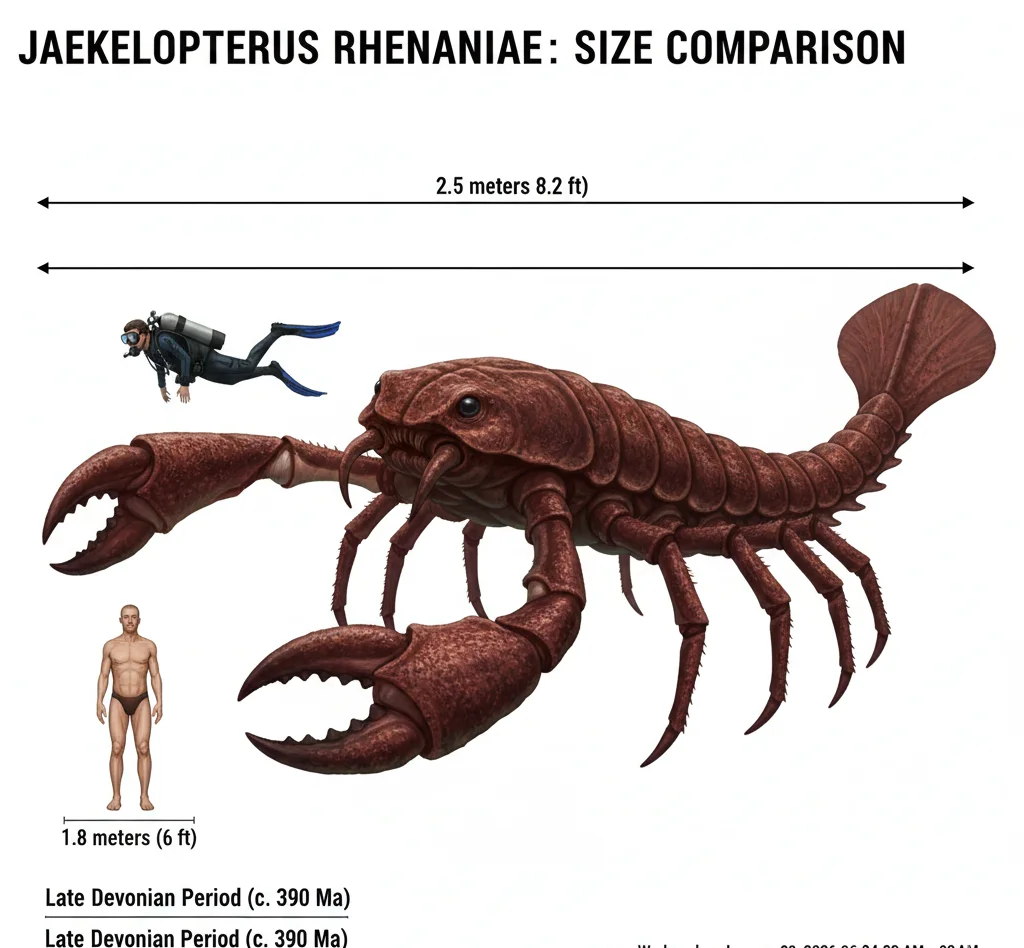
These "Sea Scorpions" were the largest arthropods to ever live. Species like Jaekelopterus rhenaniae grew up to 2.5 meters (8 feet) long. They had massive, spiny grasping claws (like a praying mantis) and a paddle-like tail for swimming.
The Transition: Fossils show Eurypterids crawling into shallow lagoons and even onto mudflats. They were likely amphibious, much like modern horseshoe crabs. It is from a small, land-curious branch of this family that the true Scorpions evolved.
58.0 THE FIRST LAND PREDATORS: SCORPIONS
The fossil Palaeophonus ("Ancient Murderer") from the Silurian (approx. 420 MYA) looks exactly like a modern scorpion.
However, there is a catch.
The Gill Evidence: Detailed analysis shows that Palaeophonus likely did not have lungs. It had gills. This suggests it was an aquatic scorpion that walked on the bottom of shallow rivers, or perhaps it could venture onto land briefly while holding its breath (like a crab).
By the Carboniferous, however, scorpions had fully committed to land. And thanks to the high oxygen levels (Part 8), they got huge.
58.1 Pulmonoscorpius: The Giant
In the coal swamps of Scotland, paleontologists found Pulmonoscorpius kirktonensis.
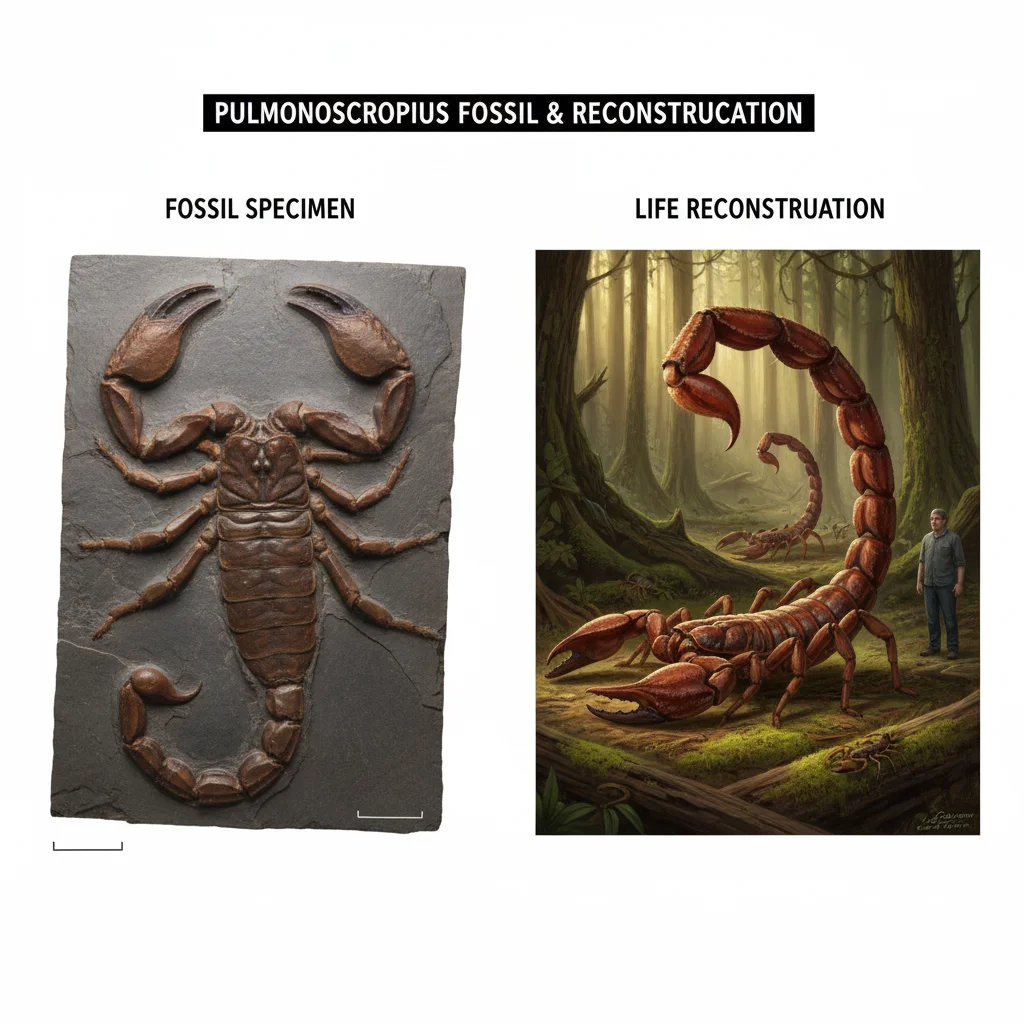
- Size: It was roughly 70 cm (2.3 feet) long—the size of a large house cat or a small dog.
- Anatomy: Unlike its aquatic ancestors, it had huge, fully developed lungs (hence the name "Pulmono-").
- Diet: With its massive stinger, it likely hunted the smaller amphibians and lizard-like reptiles of the Carboniferous, injecting enough venom to drop a tetrapod.
59.0 ENGINEERING BREATH: BOOK LUNGS
Spiders and Scorpions did not evolve the tracheal tubes of insects. Instead, they folded their exoskeleton inwards to create a structure called a Book Lung.
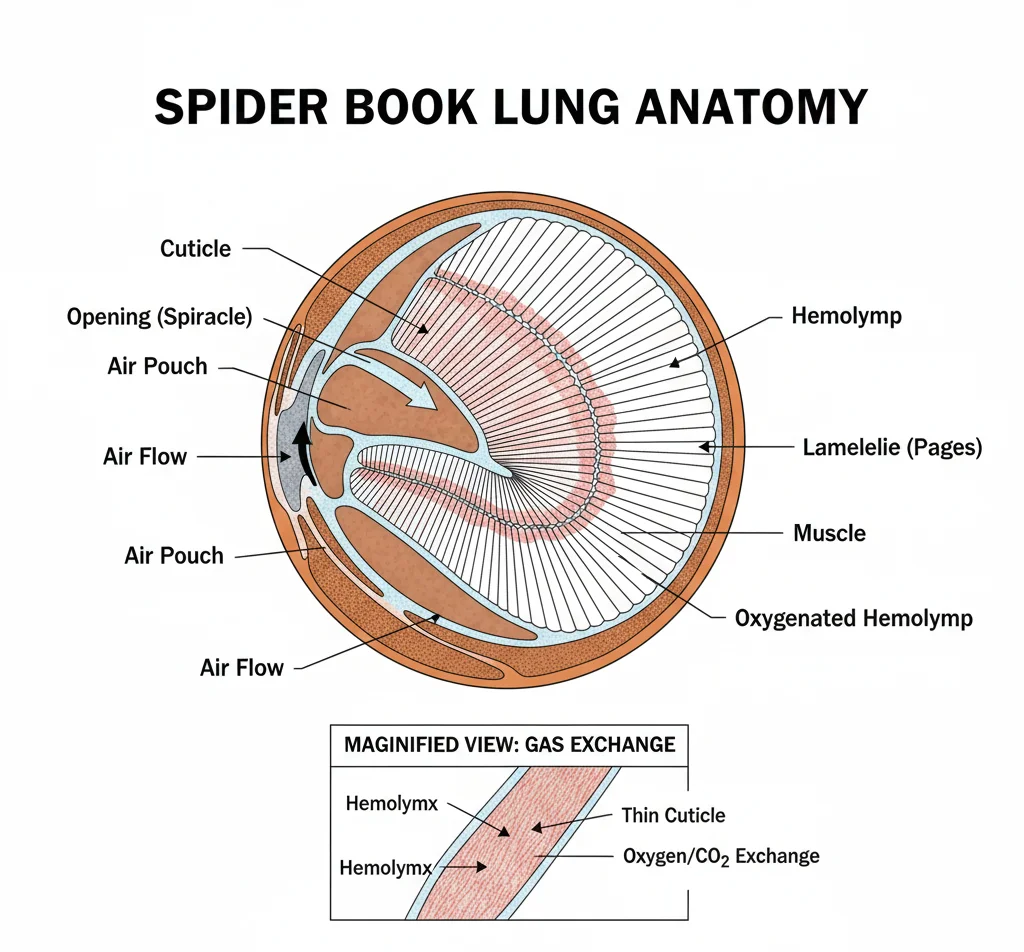
- Structure: Imagine a book with wet pages held slightly apart by tiny pillars.
- Function: Blood (Hemolymph) flows inside the pages. Air flows between the pages. This creates a massive surface area for gas exchange in a tiny space.
- The Origin: This is a direct modification of the Book Gills found in Horseshoe Crabs. Evolution simply took the external gills, moved them inside a pocket to keep them moist, and called it a lung. It is a perfect example of "Exaptation" (repurposing an old tool).
60.0 THE ORIGIN OF SPIDERS (ARANEAE)
True spiders appear in the late Carboniferous (approx. 300 MYA). But before them, there were "Proto-Spiders" like Attercopus (Devonian, 380 MYA).
Attercopus had silk-producing spigots, but it also had a long tail (telson) like a scorpion. It was the "Archaeopteryx" of spiders—halfway between the ancient scorpions and modern spiders. Over millions of years, the tail was lost, and the abdomen fused.
61.0 SILK TECHNOLOGY: NOT FOR WEBS
We associate silk with webs. But early spiders did not build webs. They were ground hunters (like Wolf Spiders).
So why evolve silk? The "Egg Protection Hypothesis" suggests silk was originally invented as a wrapping material.
- Phase 1 (Wrapping): Used to wrap eggs to protect them from fungus and drying out.
- Phase 2 (Lining): Used to line their burrows to prevent collapse (structural engineering).
- Phase 3 (Tripwires): Spiders extended lines of silk out from their burrow. When prey tripped the line, the vibration alerted the spider.
- Phase 4 (The Trap): Eventually, some spiders lifted these tripwires off the ground to catch flying insects (which were exploding in diversity). This led to the aerial orb web.
Silk is a liquid protein that hardens instantly under tension (shear stress). It is stronger than steel by weight. The invention of the spinneret (the 3D printer nozzle of biology) allowed spiders to turn this chemical into complex architecture.
62.0 THE MESOTHELAE: THE PRIMITIVE SURVIVORS
The spiders of the Carboniferous looked different from house spiders. They belonged to a group called Mesothelae.
- Segmented Abdomen: Modern spiders have a smooth, sack-like abdomen. Mesothelae spiders still had visible armor plates (segments) on their backs, a relic of their scorpion-like ancestors.
- Spinneret Location: Their spinnerets were in the middle of their belly, not at the end. This made them terrible at building webs. They were strictly ambush predators, hiding in trapdoors lined with silk, waiting for a cockroach or a *Hylonomus* to walk by.
63.0 THE GREAT DRYING: THE CARBONIFEROUS RAINFOREST COLLAPSE
Around 305 million years ago, the biological party of the Carboniferous came to a crashing halt. This event is known as the Carboniferous Rainforest Collapse (CRC).
The Cause: Plate tectonics. As the continents smashed together to form the supercontinent Pangea, the lush equatorial coastlines were pushed up into mountain ranges (the Hercynian Orogeny). The climate shifted drastically from "Tropical/Wet" to "Arid/Seasonal."
The Effect: The vast, continuous coal swamps fragmented into isolated "islands" of forest surrounded by dry deserts.
1. Amphibian Apocalypse: The giant amphibians (Temnospondyls) and lycopsid trees, dependent on constant water, were devastated. Their populations were split and isolated, leading to mass extinction.
2. Amniote Opportunity: For the Amniotes (Reptiles and Synapsids), this was the golden ticket. With their waterproof skin and hard-shelled eggs, they could cross the deserts to find new food. The collapse of the rainforests inadvertently selected for animals that liked it dry.
64.0 ENTER THE SYNAPSIDS: THE STEM-MAMMALS
In the Early Permian (299–272 MYA), the dominant land animals were not Dinosaurs (they wouldn't evolve for another 50 million years). They were the Synapsids.
These animals are often mistakenly called "Mammal-like Reptiles." This is technically incorrect. They are Stem-Mammals. They are the direct ancestors of every mammal alive today, including you.
64.1 The Skull Upgrade
As mentioned in Part 9, Synapsids are defined by having a single hole (Temporal Fenestra) behind the eye socket.
Function: This hole allowed the jaw muscles to pass through the skull and attach to the outer roof. This created a longer, stronger muscle pull. While reptiles were snapping, Synapsids were evolving to chew.
65.0 THE PELYCOSAURS: THE SAIL-BACKS
The first great wave of Synapsids were the Pelycosaurs. The most famous of these is the icon of the Permian: Dimetrodon.
65.1 Dimetrodon: NOT a Dinosaur
Dimetrodon is frequently included in toy dinosaur sets, which annoys paleontologists to no end.
It is more closely related to a human than to a T-Rex.
- Stance: It had a sprawling gait (legs splayed to the side like a lizard), unlike the upright stance of dinosaurs/mammals.
- Teeth (The Name): Dimetrodon means "Two-Measure Tooth." This is crucial. Reptiles usually have uniform teeth (all same shape). Dimetrodon had specialized teeth: huge stabbing canines in the front and smaller shearing teeth in the back.
Significance: This is the beginning of Heterodonty (Different Teeth). It is the evolutionary first step toward your incisors, canines, and molars.
65.2 The Thermodynamics of the Sail
Why did Dimetrodon (and its herbivorous cousin Edaphosaurus) grow massive sails of skin supported by long neural spines?
The leading theory is Thermoregulation.
In the Early Permian, the nights were getting colder. Dimetrodon was cold-blooded (Ectothermic).
The Morning Rush: When the sun rose, a large animal without a sail would take hours to warm up its muscles. A Dimetrodon could turn its sail broadside to the sun. The blood vessels in the sail would heat up rapidly, pumping warm blood to the core.
The Advantage: Calculations suggest a sail could cut the warm-up time by 50%. This allowed Dimetrodon to be active and hunting while its prey (the amphibians) were still sluggish and cold. It was a solar-powered killer.
66.0 THE VEGETARIANS: EDAPHOSAURUS & COTYLORHYNCHUS
Synapsids were also the first vertebrates to figure out how to eat high-fiber land plants efficiently.
66.1 Edaphosaurus (The Earth Lizard)
Living alongside Dimetrodon was Edaphosaurus. It also had a sail, but with a twist: its sail spines had cross-bars (like a telephone pole), possibly for extra fat storage or display.
The Pinhead: It had a tiny head on a massive barrel-shaped body. The huge gut was a fermentation chamber, housing bacteria to break down tough cellulose.
66.2 Cotylorhynchus (The Pinhead Giant)
Later, the Caseid Pelycosaurs like Cotylorhynchus appeared.
This was the weirdest animal of the Permian. It grew up to 6 meters long and weighed 2 tons. It had a colossal, beer-barrel body, massive muscular claws (for digging roots), and a comically tiny head. It represents the extreme of the "bulk-feeding" strategy—eat everything and let the gut bacteria sort it out.
67.0 THE EVOLUTION OF THERAPSIDS: THE NEXT UPGRADE
By the Middle Permian (approx. 270 MYA), the Pelycosaurs (like Dimetrodon) went extinct. They were replaced by their more advanced descendants: the Therapsids ("Beast Faces").
Therapsids are where things start to look undeniably mammalian.
- Stance: Their legs moved from the side of the body to under the body (Parasagittal gait). This allowed for more efficient breathing while running.
- Metabolism: Evidence suggests they were becoming Endothermic (Warm-Blooded). They no longer needed sails because they generated their own heat.
- Hair? Coprolites (fossil poop) from the Permian containing hair-like structures suggest that whiskers or primitive fur might have appeared in this group.
68.0 THE GORGONOPSIDS: THE FIRST SABER-TEETH
The apex predators of the Late Permian were the Gorgonopsids ("Gorgon Faces").
Imagine a wolf the size of a bear, but with scales (or possibly fur) and 12-centimeter saber teeth. Animals like Inostrancevia were the T-Rexes of their time. They specialized in hunting the giant armored herbivores (Pareiasaurs).
They represent the pinnacle of Synapsid dominance. For 40 million years, our ancestors ruled the world completely. There were no dinosaurs to challenge them.
But they were walking into a trap. The greatest catastrophe in the history of the universe was brewing in Siberia.
69.0 THE REPTILIAN RESISTANCE: PARAREPTILES & DIAPSIDS
While the Synapsids (Stem-Mammals) like Dimetrodon and Gorgonopsids were the undisputed rulers of the Permian, they were not alone.
Two other groups were quietly adapting to the drying world. One group chose "Armor and Bulk" (The Parareptiles). The other chose "Speed and Efficiency" (The Eureptiles/Diapsids).
70.0 THE PAREIASAURS: THE ARMORED TANKS
If Gorgonopsids were the "Wolves" of the Permian, the Pareiasaurs were the "Cows"—if cows were covered in bone armor and looked like grumpy bulldogs.
They belong to a group called Parareptiles ("Side Reptiles"), a lineage that has no living descendants today (unless turtles belong here, which is a massive debate).
70.1 Scutosaurus: The Shield Lizard
The most famous Pareiasaur is Scutosaurus karpinskii.
- Armor (Osteoderms): Its skin was embedded with massive bony plates called Osteoderms. This wasn't just on the back; the armor covered the legs and flanks. It was a walking fortress designed to withstand the saber-teeth of the Gorgonopsids.
- The Cheek Flanges: They had bizarre bony protrusions on their cheeks. These might have been for display or to protect the throat during intra-species combat (head-shoving matches).
- Physiology: They had massive, barrel-shaped ribcages to house huge digestive tracts for fermenting tough desert plants.
70.2 The Turtle Origins Debate
For decades, paleontologists believed Pareiasaurs were the ancestors of Turtles.
It makes sense: Pareiasaurs have armor, short tails, and massive bodies. Evolution just had to fuse the osteoderms into a solid shell.
The Modern Twist: Recent genetic studies suggest turtles are actually Diapsids (related to birds/crocodiles) that lost their skull holes. However, fossils like Eunotosaurus (a reptile with wide ribs) keep the debate alive. Pareiasaurs remain the classic "morphological" candidate for the origin of the turtle shell.
71.0 THE DIAPSIDS: THE SLEEPER AGENTS
While Synapsids and Pareiasaurs grew huge, the True Reptiles (Diapsids) remained small, agile, and lizard-like. They were playing the long game.
Diapsid Definition: They possess two holes (Temporal Fenestrae) behind the eye. This creates a lighter skull and allows for complex jaw muscle arrangements.
71.1 The Water Conservation Upgrade: Uric Acid
The most critical innovation of the Diapsids wasn't skeletal; it was chemical.
The Problem: Synapsids (like us) excrete Nitrogen waste as Urea. Urea is toxic and must be diluted with lots of water (Urine) to be flushed out. This is wasteful.
The Solution (Uricotely): Diapsids evolved to convert Nitrogen waste into Uric Acid.
This is a white paste (the white part of bird poop) that contains almost no water.
Significance: This allowed Diapsids to survive in hyper-arid deserts where Synapsids would die of dehydration. As the Permian world dried out, this physiological superpower gave the ancestors of Dinosaurs a massive edge.
72.0 INNOVATION IN LOCOMOTION: EUDIBAMUS
We usually think "Bipedalism" (walking on two legs) was invented by Dinosaurs or Humans.
We were wrong. A small Bolosaurid reptile named Eudibamus cursoris invented it in the Early Permian (290 MYA), nearly 60 million years before the first dinosaur.
- Anatomy: It had exceptionally long hind legs and short forelimbs. Its knees and ankles were modified to lock into a straight position.
- Function: It was likely a Facultative Biped. When threatened, it would lift its front body and sprint on its hind legs to escape predators. It proves that the "Dinosaur Body Plan" was physically possible long before dinosaurs existed; the environment just wasn't ready for it yet.
73.0 TAKING TO THE AIR: WEIGELTISAURIDS
The Permian skies also saw the first vertebrate gliders.
Coelurosauravus ("Hollow Lizard Grandfather") looked like a mythical dragon.
The Rod Structure: Unlike Pterosaurs (who used a finger) or Bats (who use a hand), Coelurosauravus used its Ribs.
It evolved specialized, elongated bones (ossified rods) separate from the ribcage that extended sideways to support a skin membrane (Patagium). It could fold these wings against its body and open them to glide from tree to tree, hunting insects.
74.0 THE END OF THE GOLDEN AGE
By the end of the Permian (Changhsingian Stage, approx 252 MYA), the ecosystem was fully mature.
- Top Predators: Giant Gorgonopsids (Synapsids).
- Large Herbivores: Dicynodonts (Synapsids) and Pareiasaurs (Parareptiles).
- Small Insectivores: Diapsids (Lizards/Archosaurs).
Life had recovered from the Carboniferous collapse and reached a new peak of diversity. The Pangean supercontinent was teeming with complex food webs.
But deep beneath Siberia, a Mantle Plume—a massive column of magma from the core of the Earth—was burning its way to the surface. It was about to trigger the Siberian Traps.
The "Great Dying" was knocking at the door.
75.0 THE ANATOMY OF PANGEA
By the Late Permian (approx. 260 MYA), the scattered continents of the Carboniferous had smashed together to form a single super-landmass: Pangea ("All Earth").
It was C-shaped.
- Panthalassa: The "All Sea." A vast, global ocean surrounding the supercontinent. Because it was so wide, a tsunami started on one side could travel uninterrupted around the globe.
- The Tethys Sea: The "bay" inside the C-shape of Pangea (located at the equator). This was the tropical nursery of marine life.
75.1 The Curse of Continentality
Geography dictates climate. When you combine all land into one mass, you create a phenomenon called Extreme Continentality.
Physics: Land heats up and cools down much faster than water.
The Result: The interior of Pangea (thousands of miles from the cooling ocean) experienced temperature swings that would kill modern humans.
Summers were likely scorching (45°C+), and winters were freezing (-20°C). This extreme fluctuation created an uninhabitable "Dead Zone" in the center of the continent, forcing animals to live on the coastal fringes.
76.0 THE PANGEAN MEGA-MONSOON
Because of the temperature difference between the hot land and the cool ocean, Pangea generated the most powerful weather system in Earth's history: The Mega-Monsoon.
How it worked:
- Summer: The supercontinent heated up like a skillet. Hot air rose rapidly, creating a massive vacuum (Low Pressure). This sucked moist air from the Tethys Sea deep into the interior, causing apocalyptic rainstorms that lasted for months.
- Winter: The land froze rapidly (High Pressure). Cold, dry winds blasted outwards from the center of the continent to the ocean, drying everything out.
This "Wet-Dry" cycle was brutal. Animals had to evolve to endure 6 months of flooding followed by 6 months of absolute drought. This explains why the Diapsids (with their water-saving uric acid) and burrowing Synapsids (Dicynodonts) were successful—they were built for stress.
77.0 THE GLOSSOPTERIS FLORA: THE PROOF OF DRIFT
While the north of Pangea (Laurasia) was dry, the south (Gondwana) was covered in a specific type of cool, temperate forest. The dominant tree was Glossopteris.
77.1 The Tongue Leaf
Glossopteris ("Tongue Fern") was a Seed Fern (Pteridosperm). It grew up to 30 meters tall. It had tongue-shaped leaves with a central vein.
Deciduous Habits: Unlike tropical trees, Glossopteris shed its leaves every autumn. This wasn't just because of cold; it was because of the Polar Night. Southern Pangea (Australia/Antarctica) was situated over the South Pole. Even if it was warm enough, trees had to survive 3-4 months of total darkness.
77.2 Wegener's Smoking Gun
Glossopteris is historically famous for one reason: It proved Continental Drift.
In the early 20th century, Alfred Wegener noticed that identical fossils of this specific plant were found in South America, Africa, India, Antarctica, and Australia.
The Puzzle: The seeds of Glossopteris were heavy and large (too big to float across oceans or be blown by wind).
The Solution: The only way this tree could exist on all these separated continents is if the continents were once joined together. Glossopteris was the botanical glue that held the theory of Pangea together.
77.3 Vertebraria: The Swamp Roots
The roots of these trees (called Vertebraria) were hollow, with air chambers. This proves they grew in waterlogged swamps. These massive southern coal swamps (The Gondwanan Coal Measures) are the reason Australia and India have huge coal reserves today.
78.0 THE SICK OCEAN: STRATIFICATION AND STAGNATION
While the land was harsh, the ocean was dying slowly. Even before the Siberian Traps erupted, the Panthalassa Ocean was in trouble.
78.1 The Shutdown of Circulation
Ocean currents (Thermohaline Circulation) are the lungs of the sea. They take oxygen-rich surface water and drag it down to the deep ocean at the poles (cold water sinks).
The Pangea Block: The configuration of Pangea blocked the equatorial currents that drive this mixing. The global circulation slowed down.
78.2 The Deep Anoxia
As circulation stopped, the deep ocean lost its oxygen supply.
Stratification: The ocean separated into layers.
1. Top Layer: Thin, oxygenated, full of life.
2. Bottom Layer: Massive, cold, stagnant, and completely Anoxic (No Oxygen).
By the Late Permian, this "Death Zone" was rising. The ocean was like a loaded gun. The deep water was full of rotting organic matter and Hydrogen Sulfide. All it needed was a trigger to overturn and kill everything on the surface.
79.0 THE OLSON'S EXTINCTION: THE REHEARSAL
We often think the Permian ended with one big bang. But recent research shows there was a precursor event around 273 MYA, called Olson's Extinction.
This mysterious event wiped out the early Pelycosaurs (like *Dimetrodon*) and primitive amphibians. It created a "gap" in the fossil record.
Significance: It shows that the Permian world was biologically unstable. The ecosystem was teetering on the edge for millions of years. It had lost its resilience. When the volcanoes finally started, they weren't attacking a healthy world; they were kicking a world that was already down.
80.0 CONCLUSION: THE PEAK OF THE PALEOZOIC
We have reached the end of the "Invasion of Land." In a span of 150 million years (from the Silurian to the Late Permian), Earth transformed from a barren alien rock into a lush, thrumming biosphere.
By 252 million years ago, the ecosystem was fully operational.
1. Energy: Massive forests of Glossopteris and Conifers captured solar energy.
2. Herbivores: Herds of Dicynodonts and Pareiasaurs turned that plant matter into meat.
3. Carnivores: The terrifying Gorgonopsids kept the populations in check.
It looked stable. It looked eternal. But biologically, it was a house of cards.
81.0 THE TRAP OF SUCCESS: OVER-SPECIALIZATION
The Synapsids (our ancestors) were the undisputed masters of this world. But their dominance came at a price.
The Efficiency Paradox: To be a top predator like Inostrancevia, you must evolve to be perfect at one thing (killing large prey).
You need massive saber teeth, huge muscles, and a high metabolism.
But if the large prey disappears, you cannot suddenly start eating bugs. You are "locked in" to your lifestyle. The Synapsids were highly specialized engines. They lacked the flexibility of the smaller, generalist Diapsids hiding in the shadows.
82.0 THE PANGEAN CURSE: COSMOPOLITANISM
Ecologists have a rule: "Biodiversity creates resilience."
If you have 100 different ecosystems with unique local species (Endemism), a disaster in one place won't kill everyone.
The Problem with Pangea: Because all land was connected, animals could walk from the South Pole to the Equator. This led to Cosmopolitanism. The same few species (like the Dicynodont Diictodon) were found everywhere.
The world became biologically "boring" and uniform.
The Risk: When a disease or a climate shift struck, it didn't just hit a local population; it hit the entire global population simultaneously. There were no "safe islands" or refuges left. Pangea had put all its eggs in one basket.
83.0 THE FORESHADOWING: THE ARCHOSAUR ADVANTAGE
While the Synapsids ruled, a small group of reptiles called Archosaurs ("Ruling Lizards") began to evolve. These were the ancestors of Crocodiles and Dinosaurs.
They were currently insignificant, but they possessed a secret weapon that would soon decide the fate of the world: The Flow-Through Lung.
While Synapsids (and we) possess tidal lungs (breath in, breath out = dead air space), Archosaurs were evolving a unidirectional airflow system (like birds). In the oxygen-rich Permian, this didn't matter. But in the choking, oxygen-starved world that was coming, this "super-lung" would allow them to breathe while our ancestors suffocated.
84.0 THE FUSE IS LIT: SIBERIA
Far to the north, in the region of Siberia, a geological nightmare was unfolding.
A Mantle Plume—a mushroom cloud of magma thousands of kilometers wide—had risen from the core-mantle boundary. It was currently pooling beneath the crust, melting the rock, building up unimaginable pressure.
It wasn't just magma. The plume was positioned directly beneath a massive deposit of Coal, Oil, and Salt.
When the eruption inevitably started, it wouldn't just be lava. It would be a chemical bomb. It would burn the fossil fuels of the Carboniferous all at once, releasing gigatons of Carbon Dioxide, Methane, and toxic Halogens.
The animals of the Permian went to sleep one night, unaware that the ground beneath them was about to turn into the greatest killing machine in history.
85.0 EPILOGUE TO TOPIC 4
We leave the Paleozoic Era here. We have seen life crawl from the slime, invent wood, flight, legs, and intelligence.
But nature is not sentimental. The next chapter is not about evolution; it is about survival.
END OF TOPIC 4
1.0 THE GREAT DYING: THE PERMIAN-TRIASSIC EXTINCTION
Before the Dinosaurs could rule, the old world had to die.
Around 252 million years ago, Earth experienced the closest call it has ever had with total sterilization. This event is known as the Permian-Triassic (P-T) Extinction Event, or simply "The Great Dying."
The Body Count:
It wiped out 96% of all marine species and 70% of all terrestrial vertebrate species. It is the only mass extinction that even impacted insects (the most resilient animals on Earth), wiping out 8 entire orders of bugs.
It wasn't just an extinction; it was a reboot.
2.0 THE MURDER WEAPON: THE SIBERIAN TRAPS
For decades, scientists debated the cause. Was it an asteroid? A supernova?
The answer lay buried beneath the snow of Russia. The Siberian Traps (Large Igneous Province).
This was not a standard volcano like Mt. Fuji or Vesuvius. It was a Flood Basalt Event. A massive plume of mantle magma ripped open the Earth's crust.
Scale: Lava covered an area of 7 million square kilometers (roughly the size of Australia). In some places, the lava rock is 4 kilometers deep.
Duration: It didn't happen in a day. It oozed continuously for roughly 60,000 to 100,000 years.
2.1 The Coal Bomb
Lava alone doesn't kill the world. The problem was where the lava came out.
The Siberian Traps erupted directly through the Tunguska Basin, which was filled with massive deposits of Coal, Oil, and Salt from the Carboniferous period.
The magma cooked these fossil fuels underground, turning the Earth's crust into a gigantic engine exhaust pipe. It pumped trillions of tons of Carbon Dioxide (CO₂), Methane (CH₄), and toxic halogens into the atmosphere.
3.0 THE KILL MECHANISMS: A CASCADE OF DOOM
The extinction was a chain reaction, a Rube Goldberg machine of death.
3.1 Phase 1: Rapid Global Warming
The CO₂ levels spiked from roughly 400 ppm to over 2,500 ppm. Global temperatures rose by roughly 5°C.
This killed the specialized animals on land (like the Gorgonopsids) who couldn't regulate their body heat. But the worst was yet to come.
3.2 Phase 2: The Methane Gun (Clathrate Gun Hypothesis)
As the oceans warmed by 5°C, the heat reached the seafloor.
Buried in the sediment were vast reserves of Methane Clathrates (frozen methane ice). When the water got too warm, this ice melted instantly.
The Explosion: Methane is roughly 25-80 times more potent as a greenhouse gas than CO₂. The release of this methane caused a second, uncontrollable temperature spike, raising global temperatures by another 5°C (Total +10°C).
3.3 Phase 3: Acid Rain and Ozone Collapse
The volcanoes also released Sulfur Dioxide (SO₂) and Halogens (Chlorine/Fluorine).
1. Sulfuric Acid Rain: It rained acid so strong that it likely stripped the leaves off the Glossopteris trees and dissolved the shells of organisms.
2. Ozone Hole: The halogens destroyed the Ozone Layer. Animals that survived the heat were fried by UV radiation. Fossil pollen from this era shows massive genetic mutations, proving that plants were being irradiated.
4.0 THE STRANGELOVE OCEAN: THE PURPLE SEAS
The oceans suffered the worst fate.
- Acidification: The CO₂ absorbed by the water turned into Carbonic Acid. This dissolved the calcium carbonate skeletons of corals, brachiopods, and mollusks. The reefs vanished completely.
- Anoxia: Warm water holds less oxygen. The circulation stopped (as discussed in Topic 4). The oceans became stagnant pools of death.
4.1 The Rise of the Slime (Euxinia)
In the absence of oxygen, a nightmare emerged from the deep: Green Sulfur Bacteria.
These primitive bacteria thrive in oxygen-free environments and produce Hydrogen Sulfide (H₂S) as waste.
H₂S smells like rotten eggs and is lethal to almost all eukaryotic life.
The Purple Tide: Scientists believe the H₂S buildup was so massive that the bacteria bloomed to the surface, turning the oceans a vibrant, toxic Purple color. When this gas bubbled out into the atmosphere, it poisoned the animals on the shore.
5.0 THE SURVIVOR: LYSTROSAURUS
In the Early Triassic, immediately after the extinction, 95% of the skeletons found on Earth belong to a single animal: Lystrosaurus.
5.1 The Disaster Taxon
Lystrosaurus ("Shovel Lizard") was a Dicynodont Synapsid (a distant cousin of ours). It was not a fighter. It looked like a pig mixed with a turtle, with two tusk-like teeth and a beak.
Why did it survive when T-Rex-sized predators died?
- Burrowing: It lived underground. This protected it from the extreme heat and the acid rain.
- Generalist Diet: It ate anything—roots, dead plants, toxic fungi. It wasn't picky.
- High Altitude Adaptation: Some theories suggest it evolved in thin mountain air, so it had efficient lungs capable of handling the low-oxygen post-apocalyptic world.
For nearly 5 million years, Earth was the "Planet of Lystrosaurus." It is the only time in history a single species has dominated the terrestrial ecosystem so completely.
6.0 THE RECOVERY GAP (THE COAL GAP)
The destruction was so total that Earth didn't recover for 10 million years.
The Coal Gap: In the Early Triassic geological layers, there is no coal.
Why? Because there were no forests. The world was a vast, baking desert covered in scrubby ferns and disaster weeds (like Pleuromeia). The majestic forests of the Permian were gone, and the complex food webs had collapsed into simple "Disaster Faunas."
But in this empty, hot, oxygen-poor world, a new group of reptiles was quietly evolving. They had a better breathing system. They had a better walk. They were the Archosaurs. The stage was cleared for them to take over.
7.0 THE TRIASSIC RECOVERY: A NEW DYNASTY
The Earth took nearly 10 million years to recover from the Great Dying. When the dust finally settled in the Middle Triassic (approx. 240 MYA), the biological landscape had completely shifted.
The Synapsids (our ancestors), who had ruled the Permian with an iron fist, were broken. The survivors were small, nocturnal, and scurrying in the undergrowth. They had lost the crown.
The new rulers were the Archosaurs ("Ruling Lizards").
8.0 THE ARCHOSAUR ADVANTAGE: WHY DID THEY WIN?
Why did Reptiles defeat Mammal-ancestors in the Triassic? It wasn't about strength; it was about Engineering Efficiency in a hostile world.
8.1 The Super-Lung (Unidirectional Airflow)
The Triassic atmosphere had dangerously low oxygen levels (dropping to around 15% at times) compared to the Permian high of 35%.
The Synapsid Problem (Us): We have "Tidal Lungs." We breathe in, the air hits a dead end (alveoli), and we breathe out. This leaves "stale air" inside the lung. It is inefficient in low oxygen.
The Archosaur Solution: They evolved Unidirectional Flow-Through Lungs (like modern birds).
Air flows in a loop. It goes into air sacs first, then pushes through the lung in one direction.
Result: Fresh, oxygen-rich air is constantly passing over the blood vessels, both during inhalation and exhalation. This allowed Archosaurs to run marathons while Synapsids were gasping for breath.
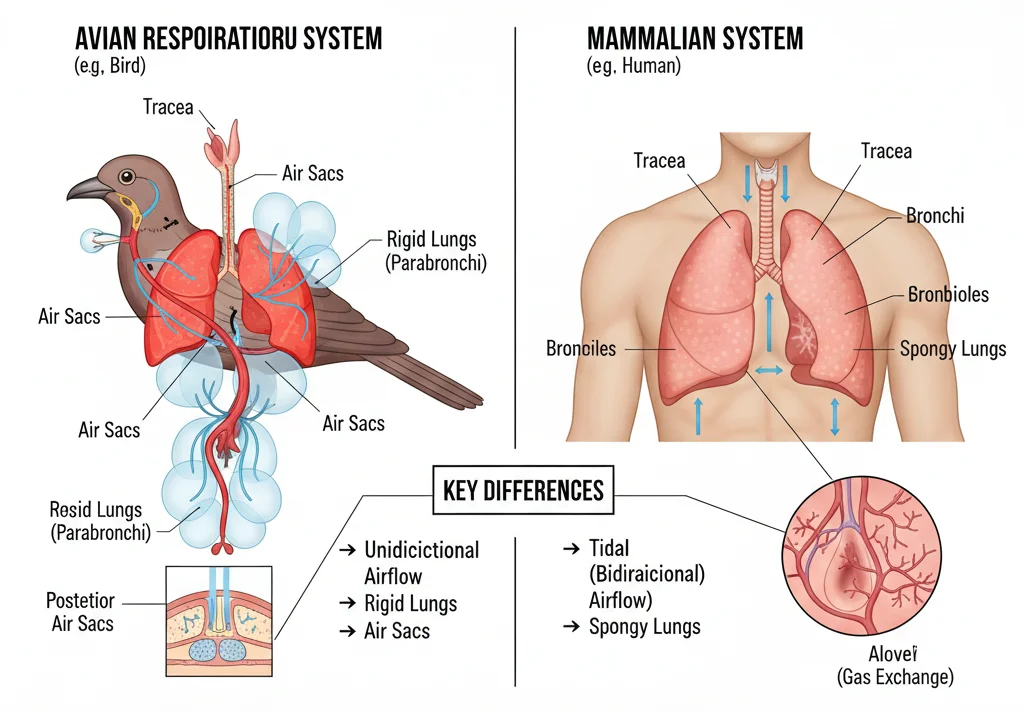
8.2 Water Efficiency
As discussed in Topic 4, Pangea was a dry, super-hot desert. Archosaurs excreted Uric Acid (white paste) which wasted almost no water. Synapsids peed Urea (lots of water). In the desert, the animal that doesn't pee wins.
9.0 THE GREAT SCHISM: CRUROTARSI VS. AVEMETATARSALIA
Almost immediately, the Archosaurs split into two rival clans. The difference between them lies in a tiny joint: The Ankle.
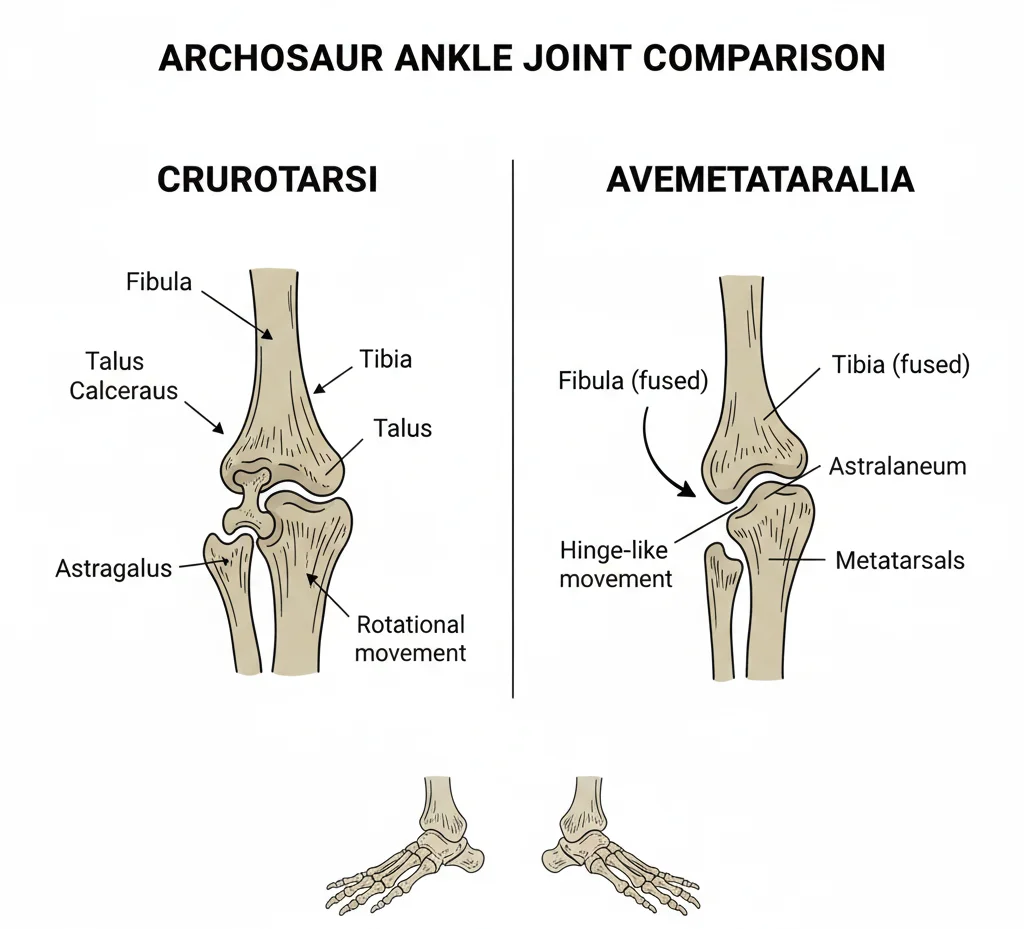
9.1 The Crocodile Line (Crurotarsi / Pseudosuchia)
"The Twisted Ankle": Their ankle bone had a peg-and-socket joint that allowed for rotation.
Advantage: This gave them a "High Walk" but also allowed them to sprawl if needed. It provided stability and power for grappling with prey. These became the Crocodiles and their extinct relatives.
9.2 The Bird/Dino Line (Avemetatarsalia)
"The Hinge Ankle": Their ankle was a simple hinge (like a door). It could only move up and down.
Advantage: Speed. By locking the ankle, they could run faster and more efficiently on two legs. These became the Pterosaurs and Dinosaurs.
10.0 THE LORDS OF THE TRIASSIC: THE PSEUDOSUCHIANS
Here is the shocker: The Crocodile Line won the first round.
For almost 30 million years, the Pseudosuchians were the dominant herbivores and carnivores. Dinosaurs were just tiny, frightened creatures trying not to get eaten.
10.1 Postosuchus: The T-Rex of the Triassic
If you traveled to the Late Triassic (220 MYA) in Arizona, you would fear Postosuchus.
- Appearance: It was 4-5 meters long, heavily armored with osteoderms.
- Stance: Despite being a crocodile relative, it walked upright. Its forelimbs were tiny compared to its hindlimbs. It could likely run on two legs to chase down prey.
- Bite: It had a massive, boxy skull designed for crushing bone. It filled the ecological niche of T-Rex long before T-Rex existed.
10.2 Saurosuchus: The Apex
In South America, the "Lizard Crocodile" Saurosuchus reigned supreme. At 7 meters long, it was the largest terrestrial predator the world had ever seen up to that point. It hunted the early dinosaurs like snacks.
10.3 Desmatosuchus: The Armored Tanks
Not all crocs were meat-eaters. The Aetosaurs (like Desmatosuchus) were herbivorous crocs.
They looked like armadillos covered in spikes. They had pig-like snouts to root for tubers. They prove that the crocodile body plan was versatile enough to produce plant-eaters too.
11.0 THE UNDERDOGS: THE ORIGIN OF DINOSAURS
While the Croc-line was huge and powerful, the Dino-line (Avemetatarsalia) was small and fast.
The Innovation: The first dinosaurs appeared around 230 MYA in South America (Ischigualasto Formation). Their key innovation was the Perforate Acetabulum (Open Hip Socket).
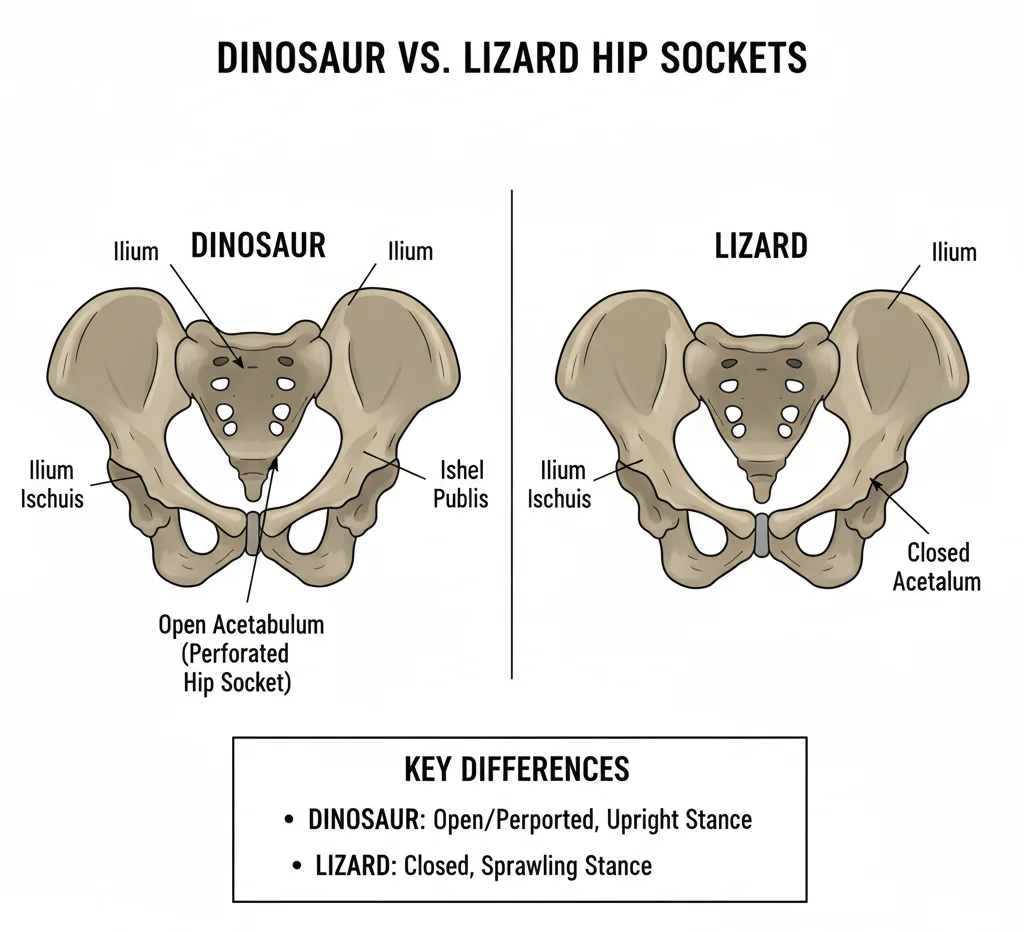
- Lizards/Crocs: Legs stick out to the side. The femur pushes into the hip socket.
- Dinosaurs: Legs are directly under the body (like pillars). The femur has a head that turns 90 degrees to lock into the hip. The hip socket is a hole (doughnut shape).
This "Pillar Erect" stance allowed dinosaurs to support more weight with less energy and breathe perfectly while running.
11.1 Eoraptor: The Dawn Thief
Eoraptor lunensis is one of the earliest known dinosaurs.
It was tiny (1 meter long), lightweight, and bipedal. It had sharp teeth but likely ate insects and small lizards. It survived by being faster than the giant Saurosuchus.
11.2 Herrerasaurus: The First Threat
Herrerasaurus was slightly bigger (3-4 meters). It shows the first signs of the terrifying carnivorous dinosaurs to come: a sliding jaw joint for grappling struggling prey and massive recurved claws. But even Herrerasaurus was a secondary predator, living in the shadow of the giant crocs.
12.0 NYASASAURUS: THE GHOST LINEAGE
There is a fossil from Tanzania called Nyasasaurus parringtoni that dates back to 243 MYA (Middle Triassic).
If it is a true dinosaur, it pushes the origin of dinosaurs back by 10 million years. However, the remains are fragmentary. It represents the "Dinosaurmorphs"—the transitional forms that were experimenting with bipedalism before the true dinosaurs appeared.
13.0 SILESAURIDS: THE VEGETARIAN COUSINS
Before true dinosaurs took over, a group of close relatives called Silesaurids were successful herbivores. They were quadrupedal and looked like lanky dogs with beaks. For a while, it seemed like they might inherit the earth, but they lacked the specialized hip structure to grow truly massive.
14.0 THE STALEMATE
For most of the Triassic (over 30 million years), the ecosystem was locked in a stalemate.
Top Tier: Giant Pseudosuchians (Crocs).
Middle Tier: Synapsids (Dicynodonts).
Bottom Tier: Early Dinosaurs and Mammal-ancestors.
Dinosaurs were not destined to rule. They were just a minor group of fast runners. To take the throne, they needed another apocalypse to wipe out the competition. And that apocalypse came in the form of rain.
15.0 THE DAY THE RAIN STARTED: THE CARNIAN PLUVIAL EPISODE
For millions of years, the Triassic world was a scorched desert. But around 234 million years ago (The Carnian Age), the geological record shows a sudden, drastic shift.
The red, dry desert sandstones disappear. They are replaced by gray river sediments, peat swamps, and massive fossilized forests. This event is called the Carnian Pluvial Episode (CPE).
The Duration: It rained, intensified by a super-monsoon system, for nearly 2 million years.
15.1 The Trigger: Wrangellia Eruption
What caused this biblical flood? The culprit was likely the Wrangellia Flood Basalts (now located in British Columbia and Alaska).
This massive underwater volcanic eruption pumped gigatons of CO₂ into the atmosphere.
The Mechanism:
1. Global Warming: Temperatures spiked by 3-4°C.
2. Evaporation: The warmer ocean evaporated faster.
3. Hydrological Cycle: The atmosphere, supercharged with moisture, dumped it all on Pangea.
15.2 The Floral Revolution
The rain changed the plants. The tough, dry scrublands (Seed Ferns) died out. They were replaced by lush, tall Conifers, Cycads, and Ferns.
The Dinosaur Advantage: The ruling reptiles (Crocodile-line) were heavy, sprawling animals adapted for digging roots in deserts. Dinosaurs were upright, agile, and had long necks. They were perfectly pre-adapted to browse on the new, taller vegetation and move through the muddy, dense forests. The rain didn't kill the Crocs, but it gave the Dinosaurs their first foothold.
16.0 THE FIRST GIANTS: SAUROPODOMORPHS
During this rainy period, we see the first explosion of dinosaur diversity. The most important group was the Sauropodomorphs (ancestors of the Long-Necks).
16.1 Plateosaurus: The Heavyweight Champion
Plateosaurus (Late Triassic, Europe) was a revelation.
- Size: It grew up to 8-10 meters long and weighed 4 tons. It was the largest animal to ever walk the Earth up to that time.
- Design: It had a long neck, a barrel gut for fermenting tough leaves, and powerful thumb claws. It was bipedal (walked on two legs) but could drop to four.
- Significance: Plateosaurus proved that the dinosaur body plan (efficient lungs + upright stance) allowed for gigantism that the crocodile-line reptiles could simply not achieve. It paved the way for the titans of the Jurassic.
17.0 THE FACE OF THE TRIASSIC: COELOPHYSIS
While Plateosaurus ate the trees, a nightmare hunted in the shadows. Coelophysis ("Hollow Form") is the definitive predatory dinosaur of the Late Triassic.
17.1 Ghost Ranch Mass Grave
At Ghost Ranch in New Mexico, paleontologists found a "bone bed" containing over a thousand Coelophysis skeletons tangled together.
This suggests they likely died in a flash flood (common in the seasonal Triassic climate) or were gathered around a drying waterhole. It provides strong evidence that early dinosaurs were gregarious (social), living and hunting in packs.
17.2 The Cannibal Myth
For years, scientists thought they saw baby Coelophysis bones inside the stomachs of adults, leading to the idea that they were cannibals.
The Correction: Modern scanning technology revealed those "babies" were actually early crocodile relatives (Hesperosuchus). Coelophysis wasn't eating its kids; it was eating the competition.
18.0 THE TRIASSIC-JURASSIC EXTINCTION (201 MYA)
Despite the dinosaurs' success, the Crocodile-line (Pseudosuchians) like Postosuchus were still the top predators. The dinosaurs were just the "pests" running around their feet.
Then, Pangea began to rip apart.
18.1 The CAMP Eruption
The supercontinent began to unzip down the middle (roughly where the Atlantic Ocean is today). This rift triggered the Central Atlantic Magmatic Province (CAMP).
This was the largest volcanic province in the solar system. It spewed lava for 600,000 years.
The Kill Switch:
1. CO₂ Spike: Massive global warming.
2. Ocean Acidification: Coral reefs collapsed again.
3. Volcanic Winter: Sulfur aerosols blocked the sun, causing freezing "short-term" winters in the middle of a "long-term" hothouse.
19.0 WHY DID DINOSAURS SURVIVE?
The T-J Extinction killed 50% of all terrestrial species.
The Losers: The giant Pseudosuchians (Postosuchus, Saurosuchus) were wiped out entirely. The only crocodile relatives to survive were the small, nimble Sphenosuchians (ancestors of modern crocs).
The Winners: The Dinosaurs survived almost unscathed.
Why? This is one of the biggest mysteries in paleontology. The leading hypothesis is Insulation.
19.1 The Feather Advantage
Recent discoveries suggest that the ancestor of all dinosaurs likely had Proto-feathers (filamentous fluff).
During the volcanic winters caused by CAMP, the world froze.
1. Crocs: Being naked and cold-blooded (ectothermic), the giant crocs froze to death.
2. Dinosaurs: Being warm-blooded (endothermic) and insulated by downy feathers, dinosaurs could retain their body heat. They simply "weathered the storm."
When the volcanoes stopped and the sun came out, the dinosaurs looked around and realized the monsters were gone. The world was empty. The throne was vacant.
20.0 WELCOME TO JURASSIC PARK
With the competition eliminated, dinosaurs exploded into every ecological niche.
The Jurassic Period began with a biological "Gold Rush."
Small bipedal herbivores evolved into the earth-shaking Sauropods.
Small pack hunters evolved into the terrifying Theropods.
And in the shadows, the tiny Synapsids (mammals) watched in terror, realizing they would have to wait another 135 million years for their turn.
21.0 THE GOLDEN AGE OF GIANTS: THE JURASSIC
The Jurassic Period (201–145 MYA) represents the pinnacle of dinosaur dominance. The fragmentation of Pangea created humid, warm coastlines. The deserts turned into lush fern prairies and conifer forests.
In this buffet of limitless food, one group of dinosaurs took an evolutionary gamble: Extreme Gigantism.
These were the Sauropods. Animals like Brachiosaurus, Diplodocus, and Apatosaurus reached sizes that defy imagination. To put it in perspective: A large African Elephant weighs 6 tons. An Argentinosaurus weighed nearly 80-100 tons. It is the biological equivalent of a Boeing 737 walking on land.
22.0 THE PHYSICS OF GIGANTISM: HOW TO DEFY GRAVITY
How is this physically possible? If you scaled a mouse up to the size of an elephant, its legs would snap instantly (Square-Cube Law). To reach 50+ tons, Sauropods had to fundamentally redesign the vertebrate chassis.
22.1 The Pneumatic Skeleton (Air-Filled Bones)
The secret to their size was not bone; it was Air.
Just like their Archosaur ancestors (and modern birds), Sauropods had a system of air sacs connected to their lungs that invaded their vertebrae.
- Pleurocoels: If you look at a Sauropod neck vertebra, it is not a solid block of bone. It is hollow, filled with deep cavities (Pleurocoels).
- Weight Reduction: This "Honeycomb Structure" made the skeleton exceptionally light without sacrificing strength. Some Sauropod necks were 60% air by volume. If their bones were solid like a mammal's, they would be too heavy to lift their own heads.
22.2 Graviportal Stance
To support the mass, their limbs evolved into Columnar Pillars.
Unlike a cat or a T-Rex (which stand on bent legs), Sauropods stood on completely straight legs, like Greek columns. This transferred the weight directly down through the bones, requiring zero muscle energy to just "stand."
The Foot Design:
1. Front Feet: Arranged in a vertical horseshoe shape (digitigrade), acting like a pedestal.
2. Back Feet: Flat and padded with a massive fatty heel cushion (plantigrade), similar to an elephant, to absorb the shock of each step.
23.0 THE NECK DILEMMA: ENGINEERING BLOOD FLOW
The defining feature of a Sauropod is the neck. In Mamenchisaurus, the neck alone was 15 meters long. This creates a nightmare for the cardiovascular system.
23.1 The Blood Pressure Problem
To pump blood from the heart up to the head (fighting gravity for 12 meters), a Sauropod would require a blood pressure of roughly 600-700 mmHg. (For comparison, a healthy human is 120/80).
- The Heart: They likely had a massive, 4-chambered heart weighing 200-400 kg.
- The Valves: To prevent the blood from rushing back down and bursting the heart between beats, the neck arteries likely had a series of one-way check valves.
- The Stroke Risk: What happens when a Brachiosaurus lowers its head to drink? The pressure would rush down, potentially blowing out the blood vessels in the brain. They likely had a Rete Mirabile ("Wonderful Net")—a complex mesh of capillaries at the base of the brain that acted as a pressure sponge/buffer.
23.2 Why a Long Neck? (The Crane Theory)
Why evolve such a dangerous structure?
It comes down to Energy Efficiency. A 50-ton animal burns massive calories just by taking a step.
With a 15-meter neck, a Sauropod could stand in one spot and graze an entire "sphere" of vegetation without moving its heavy body. It was an Energy-Saving Crane. It stripped the forest bare while burning almost zero fuel.
24.0 THE MORRISON FORMATION: NICHE PARTITIONING
The most famous ecosystem of the Jurassic is the Morrison Formation (Western USA).
Here, we find a staggering diversity of giants living side-by-side: Diplodocus, Apatosaurus, Brachiosaurus, Camarasaurus, Barosaurus, and Stegosaurus.
How can 5 or 6 species of multi-ton herbivores coexist without starving each other? The answer is Niche Partitioning. They divided the buffet.
- The High Browsers (Brachiosaurus): Held their necks vertically. They ate the pine cones and leaves at the very tops of the trees (10-15m), where no one else could reach.
- The Medium Browsers (Camarasaurus): Had shorter, thicker necks and stronger teeth. They ate the tough, woody branches in the mid-canopy (5-10m).
- The Low Browsers (Diplodocus): Had long, horizontal necks and peg-like teeth. They could not lift their heads high. Instead, they swept their necks sideways like a vacuum cleaner, stripping ferns and cycads from the forest floor.
- The Grazers (Stegosaurus): Ate the lowest, scrubbiest plants directly off the ground.
Because they didn't compete for the same food, the ecosystem could support a massive biomass of giants.
25.0 REPRODUCTION: THE "R-STRATEGY" ADVANTAGE
Why did mammals never get this big? The largest land mammal (Paraceratherium) was only 15-20 tons.
The limit is Reproduction.
Mammals (K-Strategy): We carry babies internally. This limits the size of the offspring and puts a massive strain on the mother. If a 50-ton mammal fell, the fetus would be crushed. If the baby dies, the mother has wasted 2 years of pregnancy.
Sauropods (r-Strategy): They laid eggs.
A 70-ton Argentinosaurus laid an egg the size of a soccer ball. She would lay 30-40 eggs at a time, bury them, and walk away.
The Growth Rate: The babies hatched small (5 kg) and grew at an astronomical rate, gaining 2-3 kg per day.
This "Lay and Pray" strategy allowed Sauropod populations to bounce back instantly after a disaster. A herd could lose 50% of its adults and recover in a generation. Mammals cannot do this. This reproductive resilience is likely the key reason Dinosaurs ruled for so long.
26.0 THE MYTH OF THE SECOND BRAIN
Finally, let's address a classic myth.
For years, scientists noticed a massive enlargement in the spinal canal near the hips of Sauropods and Stegosaurs. They thought it was a "Second Brain" to control the hind legs.
The Reality: It was not a brain. It was likely a Glycogen Body.
Birds have a similar structure today. It is a storage organ for energy-rich glycogen, used to supply the massive nervous system with fuel quickly. Sauropods were not geniuses, but they didn't have brains in their butts either.
27.0 THE KILLING MACHINES: THEROPODS
In the Jurassic, the Evolutionary Arms Race reached a fever pitch. As the Sauropods grew into walking fortresses and the Stegosaurs sharpened their tails, the predators had to upgrade.
The result was the refinement of the Theropods ("Beast Feet").
This group includes all carnivorous dinosaurs and birds. In the Late Jurassic, they were not yet the bone-crushing giants of the Cretaceous (like T-Rex), but they were agile, pack-hunting slashers.
28.0 THE LION OF THE JURASSIC: ALLOSAURUS
If T-Rex is the "King," then Allosaurus fragilis is the "Prince." It is the most abundant predator found in the Morrison Formation, accounting for 75% of all theropod fossils.
28.1 The "Hatchet Bite" Hypothesis
When scientists analyzed the skull of Allosaurus, they found something confusing.
The Weak Bite: Its bite force was surprisingly weak (weaker than a modern lion). If it tried to crush a bone, its jaw might break.
The Strong Neck: However, its neck muscles were exceptionally powerful, and its skull could open incredibly wide (up to 92 degrees).
The Strategy: Paleontologist Robert Bakker proposed the Hatchet Hypothesis.
Allosaurus didn't bite and hold. It used its upper jaw like a jagged axe. It would open its mouth wide, swing its head down with massive force, and "hack" into the flesh of a Sauropod. The teeth were serrated like steak knives, designed to cause massive blood loss (shock) rather than crushing trauma. It was a "Bleeder," not a "Crusher."
28.2 The Tragedy of "Big Al"
The most famous Allosaurus specimen is "Big Al" (MOR 693).
His skeleton tells a story of a brutal life. He died young (around 87% grown), but his bones preserved 19 separate injuries:
1. Broken ribs.
2. A massive infection on his middle toe (which grew into a golf-ball-sized lump of pus and bone).
3. Trauma to the hips.
This proves that being a predator was not glamorous. It was a life of constant pain, likely inflicted by the dangerous prey they hunted.
29.0 THE COMPETITION: CERATOSAURUS & TORVOSAURUS
Allosaurus wasn't alone. The Jurassic ecosystem supported multiple apex predators simultaneously. This is another example of Niche Partitioning.
29.1 Ceratosaurus: The Dragon
Ceratosaurus ("Horned Lizard") was smaller than Allosaurus but tougher.
- The Horn: It had a prominent bony horn on its nose and ridges over its eyes. These were likely for display (brightly colored?) to attract mates or intimidate rivals.
- The Teeth: Relative to its size, it had gigantic upper fangs.
- The Armor: Unlike most theropods, it had a row of bony osteoderms running down its spine.
- The Niche: Its tail was unusually flexible and deep, similar to a crocodile. Some scientists suggest Ceratosaurus specialized in hunting aquatic prey (lungfish, crocodiles) in the swamps, staying out of Allosaurus's way on the dry plains.
29.2 Torvosaurus: The Brute
Torvosaurus ("Savage Lizard") was the rare "Heavyweight." It was bulkier and stronger than Allosaurus. While Allosaurus relied on speed and agility, Torvosaurus likely used brute force to dominate carcasses and bully smaller predators.
30.0 THE DEFENDERS: STEGOSAURUS
The prey fought back. The most iconic defender of the Jurassic is Stegosaurus stenops.
30.1 The Plates: Armor or AC Unit?
For years, we thought the plates on its back were armor. But they are surprisingly fragile and filled with blood vessels.
Current Theories:
1. Thermoregulation: Like Dimetrodon's sail, they could pump blood into the plates to cool down or warm up.
2. Display: By flushing them with blood, the Stegosaurus could turn its plates bright red to threaten predators or woo a mate ("The Blush Response").
3. Size Enhancement: They made the animal look twice as tall from the side, deterring attacks.
30.2 The Thagomizer: A Joke Become Science
The four spikes on the tail are officially called the Thagomizer.
Fun Fact: This term was coined in 1982 by cartoonist Gary Larson in a The Far Side comic ("Named after the late Thag Simmons..."). Paleontologists loved the joke so much they adopted it as the formal anatomical term.
The Evidence of Combat: This weapon was real. We have found an Allosaurus tail vertebra with a hole punched straight through it. The hole perfectly matches the shape of a Stegosaurus spike.
This confirms a dramatic Jurassic scene: An Allosaurus tried to flank a Stegosaurus, and the herbivore whipped its tail with deadly precision, piercing the predator's bone and likely crippling it.
31.0 THE SMALLER WORLD: ORNITHLESTES
Not all theropods were giants. Running between the legs of the titans was Ornitholestes ("Bird Robber").
About 2 meters long, it hunted lizards and early mammals. It represents the "standard" body plan that would eventually evolve into the Raptors (Dromaeosaurs) in the next period.
32.0 THE EVOLUTIONARY SIGNIFICANCE
By the end of the Jurassic, the Theropods had perfected the bipedal killing machine design.
They possessed:
1. Hollow Bones: For speed and agility.
2. Wishbones (Furcula): Fused clavicles that acted as a spring for the arms—a feature critical for flight in birds later.
3. Complex Lungs: The unidirectional system inherited from Archosaurs.
But in the trees above them, a small group of theropods was doing something strange. They were trading their teeth for beaks, and their scales for long, complex feathers. The First Bird was about to take flight.
33.0 THE MISSING LINK: ARCHAEOPTERYX
In 1861, just two years after Charles Darwin published On the Origin of Species, a discovery was made in the Solnhofen Limestone of Germany that shook the scientific world.
It was a fossil of a creature named Archaeopteryx lithographica ("Ancient Wing"). It lived in the Late Jurassic (150 MYA).
33.1 The Perfect Mosaic
Creationists at the time argued that animals were created in fixed categories. A bird is a bird; a reptile is a reptile. *Archaeopteryx* destroyed this argument because it was undeniably both.
- Reptilian Features: It had a mouth full of sharp teeth (birds have beaks). It had a long bony tail (birds have a short pygostyle). It had three clawed fingers on each wing. It had a flat sternum (no keel for flight muscles).
- Avian Features: It had unmistakable, complex, asymmetrical flight feathers on its wings and tail. It had a wishbone (furcula).
The Verdict: It was a Dinosaur caught in the act of becoming a Bird. It is the most famous "Transitional Fossil" in history.
34.0 THE INVENTION OF FEATHERS
For a long time, we thought feathers evolved for flight. We now know this is false.
Feathers appeared on dinosaurs millions of years before any of them could fly. So, why evolve them?
34.1 Stage 1: Insulation (The "Down" Jacket)
The earliest feathers were simple filaments called "Dinofuzz."
Remember, dinosaurs were likely warm-blooded (Endothermic). Small dinosaurs lose heat rapidly. Just as mammals evolved fur to trap heat, dinosaurs evolved fuzzy proto-feathers for Thermoregulation.
34.2 Stage 2: Display (The Sexy Dinosaur)
As feathers became more complex (branching), they offered a canvas for color.
Melanosomes: By analyzing microscopic pigment structures in fossils, we now know the actual colors of some dinosaurs.
Anchiornis (a small Jurassic troodontid) had black and white wings with a bright red crest on its head.
This proves that feathers were used for Sexual Selection. Before they were airfoils, wings were billboards. "Look at my bright feathers; I am healthy, mate with me."
35.0 THE ORIGIN OF FLIGHT: THE GREAT DEBATE
How did a running dinosaur turn into a flying bird? There are two main warring theories.
35.1 Theory A: "Trees Down" (Arboreal)
This theory suggests ancestors climbed trees to escape predators.
1. They jumped from branch to branch.
2. Feathers provided drag, extending the jump into a glide.
3. Eventually, they started flapping to control the glide.
Evidence: Microraptor (a later Cretaceous dino) had four wings (feathers on legs too). It couldn't run well; it was clearly a glider.
35.2 Theory B: "Ground Up" (Cursorial)
This theory suggests ancestors were fast runners on the ground (like *Velociraptor*).
They used their feathered arms to swat at insects or for balance while turning at high speeds.
WAIR (Wing-Assisted Incline Running): Modern Chukar partridges reveal a clue. When chicks try to run up a steep tree trunk, they flap their wings not to fly, but to push themselves down for traction. This heavy flapping to climb might have accidentally evolved into powered flight.
Current Consensus: It is likely a mix. Small dinosaurs were probably scrambling up trees (WAIR) and then gliding down. *Archaeopteryx* was likely a poor flyer, capable only of short bursts, not sustained migration.
36.0 BIRDS ARE MANIRAPTORANS
Let's be biologically precise. Birds did not "evolve from" dinosaurs and become something else.
Birds ARE Dinosaurs.
Specifically, they belong to the clade Maniraptora ("Hand Snatchers"), which includes Velociraptor.
If you eat a chicken nugget, you are eating a dinosaur.
If you look at a pigeon's feet, you are looking at the scaly feet of a Theropod.
The wishbone (furcula) you break at Thanksgiving is a bone that evolved in the Jurassic to store energy in the shoulder girdle of predatory dinosaurs.
37.0 THE SOLNHOFEN LAGOON
Why do we have such perfect fossils of *Archaeopteryx*?
The Solnhofen area in Germany was a series of tropical, salty lagoons separated from the ocean by reefs. The water at the bottom was hypersaline and anoxic (no oxygen).
When an *Archaeopteryx* died and fell in, no scavengers could eat it. The soft mud preserved the delicate impression of its feathers. Without this unique geological luck, we might never have known that dinosaurs had feathers.
38.0 THE CRETACEOUS PERIOD: THE MODERN WORLD BEGINS
The Cretaceous Period (145–66 MYA) is the final and longest act of the Mesozoic Era. It lasted for nearly 80 million years—longer than the entire time that has passed since the extinction of the dinosaurs.
Geography: Pangea was history. The continents were drifting apart rapidly, looking somewhat like they do today but separated by vast oceans.
Climate: It was a "Greenhouse World." There were no ice caps. Dinosaurs lived in forests at the South Pole. Sea levels were the highest in Earth's history (200 meters higher than today), flooding the interiors of continents. North America was cut in half by a massive ocean called the Western Interior Seaway.
39.0 THE BOTANICAL REVOLUTION: ANGIOSPERMS
For the first 300 million years of plant life, sex was clumsy. Plants like ferns and conifers relied on the wind to carry their pollen. This is inefficient; you have to produce billions of pollen grains just to hope one lands on a female cone.
Around 130 million years ago, plants invented a precision-guided missile system: The Flower (Angiosperm).
39.1 Archaefructus: The First Flower
One of the earliest known flowering plants is Archaefructus sinensis ("Ancient Fruit"). It didn't look like a rose; it was a weedy, aquatic plant. But it possessed the technology that would conquer the world: Co-Evolution with Insects.
- The Deal: The plant produces Nectar (sugar water) and bright colors to attract an insect.
- The Task: The insect drinks the nectar, gets covered in sticky pollen, and flies directly to another flower of the same species.
- The Result: Cross-pollination is guaranteed with minimal waste. This efficiency allowed Angiosperms to reproduce and spread at terrifying speeds compared to the slow-growing Cycads and Pines.
39.2 The Rise of Pollinators
This triggered an explosion in insect diversity. Bees, wasps, butterflies, and moths evolved specifically to service these new plants. It was the beginning of the "Color Revolution." The world suddenly turned from drab green to red, yellow, purple, and orange.
40.0 THE DINOSAUR RESPONSE: CHEWERS VS. SWALLOWERS
This change in flora forced a change in fauna.
Jurassic Flora: Tall trees (Conifers). Favored tall browsers (Sauropods) who stripped leaves and swallowed them whole (gastroliths did the grinding).
Cretaceous Flora: Low-growing, fast-regenerating flowering bushes. Favored low browsers who could process food efficiently.
This led to the decline of the Diplodocus-type Sauropods in the Northern Hemisphere and the rise of two new dynasties: Ornithopods and Ceratopsians.
41.0 THE MASTER CHEWERS: HADROSAURS (DUCK-BILLS)
The Hadrosaurs (like Edmontosaurus and Parasaurolophus) were the "Cows" of the Cretaceous.
They possessed the most complex chewing system in the history of life, surpassing even modern cows.
The Dental Battery: They didn't just have one row of teeth. They had hundreds of teeth packed together into a solid "pavement" or grinding block.
The Pleurokinetic Hinge: Their upper jaw could flex outwards when they bit down. This allowed the upper and lower tooth batteries to grind against each other like giant millstones, pulverizing tough twigs and fibers into a paste before swallowing. This allowed them to extract massive energy from low-quality food.
42.0 THE ARMORED BROWSERS: CERATOPSIANS
The other group to exploit low vegetation was the Ceratopsians (Horned Faces). They started small (like Psittacosaurus) but grew into tanks like Triceratops.
The Beak: They evolved a sharp, parrot-like beak at the front of the mouth to shear through tough stems.
The Frill: The massive bone shield behind the head served two purposes:
1. Jaw Muscle Attachment: It provided a huge anchor point for massive jaw muscles, giving them a bite force capable of snapping palm trees.
2. Display: Like a peacock's tail, it was likely brightly colored to intimidate rivals.
43.0 MAMMALS STRIKE BACK: REPENOMAMUS
We often think of Cretaceous mammals as tiny, terrified shrews. But in the Early Cretaceous of China, one mammal fought back.
Repenomamus robustus was the size of a badger or a large dog (huge for the time).
The Smoking Gun: Inside the fossilized stomach of a Repenomamus, paleontologists found the remains of a baby Psittacosaurus (a dinosaur).
This proves that mammals were not just passive victims. They were active predators who hunted young dinosaurs. It was a brutal world; if you were a baby dino, the furry things in the dark were dangerous.
44.0 THE IGUANODON MYSTERY
We cannot discuss the Early Cretaceous without mentioning Iguanodon.
It was one of the first dinosaurs ever discovered (1822).
The Thumb Spike: Its thumb was modified into a giant conical spike. Originally thought to be a horn on its nose, we now know it was a defensive stiletto weapon used to stab predators like Neovenator.
Iguanodon represents the transition from the Jurassic body plan to the highly specialized Duck-bills of the late Cretaceous.
45.0 THE SOUTHERN TITANS: TITANOSAURS
While Sauropods became rare in North America, they thrived in the Southern Hemisphere (Gondwana: South America/Africa).
In fact, they got bigger.
The Titanosaurs (like Argentinosaurus and Patagotitan) evolved in the Cretaceous.
Armor: Unlike Jurassic sauropods, many Titanosaurs evolved bony armor plates (Osteoderms) on their skin.
Wide Stance: They adopted a "wide-gauge" stance, walking with legs far apart to support their 80-ton bulk. They remained the dominant herbivores in the south until the very end.
46.0 THE TYRANT LIZARD KING: T-REX ANATOMY
We arrive at the Late Cretaceous (Maastrichtian Stage, 68–66 MYA). North America was an island continent called Laramidia.
Here, evolution produced the ultimate terrestrial predator: Tyrannosaurus rex.
The Misconception: People think T-Rex is just a "bigger Allosaurus."
The Reality: Phylogenetically, T-Rex is a Coelurosaur. This means it is more closely related to a sparrow or a pigeon than it is to Allosaurus. It is essentially a giant, hyper-carnivorous, flightless bird with teeth.
47.0 THE SKULL: A BIOMECHANICAL VISE
The T-Rex did not hunt like other dinosaurs.
Allosaurus (Jurassic) had a weak bite and used its head like a hatchet to slice flesh (causing blood loss).
T-Rex (Cretaceous) evolved to do one thing: Crush.
47.1 The 6-Ton Bite Force
Computer models estimate T-Rex's bite force at 35,000 to 57,000 Newtons (approx. 6 tons of pressure). This is the strongest bite of any terrestrial animal in history.
- Fused Nasals: In most theropods, the nasal bones are loose to allow flexibility. In T-Rex, the nasal bones are fused into a solid arch. This rigid structure allowed the skull to withstand the immense shock of biting into solid bone without shattering itself.
- Teeth ("Lethal Bananas"): Its teeth were not flat steak knives. They were thick, round, D-shaped spikes, some as large as bananas (30 cm). They were serrated like a saw.
47.2 Osteophagy (Bone Eating)
T-Rex practiced Osteophagy. It didn't just pick the meat off the bone; it ate the bone too.
Proof: We have found T-Rex coprolites (fossilized poop) that are 50% composed of pulverized bone shards. This allowed T-Rex to access the nutrient-rich bone marrow that no other predator could reach.
48.0 SENSORY SYSTEMS: THE EYE OF SAURON
One of the biggest lies in cinema history is the line from Jurassic Park: "Don't move! He can't see us if we don't move."
If you stood still in front of a real T-Rex, you would be dead instantly.
48.1 Binocular Vision
Most dinosaurs (and crocodiles) have eyes on the sides of their heads (wide field of view, poor depth perception).
T-Rex had eyes that faced forward.
This gave it Binocular Vision (overlapping visual fields), allowing for precision depth perception.
Comparison: A T-Rex had better depth perception than a modern Hawk. It could likely spot a motionless prey item from 6 kilometers away.
48.2 The Super-Nose
CT scans of the T-Rex brain cavity reveal massive Olfactory Bulbs (the part of the brain that processes smell). Relative to brain size, they are among the largest of any animal. It could likely smell a carcass (or a living Triceratops) from miles away.
49.0 THE ARMS: WHY SO SMALL?
The tiny arms of T-Rex are the subject of endless jokes. But evolution does not keep useless parts.
1. The Balance Hypothesis: T-Rex had a massive head (1.5 meters long) full of heavy bone and muscle. To stop the animal from tipping over, the front of the body had to be lightened. The arms shrank to act as a counterweight to the massive jaws.
2. Not Weak: Despite being small (about the size of a human arm), the bones show massive muscle attachment points. A T-Rex could curl 200kg with one arm.
3. Function: Current theories suggest they were used for:
a) Mating: Clasping the female during copulation.
b) Getting Up: Helping push the massive chest off the ground after sleeping.
50.0 ONTOGENY: THE TEENAGE TERROR
T-Rex grew up strangely.
A baby T-Rex did not look like a mini Adult T-Rex.
- Juveniles (10-15 years old): They were slender, extremely fast runners with long shins and razor-thin teeth. They hunted fast prey (Ornithomimids).
- Adults (20+ years old): They bulked up, became slow, and developed the bone-crushing jaws to hunt armored prey (Triceratops).
The Nanotyrannus Debate: For years, scientists found fossils of a small, sleek predator they called Nanotyrannus. Most paleontologists now believe Nanotyrannus is not a separate species; it is just a Teenage T-Rex.
Ecological Impact: This means T-Rex dominated all predator niches. The babies were the cheetahs; the adults were the lions. This is why we don't find medium-sized carnivores in Late Cretaceous North America—the teenage T-Rexes ate all the food in that category.
51.0 PREDATOR OR SCAVENGER?
Paleontologist Jack Horner famously argued that T-Rex was purely a scavenger (too slow to hunt, tiny arms).
Today, this debate is largely settled: It was both.
Evidence for Hunting: We have found fossilized hadrosaur (duck-bill) tail bones with T-Rex teeth embedded in them, where the bone has healed over the tooth.
This proves the T-Rex attacked a living animal, failed, and the prey escaped and healed. You cannot heal from an attack if you are already a carcass. T-Rex was an active predator who wouldn't say no to a free meal if he found one.
52.0 THE ULTIMATE RIVALRY: T-REX VS. TRICERATOPS
This is not just a movie trope. T-Rex and Triceratops lived in the same place (Hell Creek Formation) at the same time.
It was an evolutionary arms race.
Triceratops evolved solid bone frills and 1-meter horns to stop a bite.
T-Rex evolved a bite capable of crushing that solid bone.
Fossils show T-Rex bite marks on Triceratops frills, and Triceratops horn puncture wounds on T-Rex ribs. They fought, and they died together.
53.0 THE SOUTHERN KINGDOM: GONDWANA
While T-Rex ruled the isolated island continent of North America, the Southern Hemisphere (Africa and South America) was a different world.
Here, the Tyrannosaurs never took over. Instead, two other families of predators grew to mythical proportions: the **Carcharodontosaurids** (Shark-Toothed Lizards) and the **Spinosaurids** (Spine Lizards).
54.0 THE RIVER MONSTER: SPINOSAURUS
Spinosaurus aegyptiacus is the most controversial and bizarre dinosaur ever discovered. It is the only known dinosaur to have adapted to a fully semi-aquatic lifestyle.
54.1 The Lost Holotype (The WWII Tragedy)
The first fossils were found in Egypt in 1912 by Ernst Stromer. They were housed in a museum in Munich.
The Disaster: During World War II (1944), an Allied bombing raid destroyed the museum. The original Spinosaurus bones were turned to dust. For decades, the animal existed only in drawings and mystery.
54.2 The 2014 & 2020 Rewrites
In recent years, new fossils from Morocco have completely changed our understanding of this animal.
- Size: It was longer than T-Rex, reaching up to 15-16 meters (50 feet).
- The Sail: The spines on its back were up to 2 meters tall. Unlike Dimetrodon, these spines were dense and heavy. They were likely for display (a warning billboard to other rivals) rather than heat regulation.
- The Tail (The 2020 Discovery): In 2020, paleontologist Nizar Ibrahim found a nearly complete tail. It wasn't a stiff dinosaur tail. It was tall, flexible, and fin-like, shaped exactly like a giant newt or crocodile paddle. This proved Spinosaurus propelled itself through water.
54.3 The Ecological Niche
Spinosaurus was not built to fight T-Rex.
Its jaws were long and narrow (like a Gavial), filled with conical teeth for gripping slippery fish, not crushing bone. Its bones were incredibly dense (osteosclerosis) to act as ballast, allowing it to sink. It was a River Dragon, terrorizing the giant sawfish (Onchopristis) and lungfish of the mangrove swamps.
55.0 THE LAND GIANTS: CARCHARODONTOSAURIDS
While Spinosaurus ruled the water, the land belonged to the **Carcharodontosaurids**.
55.1 Carcharodontosaurus (Africa)
Living side-by-side with Spinosaurus was Carcharodontosaurus saharicus ("Shark-Toothed Lizard").
- The Teeth: Unlike T-Rex's crushing spikes, this animal had flattened, serrated blades—like a Great White Shark.
- The Killing Style: It couldn't crush bone. Instead, it used a "Slash and Bleed" strategy. It would bite a giant Sauropod, carve out a chunk of flesh, and wait for the prey to weaken from blood loss.
55.2 Giganotosaurus (South America)
In Argentina, a cousin of Carcharodontosaurus grew even larger: Giganotosaurus carolinii.
Bigger than T-Rex?
In terms of length, Giganotosaurus (approx. 13.2 meters) was slightly longer than the largest T-Rex (Sue, 12.3 meters). However, T-Rex was bulkier and heavier.
Giganotosaurus hunted the largest land animal ever: Argentinosaurus. To take down a 90-ton beast, Giganotosaurus likely hunted in coordinated packs (mobbing behavior), slicing at the giant's legs until it collapsed.
56.0 THE ARMLESS SPEEDSTERS: ABELISAURIDS
As if the southern continents weren't weird enough, there was a third group of predators: the **Abelisaurids**.
56.1 Carnotaurus (The Meat-Eating Bull)
Carnotaurus sastrei is instantly recognizable by the two devil-like horns above its eyes.
- The Arms: If you think T-Rex arms are small, look at Carnotaurus. Its arms were vestigial nubs. They were completely useless, with fused fingers that couldn't even bend. Evolution had completely abandoned the forelimbs.
- The Speed: To compensate, it had massive leg muscles. The caudofemoralis muscle (which pulls the leg back) was huge, anchored to a specialized tail. Carnotaurus was likely the Fastest Sprinter among large theropods, a cheetah-dinosaur designed to run down smaller prey in the open plains.
57.0 WHY THE DIFFERENCE? (NORTH VS. SOUTH)
Why did North America get T-Rex and South America get Giganotosaurus?
It comes down to Prey Selection.
- North America (Laramidia): The dominant prey were **Armored** (Triceratops, Ankylosaurs).
Evolutionary Response: Predators needed **Crushing Power** (Tyrannosaurs). - South America (Gondwana): The dominant prey were **Gigantic** (Titanosaurs like Argentinosaurus).
Evolutionary Response: Predators needed **Size and Slicing Teeth** (Carcharodontosaurs) to bleed out massive targets.
58.0 MAJUNGASAURUS: THE CANNIBAL OF MADAGASCAR
We must mention the isolated island of Madagascar. Here, an Abelisaurid named Majungasaurus ruled.
The Cannibalism: We have found Majungasaurus bones with tooth marks that perfectly match... Majungasaurus teeth.
In the stressed, isolated ecosystem of an island, these predators likely turned on each other when food was scarce. It is one of the few confirmed cases of dinosaur cannibalism.
59.0 THE LORDS OF THE ABYSS: MARINE REPTILES
While Dinosaurs conquered the land, the oceans were ruled by three successive dynasties of Marine Reptiles.
Crucial Distinction: These animals are NOT Dinosaurs.
Dinosaurs are defined by their specific hip structure and upright terrestrial stance. Marine reptiles are distinct lineages of lizards and archosaurs that returned to the sea, independent of dinosaurs.
60.0 THE DOLPHIN MIMICS: ICHTHYOSAURS
In the Triassic and Jurassic, the oceans were dominated by the Ichthyosaurs ("Fish Lizards").
They are the textbook definition of Convergent Evolution.
Because physics is universal, natural selection shaped them exactly like modern Dolphins and Tuna.
1. Fusiform Body: Torpedo-shaped to cut through water.
2. Dorsal Fin: A fleshy fin on the back for stability (which had no bone inside, discovered only via soft-tissue preservation).
3. Tail Fluke: A vertical tail for propulsion.
60.1 Ophthalmosaurus: The Deep Diver
The Jurassic Ichthyosaur Ophthalmosaurus had the largest eyes relative to body size of any vertebrate in history.
The Eye: Its eye was the size of a soccer ball (22 cm wide).
The Bone Ring: It had a ring of bone (sclerotic ring) inside the eyeball to prevent it from collapsing under high pressure.
Function: This suggests Ophthalmosaurus was a deep diver (Mesopelagic zone), hunting squid in the pitch-black depths where light barely penetrates.
60.2 The Live Birth Solution
Reptiles lay eggs. But you cannot lay an egg underwater (the embryo drowns). Sea turtles must crawl onto land.
An 8-meter Ichthyosaur cannot crawl onto a beach; it would be crushed by its own weight.
Viviparity: Fossils show baby Ichthyosaurs emerging tail-first from the mother. They evolved to give Live Birth at sea, completely severing their tie to the land.
61.0 THE UNDERWATER FLYERS: PLESIOSAURS
In the Jurassic, a new design appeared: The Plesiosaurs.
They looked like "a snake threaded through the body of a turtle."
61.1 Four-Winged Propulsion
Most marine animals swim with their tails. Plesiosaurs swam with their Flippers.
They are unique in nature because they used all four flippers simultaneously.
Underwater Flight: Biomechanical studies suggest they didn't "row" (like a boat); they "flew" (like a penguin or sea turtle), generating lift on both the upstroke and downstroke. This made them incredibly agile, able to turn on a dime to catch fish.
61.2 The Long Neck Mystery
Some, like Elasmosaurus, had necks 7 meters long (half their total length).
Why? The neck was not flexible like a snake (it couldn't coil). It was stiff.
Sneak Attack: The leading theory is that the small head could sneak into a school of fish long before the massive body arrived to scare them away.
62.0 THE SUPER-PREDATORS: PLIOSAURS
While Plesiosaurs had long necks and small heads, their cousins the Pliosaurs went the opposite direction: Short necks and heads the size of a car.
62.1 Liopleurodon & Predator X (Pliosaurus funke)
These were the apex predators of the Jurassic and Early Cretaceous oceans.
Predator X: Discovered in Svalbard, Pliosaurus funke had a skull 2 meters long.
Bite Force: Estimates suggest a bite force 4 times stronger than T-Rex. They could crush a car. They hunted other marine reptiles, tearing them apart with massive conical teeth.
63.0 THE FINAL BOSSES: MOSASAURS
Here is a strange fact: By the Late Cretaceous (T-Rex's time), the Ichthyosaurs went extinct (likely due to climate change) and Pliosaurs declined. The oceans were empty.
Into this void stepped a group of Monitor Lizards: The Mosasaurs.
Mosasaurs are technically giant, sea-going lizards, closely related to the modern Komodo Dragon and snakes.
63.1 Mosasaurus hoffmannii
The king of them all was Mosasaurus.
- Size: It grew up to 17 meters (56 feet) long. It was bigger than T-Rex and Spinosaurus.
- Double-Hinged Jaw: Like a snake, its jaw could unhinge to swallow massive prey whole.
- Second Set of Teeth: It had Pterygoid Teeth—a second row of teeth on the roof of its mouth. These teeth acted like hooks (ratchets) to pull struggling prey down the throat so it couldn't escape.
63.2 Eating Jaws
We have fossil evidence of Mosasaurus bite marks on... everything. Giant turtles, plesiosaurs, sharks, and even other Mosasaurs. They were the ultimate generalist killers. In the Late Cretaceous ocean, if you were in the water, the Mosasaur owned you.
64.0 THE TURTLE TANK: ARCHELON
We must also mention Archelon ischyros, the largest sea turtle of all time.
Size: 4.5 meters wide (flipper to flipper). The size of a Volkswagen Beetle.
The Shell: Unlike modern turtles, it didn't have a solid shell. It had a leatherback shell supported by ribs (to save weight and allow for deep diving). It likely crunched on giant squid with its massive beak.
65.0 THE AMMONITE ARMADAS
The food source for all these monsters was the Ammonites.
These shelled cephalopods (squid in a shell) filled the oceans by the billions. They ranged from the size of a coin to 2 meters wide (Parapuzosia).
They were the "Krill" of the Mesozoic. The entire marine food web was built on them. As we will see later, when the Ammonites die, the monsters starve.
66.0 DRAGONS OF THE SKY: PTEROSAURS
While Dinosaurs ruled the land and Marine Reptiles ruled the sea, a third group conquered the air. These were the Pterosaurs ("Winged Lizards").
Crucial Distinction: Just like marine reptiles, Pterosaurs are NOT Dinosaurs. They are close cousins (both belong to the group Ornithodira), but they split off in the Triassic.
The Pioneer: They were the first vertebrates to achieve powered flight, beating birds by 70 million years and bats by 170 million years.
67.0 ENGINEERING A WING: THE HYPERTROPHIED FINGER
Evolution has invented the "wing" three separate times in vertebrates. Each used a different bone structure.
- Birds: Fused fingers. Feathers attach to the arm and hand bones.
- Bats: Webbing stretched between all fingers (like a hand).
- Pterosaurs: The "Ring Finger" solution. They had a normal arm and three tiny fingers for grabbing. But the Fourth Finger (Ring Finger) was hyper-elongated. It grew longer than the entire body. A tough membrane of skin (Patagium) stretched from the tip of this finger to the ankle.
67.1 The Living Wing
For years, scientists thought Pterosaur wings were just dead skin like a kite. We now know they were complex, living organs.
Actinofibrils: The wing contained stiff fibers to prevent it from billowing in the wind.
Muscles & Blood: The membrane had thin muscle layers to change the wing's shape (camber) in mid-air and blood vessels to dump heat. They were masterful flyers, not passive gliders.
68.0 THEY WERE NOT NAKED: PYCNOFIBERS
If you see a drawing of a scaly, lizard-like Pterosaur, it is wrong.
Exceptional fossils (like Jeholopterus) show that Pterosaurs were covered in a fur-like coat called Pycnofibers.
Function: This "fur" proves that Pterosaurs were Warm-Blooded (Endothermic). A cold-blooded animal doesn't need insulation (it blocks the sun). A warm-blooded animal needs insulation to keep its heat. They were fuzzy, active, high-energy animals.
69.0 THE LAUNCH PROBLEM: WHY SO BIG?
The largest bird in history (Argentavis) weighed 70 kg. The largest Pterosaur weighed 250 kg.
Why did Pterosaurs get so much bigger than birds? The answer lies in how they took off.
69.1 The Quad-Launch Mechanism
Birds (Bipedal Launch): A bird must jump with its legs. But its "flight motor" (wings) is separate from its "launch motor" (legs). As a bird gets heavier, it needs bigger leg muscles to jump, which makes it too heavy to fly. This is the "Bird Limit."
Pterosaurs (Quadrupedal Launch): Pterosaurs walked on all fours. To take off, they crouched and vaulted over their front legs (using their massive wing muscles).
This means their "flight motor" was also their "launch motor."
The bigger the wings got, the more power they had to launch. They broke the size limit that constrains birds. They were biological catapults.
70.0 THE GIANTS: AZHDARCHIDS
By the Late Cretaceous, small pterosaurs vanished (outcompeted by early birds). Only the giants remained. This family is called the Azhdarchids.
70.1 Quetzalcoatlus northropi
Named after the Aztec serpent god, this is the largest flying animal of all time.
- Height: On the ground, it stood as tall as a Giraffe (5-6 meters).
- Wingspan: 10-11 meters (size of an F-16 fighter jet).
- Beak: A toothless, spear-like beak over 2 meters long.
70.2 Hatzegopteryx: The Island Bully
In Romania (Hateg Island), we found a cousin called Hatzegopteryx.
It had a shorter, thicker neck. Because there were no large carnivorous dinosaurs on this island, Hatzegopteryx became the Apex Predator. It landed and hunted dwarf dinosaurs on foot, stabbing them with a beak as wide as a human torso.
71.0 LIFESTYLE: THE STORK STRATEGY
We used to think Quetzalcoatlus skimmed over the ocean catching fish. Biomechanical analysis of its neck and feet proves this is wrong. Its feet were small and padded (for walking), and its neck was too stiff to drag in the water.
Terrestrial Stalkers: They lived like modern Marabou Storks. They walked through the fern prairies, snatching up baby dinosaurs, lizards, and small mammals. They were the "Grim Reapers" of the Cretaceous plains.
72.0 THE WEIRDOS: EXTREME DIVERSITY
Not all Pterosaurs were giants. They evolved into wild shapes to fill every niche.
72.1 Pterodaustro (The Flamingo)
Found in Argentina, Pterodaustro had a beak curved upwards filled with thousands of bristle-like teeth.
Filter Feeding: It used these bristles to filter algae and tiny shrimp from the water, exactly like a modern flamingo. It likely turned pink from its diet.
72.2 Tapejara (The Show-Off)
Brazilian Tapejara had a massive, fleshy crest on its head that was three times larger than its skull. It was likely brightly colored for display. It serves as a reminder that the Mesozoic sky was not just full of monsters, but full of color.
73.0 THE DECLINE
Why aren't Pterosaurs here today?
In the Late Cretaceous, the diversity of Pterosaurs dropped.
The Bird Competition: Birds (true Avian Dinosaurs) were evolving rapidly. They were smaller, more agile, and better at breeding (nesting in trees). They took over the "insect-eater" and "seed-eater" niches.
Pterosaurs were pushed into the "Giant" niches. They became specialized mega-fauna.
The Risk: When you are a giant specialist, you are vulnerable. When the asteroid hit, the delicate food chain supporting 200kg flying monsters collapsed instantly. The birds, being small and able to eat seeds, survived. The dragons starved.
74.0 THE MYTH OF THE DUMB LIZARD
For a century, museums displayed dinosaurs as sluggish, tail-dragging reptiles that abandoned their eggs like sea turtles.
This view shattered in 1978 with a discovery in Montana by Jack Horner. He found a nesting colony that proved dinosaurs were complex, caring parents.
75.0 PARENTING: MAIASAURA AND EGG MOUNTAIN
The dinosaur was named Maiasaura peeblesorum ("Good Mother Lizard").
Horner found a massive nesting ground (now called "Egg Mountain") with multiple nests spaced exactly one dino-length apart. This suggests a crowded, organized rookery like a penguin colony.
75.1 Altricial vs. Precocial
Animals are born in two states:
1. Precocial: Ready to run (e.g., Sea Turtles, Ducks).
2. Altricial: Helpless and need care (e.g., Humans, Eagles).
The Evidence: The baby *Maiasaura* fossils in the nest were 1 meter long, but their teeth showed wear marks.
Significance: This means the babies had been eating for months, but they were still in the nest. They didn't leave. The parents must have brought food to them. This was the first proof of extended parental care in dinosaurs.
75.2 Oviraptor: The Falsely Accused
In the 1920s, a dinosaur was found on top of a nest of eggs. Scientists named it Oviraptor ("Egg Thief"), assuming it was stealing them.
The Twist: Decades later, we found an *Oviraptor* embryo inside those eggs. It wasn't stealing them; it was brooding them (sitting on them to keep them warm), exactly like a bird. The "Thief" was actually a dedicated parent protecting its unborn children in a sandstorm.
76.0 INTELLIGENCE: HOW SMART WERE THEY?
We measure intelligence in fossils using the Encephalization Quotient (EQ)—the ratio of brain size to body size.
Sauropods: Low EQ. They were browsing machines driven by instinct.
Theropods: High EQ. Predators need processing power to hunt.
76.1 Troodon: The Genius
The smartest dinosaur was likely Troodon formosus.
- Brain: It had the largest brain-to-body ratio of any dinosaur, comparable to a modern ostrich or opossum.
- Tools: It had massive eyes, binocular vision, and opposing thumbs (on three-fingered hands).
76.2 The "Dinosauroid" Thought Experiment
Paleontologist Dale Russell asked a famous "What If?" question: If the asteroid hadn't hit, would *Troodon* have evolved into a sentient being?
He sculpted the Dinosauroid—a human-like reptile with big eyes. While most scientists think the "human shape" is unlikely (evolution doesn't aim for humans), it highlights that dinosaurs were on a trajectory toward higher intelligence.
77.0 PACK HUNTING: RAPTORS
Jurassic Park made "Raptors" (Dromaeosaurs) famous as coordinated, door-opening geniuses. Is this true?
The Evidence: We often find fossils of the predator Deinonychus associated with the herbivore Tenontosaurus. Sometimes, 3 or 4 *Deinonychus* are found dead around one *Tenontosaurus*.
77.1 Wolf Pack or Komodo Mob?
Wolf Pack (Coordinated): Wolves have a hierarchy (Alpha). They communicate and share the kill.
Komodo Mob (Unorganized): Komodo dragons swarm a carcass. They attack at the same time, but they also attack each other. It is a frenzy, not a team.
The Verdict: Isotope analysis of *Deinonychus* teeth suggests babies and adults ate different food. In wolf packs, adults feed the babies. In *Deinonychus*, babies were on their own. This suggests they were likely Mob Hunters (like Komodo Dragons), not a loving family unit. They swarmed prey together, but if a pack member fell, they probably ate him too.
78.0 COMMUNICATION: THE SOUND OF SILENCE
Did T-Rex roar like a lion?
Anatomy: Lions roar using a Larynx (voice box) with loose vocal cords. Dinosaurs (and crocodiles) do not have this structure. Birds sing using a Syrinx (deep in the chest), but early dinosaurs didn't have that either.
78.1 Closed-Mouth Vocalization
So what did they sound like?
Look at their closest relatives: Crocodiles and Cassowaries.
They use Closed-Mouth Vocalization. They inflate the throat and force air through nasal cavities to create deep, low-frequency Infrasound.
The T-Rex Sound: It wasn't a high-pitched scream. It was likely a sub-sonic rumble—a vibration you would feel in your chest before you heard it. A terrifying, deep "boom" or "hiss" that traveled for miles through the ground.
78.2 Parasaurolophus: The Trombone
Some dinosaurs built instruments into their skulls.
Parasaurolophus had a 1-meter long crest on its head.
The Reconstruction: Scientists CT-scanned the crest and simulated air blowing through it. It acts exactly like a French Horn or Trombone. It produced a haunting, low-frequency foghorn sound. This proves they communicated over long distances, likely to warn the herd or call mates.
79.0 COLOR: THE TRUE APPEARANCE
For decades, we guessed dinosaur colors (usually gray or green). Now, we know.
Melanosomes: By looking at pigment capsules in fossil feathers under electron microscopes, we have decoded the palette.
- Sinosauropteryx: Had a ginger (reddish-orange) and white striped tail. (Like a lemur).
- Microraptor: Was iridescent black, shining blue/purple like a raven or a starling.
- Borealopelta: An armored nodosaur (mummy) found in Canada showed Counter-Shading (dark back, light belly). This is camouflage used to hide from predators, proving that even heavily armored tanks were afraid of being seen.
80.0 THE FINAL STAGE: THE HELL CREEK FORMATION
If you want to see what the world looked like immediately before the end, you go to Montana and the Dakotas, to a layer of rock known as the Hell Creek Formation.
This formation preserves the very end of the Cretaceous (the Late Maastrichtian stage, 68–66 MYA).
The Landscape: It was not a tropical jungle. It was a lush, subtropical floodplain, similar to modern Florida or the Louisiana Bayou, but with distinct seasons. It was filled with Conifers, Palmettos, and the very first modern deciduous trees.
81.0 THE LAST DANCE: THE BIG THREE
The ecosystem of Hell Creek was dominated by three specific dinosaurs. If you walked through the forest 66 million years ago, you would almost certainly bump into one of these:
81.1 Triceratops (The Common Cow)
Triceratops accounts for nearly 40% of all fossils found in this formation. They were everywhere.
Unlike earlier horned dinosaurs, they had solid bone frills (no holes) and forward-facing horns. They were solitary or small-group animals, not massive herd dwellers. They were the "White-Tailed Deer" of the Cretaceous—common, adaptable, and tough.
81.2 Tyrannosaurus (The Population Control)
T-Rex was the only large predator. As discussed in Part 8, because juvenile T-Rexes filled the medium-predator niche, there was no room for any other carnivore. It was a dictatorial ecosystem managed by a single species.
81.3 Edmontosaurus (The Survivor)
The third giant was the Duck-billed Edmontosaurus annectens.
These were the herd animals. They had no armor, no horns, and no spikes. Their defense was size (up to 12 meters) and pure numbers.
82.0 THE DINO-MUMMY: "DAKOTA"
In 1999, a high school student discovered an Edmontosaurus fossil in Hell Creek that changed everything. It was named "Dakota."
It wasn't just bones. It was a Mummy.
Rapid burial had preserved the skin, ligaments, and even pads on the feet.
The Hoof: We used to draw Hadrosaurs with three separate toes. Dakota showed that the toes were encased in a single fleshy pad, like a horse's hoof or a camel's foot.
The Scale Size: The scales were varied in size, not uniform.
Musculature: The preserved muscle mass showed that the tail was much thicker than previously thought. This dinosaur could run at 45 km/h—faster than a T-Rex. It didn't fight; it outran the King.
83.0 THE RETURN OF THE GIANTS: ALAMOSAURUS
For 30 million years, Sauropods (Long-Necks) had vanished from North America. But right at the end, in the Hell Creek era, they mysteriously returned.
Alamosaurus sanjuanensis migrated up from South America.
It was a Titanosaur, heavily armored and massive (30 meters long, 70 tons). T-Rex had never seen an animal this big before. It is possible that Alamosaurus was re-conquering the continent just as the world ended.
84.0 THE MAMMALIAN RESISTANCE
While T-Rex stomped above, the mammals in the undergrowth were getting bolder.
84.1 Didelphodon: The Bone-Crusher
Didelphodon vorax was the largest mammal of Hell Creek.
It was the size of a large badger or otter (5-6 kg).
The Jaws: It had massive, bulbous premolars designed for crushing.
Diet: It wasn't eating insects. It was eating snails, crustaceans, and likely Baby Dinosaurs. It had a bite force stronger than a modern hyena (relative to size). It represents the moment mammals started testing the waters of being "macro-predators."
84.2 Purgatorius: The Ancestor
Hidden in the trees was a tiny, squirrel-like creature named Purgatorius.
It is believed to be the earliest Primate-morph. It is the great-great-grandparent of monkeys, apes, and You. While Didelphodon fought on the ground, Purgatorius stayed high in the canopy—a choice that would save our lineage very soon.
85.0 THE GREAT DEBATE: WERE THEY ALREADY DYING?
Did the asteroid kill a healthy ecosystem, or did it kick an old man down the stairs?
This is the "Pulse vs. Press" debate.
85.1 The Decline Hypothesis (The Press)
Some paleontologists argue that dinosaur diversity was dropping. In older formations (like Dinosaur Park, 75 MYA), there were 30+ species of large dinos. In Hell Creek (66 MYA), there were only about 12.
The Cause: The Deccan Traps.
On the other side of the world (modern India), a massive volcanic event was unfolding. Similar to the Siberian Traps (Part 1), the Deccan Traps were pumping CO₂ and Sulfur into the atmosphere for 30,000 years before the asteroid hit.
Global temperatures were fluctuating wildly. Acid rain was stressing the plants. The ecosystems were already destabilized.
85.2 The Sudden Death Hypothesis (The Pulse)
Other scientists argue that the "decline" is an illusion caused by Sampling Bias (we just haven't found the rare fossils yet). They point out that T-Rex and Triceratops were healthy, abundant populations showing no signs of stress.
The Verdict: The consensus is shifting to a middle ground. The biosphere was stressed by the volcanoes, but not dying. Dinosaurs had survived volcanoes before. They would likely have recovered from the Deccan Traps.
But they could not survive what was coming from outer space.
86.0 THE TUESDAY AFTERNOON
It is a spring day in Laramidia. The magnolia trees are blooming. A herd of Triceratops is grazing on ferns. A T-Rex is sleeping in the shade. Purgatorius is eating a fig in a tree.
High above, a star that shouldn't be there is getting brighter. It is not a star. It is a rock, 10 kilometers wide (the size of Mount Everest), traveling at 20 kilometers per second.
It crosses the distance from the Moon to the Earth in a few hours.
It is aiming for a shallow sea near the Yucatan Peninsula.
The Mesozoic Era has exactly 10 seconds left.
87.0 THE IMPACT: CHICXULUB
66,040,000 years ago, the asteroid struck.
Location: The Yucatan Peninsula, Mexico (near the modern town of Chicxulub).
The Angle: Recent simulations show it hit at a steep angle (approx. 60 degrees) coming from the northeast. This was the Worst Case Scenario. This specific angle maximized the amount of dust and gas ejected into the upper atmosphere.
87.1 The Physics of the Crash
The asteroid was roughly 10-15 km wide.
It hit the Earth with the force of 100 Million Megatons of TNT (billions of times stronger than the Hiroshima bomb).
- The Hole: It punched a hole in the Earth's crust 30 km deep and 100 km wide almost instantly.
- Plasma: The rock didn't just break; it liquefied and vaporized. A plume of superheated plasma and vaporized rock shot into space, punching a hole through the atmosphere.
- The Tsunami: The impact created a "Ring Wave" tsunami over 1.5 kilometers (1 mile) high, racing outwards across the Gulf of Mexico.
88.0 THE KILL MECHANISM: THE BROILER EFFECT
Movies show the explosion killing the dinosaurs. In reality, the explosion only killed things nearby (within 1000 km).
What killed the dinosaurs on the other side of the world (like T-Rex in Montana) was the Ejecta.
88.1 The Rain of Glass
The vaporized rock that was shot into space condensed into trillions of tiny glass beads called Spherules (Tektites).
Earth's gravity pulled them back down.
As they re-entered the atmosphere at hypersonic speeds, friction turned them into glowing-hot bullets.
The Infrared Pulse: Imagine trillions of meteors filling the entire sky simultaneously. The friction generated immense infrared heat.
The atmosphere turned into a giant oven (The Broiler Effect). Global ground temperatures spiked to roughly 260°C (500°F) for several hours.
The Result: Any animal not underground or deep underwater was cooked alive. Forests worldwide spontaneously burst into flame. The T-Rex didn't die from the rock; it died because the sky turned into a radiator grill.
89.0 THE SMOKING GUN: THE TANIS DISCOVERY
For decades, this was just theory. Then, in 2019, paleontologist Robert DePalma revealed the Tanis Site in North Dakota.
It is the most significant discovery of the 21st century. It captures the first hour of the extinction.
89.1 The Seiche Wave
Tanis was a riverbed 3,000 km away from Mexico. The ocean tsunami couldn't reach it.
However, the Seismic Waves (Magnitude 10-11 Earthquake) arrived within minutes. These massive ground rolls caused the water in the river to slosh violently (a Seiche wave), burying fish, turtles, and triceratops alive in a chaotic mud tomb.
89.2 The Fish with Glass Lungs
Inside the gills of the fossilized Sturgeon and Paddlefish at Tanis, scientists found Impact Spherules.
The Timeline:
1. The asteroid hits Mexico.
2. 10-15 minutes later, seismic waves bury the fish in mud.
3. 15-30 minutes later, the glass beads fall from the sky and land in the water/mud.
The fish breathed in the glass beads as they were dying. This proves they died on the very day of the impact.
89.3 It Was Springtime
In 2022, high-resolution X-ray scans of the fish bones revealed their growth rings. The rings show the fish were eating and growing rapidly when they died.
Conclusion: The asteroid hit in Spring (Northern Hemisphere).
The Tragedy: This was the worst possible time. Animals were coming out of hibernation, plants were blooming, and babies were hatching. If it had hit in winter, many animals would have been asleep underground and might have survived. The timing maximized the death toll.
90.0 THE NUCLEAR WINTER
After the fires burned out, the cold set in.
The asteroid hit a region rich in Gypsum (Sulfur). Vaporized sulfur combined with water to form sulfuric acid aerosols.
These aerosols blocked the sun.
Photosynthesis Stops: For nearly 2 years, the Earth was plunged into darkness.
1. Plants died.
2. Herbivores (Triceratops) starved.
3. Carnivores (T-Rex) starved.
4. The food chain collapsed from the bottom up.
In the oceans, the plankton died, causing the collapse of the Ammonites and the Mosasaurs. The K-Pg Extinction was a "One-Two Punch": Fire first, then Ice.
91.0 THE SURVIVORS
When the sun finally broke through the clouds years later, 75% of life was gone.
The dinosaurs were dead. The pterosaurs were dead. The marine reptiles were dead.
Who was left?
1. Avian Dinosaurs (Birds): Specifically, ground-dwelling birds with beaks (who could eat seeds buried in the ash).
2. Crocodilians: Being cold-blooded with slow metabolisms, they could survive months without food in the rotting water.
3. Mammals: The generalists like Purgatorius. They were small, lived in burrows (avoiding the fire), and ate insects/worms (which thrive on dead matter).
The monsters were gone. The age of the "Meek" had begun.
92.0 THE MORNING AFTER: THE PALEOCENE DAWN
The K-Pg Extinction was the end of an era, but not the end of life.
As the dust settled and the sun returned, the Paleocene Epoch (66–56 MYA) began. The world looked alien.
92.1 The Fungal Spike
If you dig into the rock layers just millimeters above the impact boundary (the K-Pg line), the fossil pollen vanishes. Instead, you find massive amounts of Fungal Spores.
The Rotting World: With billions of dead trees and animals covering the continents, the Earth became a giant compost heap. For a brief period, fungi were the dominant life form on the planet, feasting on the corpses of the Mesozoic.
92.2 The Fern Spike
After the fungi came the Ferns.
Ferns are "Disaster Plants." They love disturbed soil and low light. Fossil records show a "Fern Spike" where 99% of plant life was just ferns. The lush flowering forests of the Cretaceous were gone, replaced by a monotonous, knee-high green carpet.
93.0 THE RULES OF SURVIVAL
Why did Purgatorius (our ancestor) live while *T-Rex* died? The selection was brutal but simple.
1. Size Limit (25 kg):
No land animal larger than a medium-sized dog survived. Large animals need huge amounts of food. In a world without plants, the big eaters starved first.
2. Diet (The Detritivores):
Herbivores died because plants died. Carnivores died because herbivores died.
The survivors were Detritivores and Insectivores. Animals that ate dead matter, rotting wood, or the insects that fed on the rot. This food chain (The Detritus Chain) does not need sunlight.
3. Habitat (Burrowers):
The infrared heat pulse (Part 14) cooked the surface. Animals that could hide underground or underwater were shielded from the initial thermal shock.
94.0 ECOLOGICAL RELEASE: THE MAMMAL EXPLOSION
For 160 million years, mammals were suppressed. They were small, nocturnal, and terrified. They lived in the "ecological shadow" of the dinosaurs.
Suddenly, the shadow was gone.
The Vacuum: Nature hates a vacuum. With no large herbivores or carnivores, the mammals exploded to fill the empty niches. This is called Adaptive Radiation.
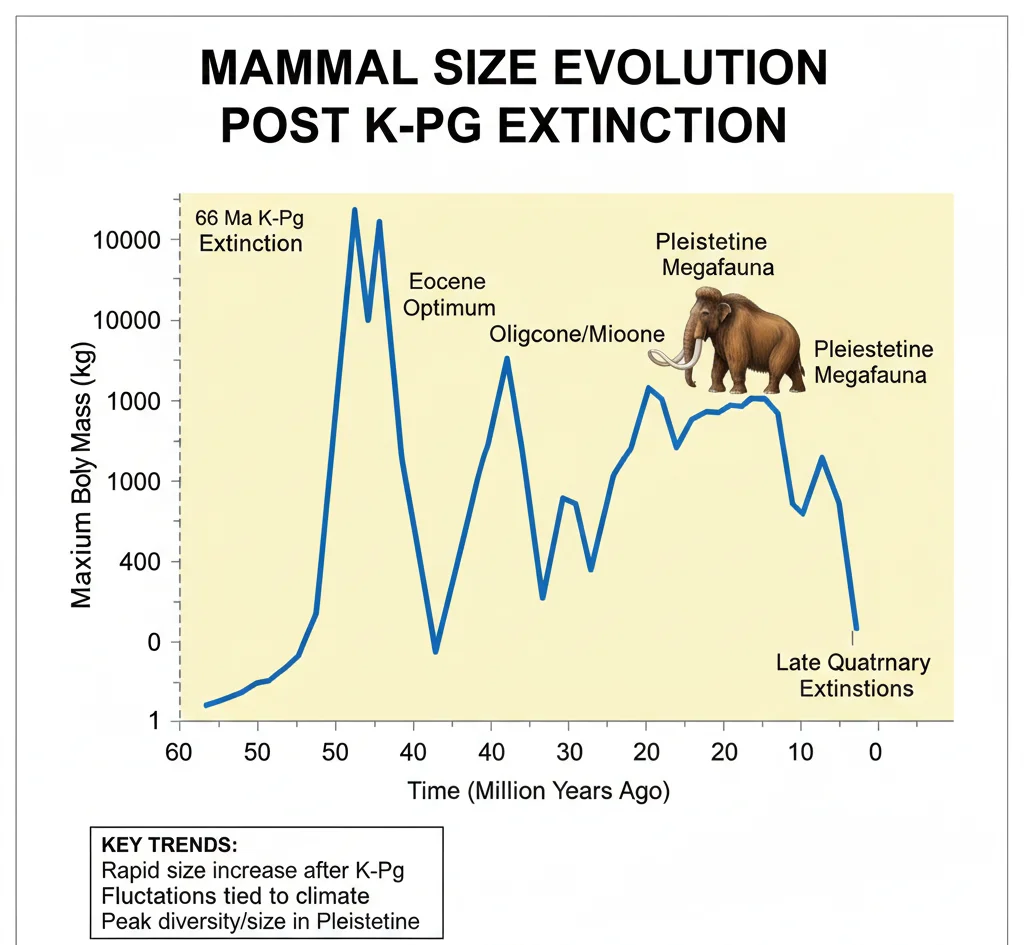
- Within 100,000 years: Mammals were still small.
- Within 1 million years: Mammals grew to the size of pigs (e.g., Ectoconus).
- Within 10 million years: Mammals grew to the size of rhinos.
Evolution, which usually takes eons, was running on steroids. They grew larger, developed hooves, horns, and specialized teeth. The "Age of Mammals" had officially begun.
95.0 THE DINOSAUR LEGACY: BIRDS
We must never forget: Dinosaurs did not go extinct.
One lineage survived: The Avian Dinosaurs (Birds).
Specifically, the ground-dwelling birds like ducks, chickens, and ostriches.
The Terror Birds: In the early Cenozoic, birds tried to reclaim their ancestors' throne. In South America, Terror Birds (Phorusrhacids) evolved. They grew 3 meters tall, couldn't fly, and had massive hooked beaks. For a while, they were the top predators, reminding the mammals that the dinosaur bloodline was not finished yet.
96.0 SUMMARY OF TOPIC 5 (THE MESOZOIC ERA)
We have covered 186 million years of history in this topic. Let's recap the journey:
- Triassic (The Dawn): The world recovered from the Great Dying. Archosaurs defeated our ancestors (Synapsids). Crocodiles ruled first, but the Carnian Rain allowed early Dinosaurs to gain a foothold.
- Jurassic (The Golden Age): Pangea broke apart. The climate got wet. Sauropods grew to 80 tons, defying physics. Theropods like *Allosaurus* became specialized pack hunters. The first bird (*Archaeopteryx*) took flight.
- Cretaceous (The Revolution): Flowers appeared, changing the world forever. Chewing dinosaurs (Duckbills/Horned) replaced the swallowers. *T-Rex* evolved as the ultimate bone-crusher. Marine reptiles like *Mosasaurus* ruled the seas.
- The End: A cosmic accident (Chicxulub) reset the board, wiping out the non-avian dinosaurs and handing the keys of the planet to the mammals.
97.0 LOOKING AHEAD: THE CENOZOIC ERA
The monsters are gone. The stage is set for a new cast of characters.
From the tiny Purgatorius hiding in a hole, a lineage will rise that will eventually walk on the Moon.
But the road to Humanity is long. We must first survive the hot jungles of the Eocene, face the giant sharks like Megalodon, and endure the freezing grip of the Ice Ages.
Welcome to Topic 6: The Rise of Mammals and Human Evolution.
END OF TOPIC 5
1.0 THE AGE OF MAMMALS BEGINS
We have entered the Cenozoic Era ("New Life"), spanning from 66 million years ago to the present day.
It is divided into three Periods: Paleogene, Neogene, and Quaternary.
It begins with the Paleocene Epoch (66–56 MYA).
The Vacuum Effect: With the dinosaurs gone, the world was full of empty ecological niches. Nature abhors a vacuum. The surviving mammals—mostly small, nocturnal insect-eaters—began to grow rapidly to fill these roles. This is the fastest rate of morphological evolution in the history of vertebrates.
2.0 THE REIGN OF BIRDS: GASTORNIS
Before mammals could truly take over, the Birds made a bid for the throne.
In the Paleocene and early Eocene, the top predators on land were not tigers or wolves, but giant flightless birds.
2.1 The Terror Bird Strategy
Gastornis stood 2 meters tall and weighed huge amounts. It had a massive, bone-crushing beak.
For a few million years, it looked like the dinosaurs (in bird form) might rule the world again. They hunted the ancestors of horses, which were then only the size of house cats. However, as mammals evolved pack-hunting strategies and larger bodies, the Terror Birds were eventually outcompeted in the Northern Hemisphere.
3.0 THE GREENHOUSE WORLD: THE PETM
Around 56 million years ago, the Earth experienced a sudden, violent global warming event known as the Paleocene-Eocene Thermal Maximum (PETM).
The Cause: Massive release of methane clathrates from the ocean floor or volcanism in the North Atlantic.
The Effect: Global temperatures spiked by 5-8°C.
The poles melted completely.
Antarctic Jungles: We have found fossils of palm trees, crocodiles, and turtles in Antarctica and the Arctic Circle. The entire planet was a steaming tropical jungle from pole to pole.
4.0 THE RETURN TO THE SEA: WHALE EVOLUTION
One of the most incredible stories of the Cenozoic is the evolution of Whales (Cetaceans).
Life moved from the Ocean to Land (Tiktaalik, Topic 4). Now, mammals decided to go back.
4.1 Indohyus: The Deer that Swam
The story begins with a small, deer-like creature named Indohyus found in the Himalayas (which were then a coastline).
It looked like a mouse-deer (Chevrotain).
The Clue: Its ear bones contain a structure called the Involucrum. This thick bone is unique to whales. It proves that whales are not related to carnivores (like seals) but are actually Artiodactyls (Even-toed Ungulates).
The Relationship: The closest living relative of the whale is the Hippo.
4.2 Pakicetus: The Wolf-Whale
The next step was Pakicetus ("Whale of Pakistan").
It looked like a wolf with a long snout. It lived on land but hunted in shallow water.
Why go back? The K-Pg extinction had wiped out the Mosasaurs and Plesiosaurs. The oceans were empty of large predators and full of fish. It was a free buffet for any mammal brave enough to swim.
4.3 Ambulocetus: The Walking Whale
Then came Ambulocetus natans.
It looked like a furry crocodile. It had webbed feet and could walk on land (clumsily) and swim in the water. It was an ambush predator, likely hunting land animals that came to drink, dragging them into the water.
5.0 THE DAWN OF MODERN MAMMALS
In the Eocene Epoch (56–33 MYA), the ancestors of modern mammal groups appeared.
5.1 Hyracotherium (The First Horse)
The ancestor of all horses, zebras, and donkeys was Hyracotherium (formerly called Eohippus).
Size: It was the size of a cat or a fox.
Toes: It didn't have hooves. It had 4 toes on the front feet and 3 on the back, with soft pads like a dog. It lived in the dense jungle undergrowth, eating fruit and soft leaves. As the world cooled and grasslands appeared later, it would be forced to grow larger and run faster.
5.2 Primates Take to the Trees
In the warm Eocene forests, a group of small mammals developed grasping hands and forward-facing eyes. These were the Adapids and Omomyids—the first true Primates.
They looked like lemurs. They spent their lives in the canopy, hunting insects and eating fruit. Their adaptation to a 3D arboreal world laid the foundation for our own intelligence.
6.0 THE KINGS OF THE EOCENE OCEAN
By the Late Eocene (40–34 MYA), whales had completely severed their ties to the land. They could no longer walk. They were fully aquatic killing machines.
6.1 Basilosaurus: The "King Lizard" Mistake
When fossils of Basilosaurus were first found in the 19th century, they were so long and serpentine that scientists thought they belonged to a giant marine reptile (hence the suffix "-saurus").
It was actually a colossal whale, reaching lengths of 18-20 meters.
- The Body: Unlike modern whales (which are torpedo-shaped), Basilosaurus was eel-like. It swam by undulating its long body up and down.
- The Vestigial Legs: The most shocking feature of Basilosaurus is its hind legs. It still possessed tiny, fully formed legs with toes, knees, and ankles. They were too small to walk on, but they likely served as "mating claspers" to hold onto partners. They are the ultimate proof of terrestrial ancestry.
- Diet: It was a bone-crusher. We have found fossilized stomach contents showing it ate sharks and smaller whales (like Dorudon).
6.2 Dorudon: The Prototype
Living alongside the giant Basilosaurus was the smaller (5-meter) Dorudon.
Dorudon looked much more like a modern dolphin. It had a compact, stiff body for high-speed swimming. It represents the body plan that would eventually give rise to all modern whales (Neoceti).
7.0 THE SPLIT: TEETH VS. BALEEN
At the end of the Eocene, a major evolutionary split occurred in the whale lineage.
1. Odontocetes (Toothed Whales):
These kept their teeth (Killer Whales, Sperm Whales, Dolphins).
Innovation: They developed Echolocation (Sonar). By using a fatty organ in their forehead (the Melon), they could emit sound waves to "see" in the dark depths. This allowed them to hunt squid in the abyss.
2. Mysticetes (Baleen Whales):
These lost their teeth.
Innovation: They developed Baleen (keratin plates) to filter plankton and krill. This allowed them to tap into a limitless food source at the bottom of the food chain, eventually enabling them to grow into the largest animals in Earth's history (Blue Whales).
8.0 THE LAND MONSTERS: MESONYCHIDS & ARTIODACTYLS
Back on land, mammals were experimenting with being "Apex Predators." But they didn't look like cats or dogs yet. They looked like nightmares.
8.1 Andrewsarchus: The Giant Wolf-Sheep
Andrewsarchus mongoliensis is the largest carnivorous land mammal ever discovered.
- The Skull: Its skull was nearly 1 meter long (twice the size of a Grizzly Bear's).
- The Mystery: We only have the skull. But based on its anatomy, it was likely a hoofed predator.
Phylogeny: It is an Artiodactyl. It is closely related to sheep, goats, and hippos. Imagine a wolf the size of a rhino, but related to a sheep. That is Andrewsarchus. It likely scavenged on beaches and crunched turtle shells with its massive jaws.
9.0 THE HELL PIGS: ENTELODONTS
The Eocene and Oligocene also saw the rise of the Entelodonts, affectionately known as "Hell Pigs" or "Terminator Pigs."
Entelodon and Daeodon were not true pigs, but distant cousins.
Appearance: They were the size of cows/bisons. They had massive bony "flanges" on their cheeks (likely for fighting rivals) and huge canine teeth.
Behavior: They were the cleanup crew of the Cenozoic. They were omnivorous scavengers who likely bullied other predators off their kills, cracking bones to get to the marrow.
10.0 THE PRIMATE PROGRESS: ANTHROPOIDS
While monsters ruled the ground and sea, our ancestors in the trees were evolving.
In the Eocene, the Anthropoids (Simians) appeared. These are the "Higher Primates" (Monkeys, Apes, Humans).
Key Features:
1. Fully Enclosed Eye Sockets: Better protection for the eyes.
2. Larger Brains: More processing power for social interaction.
3. Loss of Snout: Reliance shifted from smell to vision.
An example is Eosimias ("Dawn Monkey") from China. It was tiny, the size of a thumb, but its ankle bones show it was already moving like a monkey, not a lemur.
11.0 THE BIG CHILL: THE OLIGOCENE EPOCH
Around 34 million years ago, the Eocene hothouse crashed. The Oligocene Epoch (34–23 MYA) began with a global cooling event known as the Grande Coupure ("The Great Cut").
The Cause: Plate tectonics separated South America from Antarctica. This opened the Drake Passage.
For the first time, a cold ocean current (Antarctic Circumpolar Current) could circle the continent without hitting land. This trapped the cold air over the South Pole, forming the massive Antarctic Ice Sheet.
The Effect: The global temperature dropped. The dense tropical rainforests that covered the world retreated to the equator. In their place, a new, open habitat appeared: Dry Woodlands and Scrublands.
12.0 THE LARGEST LAND MAMMAL: PARACERATHERIUM
Open woodlands meant one thing: Animals could get bigger. Much bigger.
In Asia, the Indricotheres (a group of hornless Rhinoceroses) evolved into titans.
12.1 Paraceratherium transouralicum
This animal pushes the biological limit of how big a mammal can be.
- Weight: Estimated at 15-20 tons. (Equal to 3 or 4 African Elephants, or a medium-sized Sauropod).
- Height: 5 meters at the shoulder, with a long neck reaching 8 meters up.
- Lifestyle: It was a "Mammalian Giraffe." It browsed on the tops of trees that no other animal could reach. Unlike modern rhinos, it had no horn. It relied on sheer size for defense. Even the giant predators of the time looked like house cats next to a healthy adult.
13.0 THE PREDATORS: HYAENODON & NIMRAVIDS
With giant herbivores, you need giant killers.
13.1 Hyaenodon (The Creodont)
Hyaenodon was one of the top predators of the Oligocene.
Despite the name, it is not related to Hyenas. It belonged to an extinct order called Creodonts.
The Jaws: It had a massive skull with self-sharpening teeth. Its bite force was strong enough to crush the bones of early camels and horses. It was a successful design that lasted for 20 million years.
13.2 Nimravids (False Saber-Tooths)
This era also saw the rise of the Nimravids. They looked exactly like Saber-Toothed Cats, but they were not true cats. This is another case of Convergent Evolution. Nature invented the "saber-tooth" design multiple times because it was the perfect tool for killing thick-skinned prey.
14.0 THE CRADLE OF ANTHROPOIDS: THE FAYUM
If you want to find your ancestors in the Oligocene, you must go to Egypt.
Today, the Fayum Depression is a scorching desert. 30 million years ago, it was a lush, swampy mangrove jungle teeming with early primates.
14.1 Aegyptopithecus: The Dawn Ape
Aegyptopithecus zeuxis ("Egyptian Ape") is a crucial fossil.
It was the size of a cat.
Why it matters: It sits right at the split between:
1. Old World Monkeys (Baboons, Macaques).
2. Apes (Chimps, Gorillas, Humans).
It had the dental formula (2:1:2:3) that humans have today. It likely lived in social groups in the trees, showing sexually dimorphic canines (males had bigger fangs), which suggests a complex social hierarchy.
15.0 EVOLUTION OF THE HORSE: MESOHIPPUS
As the forests thinned out, the tiny "Dawn Horse" (Hyracotherium) had to adapt.
It evolved into Mesohippus ("Middle Horse").
- Size: It grew to the size of a Greyhound dog.
- Teeth: Its teeth became taller (hypsodont) to grind tougher leaves and early grasses.
- Toes: It lost a toe. It now stood on three toes, with the middle toe taking more weight. It was becoming a runner, designed to flee from predators in the open woodlands.
16.0 THE MIOCENE EPOCH: THE GRASS REVOLUTION
The Miocene (23–5.3 MYA) is often called "The Golden Age of Mammals."
But the real hero of this epoch is a plant: Grass (Poaceae).
The Problem with Grass:
To an herbivore, grass is a nightmare.
1. It contains Silica: Grass blades are reinforced with microscopic glass crystals (phytoliths). Eating grass is like chewing sandpaper. It grinds teeth down to the gum line rapidly.
2. It grows from the bottom: Unlike trees (which grow from the tips), grass grows from the base. You can graze it down to the dirt, and it grows back in a week.
The Evolutionary Response:
Mammals had to evolve Hypsodonty (High-Crowned Teeth). Their teeth became incredibly long, extending deep into the jaw bone, erupting slowly over a lifetime to compensate for the wear. If you didn't evolve these teeth, you starved.
17.0 THE EVOLUTION OF HORSES: MERYCHIPPUS
The horse lineage shows this adaptation perfectly. As forests turned into grasslands, the small Mesohippus evolved into Merychippus.
- Size: It was the size of a pony.
- The Leg: In tall grass, predators can hide anywhere. Speed became the only defense. Merychippus elongated its legs.
Crucially, it evolved the Spring-Foot Mechanism. It stood primarily on its middle toe (the hoof), using massive ligaments to store energy like a rubber band with every step. This made it an endurance runner.
18.0 THE MONSTER SHARK: MEGALODON
While horses ran on the plains, the oceans were warm and teeming with a new food source: Small, blubber-rich whales (like Cetotherium).
This energy-rich diet allowed a shark to grow to god-like proportions.
18.1 Otodus megalodon
Megalodon is the largest shark to ever live.
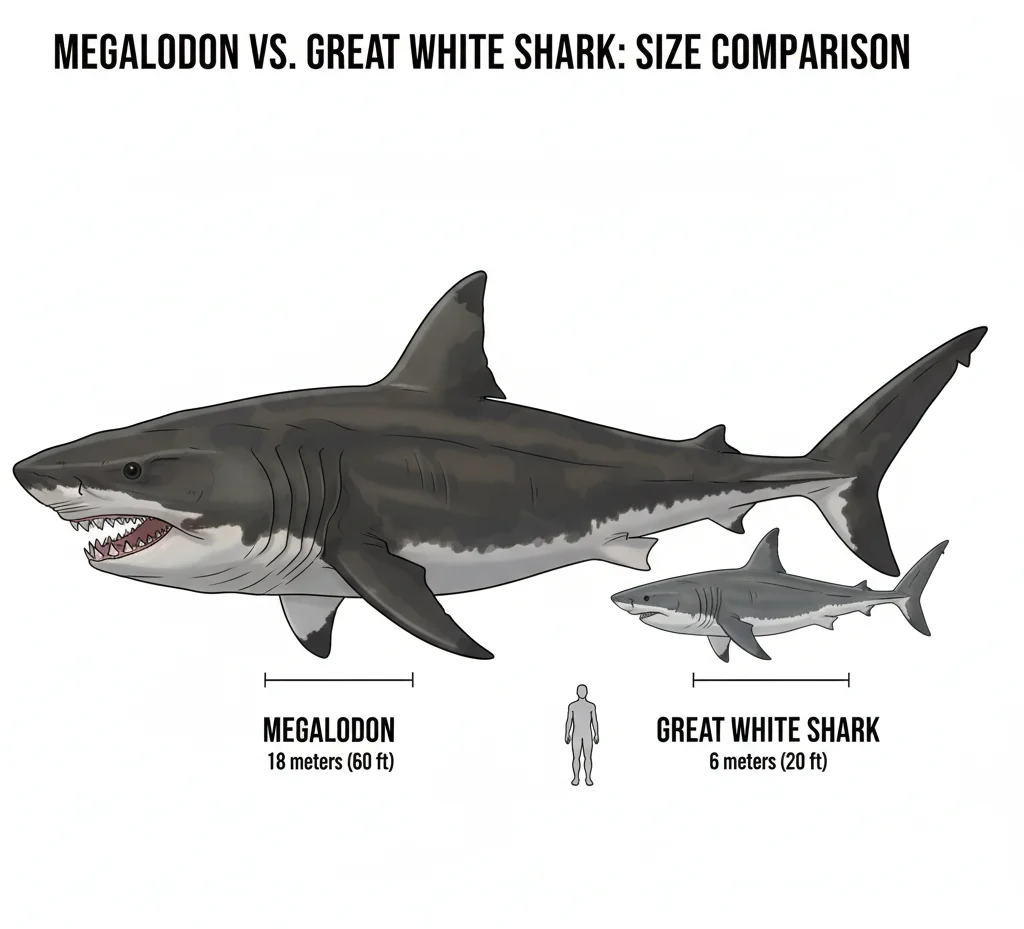
- Size: Estimates suggest it reached 15-18 meters (50-60 feet). A Great White Shark is about 5-6 meters.
- The Jaws: Its jaws were big enough to swallow two adult humans standing side-by-side.
Bite Force: Estimated at 108,000 to 182,000 Newtons. That is roughly 10 times stronger than a Great White and stronger than T-Rex. It could crush a whale's skull like a grape.
Why did it go extinct?
Around 3.6 million years ago, the oceans cooled (Ice Ages began).
1. Whales migrated to the freezing poles (where Megalodon couldn't follow because it was warm-blooded enough to need food, but not warm enough to survive freezing water).
2. Competition: A new, smarter, pack-hunting predator appeared: The Great White Shark and the Orca. They ate the baby Megalodons. The giant starved to death.
19.0 THE FIRST APES: PROCONSUL
Back in the African forests, a quiet revolution was happening in the Primate family tree.
The Hominoidea (Apes) split from the Monkeys.
19.1 Proconsul: Losing the Tail
Proconsul (23-14 MYA) is one of the earliest known apes.
- No Tail: This is the defining feature of apes. Monkeys use tails for balance. Apes use complex musculature and long arms for swinging (brachiation) and balance.
- The Brain: Relative to body size, its brain was larger than a monkey's.
- Locomotion: It wasn't fully walking on two legs yet. It was an arboreal quadruped, moving carefully through the trees "above the branch," not swinging below it like a gibbon.
20.0 PIEROLAPITHECUS: UPRIGHT POSTURE
Later in the Miocene (13 MYA), apes like Pierolapithecus (found in Spain) show adaptations for an Upright Trunk.
Their ribcage was wide and flat (like ours), not deep and narrow (like a dog or monkey). Their wrists were flexible. This anatomy allowed them to climb vertically and hang from branches, pre-adapting our ancestors for eventually walking upright on the ground.
21.0 THE DRYOPITHECUS MIGRATION
During the Miocene, Africa collided with Eurasia. This land bridge allowed elephants and apes to migrate out of Africa.
Apes like Dryopithecus spread across Europe and Asia.
For a while, Europe was the "Planet of the Apes." But as the climate cooled further, the European apes died out, and the lineage continued only in Africa and Southeast Asia (Orangutans). The stage was set for the African cradle.
22.0 THE PLIOCENE EPOCH: THE DRYING OF AFRICA
The Pliocene (5.3–2.6 MYA) brought a cooler, drier world.
In East Africa, geological forces were tearing the continent apart, creating the Great Rift Valley. Mountains rose, blocking the rain. The lush rainforests turned into a patchwork of woodlands and open savannas.
23.0 THE CHIMP-HUMAN SPLIT
Genetic molecular clocks tell us that Humans and Chimpanzees share 98.8% of their DNA.
We are not "descended from chimps." We are cousins. We both descended from a Last Common Ancestor (LCA) that lived roughly 6 to 7 million years ago.
One group stayed in the trees (becoming Chimps/Bonobos). The other group ventured onto the ground (becoming Hominins).
24.0 THE CONTENDERS: THE FIRST HOMININS
Who was the first to stand up? We have three main candidates.
24.1 Sahelanthropus tchadensis ("Toumai")
Discovered in Chad (Central Africa) and dated to 7 million years ago.
- The Evidence: We only have a crushed skull. It looks very ape-like with a small brain (350cc).
- The Smoking Gun: The Foramen Magnum (the hole where the spine enters the skull) is located underneath the skull, not at the back.
In dogs or chimps, it's at the back (because they walk on four legs).
In humans, it's at the bottom (because we balance our heads vertically).
This suggests Toumai was likely bipedal, making it the earliest known ancestor on our line.
24.2 Orrorin tugenensis ("Millennium Man")
Found in Kenya (6 MYA).
We have thigh bones (femurs). The shape of the femoral neck suggests it carried weight vertically, like a human leg, not arguably like an ape leg.
25.0 ARDIPITHECUS RAMIDUS ("ARDI")
In 1994, a team led by Tim White found a skeleton in Ethiopia that changed everything. Dated to 4.4 million years ago. They called her "Ardi."
25.1 The Mosaic Anatomy
Ardi destroyed the old theory that we evolved from "Knuckle-Walkers" (like chimps). She was something entirely different.
- The Feet: She had an Opposable Big Toe (like a chimp) for grasping branches. But... she had a rigid foot bone (os peroneum) that allowed her to push off the ground like a human.
- The Hips: Her pelvis was short and bowl-shaped (Human-like) to support upright walking, not tall and narrow (Ape-like).
- The Hands: She did not have the specialized wrists of a knuckle-walker. Her palms were flexible.
Conclusion: Ardi was a Facultative Biped. She walked upright on the ground (clumsily) but was still a master climber in the trees. She proves that bipedalism started in the woodlands, not out on the open savanna.
26.0 WHY STAND UP? (THEORIES OF BIPEDALISM)
Walking on two legs is slow, unstable, and causes back pain. Why did evolution select for it?
26.1 The Energy Efficiency Theory
Chimpanzees waste massive energy walking on two legs (waddling).
Humans are efficient pendulums. Experiments showing chimps on treadmills vs humans prove that human walking burns 75% less energy. As the forests fragmented, ancestors had to travel longer distances between food patches. Bipedalism was the "Fuel Efficient" mode of travel.
26.2 The Thermoregulation Theory (The Radiator)
Standing up reduces the surface area of the body exposed to the direct midday sun (only the head and shoulders). It also lifts the body into the cooler breeze above the ground. This allowed early hominins to forage in the heat of the day when predators (lions) were sleeping.
26.3 The Carrying Hypothesis
If you walk on four legs, your mouth is your only carrying tool.
If you stand up, your hands are free. You can carry food back to a safe spot (Provisioning), carry babies, or eventually, carry sticks and stones.
27.0 THE LOSS OF THE CANINES
Another crucial change happened in the mouth.
Male chimps have massive, dagger-like canine teeth for fighting other males (dominance).
Sahelanthropus and Ardipithecus had small, diamond-shaped canines similar to females.
Social Implication: This suggests a massive reduction in male-to-male aggression. Our ancestors were likely moving toward a social structure based on Cooperation and Pair-Bonding rather than brute force dominance. The "smile" was becoming more important than the "bite."
28.0 THE SOUTHERN APES: AUSTRALOPITHECUS
Around 4 million years ago, a new group of hominins appeared in East Africa. They were the Australopithecines ("Southern Apes").
They represent the decisive step out of the forest and onto the savanna. They are the genus from which the genus Homo (Us) would eventually emerge.
29.0 LUCY IN THE SKY WITH DIAMONDS
In 1974, paleoanthropologist Donald Johanson was searching the Afar region of Ethiopia (Hadar). He found a small elbow bone, then a thigh bone, then vertebrae.
It was a 40% complete skeleton of a female Australopithecus afarensis, dated to 3.2 million years ago.
The Name: While celebrating the discovery at the camp, the Beatles song "Lucy in the Sky with Diamonds" was playing on a cassette tape. The name stuck.
29.1 The Chimera Anatomy
Lucy was a confusing mix of ape and human traits.
- Brain: Small (approx. 400cc), roughly the size of a chimp's. She was not a genius.
- Face: She had a protruding snout (prognathism) and no chin.
- Hips & Legs: This is where she was human. Her pelvis was short and wide. Her femur slanted inward toward the knee (Valgus Angle), placing her feet directly under her center of gravity.
The Verdict: Lucy walked upright just like us. If you saw her from 100 meters away in the tall grass, you would think she was a small human. If you got close, you would see an ape head on a human body.
30.0 THE LAETOLI FOOTPRINTS: WALKING INTO HISTORY
In 1976, Mary Leakey made a discovery in Tanzania that brought these bones to life.
A nearby volcano (Sadiman) had erupted, covering the ground in ash. It rained, turning the ash into cement. Animals walked across it, and the sun baked it hard.
The Trail: It preserves the footprints of two (possibly three) Australopithecus afarensis individuals walking side-by-side for 27 meters.
The Mechanics: The prints show a distinct Heel Strike, a Deep Arch, and a Big Toe push-off. The big toe is in line with the other toes (adducted), not sticking out like a chimp's. This proves that 3.6 million years ago, our ancestors walked with a modern human gait.
31.0 SELAM: THE DIKIKA CHILD
In 2000, Zeresenay Alemseged found the fossil of a 3-year-old A. afarensis girl, nicknamed "Selam" (Peace).
She is often called "Lucy's Baby" (though she lived 100,000 years before Lucy).
Shoulder Blades: Her shoulder blades (scapula) look like a gorilla's, designed for overhead climbing.
Finger Bones: Curved and long, for gripping branches.
Conclusion: While Lucy and Selam walked upright during the day to find food, they likely still climbed trees at night to sleep safely away from leopards and saber-tooth cats. They were not fully terrestrial yet.
32.0 THE COST OF WALKING UPRIGHT
Evolution is a series of trade-offs. Bipedalism gave us free hands and efficiency, but it broke our bodies. We are still paying the price today.
32.1 The Back Problem
To balance a heavy torso on two legs, the spine had to curve into an "S" shape (Lordosis). This puts immense pressure on the lower vertebrae, leading to the chronic Lower Back Pain and slipped discs that plague modern humans.
32.2 The Obstetric Dilemma (Childbirth)
To walk upright efficiently, the pelvis must be narrow and bowl-shaped.
But later in evolution, our brains got huge.
The Conflict: Big baby head vs. Narrow birth canal.
The Result: Human childbirth is more dangerous and painful than in any other primate. It forced human babies to be born "early" (prematurely helpless) so their heads could fit, which in turn required intense parental care and social bonding to raise them.
33.0 DIET: THE NUTCRACKER MAN (PARANTHROPUS)
Not all Australopithecines evolved into humans. Some took a different path. They became the Paranthropus group (Robust Australopithecines).
Instead of getting smarter, they got stronger jaws.
Species like Paranthropus boisei ("Nutcracker Man") evolved massive cheekbones, huge molar teeth, and a bony crest on top of the skull (Sagittal Crest) to anchor powerful chewing muscles. They specialized in eating tough roots, nuts, and dry sedges.
They were the "Gorillas" of the savanna. They lived alongside our ancestors for millions of years but eventually went extinct because they were too specialized.
34.0 THE PLEISTOCENE BEGINS: THE ICE AGES
Around 2.58 million years ago, the Earth entered the Pleistocene Epoch.
This is the era of the Ice Ages. Massive glaciers advanced and retreated in the north. In Africa, this caused severe drying. The forests didn't just shrink; they vanished in many places, replaced by harsh, arid scrubland.
The Australopithecines (like Lucy) faced a choice: Change your diet or die.
One group (Paranthropus) chose to eat tough roots (specialization).
The other group chose to eat Meat (adaptation). This group became the genus Homo.
35.0 HOMO HABILIS: THE HANDY MAN
In 1960, at Olduvai Gorge (Tanzania), Louis and Mary Leakey found the fossil of a new hominin dated to 2.4 - 1.4 million years ago.
- The Brain: It had a brain size of roughly 600-700 cc. This is 50% larger than Lucy's (400 cc) but still half the size of a modern human's (1350 cc).
- The Face: The snout was reduced. The teeth were smaller. It looked less "ape-like."
- The Name: Because stone tools were found nearby, Leakey named it Homo habilis ("Handy Man"), declaring it the first member of our genus.
36.0 THE FIRST TECHNOLOGY: OLDOWAN TOOLS
Chimpanzees use tools (sticks for termites, rocks to smash nuts). But they do not make stone tools.
Around 2.6 million years ago (actually slightly before *H. habilis*), hominins crossed a cognitive Rubicon. They invented the Oldowan Industry.
36.1 The Cognitive Leap
To make an Oldowan "Chopper," you need to:
1. Find a suitable stone (Core).
2. Find a hammerstone.
3. Strike the core at a precise angle (less than 90 degrees) to flake off a sharp edge.
This requires understanding fracture mechanics and foresight. You have to visualize the tool inside the rock before you make it. This suggests a rewiring of the brain's motor and planning centers.
37.0 THE EXPENSIVE TISSUE HYPOTHESIS
Why did the brain start growing now? Brains are biologically expensive. Your brain is 2% of your weight but consumes 20% of your energy.
To afford a big brain, you need high-quality fuel.
The Trade-Off: Paleoanthropologist Leslie Aiello proposed the Expensive Tissue Hypothesis.
Meat is calorie-dense and easy to digest compared to raw leaves.
1. Eating meat allowed the Gut (Intestines) to shrink. (Leaves require huge guts to ferment; meat doesn't).
2. The energy saved from having a smaller gut was redirected to build a bigger Brain.
Thus, technology (tools) -> Meat -> Smaller Gut -> Bigger Brain.
38.0 SCAVENGERS, NOT HUNTERS
Don't imagine Homo habilis hunting mammoths. They were small (1.3 meters tall). If they attacked a zebra, they would die.
They were Power Scavengers.
The Strategy:
1. A leopard kills an antelope.
2. The leopard eats the meat but leaves the bones.
3. Homo habilis runs in, uses a stone chopper to smash the bone open.
4. They extract the Bone Marrow.
Marrow is "nature's fat packet." It is pure energy, protected inside the bone where lions and vultures couldn't reach it. The stone tool was the "key" to this locked safe of calories.
39.0 HOMO RUDOLFENSIS: THE MYSTERIOUS COUSIN
The story is rarely simple. In 1972, Richard Leakey found a skull (KNM-ER 1470) in Kenya that looked different.
It had a larger brain (775 cc) than *habilis* but a flatter, wider face. Named Homo rudolfensis, it suggests that there wasn't just one "human" species at this time. Several different types of early *Homo* were experimenting with tools and meat-eating simultaneously.
40.0 THE FIRST STEPS OF BROCA'S AREA
Endocasts (molds of the inside of the skull) of *Homo habilis* show a bulge in the region known as Broca's Area.
In modern humans, this area controls speech production.
Did they speak? Probably not like us. But they likely had a more complex system of grunts and gestures than chimps, possibly to teach each other how to make tools. Technology and language likely evolved hand-in-hand.
41.0 THE FIRST TRUE HUMAN: HOMO ERECTUS
Around 1.9 million years ago, a new kind of hominin appeared on the African savanna.
They were tall. They were hairless. They ran on two legs with grace.
This is Homo erectus (or Homo ergaster for the African variety). If Homo habilis was "Man 1.0," Homo erectus was "Man 2.0"—a complete overhaul of the human design.
42.0 THE TURKANA BOY: BORN TO RUN
In 1984, near Lake Turkana in Kenya, Kamoya Kimeu discovered the most complete early human skeleton ever found.
It belonged to a boy, aged roughly 8-12 years old, who died 1.6 million years ago. He is known as the Turkana Boy (or Nariokotome Boy).
- Proportions: Unlike Lucy (who had short legs and long arms), this boy had long legs and shorter arms, identical to modern humans. If he had grown to adulthood, he would have stood 1.85 meters (6 ft 1 in) tall.
- Rib Cage: His rib cage was barrel-shaped (like ours), not cone-shaped (like an ape's). This means he didn't need a huge gut to ferment plants. He ate high-quality food.
- Loss of Fur: Genetic models suggest this is when we lost our thick body hair. Why? To sweat. Homo erectus was evolving to run marathons in the midday sun. Fur would cause heatstroke; sweating allowed for cooling.
43.0 PERSISTENCE HUNTING
How do you hunt a gazelle without a bow and arrow? You run it to death.
Most animals cool down by panting, which they cannot do while running. Humans cool down by sweating, which we can do while running.
The Strategy: Homo erectus likely chased prey for hours during the hottest part of the day. The prey would eventually collapse from heat exhaustion (hyperthermia), allowing the hunter to walk up and finish it with a spear or rock. We are the Terminators of nature: we don't sprint fast, but we never stop coming.
44.0 THE ACHEULEAN REVOLUTION: THE HAND AXE
Homo erectus upgraded the technology. Around 1.76 million years ago, they invented the Acheulean Industry.
The signature tool is the Hand Axe.
The Mental Leap: Oldowan tools (Part 7) were just smashed rocks with an edge. The Hand Axe is Bifacial (worked on both sides) and Symmetrical (teardrop shape).
To make one, you have to chip away the stone to match a mental image of symmetry. This implies a sense of aesthetics and standard design. It was the "Swiss Army Knife" of the Pleistocene, used for butchering, digging, and breaking wood. They made these identical tools for over a million years.
45.0 THE CONQUEST OF FIRE
This is the most controversial but transformative moment.
Sites like Wonderwerk Cave (South Africa) suggest Homo erectus was using fire by 1 million years ago (possibly earlier).
45.1 The Cooking Hypothesis
Primatologist Richard Wrangham proposed that Cooking is what made us human.
1. Digestion: Cooking breaks down tough fibers and denatures proteins, making food much easier to digest.
2. Energy: Cooked food gives more calories than raw food.
3. The Brain: This surplus energy allowed the Homo erectus brain to grow to 900-1100 cc (approaching modern size).
4. Social Life: Fire forced people to sit together at night. It created a safe space from predators. This "Campfire Time" likely fostered storytelling, language, and social bonding.
46.0 OUT OF AFRICA: THE FIRST WAVE
Before erectus, hominins were strictly African. Homo erectus was the first to leave.
46.1 Dmanisi, Georgia (1.8 MYA)
In the Caucasus Mountains of Georgia, we found skulls of early Homo erectus.
The Old Man: One skull belonged to an elderly individual who had lost all his teeth years before he died. The bone had healed.
Significance: He could not chew. He survived only because others in the group likely chewed his food for him or prepared soft soup. This is the earliest evidence of Compassion and care for the elderly in human history.
46.2 Java Man and Peking Man
They walked all the way to East Asia.
Java Man (Indonesia): Discovered in 1891, proved they crossed into Southeast Asia when sea levels were lower (Sunda Shelf).
Peking Man (China): Lived in caves near Beijing 700,000 years ago, leaving behind massive ash layers from controlled fires.
47.0 THE HOBBITS: HOMO FLORESIENSIS
One group of Homo erectus got stranded on the island of Flores (Indonesia).
Due to the limited resources on the island, they underwent Insular Dwarfism.
They evolved into Homo floresiensis ("The Hobbit"). Standing only 1 meter tall, these tiny humans hunted mini-elephants (Stegodon) and lived until very recently (approx. 50,000 years ago). They prove how adaptable the human body plan is.
48.0 THE ENDURANCE OF ERECTUS
We (Homo sapiens) have been around for maybe 300,000 years.
Homo erectus survived for nearly 1.5 million years.
They survived Ice Ages, volcanic super-eruptions, and changing climates. They are, strictly speaking, the most successful human species to ever live. We are just the new kids on the block.
49.0 THE COMMON ANCESTOR: HOMO HEIDELBERGENSIS
Around 700,000 years ago, *Homo erectus* populations in Africa and Europe evolved into a distinct, more advanced species: Homo heidelbergensis.
They are the "Cosmopolitan Ancestors."
They are the bridge. If you trace their lineage forward in Europe, you get Neanderthals. If you trace it forward in Africa, you get *Homo sapiens*. They hold the DNA of both worlds.
49.1 The Physical Tank
Homo heidelbergensis was physically impressive.
- Brain Size: Their brains jumped to 1200-1300 cc (overlapping with modern humans).
- The Face: They still had massive brow ridges (the supraorbital torus) and no chin, but the face was flatter than *erectus*.
- The Build: They were robust, broad-chested, and heavily muscled. Fossil evidence suggests they were accustomed to intense physical exertion. You would not want to arm-wrestle a *Heidelbergensis*.
50.0 THE KILLER TECH: SCHÖNINGEN SPEARS
For a long time, we debated: Were early humans actually hunting big game, or just scavenging better?
In 1994, a discovery in a coal mine in Schöningen, Germany, ended the debate.
The Artifacts: Archaeologists found eight wooden spears dated to 400,000 years ago.
The Engineering: These weren't just sharpened sticks.
1. They were made from the hardest part of spruce trees (the base).
2. They were carved to be aerodynamic, with the center of gravity 1/3rd from the tip—exactly like a modern Olympic javelin.
3. They were 2 meters long.
The Scene: They were found amidst the butchered bones of 20 wild horses.
Conclusion: *Heidelbergensis* were not scavengers. They were apex predators capable of coordinating complex ambushes to slaughter herds of fast, dangerous animals.
51.0 THE FIRST SHELTERS: TERRA AMATA
In Nice, France, at a site called Terra Amata (approx. 400,000 years old), we find evidence that they were building homes.
Oval rings of stones were found with post holes in the center. This suggests they built temporary huts made of wood and animal skins, with a central hearth for fire. They were modifying their environment to suit them, rather than just sleeping in caves.
52.0 THE DAWN OF RITUAL: SIMA DE LOS HUESOS
In the Atapuerca Mountains of Spain, there is a deep cave shaft called the Sima de los Huesos ("Pit of Bones").
At the bottom of this 13-meter vertical drop, scientists found the skeletal remains of at least 28 *Homo heidelbergensis* individuals.
52.1 The Mystery of Excalibur
How did they get there?
There are no signs of habitation (no trash, no tools, no animal bones except bears that fell in). The bodies seem to have been dropped there intentionally.
Among the bones, only one artifact was found: A hand axe made of rare red/pink quartz. Archaeologists nicknamed it "Excalibur."
The Implication: This stone had never been used. It was likely an offering.
This might be the earliest evidence of Funerary Ritual and symbolic thought. It suggests that 400,000 years ago, our ancestors were already feeling grief and thinking about the concept of death.
53.0 THE GREAT DIVERGENCE (300,000 - 400,000 YA)
As the climate oscillated violently between Ice Ages and Warm Periods, populations got separated. This geographical barrier drove the final split.
53.1 The North (Europe/Asia): The Neanderthal Line
The *Heidelbergensis* groups trapped in Europe faced brutal cold.
Evolution selected for:
1. Stocky Bodies: Short limbs and wide chests to conserve heat (Allen's Rule).
2. Large Noses: Huge nasal cavities to warm and humidify the freezing air before it hit the lungs.
3. Power: Immense muscle mass to ambush large megafauna (Mammoths/Rhinos) at close range.
This line evolved into Homo neanderthalensis.
53.2 The South (Africa): The Sapiens Line
The *Heidelbergensis* groups in Africa faced periodic megadroughts and heat.
Evolution selected for:
1. Slender Bodies: Long limbs to dissipate heat.
2. Efficiency: Bodies built for long-distance endurance walking/running.
3. Brain Reorganization: A shift toward complex social planning and adaptability.
This line evolved into Homo sapiens (Us).
54.0 THE LOST COUSINS: DENISOVANS
There was a third child.
A group of *Heidelbergensis* moved east into Asia. We know almost nothing about what they looked like, but DNA from a finger bone found in a Siberian cave (Denisova Cave) proves they existed. They are the Denisovans. They were the "Neanderthals of the East," and as we will see later, they interbred with both us and the Neanderthals.
55.0 PRELUDE TO CONTACT
By 300,000 years ago, the stage was set.
In the snowy forests of Europe, the Neanderthals were sharpening their spears.
In the dusty plains of Africa, early *Homo sapiens* were gazing at the stars.
For hundreds of thousands of years, they would remain apart. But eventually, the Africans would leave their home again. And when they met their European cousins, history would change forever.
56.0 THE LORDS OF THE ICE: HOMO NEANDERTHALENSIS
While *Homo sapiens* were evolving under the African sun, their cousins in Europe and Western Asia were forging a different destiny in the heart of the Ice Age.
First discovered in 1856 in the Neander Valley (Neandertal) in Germany, they are the closest evolutionary relatives we have ever had.
57.0 BUILT FOR THE COLD: THE NEANDERTHAL TANK
If you saw a Neanderthal on the subway today, dressed in a suit, you would think: "That guy plays rugby professionally."
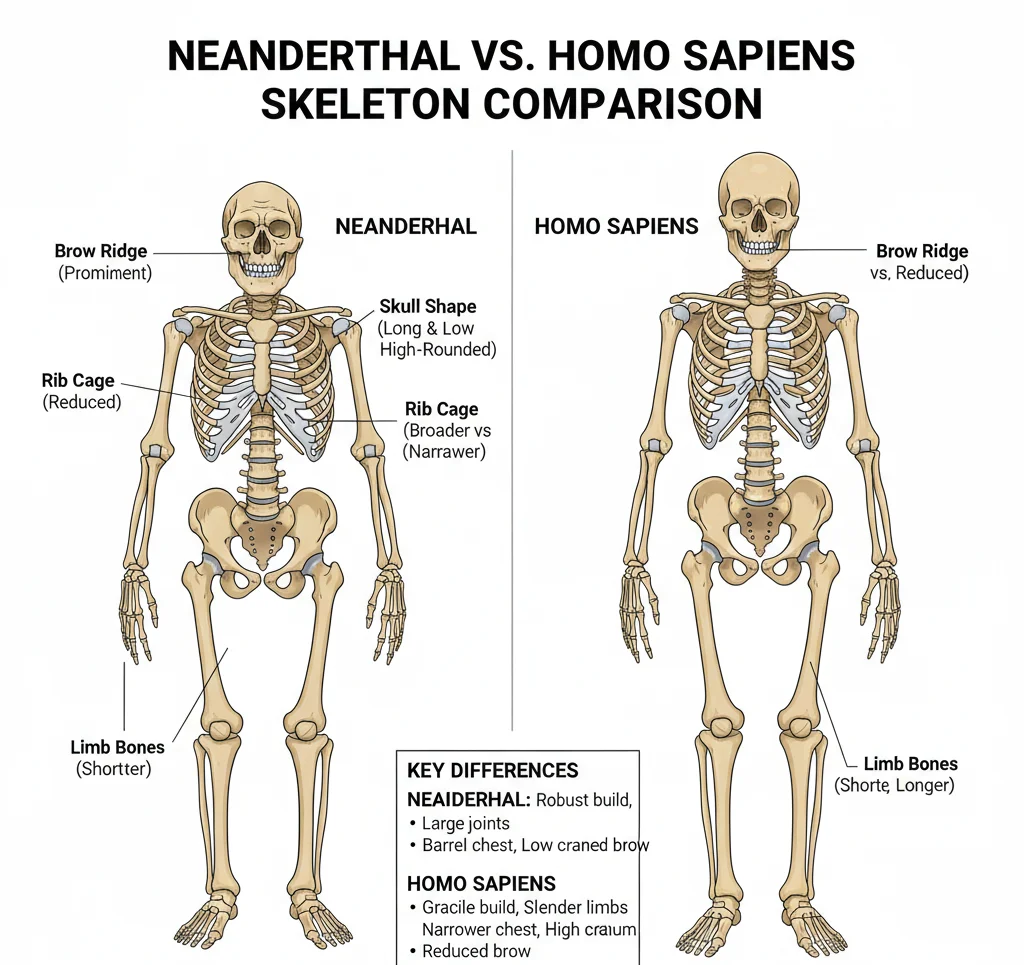
57.1 Hyper-Robust Anatomy
- Brain Size: Here is the shocker: Their brains were larger than ours on average (1600cc vs 1350cc). However, the structure was different—more focused on vision and body control, less on the frontal lobe (social networking).
- The Body: They were shorter (1.65m) but significantly heavier and denser. Their bones were thick, and their muscle attachment points were massive. Biomechanical studies suggest a Neanderthal was 30-40% stronger than a modern human.
- The Face: They had a huge, projecting mid-face and a massive nose. This acted as a radiator to warm and humidify the freezing, dry glacial air before it damaged their delicate lungs.
58.0 THE RODEO RIDER HYPOTHESIS
How did they hunt? We analyzed the fracture patterns in Neanderthal skeletons.
They had a terrible number of broken bones: head trauma, smashed ribs, broken arms.
The Match: These injuries matched only one group of modern humans: Rodeo Cowboys.
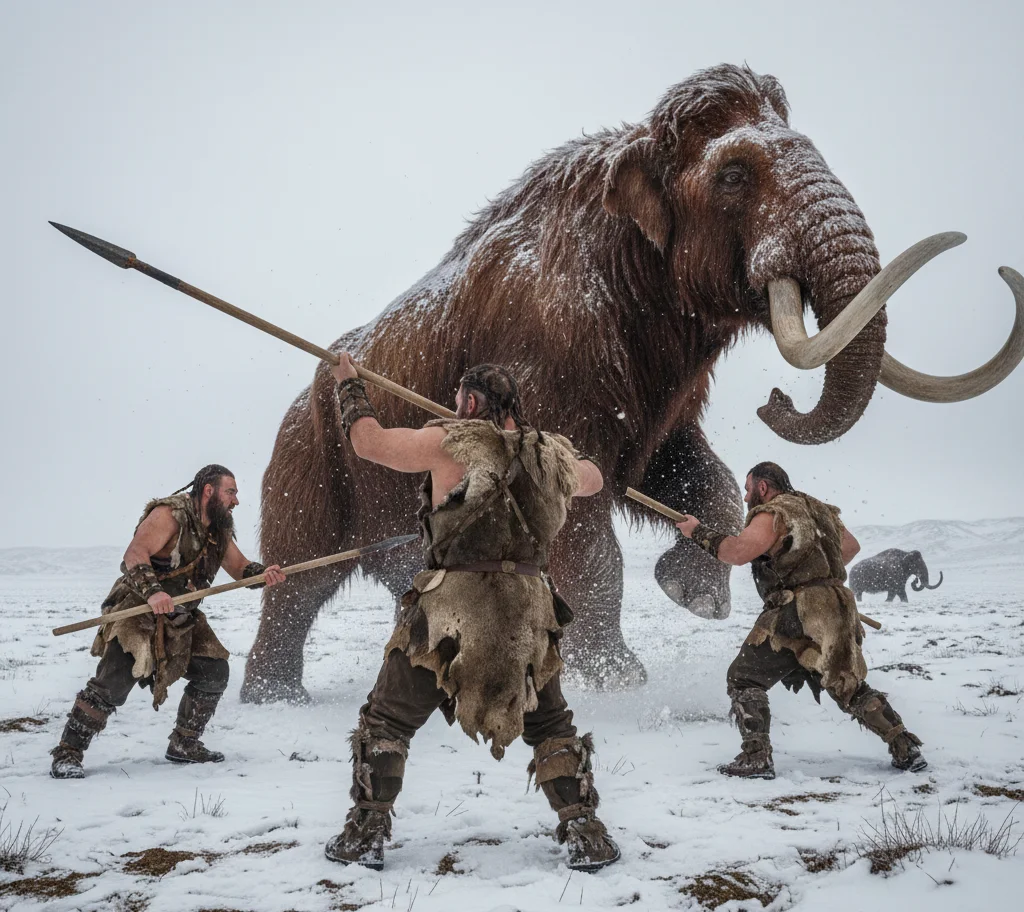
The Strategy: Unlike *Homo sapiens*, who later invented projectile weapons (spear throwers/bows) to kill from a safe distance, Neanderthals used heavy, thrusting spears.
They practiced Close-Quarters Ambush Hunting. They had to jump onto the back of a Woolly Mammoth or Rhino and stab it repeatedly while the animal thrashed around. It was a high-risk, high-reward lifestyle. Few Neanderthals lived past age 40.
59.0 CULTURE AND COMPASSION
The old myth says they were brutal savages. The fossils say they were loving families.
59.1 The Old Man of La Chapelle
In France, we found the skeleton of an elderly Neanderthal ("The Old Man of La Chapelle-aux-Saints").
He had severe arthritis, a broken hip, and no teeth. He could not hunt. He could not even chew.
The Implication: Yet, he survived for years in this condition. This proves his group cared for him, pre-chewing his food and protecting him. Neanderthals did not leave the weak behind.
59.2 The Shanidar Flower Burial
In Shanidar Cave (Iraq), soil samples from a Neanderthal grave revealed massive amounts of pollen from medicinal flowers (yarrow, cornflower, hollyhock).
While debated (some say rodents brought the flowers), many interpret this as a funeral rite—placing flowers on the dead. It suggests deep emotional capacity and spiritual thought.
60.0 DID THEY SPEAK?
For years, scientists thought they couldn't make complex sounds.
The Evidence:
1. The Hyoid Bone: In 1983, a Neanderthal hyoid bone (the bone that anchors the tongue) was found in Israel. It is identical to a modern human's.
2. The FOXP2 Gene: DNA analysis shows they had the same "Language Gene" (FOXP2) mutation that allows us to have fine motor control over our mouths.
Verdict: They almost certainly spoke. Their voices might have been higher-pitched and louder (due to their deep chests and large skulls), but they had language.
61.0 ART AND SYMBOLISM
Did they make art?
For a long time, the answer was "No." But recent dating of cave paintings in Spain (La Pasiega) places them at 64,000 years ago—20,000 years before *Homo sapiens* arrived in Europe.
We also found eagle talons cut and shaped into necklaces. Neanderthals were decorating themselves. They had an aesthetic sense.
62.0 GENETICS: THE GINGER GENE
We have sequenced the Neanderthal genome.
We found mutations in the MC1R gene, suggesting that many Neanderthals had pale skin and red hair. This is an adaptation to low sunlight in Europe (to synthesize Vitamin D), appearing independently from modern Europeans.
63.0 WHY ARE THEY GONE?
If they were so strong, smart, and adapted, why did they vanish around 40,000 years ago?
They didn't just "die out." Something arrived in Europe.
A new species. Smaller, weaker, but armed with better technology and larger social networks. Us.
64.0 THE ORIGIN OF US: HOMO SAPIENS
While Neanderthals ruled the North, the lineage of Homo heidelbergensis that stayed in Africa evolved into Homo sapiens ("Wise Man").
64.1 Rewriting the Timeline: Jebel Irhoud
For decades, textbooks said modern humans appeared in East Africa (Omo Kibish, Ethiopia) around 200,000 years ago.
In 2017, everything changed.
Fossils found at Jebel Irhoud, Morocco were dated to 300,000 years ago.
The Implication: Humans didn't evolve in one small corner of Africa. We evolved across the entire continent (Pan-African Evolution).
These early humans had faces like ours (flat, with chins), but their braincases were still elongated. They were Anatomically Modern, but not yet fully modern in their behavior.
65.0 THE GREAT BOTTLENECK: THE TOBA CATASTROPHE
Genetic studies reveal a shocking fact: Humans have incredibly low genetic diversity compared to Chimpanzees.
Why? Because we almost went extinct.
The Event: Around 74,000 years ago, the Toba Supervolcano in Sumatra, Indonesia, exploded. It was the largest volcanic eruption in the last 25 million years.
- Volcanic Winter: It spewed so much ash that it blocked the sun for years, dropping global temperatures by 3-5°C (instant Ice Age).
- The Die-Off: Africa suffered a megadrought. The human population is estimated to have crashed to as few as 2,000 to 10,000 breeding pairs.
We are all Survivors: Every human alive today is a descendant of that small, hardy group that survived the Toba winter. We are a "lucky" species.
66.0 THE GREAT LEAP FORWARD: BEHAVIORAL MODERNITY
After Toba, something changed.
Anatomically, humans 100,000 years ago looked like us. But they used simple stone tools. They didn't make art.
Around 50,000 years ago, a "Software Update" occurred in the human brain. This is called Behavioral Modernity.
- Art: Cave paintings, carved figurines (Venus of Hohle Fels).
- Jewelry: Beads made of ostrich eggshells (proof of self-identity).
- Complex Weapons: The invention of the Bow and Arrow and the Spear Thrower (Atlatl).
- Trade: We find obsidian tools hundreds of kilometers away from their source, proving distinct tribes were trading with each other.
We don't know exactly why this happened (maybe language complexity reached a tipping point), but suddenly, humans became Innovative.
67.0 OUT OF AFRICA II: THE SUCCESSFUL WAVE
Humans had tried to leave Africa before (e.g., graves in Israel 100,000 years ago), but those attempts failed (either they died out or retreated).
Around 60,000 years ago, a new wave left Africa, likely crossing the "Gate of Tears" (Bab-el-Mandeb strait) into the Arabian Peninsula.
The Beachcombers: They likely followed the coastline of India, moving rapidly towards Southeast Asia and Australia (reaching it by 50,000 years ago).
Another group turned North, heading towards Europe and Central Asia.
68.0 THE MEETING
As *Homo sapiens* moved into Eurasia, they found it was not empty.
In Europe, the Neanderthals were waiting.
In Asia, the Denisovans were waiting.
For the first time in history, the "Smart, Creative, but Weak" Africans were about to meet the "Strong, Ice-Adapted" Europeans. It was the ultimate clash of civilizations.
69.0 THE GREAT ENCOUNTER: SAPIENS MEETS NEANDERTHAL
Around 45,000 years ago, *Homo sapiens* pushed into Europe.
It was an alien world. Dark forests, freezing temperatures, and massive Woolly Mammoths.
But the biggest shock was the locals. They met humans who were pale, stocky, incredibly strong, and spoke a different language.
70.0 MAKE LOVE, NOT WAR (SOMETIMES)
For years, scientists debated: Did we kill them, or did we ignore them?
In 2010, the Neanderthal Genome Project revealed the shocking truth: We mated with them.
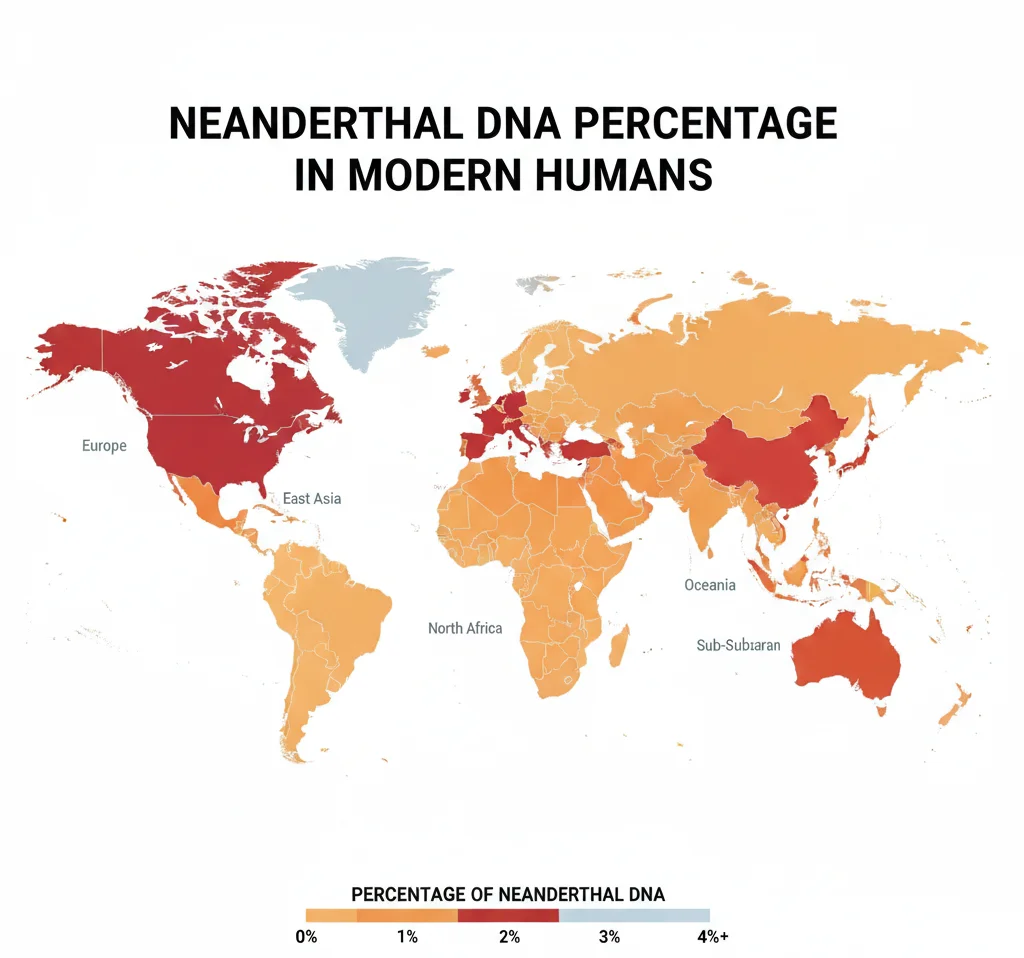
The Legacy: If you are of non-African descent (European, Asian, Native American), roughly 1% to 4% of your DNA is Neanderthal.
Why? When Sapiens left Africa, they met Neanderthals in the Middle East first. They interbred there before spreading to the rest of the world.
The Gift: We didn't just get random DNA. We inherited genes for Immunity (to fight Eurasian viruses our African ancestors had never seen) and genes for skin/hair adaptation to the cold.
71.0 THE EXTINCTION: WHY DID THEY DIE?
Despite the interbreeding, Neanderthals as a distinct species vanished by 40,000 years ago. Why?
71.1 The Efficiency Hypothesis
It likely wasn't a genocide (war). It was Competitive Exclusion.
Neanderthals had high energy needs. Their massive muscular bodies required 4,000 - 5,000 calories a day just to survive.
Sapiens, being slender, needed far less. In a harsh winter where food is scarce, the "fuel-efficient" model (Sapiens) survives, while the "gas-guzzler" (Neanderthal) starves.
71.2 Technology Gap
Sapiens had Spear Throwers (Atlatls) and Bows. We could kill from a distance.
Neanderthals had to get close to stab prey (high risk of injury).
Sapiens also used Sewing Needles to make tight-fitting, layered clothes (parkas). Neanderthals likely wore loose capes. We stayed warmer and hunted safer.
72.0 THE SECRET WEAPON: DOGS
There is a controversial but compelling theory: The Wolf Alliance.
Around 30,000 - 40,000 years ago, Sapiens began domesticating wolves.
The Advantage:
1. Tracking: Wolves can smell prey miles away.
2. Harassing: Wolves can chase and tire out a mammoth.
3. Protection: Dogs guard the camp at night, allowing humans to sleep deeply and save energy.
The Verdict: There is no evidence that Neanderthals domesticated dogs. Sapiens + Dogs was an unstoppable hunting team that outcompeted every other predator on the continent.
73.0 THE LAST STAND: GIBRALTAR
As Sapiens numbers grew, Neanderthals retreated to the edges of the continent.
Their final refuge was likely Gorham's Cave in Gibraltar (tip of Spain).
The End: Around 24,000 - 28,000 years ago, a small group of Neanderthals lit a fire in that cave, ate some mussels, and looked out at the ocean. When they died, their species ended.
They were the last of their kind. The solitary reign of *Homo sapiens* had begun.
74.0 DENISOVANS: THE GHOSTS OF ASIA
While Neanderthals vanished in the West, their cousins, the Denisovans, vanished in the East.
But they also left a legacy.
Tibetan people today possess a unique gene (EPAS1) that allows them to breathe easily at high altitudes. This gene did not evolve in Sapiens; we got it by mating with Denisovans. They gave us the ability to conquer the roof of the world.
75.0 THE MIND IN THE CAVE: THE BIRTH OF ART
Around 40,000 years ago, humans began to venture deep into limestone caves in Europe (like Chauvet, Lascaux, and Altamira). They didn't live there (it was too dark and damp). They went there for something else.
The Technique: They didn't just doodle. They used scaffolding to reach ceilings. They mixed pigments (ochre, charcoal) with binders (fat, blood). They used "Spray Painting" by blowing pigment through hollow bird bones over their hands.
75.1 The First Cinema
Why paint overlapping animals with 8 legs?
Under the steady light of an electric bulb, it looks messy. But under the flickering light of a torch, the overlapping images create an optical illusion. The lion seems to run; the bison seems to toss its head. This was the first "Animation"—a mystical experience in the womb of the Earth.
76.0 THE LION MAN: THE INVENTION OF FICTION
In the Hohle Fels cave in Germany, archaeologists found a figurine carved from mammoth ivory, dated to 40,000 years ago.
It is the Löwenmensch (Lion Man).
It has the body of a human and the head of a cave lion.
The Cognitive Revolution: This is profoundly important. A lion exists. A man exists. But a "Lion-Man" does not exist in the physical world.
This proves that Sapiens had developed the ability to imagine things that are not real. This is the root of Mythology, Religion, and Storytelling. If you can imagine a Lion Man, you can imagine a Spirit, a God, or a Nation.
77.0 THE VENUS MYSTERY
Across Europe, from France to Siberia, we find hundreds of small figurines depicting obese women. They are collectively called "Venus Figurines" (e.g., Venus of Willendorf).
Features: They have faceless heads, tiny arms, but massive breasts, bellies, and hips.
Theory A (Fertility): They represent a Mother Goddess or a fertility charm.
Theory B (Survival): In the freezing Ice Age, fat was life. A heavy woman was a symbol of success and survival.
Theory C (Self-Portraits): Some anthropologists suggest these were carved by women looking down at their own bodies (which explains the distorted perspective—big breasts and belly, small feet).
78.0 THE SOUND OF THE ICE AGE
We were not just painting; we were playing.
In the same caves in Germany, we found the world's oldest musical instruments: Flutes made of Vulture Wing Bones.
The Scale: When replicas are played, they produce a Pentatonic Scale (the same scale used in modern blues, jazz, and rock).
Social Glue: Music was not just for fun. It was a technology for social bonding. A tribe that sings and dances together stays together. This gave Sapiens a massive advantage over the silent Neanderthals.
79.0 SHAMANISM AND ENTOPTIC PHENOMENA
Why did they paint geometric shapes (dots, grids, zigzags) alongside the animals?
The Shamanic Theory: Neuroscientists affirm that when the human brain is in a trance (induced by sensory deprivation in a dark cave, dancing, or psychedelics), it generates specific geometric hallucinations called Entoptic Phenomena.
The cave art was likely the work of Shamans—spiritual leaders recording their visions from the spirit world.
80.0 THE GREAT THAW: THE HOLOCENE EPOCH
Around 11,700 years ago, the Ice Age ended abruptly.
The glaciers retreated. Sea levels rose, drowning the land bridges (separating Britain from Europe and America from Asia).
The Earth entered the Holocene Epoch. It was a period of unusually stable, warm, and wet climate. This stability was the prerequisite for what came next.
81.0 THE IMPOSSIBLE TEMPLE: GÖBEKLI TEPE
Standard history textbooks used to say:
Agriculture comes first -> Then Cities -> Then Organized Religion/Temples.
In 1994, a discovery in Şanlıurfa, Turkey, destroyed this timeline.
The Site: Göbekli Tepe dates back to 11,500 years ago.
It consists of massive T-shaped limestone pillars (up to 5 meters tall, weighing 15 tons), arranged in circles and carved with 3D reliefs of scorpions, lions, and vultures.
The Shock: There are no houses. No pottery. No wheat fields.
It was built by Hunter-Gatherers.
This proves that complex religion and social organization came before agriculture. Perhaps the need to feed the massive workforce building the temple forced them to invent farming. The Temple built the City, not the other way around.
82.0 THE NEOLITHIC REVOLUTION: DOMESTICATION
Humans began to interfere with the genetics of other species. This is Domestication.
82.1 The Plant Transformation
Take Corn (Maize). Its ancestor is a tiny grass called Teosinte with only 12 hard kernels.
Through selective breeding (picking the biggest seeds), humans turned it into the massive, calorie-rich corn cob we have today. We did the same with Wheat, Rice, and Potatoes.
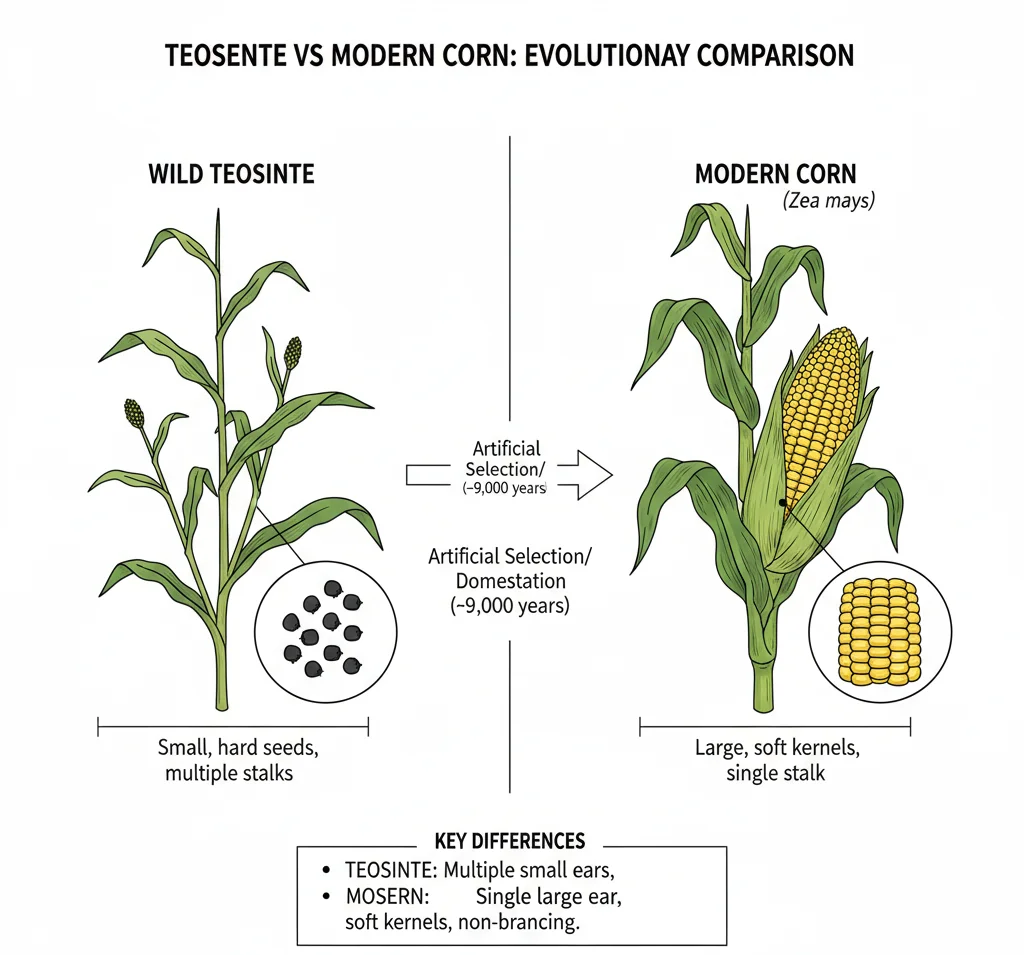
82.2 The Animal Transformation
We took the fierce Aurochs (wild ox) and turned it into the docile Cow.
We took the Wild Boar and turned it into the Pink Pig.
This created a symbiotic relationship. The animals got protection and food; we got meat, milk, and labor. But they lost their freedom and brains (domestic animals have smaller brains than their wild ancestors).
83.0 THE TRAP OF LUXURY
Historian Yuval Noah Harari famously called the Agricultural Revolution "History's Biggest Fraud."
Why? Because for the individual human, life got worse.
- Harder Work: A hunter works 4 hours a day. A farmer works from sunrise to sunset, breaking his back (literally—skeletal remains of early farmers show massive spinal damage).
- Worse Diet: Hunters ate 50 types of plants and animals. Farmers ate mostly wheat/rice. This lack of variety led to vitamin deficiencies and stunted growth. (The average height dropped by 10 cm).
- Disease: Living close to animals and their waste (manure) introduced Zoonotic Diseases: Smallpox (from cows), Flu (from pigs/ducks), Measles (from cattle).
Why did we do it?
Because it allowed for More People. Farming produces 100x more calories per acre than foraging. It feeds a population explosion.
Evolution doesn't care if you are happy or healthy; it only cares if you make more copies of yourself. Farming was a victory for the DNA, but a tragedy for the individual.
84.0 THE BIRTH OF PROPERTY AND WAR
With farming came Surplus (extra food).
Surplus can be stolen. So you build walls (Jericho).
You need someone to guard the surplus (Soldiers).
You need someone to count the surplus (Bureaucrats/Kings).
Thus, the concept of "Mine" vs "Yours" was born. The egalitarian bands of hunters were replaced by strict Hierarchies, Kings, and Slaves. The "State" was born.
85.0 THE ACCELERATION: WRITING AND METAL
After the invention of agriculture, cultural evolution overtook biological evolution.
The Speed: It took millions of years to go from the Stone Chopper to the Hand Axe. It took only 5,000 years to go from the first Wheel to the Moon Landing.
- Writing (3200 BCE): In Sumer, humans invented a way to store information outside the brain. This allowed knowledge to accumulate across generations, creating "Collective Learning."
- The Age of Metals: Copper, Bronze, and Iron gave us tools to reshape the planet and weapons to kill each other more efficiently.
86.0 THE ANTHROPOCENE: THE HUMAN EPOCH
Geologists divide Earth's history into epochs (Pleistocene, Holocene).
Many scientists argue we have entered a new one: The Anthropocene.
Definition: An epoch where human activity is the dominant influence on climate and the environment. We are no longer just residents; we are the architects (and destroyers).
86.1 The Technofossils
If a geologist looks at the rock layers of 2026 AD in 100 million years, what will they see?
- Plastiglomerates: Rocks fused with melted plastic.
- Radioactive Isotopes: A distinct layer of plutonium-239 from nuclear bomb tests (1945-present).
- Chicken Bones: We eat 65 billion chickens a year. Their fossilized bones will be the defining marker of our civilization.
87.0 THE SIXTH EXTINCTION
We are currently living through the Sixth Mass Extinction.
The Rate: Species are going extinct 100 to 1,000 times faster than the natural background rate.
The Cause: Unlike the asteroid that killed the dinos, this time the asteroid is Us. Through habitat destruction, climate change, and pollution, we are pruning the tree of life. Large mammals (Rhinos, Elephants, Tigers) are on the brink, just like the Megafauna of the Ice Age.
88.0 THE FUTURE OF EVOLUTION: HOMO DEUS?
Has human evolution stopped?
Biologically, Natural Selection is weak now (medicine keeps everyone alive).
But a new force has taken over: Intelligent Design (by Us).
88.1 Genetic Engineering (CRISPR)
We now have the technology (CRISPR-Cas9) to edit DNA.
We can potentially cure genetic diseases, increase intelligence, or adapt humans for life on Mars. We are seizing control of the source code of life. We are becoming the first species to direct its own evolution.
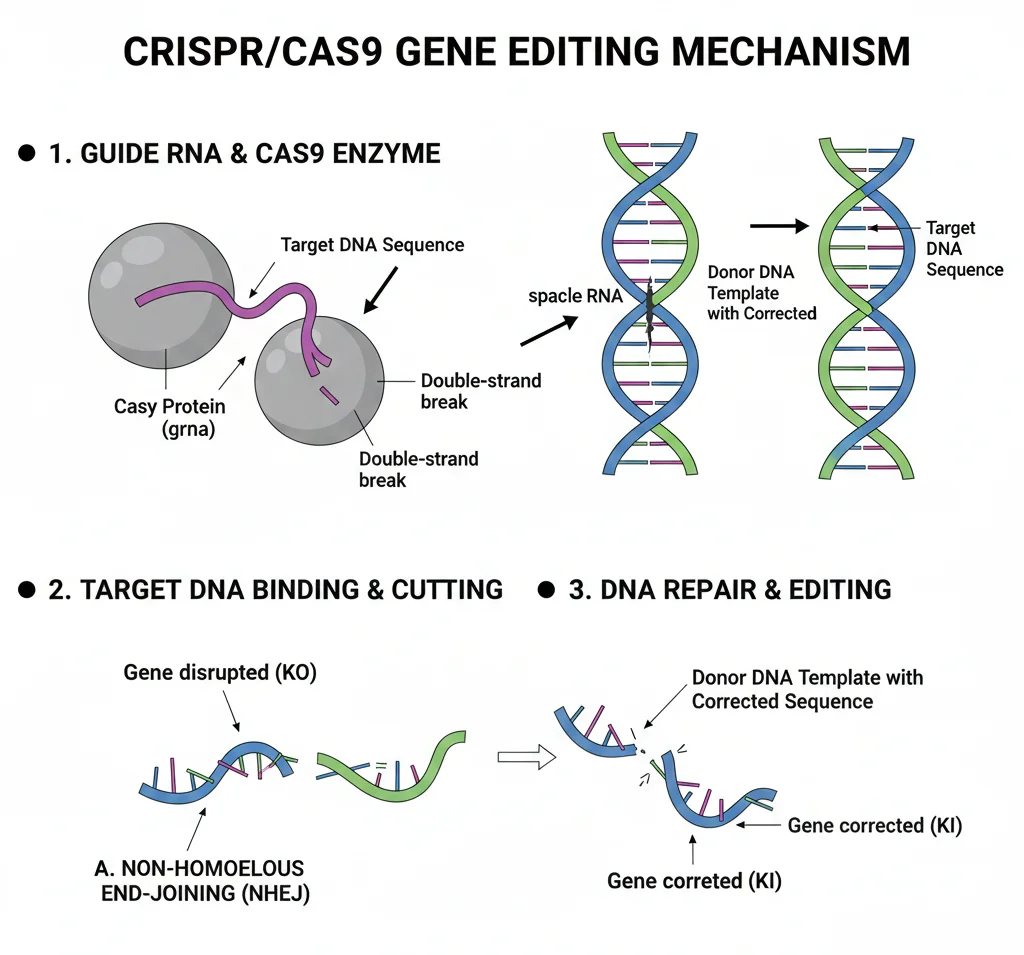
88.2 The Singularity (AI Integration)
The next step might not be biological. It might be the merger of biology and machine. Neuralink interfaces and Artificial Intelligence could create a hybrid species. Historian Yuval Noah Harari calls this future being Homo Deus (God Man).
89.0 GRAND SUMMARY OF CHAPTER 2 (THE HISTORY OF EARTH)
We have traveled 4.56 billion years. Let's look back at the milestones of this epic journey:
- 🌋 Hadean (4.5 BYA): Earth is born. The Moon forms. Hell on Earth.
- 🌊 Archean (4.0 BYA): Water oceans form. First Life (LUCA) appears.
- 🦠 Proterozoic (2.5 BYA): Cyanobacteria invent Photosynthesis. The Great Oxygen Event kills almost everything but paves the way for complex cells (Eukaryotes).
- 🦂 Paleozoic (541 MYA): Cambrian Explosion. Life invades the Land. Fish -> Amphibians -> Reptiles. Ends with the Great Dying (Permian Extinction).
- 🦖 Mesozoic (252 MYA): The Age of Reptiles. Dinosaurs, Pterosaurs, and Marine Reptiles rule. Flowers appear. Ends with the Asteroid (K-Pg).
- 🐒 Cenozoic (66 MYA): The Age of Mammals. Whales return to the sea. Grasslands spread. Primates stand up.
- 🔥 The Human Era: Homo sapiens tames fire, invents gods, builds cities, and splits the atom.
90.0 EPILOGUE: THE PALE BLUE DOT
We are the universe becoming aware of itself.
We are the only species that knows how we got here. We are the only species that knows the dinosaurs died. We are the only species that can worry about the future.
The story of Earth is a story of resilience. Life has been nearly wiped out five times, but it always came back stronger.
Now, the pen is in our hands. The next chapter will be written not by blind natural selection, but by human choice.
END OF CHAPTER 2
(The Origin of Life and Evolution)
VOL III
HUMAN HISTORY AND CIVILIZATIONS
1.0 THE LAND BETWEEN THE RIVERS
We left Chapter 2 in the Neolithic era. Humans had learned to farm, but they still lived in small, egalitarian villages.
Around 4500 BCE, in the southern part of modern-day Iraq, something changed.
This region is Mesopotamia (Greek for "Between the Rivers": the Tigris and the Euphrates).
1.1 The Challenge of the Environment
Southern Mesopotamia (Sumer) was not a paradise. It was a hot, dry swamp with no rain, no stone, and no timber.
But it had two things:
1. Extremely Fertile Mud: Brought down by the rivers.
2. Water: But the water was chaotic. The rivers flooded violently and unpredictably.
2.0 THE INVENTION OF THE STATE: HYDRAULIC EMPIRE
To survive here, you couldn't just throw seeds on the ground. You needed Irrigation (Canals, Levees, Dams).
But a single farmer cannot build a dam. A whole village cannot build a massive canal system.
You need thousands of people working together.
You need a plan.
You need someone to give orders.
The Result: The need for water management created the first Centralized Government (The State). The erratic rivers forced humans to organize or die.
3.0 THE FIRST CITY: URUK
Around 4000 - 3200 BCE, the village of Uruk exploded in size. It became the world's first true city.
- Population: At its peak, it housed 40,000 - 80,000 people. This was unprecedented in human history.
- Architecture: Since there was no stone, they invented the Mud Brick. They built massive walls and towering temples called Ziggurats to get closer to the gods.
- Social Classes: For the first time, not everyone was a farmer. There were priests, potters, soldiers, and kings. The egalitarian life of the hunter-gatherer was gone.
4.0 THE INVENTION OF WRITING: CUNEIFORM
As the city grew, the temple priests faced a problem: "How much grain did Farmer Enki give us? Did we pay the workers their beer rations?"
The human brain cannot remember millions of transactions.
Around 3400 BCE, the Sumerians invented Writing.
Not for Poetry: It didn't start as literature. It started as Accounting.
They used a reed stylus to press wedge-shaped marks into wet clay. This system is called Cuneiform ("Wedge-Shaped").
This invention divided human existence into two eras:
1. Prehistory: Before writing (we guess what happened).
2. History: After writing (they tell us what happened).
5.0 THE WHEEL
We often joke "who invented the wheel?"
It was the Sumerians (around 3500 BCE).
Surprisingly, it wasn't invented for transport first. It was invented as a Potter's Wheel to mass-produce bowls. Later, someone flipped it on its side, put an axle through it, and attached it to a chariot. This revolutionized trade and warfare.
6.0 THE GODS AND THE ZIGGURATS
In the flat plains of Sumer, the sky felt huge and distant. To reach the gods, the Sumerians built artificial mountains called Ziggurats.
- Structure: Unlike Egyptian pyramids (which were tombs), Ziggurats were Temples. They were stepped towers made of mud brick, with a shrine on the very top.
- Function: The god lived in that top shrine. Only the High Priest could enter. It was the "waiting room" for the deity.
- City States: Each city belonged to a specific god. Eridu belonged to Enki (Water), Ur belonged to Nanna (Moon), and Uruk belonged to Inanna (Love & War).
7.0 A PESSIMISTIC RELIGION
The Sumerians were not optimistic people.
Because their rivers flooded violently and killed randomly, they believed the gods were capricious and cruel.
The Purpose of Man: According to their myths, the gods got tired of working (digging canals). So, they created Humans out of clay to be their Slaves.
We were not created to be loved; we were created to do the heavy lifting.
The Afterlife: There was no Heaven. When you died, you went to the "House of Dust" (Irkalla). Everyone—kings and slaves alike—sat in darkness, eating dust and clay, dressed in feathers like birds. It was a bleak existence.
8.0 THE FIRST SUPERHERO: GILGAMESH
Around 2100 BCE (though the oral stories are older), the Sumerians wrote down the Epic of Gilgamesh. It is the oldest surviving great work of literature.
8.1 The King and the Wild Man
Gilgamesh was the King of Uruk. He was 2/3 God and 1/3 Man.
He was strong but arrogant. He abused his people.
To teach him a lesson, the gods created a wild man named Enkidu.
Enkidu lived with the animals. But after being "civilized" by a temple priestess, he went to Uruk to fight Gilgamesh. They fought to a draw and became best friends. (The original "Bromance").
Together, they went on adventures, killing the Monster Humbaba and the Bull of Heaven. They defied the gods.
8.2 The Fear of Death
The gods were angry. They sentenced Enkidu to death.
Watching his friend die, Gilgamesh had the first recorded Existential Crisis in history.
"If my friend can die, I can die too. I don't want to be dust."
8.3 The Quest for Immortality
Gilgamesh abandoned his throne and traveled to the end of the world to find the only human who had become immortal: Utnapishtim.
The Flood Story: Utnapishtim tells Gilgamesh a story. Long ago, the gods decided to drown the world with a Flood. The god Enki warned Utnapishtim to build a giant boat and put animals in it.
(Note: This was written >1000 years before the Bible's Noah story. It is the source material for the Genesis Flood).
8.4 The Lesson
Utnapishtim tells Gilgamesh: "You cannot live forever."
Gilgamesh finds a "Plant of Youth," but a snake eats it while he is sleeping (explaining why snakes shed their skin—they are reborn).
Gilgamesh returns to Uruk empty-handed. But as he looks at the massive walls of his city, he realizes the truth:
Immortality is not living forever. Immortality is leaving a legacy that people will remember.
And he was right. We are still talking about him 4,000 years later.
9.0 THE AKKADIAN EMPIRE: THE FIRST EMPIRE
Sumer was a collection of independent City-States (like Uruk, Ur, Lagash) that fought each other.
Around 2334 BCE, a man named Sargon of Akkad changed the rules.
He didn't just conquer a neighbor; he conquered all of them. He united the Sumerian speakers and the Akkadian speakers under one rule.
He created the world's first Empire (a state containing many different nations/peoples).
He standardized weights and measures. He created the first standing army. But like all empires, it eventually collapsed under drought and invasion.
10.0 THE RISE OF BABYLON
After the fall of the Akkadian Empire, the region fell into chaos. Around 1894 BCE, a new Amorite dynasty established a small city-state named Babylon (Bab-ili: "Gate of the God").
Under King Hammurabi (1792–1750 BCE), this city conquered all of Mesopotamia. The era of Sumer was over; the era of Babylon had begun.
11.0 THE CODE OF HAMMURABI: LAW IN STONE
Hammurabi was a brilliant general, but he wanted to be remembered as the "King of Justice."
He compiled 282 laws and carved them onto a massive, finger-shaped black basalt stele (pillar), 2.25 meters high.
11.1 "Eye for an Eye" (Lex Talionis)
The Code is famous for its principle of Retaliation.
"If a man puts out the eye of another man, his eye shall be put out."
"If a builder builds a house and it collapses and kills the owner, that builder shall be put to death."
11.2 Class Justice
However, justice was not equal. It depended on your social class.
1. Awilum (Free Man/Noble): If you hurt a noble, you get hurt back (Eye for an Eye).
2. Mushkenum (Commoner): If a noble hurts a commoner, he just pays a fine.
3. Wardum (Slave): A slave was property. If you killed someone's slave, you just paid the owner the price of the slave.
Despite this inequality, the Code was revolutionary because it introduced the Presumption of Innocence ("The accuser must bring witnesses") and established that the Law is written and unchangeable, not just the King's whim.
12.0 THE MATHEMATICS OF TIME (BASE-60)
Look at your watch. Why is a minute 60 seconds? Why is an hour 60 minutes?
Because of the Babylonians.
Most cultures count in Base-10 (because we have 10 fingers).
The Sumerians and Babylonians counted in Base-60 (Sexagesimal).
Why 60? Because 60 is a "Superior Highly Composite Number." It can be easily divided by 1, 2, 3, 4, 5, 6, 10, 12, 15, 20, and 30. This made trade and division incredibly easy without needing fractions.
We still use their system today for:
1. Time: 60 seconds, 60 minutes.
2. Geometry: 360 degrees in a circle (6 x 60).
13.0 ASTRONOMY AND OMENS
The Babylonians were obsessed with the sky. They believed the movement of planets was the handwriting of the gods.
They built massive archives of planetary positions (Enuma Anu Enlil).
The Zodiac: They were the first to divide the sky into 12 sections (The Zodiac) to track the path of the sun. If you check your horoscope today, you are using a system invented in Babylon 3,000 years ago.
14.0 THE TOWER OF BABEL
The Bible speaks of a tower built to reach heaven. This was almost certainly a reference to the Etemenanki, the great Ziggurat of Babylon dedicated to the god Marduk. It stood 91 meters tall, a multicolored mountain of brick rising from the flat plains, impressing (and terrifying) all visitors, including the Hebrews.
END OF TOPIC 1
15.0 THE GEOGRAPHY OF ETERNITY
While Mesopotamia was a chaotic crossroads open to invasion, Egypt was a fortress designed by nature.
It was surrounded by deadly deserts to the West and East, cataracts (waterfalls) to the South, and the sea to the North.
The Result: Egypt enjoyed thousands of years of isolation and peace. This allowed them to build a culture focused not on war (like Assyria) but on Eternity and Stability.
16.0 THE ENGINE: THE NILE RIVER
The Greek historian Herodotus famously said, "Egypt is the gift of the Nile."
Without this river, the entire region is just part of the Sahara Desert.
- The Direction: The Nile flows North (from the mountains of Africa to the Mediterranean Sea). This confuses modern map readers.
Upper Egypt: Is in the South (Highlands).
Lower Egypt: Is in the North (The Delta). - The Clockwork Flooding: Unlike the violent Tigris/Euphrates, the Nile flooded predictably every year (The Inundation or Akhet). It brought nutrient-rich black silt. Farmers didn't have to fertilize the soil; the river did it for them.
16.1 Kemet vs. Deshret
The Egyptians didn't call their country "Egypt." They called it Kemet ("The Black Land"), referring to the fertile river banks.
Beyond the river lay Deshret ("The Red Land"), the deadly desert.
The boundary was so sharp you could stand with one foot in a lush field and the other in burning sand. This duality (Life vs. Death) shaped their entire worldview.
17.0 THE UNIFICATION: NARMER (3100 BCE)
For a long time, the Nile valley was divided into two rival kingdoms: Upper Egypt (White Crown) and Lower Egypt (Red Crown).
Around 3100 BCE, a king from the South named Narmer (or Menes) marched North and conquered the Delta.
The Narmer Palette: This stone tablet depicts Narmer smashing the skull of his enemy. It is the "First Historical Document" of Egypt.
Narmer created the Double Crown (Pschent), combining the White and Red crowns. He founded the First Dynasty and built the capital at Memphis (where the two lands meet).
18.0 THE PHARAOH: GOD ON EARTH
In Mesopotamia, the king was a "Representative of the Gods." He was human.
In Egypt, the King (later called Pharaoh) WAS a God.
- Horus Incarnate: While alive, the Pharaoh was the falcon-god Horus.
- Osiris Incarnate: When he died, he became Osiris, the god of the underworld.
Absolute Power: Because he was a god, his word was the law of nature. If the Pharaoh was healthy, the Nile would flood. If he was weak, the sun might not rise. This created a highly centralized state where the entire economy revolved around the King.
19.0 THE CONCEPT OF MA'AT
The glue holding this society together was Ma'at.
Ma'at is a concept difficult to translate. It means Truth, Balance, Order, and Justice.
The universe is a machine that runs on Ma'at.
The Pharaoh's only job was to maintain Ma'at (keep out chaos/enemies). If he failed, the world would dissolve back into the primordial waters of chaos (Nun). This is why Egyptians hated change. Change was the enemy of Ma'at.
20.0 THE OLD KINGDOM: THE AGE OF BUILDERS
The Old Kingdom (c. 2686–2181 BCE) is the era when Egypt figured out how to work with stone on a massive scale.
Before this, kings were buried in simple mud-brick benches called Mastabas.
21.0 THE FIRST ARCHITECT: IMHOTEP
Around 2670 BCE, King Djoser wanted something grander.
He hired a genius named Imhotep. Imhotep is the first architect, doctor, and engineer known by name in history.
The Innovation: Imhotep decided to stack six Mastabas on top of each other, each smaller than the one below.
The result was the Step Pyramid of Saqqara. It was a "Stairway to Heaven" for the Pharaoh's soul to climb to the stars. It was the world's first monumental stone structure.
22.0 THE GIZA PLATEAU
A few generations later, the Egyptians perfected the design. They filled in the steps to create a smooth, "True Pyramid."
The climax of this era is the Giza Plateau.
22.1 The Great Pyramid of Khufu (Cheops)
Built around 2560 BCE.
It remained the tallest man-made structure in the world for 3,800 years (until Lincoln Cathedral in 1311 AD).
- Stats: It consists of 2.3 million stone blocks. Each weighs an average of 2.5 tons. Some (the granite in the King's Chamber) weigh up to 80 tons.
- Precision: The base is almost a perfect square, aligned to the four cardinal points (North, South, East, West) with incredible accuracy.
22.2 Khafre and Menkaure
Khufu's son, Khafre, built the second pyramid (it looks taller because it sits on higher ground).
His grandson, Menkaure, built the third and smallest one. By then, the economy was straining under the cost of these massive projects.
23.0 HOW DID THEY BUILD THEM?
Myth: They were built by Jewish slaves or Aliens.
Reality: They were built by paid Egyptian workers.
The Workforce: Farmers cannot farm during the flood season (3 months a year). Instead of sitting idle, they worked for the King in exchange for food, beer, and tax breaks. It was a national project that united the country.
The Tech: They didn't have wheels (for heavy loads) or iron tools. They used:
1. Copper Chisels: To cut limestone.
2. Dolerite Balls: To pound granite.
3. Water and Sledges: They poured water on the sand in front of the sledges to reduce friction by 50%.
4. Ramps: Massive earthen ramps (straight or spiraling) to drag stones up.
24.0 THE GREAT SPHINX
Guarding the pyramid of Khafre is the Sphinx.
It has the body of a lion and the head of a human (likely King Khafre himself).
The Nose: The nose is missing. Legend says Napoleon's soldiers shot it off. This is false. Sketches from before Napoleon show the nose was already gone. It was likely destroyed by a religious zealot in the 14th century who saw it as an idol.
25.0 THE COLLAPSE OF THE OLD KINGDOM
Why did the pyramid age end?
Around 2181 BCE, the Nile stopped flooding. A massive drought lasted for decades. Famine struck. The central government collapsed. The local governors (Nomarchs) seized power.
Egypt entered a dark age called the First Intermediate Period. The pyramids were looted, and "Ma'at" was lost.
26.0 THE VALLEY OF THE KINGS
After the chaos of the intermediate periods, the New Kingdom (c. 1550–1070 BCE) emerged.
The Pharaohs realized that pyramids were essentially giant advertisements saying "Treasure Here!"
Instead, they chose a remote, dry canyon in Upper Egypt (near Luxor/Thebes) to hide their tombs. This is the Valley of the Kings.
Here, they dug deep tunnels into the limestone cliffs, decorating the walls with spells and filling the chambers with gold, preparing for the afterlife in secret.
27.0 THE SCIENCE OF MUMMIFICATION
The Egyptians believed that the Soul (Ka) needed a physical body to recognize and return to. If the body decayed, the soul died. Preservation was not a hobby; it was a matter of spiritual survival.
27.1 The Process (70 Days)
- Brain Removal: They believed the brain was useless (just mucus). They inserted a hook through the nose, scrambled the brain, and pulled it out.
- Evisceration: They removed the stomach, liver, lungs, and intestines. These were preserved separately in Canopic Jars.
- The Heart: The heart was left inside the body. It was considered the seat of intelligence and the soul.
- Dehydration: The empty body was covered in Natron (a natural salt) for 40 days. This sucked out all moisture, turning the body into "human jerky."
- Wrapping: Finally, it was wrapped in hundreds of meters of linen, with amulets tucked between the layers for magical protection.
28.0 THE SOUL: KA AND BA
We think of the "Soul" as one thing. They thought of it as parts:
1. Ka: The life force (Spark). It stays in the tomb and eats the food offerings.
2. Ba: The personality (Head of a human, body of a bird). It can fly out of the tomb during the day but must return to the mummy at night.
3. Akh: The glorified spirit that lives among the stars if you pass the final test.
29.0 THE BOOK OF THE DEAD
Dying was just the beginning. The underworld (Duat) was a dangerous place full of demons, snakes, and lakes of fire.
To survive, you needed a guide.
The Book of the Dead was a collection of magic spells (written on papyrus and placed in the coffin). It was essentially a "Cheat Sheet" for the afterlife. It told you the secret passwords to get past the gatekeeper demons.
30.0 THE FINAL EXAM: WEIGHING OF THE HEART
If you survived the journey, you arrived at the Hall of Ma'at for the ultimate judgment.
- The Judges: You stood before Osiris and 42 judges. You had to make the "Negative Confession" (e.g., "I have not killed," "I have not stolen," "I have not polluted the river").
- The Scale: Anubis (God of Embalming) took your Heart and placed it on a scale. On the other side, he placed the Feather of Ma'at (Truth).
30.1 The Verdict
Option A (Success): If your heart was lighter than or equal to the feather, you were pure. You entered the Field of Reeds (Aaru)—a perfect version of Egypt where the crops grow tall and there is no sickness.
Option B (Failure): If your heart was heavy with sin, it was thrown to Ammit.
Ammit was the "Devourer"—part crocodile, part lion, part hippo. She ate your soul. This was the "Second Death." Absolute non-existence. This was what Egyptians feared most.
31.0 HATSHEPSUT: THE WOMAN WHO WOULD BE KING
Around 1479 BCE, a woman shattered the glass ceiling.
Hatshepsut was supposed to be a regent for her young stepson (Thutmose III). Instead, she declared herself Pharaoh.
The Image: To prove her authority, she wore the traditional male royal kilt and the False Beard of the Pharaoh. Statues depict her with a masculine body.
Her Reign: She didn't conquer by war; she conquered by Trade. She launched a massive expedition to the mysterious Land of Punt (likely Somalia/Eritrea), bringing back exotic trees, gold, and incense. She was one of Egypt's most successful rulers.
The Erasure: After she died, her stepson tried to erase her name from history, smashing her statues. We only rediscovered her in the 19th century.
32.0 AKHENATEN: THE HERETIC KING
Around 1353 BCE, Amenhotep IV took the throne and did the unthinkable.
He changed his name to Akhenaten ("Living Spirit of Aten").
He declared that all the old gods (Amun, Osiris, Isis) were fake. There was only one god: The Aten (The Sun Disk).
The Revolution: This was the world's first attempt at Monotheism.
He built a new capital in the middle of the desert (Amarna).
The Art: He changed Egyptian art. Instead of rigid, perfect bodies, he ordered artists to show him as he really was: with a potbelly, long face, and thin limbs. It was a bizarre, short-lived period of realism.
33.0 TUTANKHAMUN: THE GOLDEN BOY
Akhenaten's revolution failed. After he died, the priests restored the old gods.
His son, Tutankhamun, took the throne at age 9 and died at 19 (likely from malaria and a broken leg).
Why is he famous? Historically, he was a minor king.
But in 1922, British archaeologist Howard Carter found his tomb in the Valley of the Kings. Unlike all others, it had never been robbed.
It contained over 5,000 artifacts, including the famous 11kg solid gold death mask. He shows us the unimaginable wealth that major pharaohs like Ramses must have had before they were looted.
34.0 RAMSES II: THE GREAT
Ramses II (ruled 1279–1213 BCE) is the image of the ultimate Pharaoh.
He lived to be 90 years old, had over 100 children, and ruled for 66 years.
34.1 The Master Builder
He was obsessed with his own legacy. He put his name on every statue he found (even ones he didn't make).
His masterpiece is Abu Simbel: A temple carved directly into a mountain, guarded by four massive statues of himself.
34.2 The Battle of Kadesh (1274 BCE)
Ramses marched north to fight the Hittite Empire (from Turkey).
It was the largest chariot battle in history (5,000 chariots).
The result was a stalemate. Both sides claimed victory.
First Peace Treaty: Realizing neither could destroy the other, Ramses and the Hittite king signed the eternal Treaty of Kadesh. It is the oldest recorded peace treaty in the world. A copy hangs in the United Nations headquarters today.
35.0 THE COLLAPSE
Nothing lasts forever. After Ramses, the Bronze Age world began to crumble.
Around 1200 BCE, mysterious invaders known as the Sea Peoples attacked Egypt.
Egypt survived, but it was exhausted. It eventually fell under the rule of Libyans, Nubians, Persians, Greeks (Alexander the Great), and finally, the Romans (Cleopatra).
The age of the Pharaohs ended, but their stones still speak.
END OF TOPIC 2
36.0 BEFORE THE GREEKS: THE BRONZE AGE
Long before Socrates or Sparta, there were two great civilizations in the Aegean Sea. They were the "Greeks before the Greeks."
This is the Heroic Age, the era of myths, monsters, and massive palaces.
37.0 THE MINOANS: EUROPE'S FIRST CIVILIZATION
On the island of Crete, around 2700–1450 BCE, a sophisticated culture flourished. We call them the Minoans (named after the mythical King Minos).
37.1 The Palace of Knossos
They built massive, multi-story palaces with plumbing, flush toilets, and colorful frescoes.
The Labyrinth Myth: The palace at Knossos was so complex, with hundreds of winding rooms, that later Greeks thought it was a "Labyrinth" housing a monster (The Minotaur).
A Peaceful Society? Unlike other ancient civilizations, Minoan cities had no defensive walls. Their art shows nature, dolphins, and "Bull Leaping" (a sport where acrobats jumped over charging bulls), not war. They relied on their powerful navy for protection.
38.0 THE MYCENAEANS: THE WARRIOR KINGS
Around 1600 BCE, a more aggressive people from mainland Greece rose to power: The Mycenaeans.
They conquered the Minoans and took over their trade routes.
- Architecture of Fear: Unlike the open Minoan palaces, Mycenaean cities (like Mycenae and Tiryns) were heavily fortified fortresses built on hilltops.
Their walls were made of stones so huge that later Greeks believed only Cyclops (one-eyed giants) could have lifted them. We still call this Cyclopean Masonry. - The Mask of Agamemnon: Their tombs were filled with weapons and gold death masks, proving they were a warrior aristocracy obsessed with honor and battle.
39.0 THE TROJAN WAR: MYTH OR HISTORY?
The most famous event of this era is the Trojan War, immortalized by Homer in The Iliad.
The Myth: Paris of Troy kidnaps Helen (wife of King Menelaus). The Greeks, led by Agamemnon, besiege Troy for 10 years, finally winning with the Trojan Horse trick.
The History: For centuries, scholars thought Troy was a fairy tale.
In the 1870s, Heinrich Schliemann excavated a hill in Turkey (Hisarlik) and found massive burnt walls and gold jewelry.
Verdict: Troy was real (known as Wilusa to the Hittites). It was likely destroyed by an earthquake or war around 1200 BCE. Homer's story is a poetic memory of a real conflict over trade routes, not necessarily a fight over a woman.
40.0 THE BRONZE AGE COLLAPSE (1177 BCE)
Around 1200 BCE, the lights went out.
The Mycenaean palaces were burned. The Hittite Empire collapsed. Egypt was attacked.
Causes: A "Perfect Storm" of earthquakes, drought, internal rebellions, and invasion by the mysterious Sea Peoples.
The Result: Greece entered the Dark Ages. Writing (Linear B) was forgotten. Fine art vanished. The population plummeted. It would take 400 years for the Greek world to recover and re-emerge as the civilization we know today.
41.0 OUT OF THE DARKNESS: THE ARCHAIC AGE
From the ashes of the Bronze Age collapse, a new Greece emerged around 800 BCE.
This period (800–480 BCE) is called the Archaic Period.
The population exploded, trade restarted, and two monumental inventions changed everything: The Alphabet and the Polis.
42.0 THE ALPHABET REVOLUTION
The Greeks forgot their old writing (Linear B). When they started writing again, they didn't reinvent it; they borrowed it.
They took the Phoenician Alphabet (which had only consonants) and added something new: Vowels (A, E, I, O, U).
Why this matters:
Hieroglyphs and Cuneiform were hard. You needed years to learn them.
The Greek Alphabet was phonetic and simple. A child could learn it. This Democratized Literacy. It meant laws, poetry (Homer), and philosophy could be read by ordinary citizens, not just scribes.
43.0 THE INVENTION OF THE POLIS
Geography shaped politics. Greece is mountainous, dividing the land into isolated valleys.
Instead of a giant empire (like Egypt), Greece split into hundreds of independent City-States.
They called this the Polis.
- Definition: A Polis was not just a city (buildings); it was a community of citizens.
- Structure:
- Acropolis: High city (fortified hill for temples).
- Agora: The marketplace and gathering spot. This was the heart of the city, where politics happened. - The Citizen: For the first time, people were not "Subjects" of a King; they were "Citizens" of a Polis. They had rights and duties (mostly to fight for the city).
44.0 THE GREAT COLONIZATION (FROGS AROUND A POND)
The rocky soil of Greece couldn't feed the growing population. So, they exported people.
Between 750–550 BCE, Greek cities sent out waves of ships to found new cities (Colonies).
Plato later joked: "We Greeks sit around the Mediterranean like frogs around a pond."
They founded:
- Byzantium (Istanbul)
- Neapolis (Naples)
- Massalia (Marseille)
- Syracuse (Sicily)
They didn't conquer natives; they built "Apoikia" (Homes away from home), spreading Greek culture everywhere.
45.0 THE OLYMPIC GAMES (776 BCE)
Despite being divided into rival cities, they shared a culture: Hellenism.
They spoke the same language, worshipped the same gods (Zeus, Hera, Apollo), and read the same poet (Homer).
To celebrate this unity, they established the Olympic Games in 776 BCE at Olympia.
- The Sacred Truce: During the games, all wars were paused. Athletes from warring cities competed naked (gymnos) in running, wrestling, and chariot racing.
- The Prize: No money. Just a wreath of olive leaves and eternal glory (Kleos).
- Timekeeping: The Greeks loved the Olympics so much they used it as their calendar. They counted years in "Olympiads" (4-year cycles) starting from 776 BCE.
46.0 SPARTA: THE MILITARY MACHINE
While Athens was experimenting with democracy and art, Sparta (Lacedaemon) turned itself into an armed camp.
They were the only Greek city without defensive walls.
When asked why, a Spartan King pointed to his soldiers and said: "These are the walls of Sparta."
47.0 THE ROOT OF FEAR: THE HELOTS
Why was Sparta so obsessed with war? Fear.
Centuries earlier, Sparta conquered their neighbors, the Messenians, and turned them into state slaves called Helots.
The Helots outnumbered the Spartans 7 to 1.
The entire Spartan society was designed for one purpose: To create soldiers strong enough to prevent a Helot revolt. They were prisoners of their own conquest.
48.0 THE AGOGE: SURVIVAL OF THE FITTEST
The legendary lawgiver Lycurgus created the system.
If a baby was born weak or deformed, it was thrown off a cliff (Mount Taygetos). Only the strong were allowed to live.
- Age 7: Boys were taken from their mothers and put into military barracks (The Agoge).
- The Hardship: They were given one cloak for the whole year. No shoes. They slept on reeds. They were barely fed to encourage them to Steal Food.
Lesson: If you steal and get away with it, you have good stealth skills. If you get caught, you are whipped—not for stealing, but for being caught. - Age 20: If they survived, they became full citizens (Similars) and joined a dining mess (Syssitia). They remained soldiers until age 60.
49.0 WITH YOUR SHIELD OR ON IT
The Spartan ethos was total selflessness. You did not exist for yourself; you existed for the State.
The Phalanx: They fought in a tight formation called a Phalanx. Each soldier's shield protected the man to his left. If you dropped your shield and ran, you killed your neighbor.
Hence the famous farewell of Spartan mothers to their sons: "Come back with your shield, or on it" (Victory or Death).
50.0 SPARTAN WOMEN: THE FREE ONES
Surprisingly, Spartan women were the most liberated in Greece.
Unlike Athenian women (who were locked in the house), Spartan women:
1. Were educated.
2. Exercised outdoors naked (running, wrestling) to become strong mothers.
3. Could own land and handle finances (since the men were always at war).
When a foreign woman asked Queen Gorgo, "Why are you Spartan women the only ones who can rule over men?", she replied: "Because we are the only ones who give birth to men."
51.0 LACONIC WIT
Spartans hated long speeches. They valued brevity. (The region is Laconia, hence the word "Laconic").
Famous Example: Philip II of Macedon sent a threat to Sparta:
"If I enter Laconia, I will raze Sparta to the ground."
The Spartans sent back a reply containing just one word:
"If."
52.0 ATHENS: THE EXPERIMENT
If Sparta was the shield of Greece, Athens was the spear.
Located on the rocky peninsula of Attica, Athens turned to the sea. They became merchants, sailors, and thinkers.
While Spartans feared change, Athenians were addicted to it.
53.0 THE ROAD TO DEMOCRACY
Democracy was not planned; it was a solution to civil war.
Early Athens was ruled by aristocrats (Oligarchy). The poor were suffering. If a farmer couldn't pay his debts, he was sold into slavery. The city was on the verge of exploding.
53.1 Draco: Written in Blood (621 BCE)
The first attempt to fix things failed. A lawmaker named Draco wrote the first written laws of Athens.
They were incredibly harsh. Stealing a cabbage? Death. Idleness? Death. Murder? Death.
Plutarch said Draco's laws were "written not in ink, but in blood." Hence, the modern word "Draconian" (excessively harsh).
53.2 Solon: The Shaking Off of Burdens (594 BCE)
Realizing Draco's laws were causing chaos, the Athenians gave absolute power to a poet and merchant named Solon.
He made a radical move: He canceled all debts.
He outlawed debt slavery. He liberated the people but didn't give them full power yet. He was the moderate hero Athens needed.
54.0 CLEISTHENES: FATHER OF DEMOCRACY (508 BCE)
After a period of Tyrants, the people revolted. A nobleman named Cleisthenes sided with the common people.
In 508 BCE, he introduced a system called Demokratia (Demos = People, Kratos = Power).
The Innovation:
He broke the old power of the wealthy families by mixing the population into 10 new "Tribes" based on geography, not bloodline.
He created the Council of 500 (Boule), where citizens were chosen by Lottery, not by election (because elections favor the rich/famous, lottery implies equality).
55.0 HOW IT WORKED: DIRECT DEMOCRACY
Modern democracy is "Representative" (we elect people to decide for us).
Athenian democracy was Direct.
Every eligible citizen (adult male born in Athens) went to the Pnyx hill. They listened to speeches and voted directly on everything: War, taxes, laws.
The Flaw: It was an exclusive club. Women, foreigners (Metics), and Slaves were excluded. Only about 10-20% of the population could actually vote. But for those 10-20%, it was radical equality.
56.0 OSTRACISM: THE SAFETY VALVE
The Athenians were terrified of one man becoming too powerful (a Tyrant).
Once a year, they held a special vote. Citizens would scratch a name on a piece of broken pottery (called an Ostrakon).
If a person received 6,000 votes, they were Exiled (Ostracized) for 10 years.
It wasn't a punishment for a crime; it was a "Time-Out" for being too popular or ambitious. It was how democracy protected itself from charisma.
57.0 THE GIANT AWAKENS: THE PERSIAN WARS
In 499 BCE, the Greek cities in Ionia (modern Turkey) rebelled against their Persian masters. Athens sent ships to help them and burned the Persian city of Sardis.
The revolt failed.
King Darius I of Persia was furious. He ordered a servant to stand by him at dinner every night and whisper: "Master, remember the Athenians."
The goal was no longer just punishment; it was total conquest.
58.0 ROUND 1: THE BATTLE OF MARATHON (490 BCE)
Darius sent a massive fleet to destroy Athens. They landed at the Bay of Marathon, just 42 km from the city.
Athens asked Sparta for help, but the Spartans were celebrating a religious festival (Carneia) and refused to march until the full moon. Athens was alone.
58.1 The Charge
10,000 Athenians faced a Persian army twice their size.
Instead of waiting, the Athenian general Miltiades ordered a run. The heavy Greek hoplites charged the Persian archers.
Technology vs Numbers: The Persians wore cloth armor and used wicker shields. The Greeks wore bronze armor and had long spears. In close combat, the Persians were slaughtered. 6,400 Persians died; only 192 Athenians fell.
The Run: Legend says a runner named Pheidippides ran the 42 km back to Athens to announce the victory ("Nike!"), then collapsed and died. This is the origin of the modern Marathon race.
59.0 THE INTERLUDE: THE WOODEN WALL
Darius died, but his son Xerxes prepared an even bigger invasion.
In Athens, a brilliant politician named Themistocles saw it coming.
When Athens found a new vein of silver in their mines, Themistocles convinced the people not to distribute the cash, but to build a massive navy of Triremes (warships).
The Oracle of Delphi prophesied that only a "Wooden Wall" would save Athens. Themistocles argued that the "Wooden Wall" was the ships.
60.0 ROUND 2: THERMOPYLAE (480 BCE)
Xerxes arrived with an army so huge (Herodotus says millions, historians say ~200,000) that it "drank rivers dry."
The Greeks needed to buy time for the navy to get ready.
King Leonidas of Sparta led a small force (300 Spartans + ~7,000 allies) to block the narrow pass of Thermopylae ("The Hot Gates").
60.1 "Molon Labe"
When Xerxes ordered them to surrender their weapons, Leonidas replied: "Molon Labe" (Come and take them).
For three days, the Greeks held the pass. The massive numbers of the Persians were useless in the narrow gap. The Spartans slaughtered wave after wave, even the elite "Immortals."
The Betrayal: A local traitor named Ephialtes showed the Persians a mountain path to surround the Greeks.
Leonidas dismissed the allies but stayed behind with his 300 Spartans (and 700 Thespians) to die fighting, fulfilling a prophecy that a Spartan King must die to save Greece. They were wiped out, but their sacrifice inspired all of Greece to unite.
61.0 THE TURNING POINT: SALAMIS (480 BCE)
Xerxes marched on and burned Athens to the ground. The Athenians fled to the island of Salamis.
Themistocles tricked Xerxes into attacking the Greek fleet in the narrow straits between the island and the mainland.
The Trap: The large, heavy Persian ships couldn't maneuver in the tight space. They crashed into each other.
The smaller, faster Greek triremes rammed them, smashing their hulls.
Xerxes watched from a golden throne on a hill as his navy—his supply line—was destroyed. He returned to Persia in defeat, leaving his army to be finished off at the Battle of Plataea a year later.
62.0 THE SIGNIFICANCE
If Persia had won, there would likely be no democracy, no "Classical" art, and no Western philosophy as we know it. Europe would have become a province of the East. The Greek victory preserved the seed of Western Civilization.
63.0 THE GOLDEN AGE OF ATHENS
After defeating the Persians, Athens felt invincible.
For roughly 50 years (480–430 BCE), under the leadership of Pericles, the city produced more genius per capita than any other place in human history.
64.0 THE DELIAN LEAGUE: FROM ALLIANCE TO EMPIRE
To prevent the Persians from returning, Athens formed a grand alliance called the Delian League.
Hundreds of Greek cities paid money into a treasury kept on the island of Delos.
The Heist: In 454 BCE, Pericles moved the treasury from Delos to Athens. He used this money not for defense, but to rebuild Athens in marble.
When allies complained, Athens crushed them. The "Defender of Liberty" had become a Tyrant City.
65.0 THE PARTHENON: THE TEMPLE OF OPTICAL ILLUSIONS
Pericles wanted to build a monument so beautiful that the world would never forget it.
On top of the Acropolis, he built the Parthenon, dedicated to Athena Parthenos (Athena the Virgin).
The Perfection: It looks like a simple box of columns. It is actually a mathematical masterpiece.
The Greeks knew that straight lines look curved from a distance (due to the eye's lens).
- Entasis: The columns bulge slightly in the middle to look straight.
- Curvature: The floor is not flat; it curves upward in the center. If it were flat, it would look like it was sagging.
- Tilt: The columns tilt slightly inward. If you extended them into the sky, they would meet 1.5 km above the temple.
- There is not a single straight line in the entire building. Everything is curved to appear straight.
66.0 THE INVENTION OF THEATRE
The Greeks invented drama as a religious festival for Dionysus (God of Wine and Ecstasy).
Twice a year, the whole city gathered in the Theatre of Dionysus (seating 15,000) to watch plays. It was a competition.
66.1 Tragedy: The School of Empathy
Playwrights like Sophocles, Aeschylus, and Euripides wrote Tragedies.
Famous Example: Oedipus Rex (The man who kills his father and marries his mother).
The Purpose: Why watch sad things? Aristotle called it Catharsis (Purification). By watching a hero suffer due to a fatal flaw (Hubris), the audience releases their own emotions of pity and fear, leaving the theatre "cleansed."
66.2 Comedy: The Power of Satire
Playwrights like Aristophanes wrote Comedies.
Nothing was off-limits. They made fun of the Gods, the Politicians (especially Pericles), and the Philosophers (Socrates was mocked as a cloud-gazer). It proves that Free Speech (Parrhesia) was alive and well in Athens.
67.0 THE AGE OF PERICLES
Pericles ruled Athens for 30 years. He was an aristocrat who led the common people.
In his famous Funeral Oration, he defined the Athenian spirit:
"We do not copy our neighbors, but are an example to them... Future ages will wonder at us, as the present age wonders at us now."
He was right. But his ambition would eventually lead Athens into a war that would destroy it.
68.0 FROM MYTHOS TO LOGOS: THE BIRTH OF PHILOSOPHY
Before the Greeks, explanations were religious.
"Why does it rain?" -> "Because the gods will it."
Around 600 BCE, in the Greek cities of Ionia (modern Turkey), a revolution occurred. Thinkers began to look for natural, rational explanations for the universe.
They called this Logos (Reason/Word).
68.1 The Pre-Socratics: The First Scientists
These early thinkers were essentially scientists without labs.
- Thales of Miletus: He predicted a solar eclipse in 585 BCE. He argued that the world wasn't held up by gods, but floated on water. He was wrong about the water, but right that there was a physical explanation.
- Heraclitus: "No man steps in the same river twice." He taught that the only constant in the universe is Change.
- Democritus: The most mind-blowing of them all. Without microscopes, he theorized that if you cut cheese into smaller and smaller pieces, eventually you reach a piece that cannot be cut. He called this Atomos (Uncuttable). He guessed the existence of atoms 2,400 years before modern science.
69.0 THE SOPHISTS: TEACHERS FOR HIRE
As Athens became a democracy, being able to speak well became the key to power.
A group of teachers called Sophists appeared. They taught rhetoric (the art of persuasion) for money.
Their Philosophy: "Man is the measure of all things." Truth is subjective. If you can convince the jury you are right, then you are right. They were the ancestors of modern lawyers and spin doctors.
70.0 SOCRATES: THE GADFLY OF ATHENS
Then came Socrates (470–399 BCE).
He was short, ugly, poor, and never wore shoes. He hated the Sophists because they charged money and didn't care about Truth.
He walked around the Agora asking people simple questions: "What is Justice?", "What is Courage?", "What is Piety?"
70.1 The Socratic Method
He never lectured. He only asked questions.
When a general claimed to know what courage was, Socrates would ask questions until the general contradicted himself.
The Goal: To show people that they didn't actually know what they thought they knew.
His Wisdom: The Oracle of Delphi said Socrates was the wisest man in Greece. Socrates replied:
"I am the wisest man alive, for I know one thing, and that is that I know nothing."
70.2 The Gadfly Analogy
He compared himself to a Gadfly (Horsefly) and Athens to a lazy horse. The horse wants to sleep, but the fly keeps biting it to keep it awake. Socrates kept Athens "awake" by irritating it with the truth.
71.0 THE TRIAL AND DEATH OF SOCRATES
After Athens lost the war to Sparta (see Part 9), the city was angry and paranoid. They needed a scapegoat.
They arrested Socrates, now 70 years old.
The Charges:
1. Corrupting the Youth (teaching them to question authority).
2. Impiety (not believing in the city's gods).
The Verdict: A jury of 501 citizens voted to convict him.
Instead of begging for mercy or fleeing into exile, Socrates mocked the jury. He said his "punishment" should be free meals for life for the service he did the city.
Furious, they sentenced him to death.
He calmly drank a cup of Hemlock (poison) while comforting his weeping friends. He chose to die rather than betray his principles, becoming the first martyr of philosophy.
72.0 PLATO: THE IDEALIST
Plato (428–348 BCE) was Socrates' prize student.
Devastated by his teacher's execution, he concluded that democracy was "Mob Rule" led by ignorant people.
He founded a school called The Academy (the ancestor of the modern University). Above the door, it read: "Let no one ignorant of geometry enter here."
72.1 The Theory of Forms (Ideas)
Plato asked: "Why can we never draw a perfect circle?"
Answer: Because everything in this world is imperfect and temporary.
He believed there is another realm, the World of Forms, where the "Perfect Circle," "Perfect Justice," and "Perfect Beauty" exist. Our world is just a poor copy (shadow) of that perfect world.
72.2 The Allegory of the Cave
In his famous book The Republic, he explains reality with a story:
Imagine prisoners chained in a cave, facing a wall. They see shadows cast by a fire behind them. They think the shadows are real.
One prisoner escapes, goes outside, and sees the Sun (The Truth).
When he returns to tell the others, they think he is crazy and try to kill him (just like Athens killed Socrates).
Meaning: We are the prisoners. The philosopher's job is to drag us into the light, even if we resist.
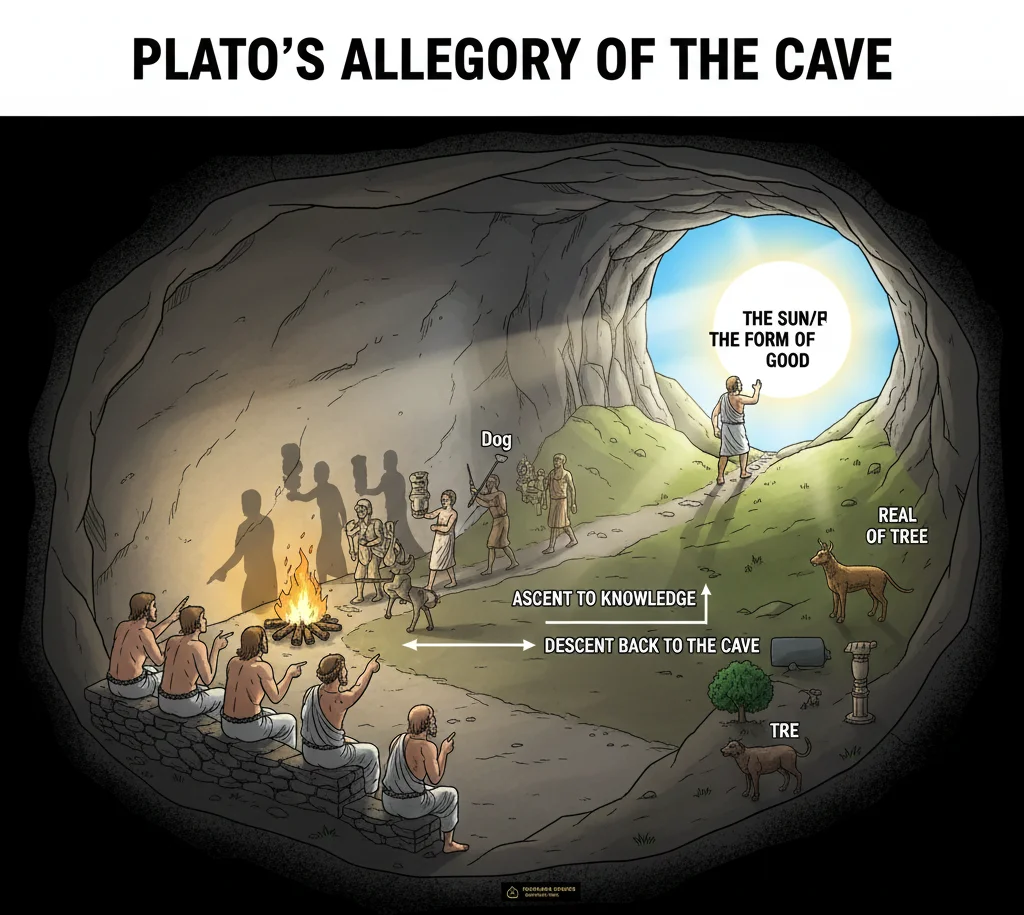
72.3 Philosopher-Kings
Since regular people are "in the cave," they shouldn't vote.
Plato argued that nations will never know peace until "philosophers become kings, or kings become philosophers." He wanted a benevolent dictatorship of the wise.
73.0 ARISTOTLE: THE REALIST
Aristotle (384–322 BCE) was Plato's student for 20 years.
But he disagreed with his master.
Plato looked Up (to the heavens/abstract). Aristotle looked Down (to the earth/observation).
He founded his own school, The Lyceum.
73.1 The Master of Those Who Know
Aristotle was obsessed with categorizing everything.
He dissected octopuses to understand biology. He read 158 constitutions to understand politics. He wrote books on Physics, Metaphysics, Poetry, Theatre, Music, Logic, Rhetoric, and Politics.
He essentially invented the Scientific Method: Observe -> Collect Data -> Classify.
73.2 Logic and The Golden Mean
Logic: He invented formal logic (Syllogism).
Premise 1: All men are mortal.
Premise 2: Socrates is a man.
Conclusion: Therefore, Socrates is mortal.
This system was the basis of Western thought for 2,000 years.
Ethics: How to be happy?
Not by going to extremes. Courage is the Golden Mean between Cowardice (too little) and Rashness (too much). Virtue is the middle path.
74.0 THE TUTOR OF KINGS
Aristotle's most famous job wasn't writing books. It was teaching a 13-year-old wild prince from Macedonia.
That boy was Alexander the Great.
When Alexander conquered the world, he sent rare plants and animals back to Aristotle for study. This link between the greatest Mind (Aristotle) and the greatest Sword (Alexander) marks the transition to the next era.
75.0 THE SUICIDE OF GREECE: THE PELOPONNESIAN WAR
The Golden Age ended in blood.
In 431 BCE, the tension between the Athenian Empire (Delian League) and the Spartan Alliance (Peloponnesian League) exploded into war.
It was a "World War" of the ancient Greek world, dragging in every city from Sicily to Turkey.
76.0 THE ELEPHANT VS. THE WHALE
The two sides had opposite strengths:
Sparta: Had the best land army. They ravaged the Athenian countryside, trying to force a battle.
Athens: Had the best navy. Pericles refused to fight on land. He pulled all citizens inside the Long Walls (walls connecting Athens to its port, Piraeus) and used the navy to import food and raid Sparta's coast.
77.0 THE PLAGUE OF ATHENS (430 BCE)
Pericles' strategy was smart, but he forgot one thing: Hygiene.
Cramming thousands of refugees into a hot, crowded city was a recipe for disaster. A mysterious plague (likely Typhoid or Viral Hemorrhagic Fever) arrived on a ship.
The Horror: People died so fast they piled up in the streets. Law and religion collapsed.
Around 1/3 of the population died, including Pericles himself. Athens lost its great leader when it needed him most.
78.0 THE TRAITOR: ALCIBIADES
After Pericles, a new generation took over. The most famous was Alcibiades.
He was Socrates' student, incredibly handsome, rich, and brilliant—but totally immoral.
He convinced Athens to launch a massive invasion of Sicily (Syracuse) to expand the empire.
The Switch: Just as the fleet launched, Alcibiades was accused of a crime (vandalizing religious statues). Instead of facing trial, he defected to Sparta!
He gave the Spartans two deadly pieces of advice:
1. "Send a general to help Syracuse destroy the Athenian fleet."
2. "Build a permanent fort near Athens to starve them year-round."
79.0 THE SICILIAN DISASTER (413 BCE)
The invasion of Sicily was a total catastrophe.
Through incompetence and bad luck (an eclipse scared them from retreating), the entire Athenian fleet was trapped in the harbor of Syracuse.
Thousands of Athenians were slaughtered or sold into slavery in stone quarries. Athens lost its navy, its money, and its morale.
80.0 THE FALL OF ATHENS (404 BCE)
Athens somehow kept fighting for 9 more years.
But Sparta did the unthinkable: They made a deal with the Persians.
Using Persian gold, Sparta built a massive navy. Under the brutal general Lysander, they destroyed the last Athenian ships at the Battle of Aegospotami.
The End: Lysander besieged Athens. Starving, the Athenians surrendered in 404 BCE.
Sparta ordered the Long Walls—the symbol of Athenian power—to be torn down to the sound of flutes. Democracy was briefly abolished. The Golden Age was over.
81.0 THE RISE OF MACEDONIA
To the sophisticated Athenians, the Macedonians were semi-barbarians who drank their wine undiluted and lived in tribes.
But King Philip II (ruled 359–336 BCE) changed everything.
He was a military genius. While held hostage in Thebes as a youth, he studied Greek tactics and improved them.
81.1 The Macedonian Phalanx
The Greeks used short spears (dory).
Philip invented the Sarissa: A massive pike, 6 meters long.
His phalanx was a moving forest of spikes. Before the enemy could even touch the Macedonians, they were impaled.
Battle of Chaeronea (338 BCE): Philip crushed the combined armies of Athens and Thebes. For the first time in history, Greece was united—not by choice, but by force.
82.0 ALEXANDER THE GREAT
Philip was assassinated at his daughter's wedding.
His son, Alexander, took the throne at age 20.
He had been tutored by Aristotle, slept with The Iliad under his pillow, and believed he was the son of Zeus.
82.1 The Gordian Knot
In 333 BCE, Alexander arrived in Gordium (near modern Ankara).
Legend said that whoever untied the complex knot of King Gordias would rule Asia.
Alexander struggled for a moment, then drew his sword and sliced the knot in half.
The Lesson: Sometimes the best solution is decisive action ("Thinking outside the box").
83.0 CONQUERING THE WORLD
Alexander led 40,000 men against the massive Persian Empire. He never lost a single battle.
- Battle of Gaugamela (331 BCE): Outnumbered 5 to 1, Alexander charged directly at the Persian King Darius III, causing him to flee. The Persian Empire fell.
- To the Edge of the World: He pushed all the way to India (Indus River). His soldiers, exhausted and missing their families, finally refused to go further. He wept because "there were no more worlds to conquer."
84.0 THE HELLENISTIC AGE
Alexander died in Babylon at age 32 (likely fever or poison).
When asked on his deathbed who should succeed him, he whispered: "To the strongest."
His generals fought for decades, splitting his empire into kingdoms (Ptolemies in Egypt, Seleucids in Asia).
The Cultural Fusion: Alexander's greatest legacy wasn't war; it was Hellenism.
He built Greek cities (like Alexandria in Egypt) everywhere. Greek culture mixed with Persian, Egyptian, and Indian cultures.
This era produced:
- The Library of Alexandria: The sum of human knowledge.
- Science: Eratosthenes calculated the Earth's circumference. Archimedes invented physics. Euclid invented geometry.
85.0 SUMMARY OF TOPIC 3 (ANCIENT GREECE)
From the myths of Troy to the logic of Aristotle, the Greeks laid the foundations of the Western World.
They gave us Democracy, Philosophy, Theatre, the Olympics, and the Scientific Method.
But as the sun set on the Greek world, a new power was rising in the West. A city that would take Greek culture, armor it in iron, and conquer the world.
Rome is coming.
END OF TOPIC 3
86.0 THE LEGEND: ROMULUS AND REMUS
Every great empire needs a great origin story.
According to legend, the god Mars fathered twin boys, Romulus and Remus.
A jealous king threw them into the Tiber River. They washed ashore and were suckled by a She-Wolf (Lupa) and raised by a shepherd.
Fratricide: In 753 BCE, the twins decided to build a city on seven hills. They argued over the walls. Romulus killed Remus and named the city after himself: Roma.
The message was clear: "No one crosses the walls of Rome, not even a brother."
87.0 THE REALITY: ETRUSCANS AND LATINS
Historically, Rome started as a small village of Latin farmers living in huts.
To the north lived the Etruscans, a mysterious and advanced civilization who loved parties, art, and tombs. The Etruscans conquered Rome and ruled it as Kings for a century. They taught the Romans how to build arches, sewers, and organized armies.
88.0 THE BIRTH OF THE REPUBLIC (509 BCE)
The last Etruscan King, Tarquin the Proud, was a tyrant. His son raped a noble Roman woman named Lucretia, causing her suicide.
Enraged, the Roman nobles (led by Brutus) rose up and expelled the kings in 509 BCE.
They swore an oath: "Never again will a single man rule Rome."
They created a new system called Res Publica ("The Public Affair").
89.0 SPQR: THE ROMAN CONSTITUTION
The Roman government was a complex mix of checks and balances to prevent tyranny. Their motto was SPQR (Senatus Populusque Romanus - The Senate and People of Rome).
89.1 The Structures of Power
- Consuls: Instead of a King, they elected Two Consuls. They could only rule for 1 year, and each could veto ("I forbid") the other.
- The Senate: 300 wealthy men (Patricians) who served for life. They didn't make laws, but their "advice" was almost always followed.
- Dictator: In extreme emergencies (war), they could appoint a Dictator for 6 months only. Cincinnatus is the ideal example: He took power, defeated the enemy in 15 days, and immediately went back to his farm.
90.0 THE STRUGGLE OF THE ORDERS
Rome was divided into two classes:
1. Patricians: The wealthy, old families (Aristocrats).
2. Plebeians: The commoners (Farmers, merchants, artisans).
The Plebeians fought the wars but had no political power. So they went on strike (The Secession of the Plebs). They marched out of the city and refused to work or fight.
Terrified, the Patricians caved. They allowed the Plebeians to elect their own leaders called Tribunes, who had the power to veto the Senate.
This internal tension strengthened Rome, making it a state where (almost) everyone had a stake in victory.
91.0 THE CLASH OF TITANS: ROME VS. CARTHAGE
By 264 BCE, Rome controlled Italy. But across the sea, in modern-day Tunisia, lay the superpower of the Mediterranean: Carthage.
Carthage was everything Rome was not: A naval power, fabulously wealthy, and driven by trade, not land.
They fought three massive wars called the Punic Wars (Punic comes from "Phoenician," the ancestors of Carthage).
92.0 ROUND 1: THE WAR AT SEA (264–241 BCE)
The war started over Sicily.
Rome had a problem: They had no navy. Carthage had the best ships in the world.
The Roman Solution: They found a wrecked Carthaginian ship, reverse-engineered it, and built 100 copies in two months.
But they still couldn't sail well. So they invented the Corvus (The Raven)—a bridge with a spike.
Instead of ramming, the Romans dropped the bridge onto the enemy ship, turning a sea battle into a land battle (which they were good at). Rome won and took Sicily, its first overseas province.
93.0 ROUND 2: HANNIBAL AT THE GATES (218–201 BCE)
Carthage wanted revenge. Their general, Hamilcar, made his 9-year-old son swear a blood oath: "Never be a friend to Rome."
That boy was Hannibal Barca.
93.1 Crossing the Alps
Rome expected an attack by sea. Hannibal did the impossible.
He marched his army and 37 War Elephants from Spain, over the Pyrenees, and across the freezing Alps into Italy.
He lost half his men and most of his elephants to the cold, but he arrived in Italy. The Romans were terrified. The "Ghost" was in their backyard.
94.0 THE NIGHTMARE: CANNAE (216 BCE)
Hannibal destroyed every Roman army sent against him. The climax was the Battle of Cannae.
Rome sent 80,000 men. Hannibal had 50,000.
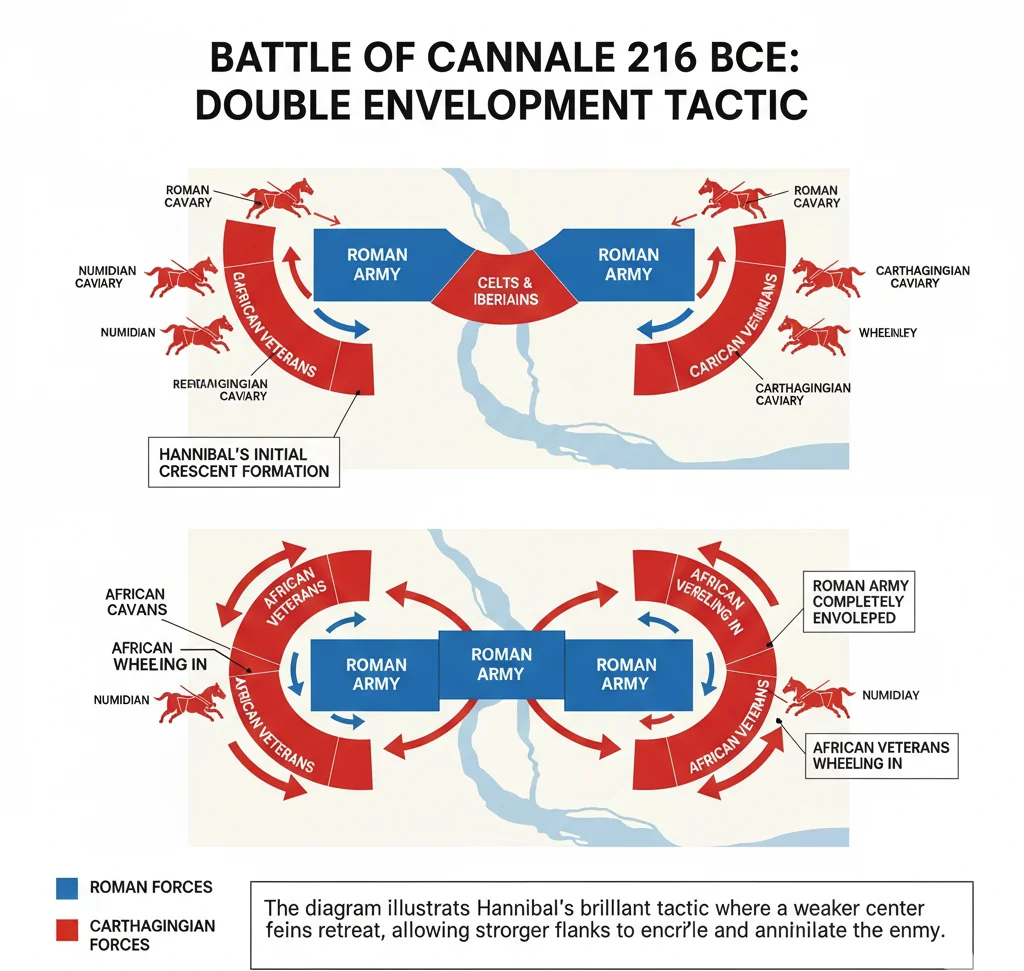
The Trap: Hannibal placed his weakest troops in the center and his veterans on the wings. As the Romans pushed the center back, Hannibal's wings swung around and surrounded them.
It was a slaughter. 50,000 - 70,000 Romans died in one day. It is still studied in military academies today as the perfect "Double Envelopment."
95.0 ROMAN RESILIENCE AND SCIPIO
Any other nation would have surrendered. Rome refused. They banned the word "Peace."
They realized they couldn't beat Hannibal in Italy. So, a young general named Scipio (later Africanus) proposed a daring plan: "Don't fight Hannibal here. Attack his home."
Scipio invaded Africa. Hannibal was forced to leave Italy to defend Carthage.
95.1 Battle of Zama (202 BCE)
Scipio studied Hannibal's tactics. When Hannibal charged with elephants, Scipio ordered his troops to blow trumpets and open lanes, letting the elephants pass harmlessly through.
Scipio defeated Hannibal. Rome won the war and became the master of the Mediterranean.
96.0 ROUND 3: "CARTHAGO DELENDA EST"
50 years later, Rome was paranoid that Carthage might rise again.
Senator Cato the Elder ended every single speech—no matter the topic—with the phrase:
"Ceterum censeo Carthaginem esse delendam" (Furthermore, I consider that Carthage must be destroyed).
In 146 BCE, Rome finally did it. They burned the city to the ground, enslaved the population, and (legend says) sowed the fields with salt so nothing would ever grow there again. The rival was gone.
97.0 THE POISON OF VICTORY: INEQUALITY
After destroying Carthage, Rome was flooded with wealth and slaves.
Rich Senators bought up all the land, creating massive plantations called Latifundia worked by slaves.
The average Roman soldier—a farmer—returned from war to find his farm sold. He drifted to Rome, unemployed and angry. The gap between the 1% and the 99% became unbearable.
98.0 THE BLOOD ON THE FORUM: THE GRACCHI BROTHERS
Two brothers, Tiberius and Gaius Gracchus, tried to save the poor.
As Tribunes, they proposed limiting how much land one person could own and giving the rest to the poor.
The Reaction: The Senate called Tiberius a tyrant. A mob of Senators took chair legs and clubs and beat Tiberius to death in the Forum (133 BCE). Ten years later, they killed his brother Gaius.
The Turning Point: For the first time in Roman history, political disputes were settled not by votes, but by Murder. The taboo was broken.
99.0 THE PRIVATE ARMIES: MARIUS
Around 107 BCE, a general named Gaius Marius changed the rules of war.
Before Marius, you had to own land to be a soldier (fighting for the State).
Marius needed men, so he recruited the Landless Poor.
He promised them pay and land from his own pocket (loot).
The Consequence: Soldiers became loyal to their General, not to Rome. If the General said "March on Rome," they would do it.
100.0 THE SLAVE REVOLT: SPARTACUS (73 BCE)
While the elite fought for power, the slaves fought for freedom.
A Thracian gladiator named Spartacus escaped from a training school in Capua with 70 others.
His army grew to 120,000 men. They defeated Roman legions repeatedly. They ravaged Italy for two years.
Finally, the richest man in Rome, Crassus, trapped and destroyed them.
The Message: To warn other slaves, Crassus crucified 6,000 survivors along the Appian Way. For 200 kilometers, travelers walked past dying men on crosses.
101.0 THE FIRST DICTATOR: SULLA
The chaos culminated in Sulla.
He was a rival of Marius. When the Senate tried to take his command away, Sulla did the unthinkable: He turned his army around and Marched on Rome (88 BCE).
He conquered his own city. He declared himself Dictator.
Proscriptions: He posted lists of his enemies' names in the Forum. Anyone on the list could be killed legally, and their property taken.
Sulla eventually retired, but he had set a precedent. A young man watching all this learned a valuable lesson: "If you have the army, you make the law."
That young man was Julius Caesar.
102.0 THE RISE OF JULIUS CAESAR
Born into an old but poor aristocratic family, Julius Caesar knew that in the chaotic late Republic, the path to power was through the People (Populares) and the Army.
He was charismatic, ambitious, and drowning in debt from bribing voters with expensive games.
103.0 THE THREE-HEADED MONSTER: THE FIRST TRIUMVIRATE
The Senate blocked Caesar's ambitions. So, in 60 BCE, he made a secret deal that broke the Republic. He formed an unofficial alliance called the First Triumvirate ("Rule of Three Men"):
- Crassus (The Money): The richest man in Rome.
- Pompey (The Sword): The greatest general of the time.
- Caesar (The Brains/Charisma): The up-and-coming politician.
Together, they controlled everything: elections, armies, and laws. The Senate was powerless against them. To seal the deal, Pompey married Caesar's daughter, Julia.
104.0 THE GALLIC WARS: BUILDING A LEGEND (58–50 BCE)
Caesar needed military glory (and money to pay his debts). He engineered a war in Gaul (modern France).
For eight years, he waged a brutal campaign. He claimed to have killed 1 million Gauls and enslaved another 1 million.
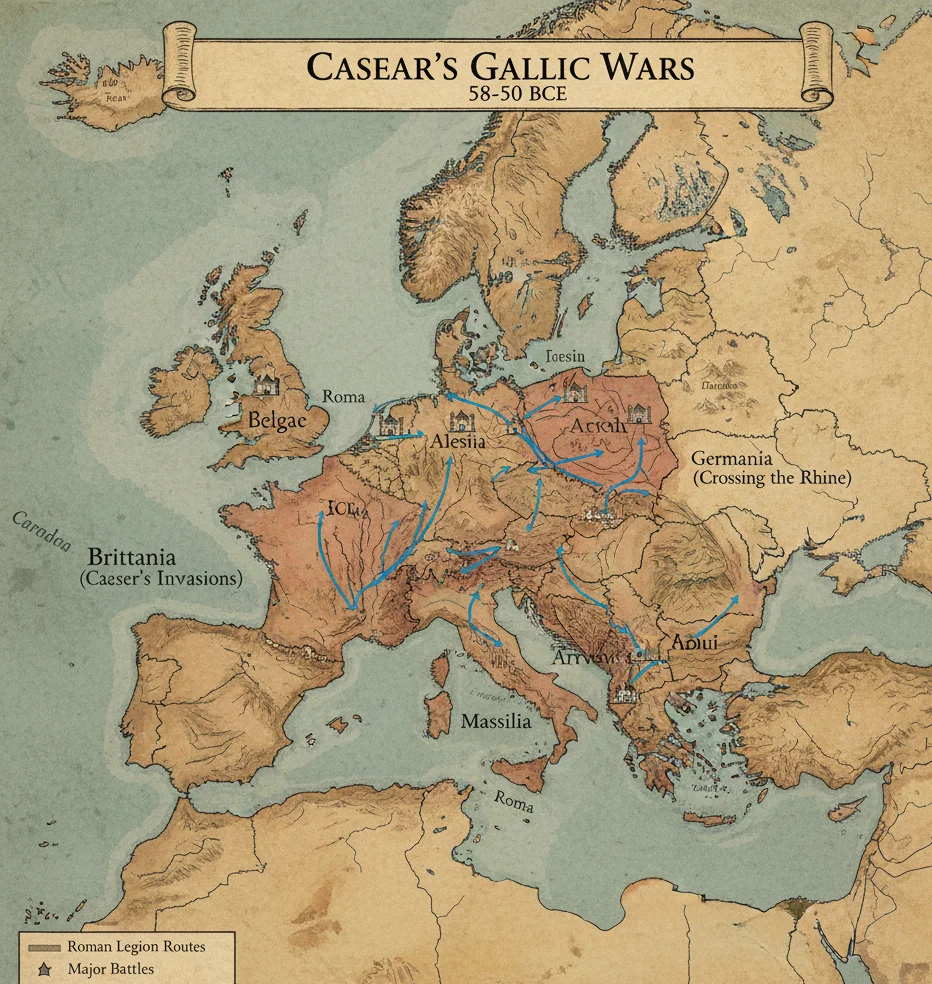
The Propaganda Machine: Caesar wrote reports sent back to Rome (The Gallic Wars). He wrote about himself in the third person: "Caesar did this...", "Caesar conquered that..." The common people of Rome loved reading about his victories. His soldiers adored him because he fought alongside them and paid them well. He was becoming too powerful.
105.0 CROSSING THE RUBICON (49 BCE)
The Triumvirate collapsed. Crassus died in a disastrous war against Parthia (Persia). Julia died in childbirth, breaking the bond between Caesar and Pompey.
The Senate, terrified of Caesar, allied with Pompey. They ordered Caesar to disband his army and return to Rome to face trial for his "illegal" wars.
Caesar had a choice: Return alone and be ruined, or return with his army and start a civil war.
On January 10, 49 BCE, he stood at the Rubicon River, the northern border of Italy. It was illegal for a general to cross it with an army.
He famously said, "Alea Iacta Est" (The die is cast), and crossed the river. There was no turning back.
106.0 CIVIL WAR AND DICTATORSHIP
Pompey and the Senate fled Rome. Caesar chased them across the Mediterranean.
At the Battle of Pharsalus in Greece, Caesar's hardened veterans crushed Pompey's larger army. Pompey fled to Egypt, where he was murdered by the young Pharaoh Ptolemy XIII.
Cleopatra: Caesar arrived in Egypt. He was furious they killed Pompey (a Roman consul). He sided with Ptolemy's sister, Cleopatra, in the Egyptian civil war, making her Queen (and his lover).
After mopping up resistance, he returned to Rome. He sent a message to the Senate summarizing a quick victory in Turkey: "Veni, Vidi, Vici" (I came, I saw, I conquered).
He declared himself Dictator Perpetuo (Dictator for Life). He wore purple boots (like the old kings). He put his face on coins (something only living gods did). The Republic was dead in all but name.
107.0 THE IDES OF MARCH (44 BCE)
The old Senators, obsessed with the "freedom" of the Republic, plotted against him. They were led by Brutus (whose ancestor had expelled the last King in 509 BCE) and Cassius.
On March 15, 44 BCE (The Ides of March), they surrounded him in the Senate house.
They stabbed him 23 times. As he saw Brutus among the attackers, legend says his last words were "Et tu, Brute?" (You too, Brutus?).
He died at the foot of a statue of Pompey.
The assassins ran into the streets shouting "Liberty restored!", but the people were horrified. Rome plunged back into chaos.
108.0 THE HEIR AND THE GENERAL
Caesar's will dropped a bombshell. He didn't leave his power to Mark Antony, his best general. He left it to his 18-year-old grand-nephew, Octavian.
Antony laughed at the "boy." But Octavian had Caesar's name and the loyalty of Caesar's veterans.
109.0 THE SECOND TRIUMVIRATE
Realizing they couldn't defeat each other yet, Octavian and Antony (along with a third man, Lepidus) formed the Second Triumvirate.
Revenge: They hunted down Brutus and Cassius, defeating them at the Battle of Philippi. The assassins committed suicide.
The Split: They divided the Roman world:
- Octavian took the West (Rome and Europe).
- Antony took the East (Egypt and Asia).
110.0 ANTONY AND CLEOPATRA
In the East, Antony fell in love with Cleopatra (yes, Caesar's ex-lover).
They had children. Antony started dressing like an Egyptian pharaoh and giving Roman provinces to Cleopatra.
The Propaganda War: In Rome, Octavian used this brilliantly. He told the Romans: "Antony is no longer Roman. He is a slave to a foreign Queen. He wants to move the capital to Alexandria."
Rome declared war—not on Antony, but on Cleopatra.
111.0 THE BATTLE OF ACTIUM (31 BCE)
The final showdown happened at sea, off the coast of Greece.
Octavian's admiral, Agrippa, trapped Antony's fleet.
In the middle of the battle, Cleopatra's ship turned and fled. Surprisingly, Antony abandoned his men and followed her.
The End: Defeated, they fled to Alexandria. As Octavian closed in, Antony fell on his sword. Cleopatra let a poisonous snake (asp) bite her. The last Hellenistic kingdom (Egypt) fell and became a Roman province.
112.0 AUGUSTUS: THE FIRST EMPEROR (27 BCE)
Octavian was now the sole master of the Roman world. But he learned from Caesar's mistake: Don't look like a King.
He returned to the Senate and said, "I restore the Republic to you."
The Senate, terrified of more civil war, begged him to stay. They gave him the title Augustus ("The Revered One").
The Illusion: He called himself Princeps ("First Citizen"). He kept the Senate, the Consuls, and the elections. But he held all the real power (the army and the veto).
The Republic was dead, replaced by the Empire, but the facade remained.
113.0 THE PAX ROMANA (ROMAN PEACE)
Augustus's reign began a 200-year period of relative peace and stability known as the Pax Romana.
For the first time in history, you could travel from England to Syria on paved roads, using the same currency, speaking some Latin, without fear of pirates or bandits.
Augustus famously boasted: "I found Rome a city of brick and left it a city of marble."
114.0 THE LOTTERY OF BIRTH
Augustus died in 14 AD. He left the empire to his stepson, Tiberius.
Tiberius was a gloomy, paranoid general who hated Rome. He retired to the island of Capri and ruled by sending letters, while executing anyone he suspected of treason.
But Tiberius was a saint compared to what came next.
115.0 CALIGULA: THE MAD GOD (37–41 AD)
Tiberius was succeeded by his grand-nephew Gaius, nicknamed Caligula ("Little Boots").
At first, he was loved. Then, after a severe illness, he seemingly went insane.
- Living God: He declared himself a god and replaced the heads of statues of Zeus with his own head.
- War on the Sea: He marched his army to the English Channel to invade Britain but changed his mind. Instead, he declared war on Neptune (God of the Sea) and ordered his soldiers to stab the waves and collect seashells as "war booty."
- The Horse Consul: Legend says he planned to make his favorite horse, Incitatus, a Consul (highest politician).
The End: His own guards (Praetorian Guard) had enough. They stabbed him to death in a tunnel under the palace. He was 28.
116.0 CLAUDIUS: THE UNDERESTIMATED (41–54 AD)
After killing Caligula, the guards found his uncle Claudius hiding behind a curtain, shaking with fear.
Claudius had a limp and a stutter. Everyone thought he was an idiot. So the guards made him Emperor as a joke.
Surprise: He was actually a genius historian. He ruled wisely and conquered Britannia (Britain), something even Caesar hadn't done. He proved that you don't need to look like a hero to be one.
117.0 NERO: THE ARTIST (54–68 AD)
Claudius was poisoned by his wife so her son, Nero, could rule.
Nero didn't want to rule; he wanted to be an actor and musician (which was considered shameful for a Roman noble).
117.1 The Great Fire of Rome (64 AD)
A massive fire broke out, burning 10 of Rome's 14 districts.
Myth: "Nero fiddled while Rome burned." (Fiddles weren't invented yet, he played the lyre).
Reality: Nero actually helped the victims. BUT, after the fire cleared, he built a massive "Golden House" (Domus Aurea) for himself on the ruins. This made people suspect he started the fire.
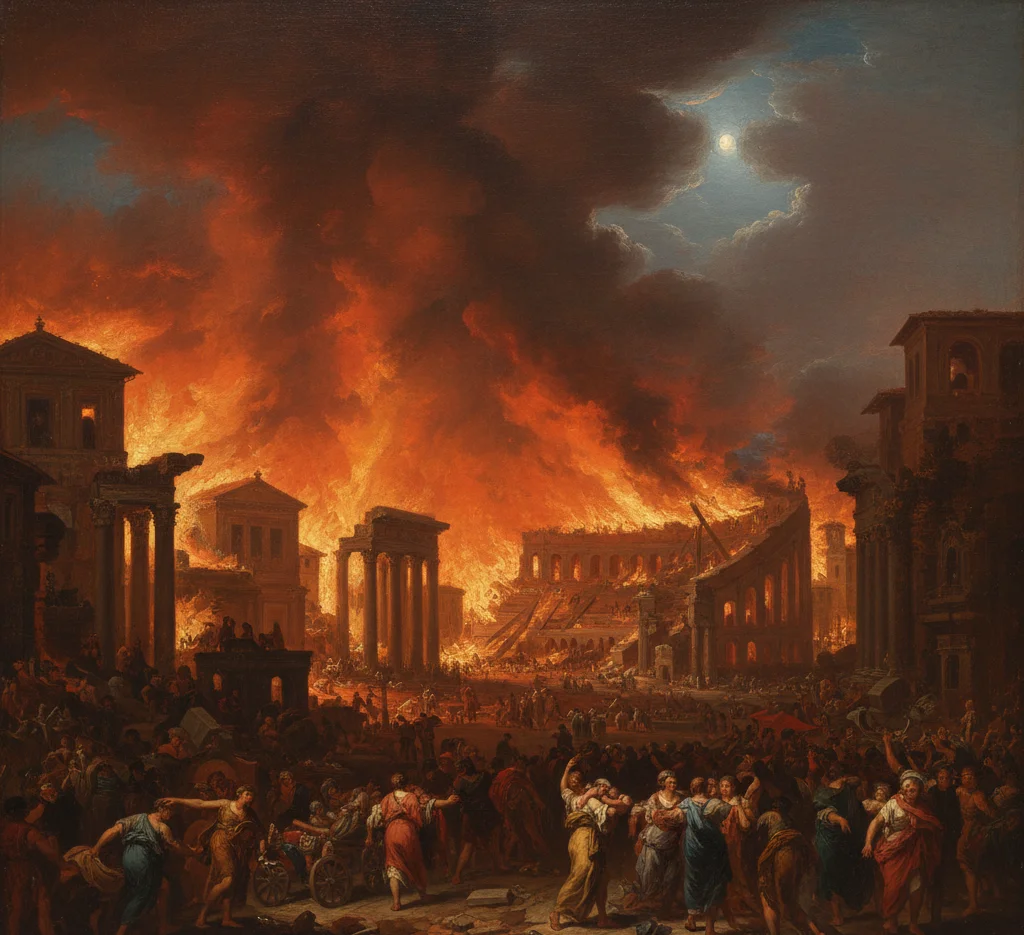
117.2 The First Persecution
To deflect the blame, Nero needed a scapegoat. He chose a small, unpopular religious sect: The Christians.
He arrested them, dipped them in oil, and burned them alive as human torches to light his garden parties. Among the victims were Saints Peter and Paul.
Nero eventually committed suicide as the army rebelled, crying: "Qualis artifex pereo!" (What an artist dies in me!).
118.0 THE SILENT REVOLUTION: CHRISTIANITY
While Emperors were playing god, a carpenter from Judea named Jesus of Nazareth had preached a different message: "Blessed are the poor... Love your enemies."
After his crucifixion (c. 30-33 AD), his followers believed he rose from the dead.
Why did it spread?
1. Roman Roads: Missionaries like Paul used the safe Roman roads to travel fast.
2. Equality: Roman religion was for the state. Christianity offered personal salvation to everyone—slaves, women, and the poor.
3. Martyrs: The more Rome killed them (in the Colosseum), the more impressed the public became by their courage. As Tertullian said: "The blood of the martyrs is the seed of the Church."
119.0 THE INDIAN SUMMER: THE FIVE GOOD EMPERORS
After the chaos of Nero, Rome enjoyed one last golden century (96–180 AD) under the "Five Good Emperors".
They were Nerva, Trajan, Hadrian, Antoninus Pius, and Marcus Aurelius.
Why were they good? Because they had no sons. They Adopted the most capable man to succeed them, based on merit, not blood.
- Trajan: Expanded the empire to its largest size (conquering Dacia/Romania).
- Hadrian: Realized the empire was too big. He built Hadrian's Wall in Britain to mark the limit. He shifted from "Expansion" to "Defense."
- Marcus Aurelius: The Philosopher King. He wrote Meditations (Stoic philosophy) while fighting barbarians in the mud. His death in 180 AD marks the end of the Pax Romana.
120.0 THE CRISIS OF THE THIRD CENTURY (235–284 AD)
Marcus Aurelius made one mistake: He left the throne to his idiot son, Commodus (the villain in the movie Gladiator).
Commodus was murdered, and hell broke loose.
For 50 years, Rome was in anarchy. There were 26 Emperors in this period. Only one died of natural causes; the rest were murdered.
Inflation: To pay the army, emperors put less silver in the coins. Money became worthless. Trade collapsed.
121.0 DIOCLETIAN AND THE SPLIT
In 284 AD, a tough general named Diocletian seized power.
He realized the problem: "The Empire is too big for one man."
He split the empire into two halves:
1. West: Ruled from Milan/Rome (Latin speaking).
2. East: Ruled from Nicomedia (Greek speaking, richer).
122.0 CONSTANTINE AND CHRISTIANITY
After Diocletian, civil war returned until Constantine emerged.
Before the Battle of Milvian Bridge (312 AD), he claimed to see a cross in the sky with the words: "In Hoc Signo Vinces" (In this sign, you will conquer).
He painted the Christian symbol (Chi-Rho) on his shields and won.
122.1 Two Major Changes
- Edict of Milan (313 AD): He legalized Christianity. The persecuted religion became the favored religion.
- New Capital (330 AD): He moved the capital to the ancient Greek city of Byzantium and renamed it Constantinople (Istanbul). It was closer to the rich trade routes of the East. Rome became a backwater.
123.0 THE FALL OF THE WEST (476 AD)
The East (Byzantine Empire) was strong. The West was weak and broke.
Then came the Barbarian Migrations. The Huns (led by Attila) pushed German tribes (Goths, Vandals) into Roman territory. Rome couldn't stop them.
- 410 AD: The Visigoths sacked Rome. It was the first time in 800 years enemies entered the city.
- 455 AD: The Vandals sacked Rome again (hence the word "Vandalism").
- 476 AD (The End): A German general named Odoacer walked into the palace, deposed the last Western Emperor (a boy ironically named Romulus Augustulus), and declared himself King of Italy.
There was no big explosion. The Western Roman Empire just... ceased to exist.
124.0 SUMMARY OF TOPIC 4 (ROME)
Rome fell, but it didn't disappear.
1. The East survived for another 1,000 years as the Byzantine Empire.
2. The Laws became the basis of European law.
3. The Church (Catholic Church) took over the structure of the Empire. The Pope became the new Emperor-figure in Rome.
The Ancient World is over. The Middle Ages have begun.
END OF TOPIC 4
125.0 THE "DARK" AGES (c. 500–1000 AD)
When Rome fell in 476 AD, the lights went out in Western Europe.
It wasn't that the sun stopped shining; it was a collapse of Infrastructure.
- No Central Government: No one repaired the roads or aqueducts.
- No Trade: Travel was too dangerous due to bandits.
- Illiteracy: Most people, even kings, couldn't read. Knowledge was kept alive only by monks in isolated monasteries.
People forgot how to build concrete domes. They lived in the ruins of a greater past.
126.0 THE SOLUTION: FEUDALISM
In a world without police, you needed protection.
A new system emerged called Feudalism. It was a trade: Land for Loyalty.
The hierarchy was strict. You were born into a class, and you died in it.
126.1 The Pyramid of Power
- The King: Owned all the land but couldn't manage it alone. He gave chunks of land (called Fiefs) to his friends.
- Nobles (Lords/Barons): In exchange for the land, they promised to provide the King with soldiers and horses for war. They were the real power.
- Knights: The elite warriors. They were given small plots of land by the Lords. In return, they fought. The stirrup (a new invention) allowed them to ride horses and fight with heavy lances, making them the "Tanks" of the battlefield.
- Peasants/Serfs (90%): At the bottom. They were not slaves (couldn't be sold), but they were bound to the land. They worked the Lord's fields in exchange for physical protection inside the castle walls during attacks.
127.0 THE POWER OF THE CHURCH
While kings fought for land, one institution held everyone together: The Catholic Church.
The Pope in Rome was often more powerful than any King.
Why? Because the King could kill your body, but the Pope could Excommunicate you (send your soul to Hell). In a deeply religious age, this was the ultimate weapon.
128.0 A FLICKER OF LIGHT: CHARLEMAGNE
Around 800 AD, a Frankish king named Charlemagne (Charles the Great) briefly united Western Europe (France, Germany, Italy).
He tried to revive Roman glory. He forced people to learn to read.
On Christmas Day, 800 AD, the Pope crowned him "Holy Roman Emperor."
It was a symbolic attempt to bring Rome back, but after his death, his empire split apart, and the darkness returned with a new threat from the North.
129.0 THE FURY FROM THE NORTH: THE VIKINGS
From roughly 793 to 1066 AD, Europe was terrorized by warriors from Scandinavia (modern Norway, Sweden, Denmark).
They were called Vikings (from the Old Norse word *víkingr*, meaning "pirate").
It started with the raid on the monastery of Lindisfarne in England (793 AD). They killed the monks, stole the gold, and vanished before help could arrive.
130.0 THE TECHNOLOGY: THE LONGSHIP
The secret to their success was the Longship (Drakkar).
It was an engineering masterpiece.
- Shallow Draft: The ship could float in only 1 meter of water. This meant they didn't just stay at sea; they could sail up rivers.
They could attack Paris, London, or Kiev, hundreds of kilometers inland. No one was safe. - Speed: Powered by wind (sail) and muscle (oars), they were faster than anything else on the water.
- Symmetrical: Both ends looked the same, so they could reverse direction without turning around.
131.0 VALHALLA: THE CULT OF WAR
Christians feared death (Judgment Day). Vikings welcomed it.
Their religion (Norse Mythology) taught that if you died of old age or sickness ("Straw Death"), you went to a boring, misty underworld (Hel).
But if you died in Battle, with a weapon in your hand, the Valkyries would carry you to Valhalla (Odin's Hall). There, you would feast and fight forever.
This belief made them fearless. You cannot defeat an enemy who wants to die.
132.0 EXPLORERS: BEYOND THE EDGE
They weren't just raiders; they were the greatest explorers of the age.
They discovered and settled Iceland and Greenland.
132.1 Leif Erikson and Vinland
Around 1000 AD (500 years before Columbus), a Viking named Leif Erikson sailed west from Greenland and landed in North America (Canada/Newfoundland).
He called it Vinland (Land of Wine).
They tried to settle there but were driven out by the locals (whom they called Skraelings). History could have been very different if they had stayed.
133.0 THE LEGACY: THEY DIDN'T LEAVE, THEY STAYED
Eventually, the Vikings stopped raiding and started ruling.
They settled in Northern France (creating Normandy -> "Land of the Northmen").
They settled in Russia (the Rus people were originally Swedish Vikings).
In 1066, a descendant of these Vikings, William the Conqueror, conquered England. The raiders became the kings.
134.0 THE GOLDEN AGE OF ISLAM
While Europe was sleeping in the Dark Ages, the Islamic World (stretching from Spain to India) was experiencing a scientific and cultural explosion.
From roughly 750 to 1258 AD, cities like Baghdad, Cairo, and Cordoba were the centers of the world's knowledge.
The Prophet Muhammad famously said: "The ink of the scholar is more holy than the blood of the martyr." This drove a massive hunger for books.
135.0 THE HOUSE OF WISDOM (BAGHDAD)
The Abbasid Caliphs built the House of Wisdom (Bayt al-Hikmah) in Baghdad.
It was a library, translation institute, and university all in one.
The Translation Movement: Muslim scholars realized the Greeks (Aristotle, Plato, Euclid) had valuable knowledge. Instead of burning their books, they translated them into Arabic.
If they hadn't done this, these ancient texts would have been lost forever. Europe later relearned its own history by translating these Arabic books back into Latin.
136.0 MATHEMATICS: ALGEBRA AND ALGORITHMS
Math in Europe was hard (try doing multiplication with Roman Numerals: XIV * III).
The Islamic world adopted the Indian Numerals (0, 1, 2, 3...) and the concept of Zero.
136.1 Al-Khwarizmi
A Persian mathematician named Al-Khwarizmi wrote a book called "Kitab al-Jabr." This is where the word Algebra comes from.
His name, "Al-Khwarizmi," was Latinized into Algorithm. Every computer running today owes its logic to him.
137.0 MEDICINE: IBN SINA (AVICENNA)
While Europeans were trying to cure headaches by drilling holes in skulls to let demons out, Muslim doctors were performing eye surgery.
Ibn Sina (known in the West as Avicenna) wrote The Canon of Medicine.
It was a medical encyclopedia that diagnosed cancer, tuberculosis, and contagious diseases. It became the standard medical textbook in European universities until the 1650s.
138.0 THE LIGHT OF EUROPE: AL-ANDALUS (SPAIN)
The most advanced city in Europe wasn't Paris or London (which were muddy villages); it was Cordoba in Muslim Spain.
It had paved streets, streetlights, 700 mosques, and a library with 400,000 books.
It was a place of Convivencia (Coexistence), where Muslims, Christians, and Jews lived and studied together in relative peace. It was the bridge through which knowledge flowed into Europe.
139.0 "DEUS VULT!" (GOD WILLS IT)
In 1095, Pope Urban II gave a speech in France that set the world on fire.
He called on the knights of Europe to stop fighting each other and march to Jerusalem to reclaim the Holy Sepulchre from the Muslims.
The Deal: Anyone who went would have all their sins forgiven. It was a ticket to Heaven involving murder.
The crowd shouted "Deus Vult!" (God wills it). They sewed red crosses onto their chests. The Crusades had begun.
140.0 THE FIRST CRUSADE: A BLOODY MIRACLE (1099)
Tens of thousands of people (knights, peasants, women) marched 4,000 km to Jerusalem. Most died of starvation or disease along the way.
Against all odds, the survivors reached Jerusalem in 1099.
The Massacre: They breached the walls and slaughtered almost everyone inside—Muslims, Jews, and even some Christians. Chronicles say the horses waded in blood up to their knees. They established the Kingdom of Jerusalem.
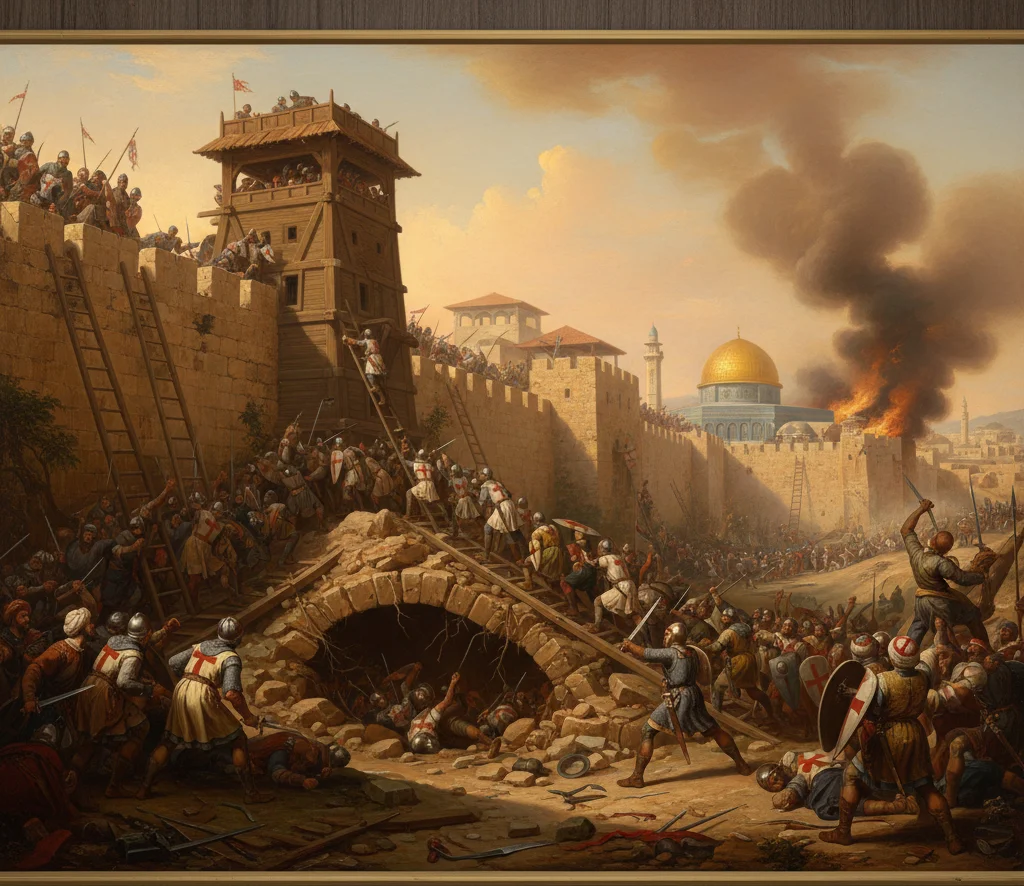
141.0 THE RESPONSE: SALADIN
For decades, the Muslims were divided. Then came Salah al-Din (Saladin).
He was a Kurd who united Egypt and Syria. He was not just a warrior; he was a man of honor.
Battle of Hattin (1187): He lured the Crusader army into a waterless trap in the desert. The Crusaders, dying of thirst, were crushed.
Taking Jerusalem Back: When Saladin retook Jerusalem in 1187, the Christians expected a massacre (revenge for 1099). Instead, Saladin let those who could pay leave peacefully. He became a legend even in Europe for his chivalry.
142.0 THE THIRD CRUSADE: KINGS AND SULTANS
Europe was shocked. Three kings (including Richard the Lionheart of England) marched to fight Saladin.
Richard vs. Saladin: Their rivalry is legendary. They fought brutally but respected each other.
- When Richard fell ill, Saladin sent him fresh fruit and snow.
- When Richard's horse died in battle, Saladin sent him two new horses because "a king should not fight on foot."
The Result: A stalemate. They signed a treaty: Jerusalem stayed Muslim, but Christian pilgrims could visit safely.
143.0 THE LEGACY: UNINTENDED CONSEQUENCES
Militarily, the Crusades failed (Jerusalem remained Muslim).
But culturally, they changed Europe forever. The returning knights brought back things they had never seen in their muddy villages:
1. Taste: Spices (pepper, cinnamon), sugar, lemons.
2. Comfort: Silk, velvet, mirrors, carpets.
3. Knowledge: The Arabic translations of Greek philosophy, the concept of Zero, and advanced medicine.
Ironically, by trying to destroy the East, the West learned how to be civilized.
144.0 THE APOCALYPSE: THE BLACK DEATH (1347–1351)
The Crusades were bloody, but nature is deadlier.
In October 1347, a Genoese trading ship arrived in Sicily from the Black Sea.
The people on the docks were horrified. Most sailors were dead. Those alive were covered in black, oozing boils.
The authorities ordered the ship to leave, but it was too late. The rats (and the fleas on them) had already scurried ashore.
145.0 THE DISEASE: YERSINIA PESTIS
The bacteria lived in the stomachs of fleas, which lived on black rats.
When the rats died, the fleas jumped to humans.
Symptoms:
1. Fever and chills.
2. Buboes: Apple-sized swellings in the armpits and groin.
3. Black spots on the skin (internal bleeding).
4. Death within 3–5 days.
It was terrifyingly contagious. Doctors caught it from patients. Priests caught it from giving last rites.
146.0 THE PLAGUE DOCTORS
They didn't know about bacteria. They thought it was caused by "Bad Air" (Miasma).
Doctors wore terrifying costumes to protect themselves.
- The Beak: Filled with flowers and herbs to smell "good air."
- The Stick: To examine patients without touching them.
- It didn't work. The fleas just jumped on their robes.
147.0 THE TOLL: A CONTINENT EMPTIED
In just 4 years, between 30% and 60% of Europe's population died.
Imagine a city of 100,000 people. 50,000 die in a month. There was no one left to dig graves. Bodies were piled in the streets.
Villages were abandoned and reclaimed by the forest. People thought it was the End of the World.
148.0 THE UNEXPECTED CONSEQUENCE: FREEDOM
The plague killed millions, but it actually improved life for the survivors.
Supply and Demand:
- Before the plague: Too many peasants, low wages. Lords treated them like dirt.
- After the plague: Not enough workers.
Peasants realized their value. They demanded higher wages. If a Lord refused, they just left to work for another Lord.
The End of Serfdom: The rigid feudal system collapsed. The "Common Man" began to have power and money. This new wealth and freedom paved the way for the Renaissance.
149.0 SUMMARY OF TOPIC 5 (MIDDLE AGES)
The Middle Ages began with the fall of Rome and ended with the death of Feudalism.
It was a time of castles, faith, and survival.
But out of the ashes of the Plague, a new flower was about to bloom in Italy. People started looking back at the glory of Greece and Rome and said: "We can do that again."
The Rebirth (Renaissance) is coming.
END OF TOPIC 5
150.0 WAKING UP: THE RENAISSANCE (c. 1350–1600)
"Renaissance" is French for Rebirth.
After the Black Death, survivors in Italy looked around at the ruins of ancient Rome and asked: "We used to be great. We built colosseums and aqueducts. Now we live in mud. Why don't we do that again?"
They decided to revive the art and learning of Ancient Greece and Rome.
151.0 WHY FLORENCE? THE MEDICI FAMILY
The Renaissance didn't start in a capital city; it started in Florence.
Why? Because of Money.
The Medici Family were bankers. They were the richest family in Europe (even the Pope borrowed money from them).
Lorenzo the Magnificent: He didn't just hoard gold; he spent it on Art. He sponsored geniuses like Michelangelo and Botticelli. Without Medici gold, there would be no Renaissance art.
152.0 HUMANISM: A NEW WAY OF THINKING
In the Middle Ages, the focus was on God and the Afterlife.
In the Renaissance, the focus shifted to Humans and This Life.
This philosophy is called Humanism.
They believed humans had limitless potential. As Leonardo da Vinci proved, a man could be an artist, engineer, anatomist, and musician all at once (The Renaissance Man).
153.0 THE ART REVOLUTION: PERSPECTIVE
Medieval art looked flat and cartoonish. The size of a person depended on their importance (Kings were huge, servants were tiny).
Renaissance artists invented Linear Perspective.
By using a "Vanishing Point," they created the illusion of 3D depth on a 2D canvas. Suddenly, paintings looked like windows into the real world.
154.0 THE TITANS: LEONARDO AND MICHELANGELO
154.1 Leonardo da Vinci (1452–1519)
The ultimate genius. He painted the Mona Lisa and The Last Supper.
But he was more than a painter. His notebooks contain sketches of helicopters, tanks, and submarines—400 years before they were invented. He dissected corpses to understand muscles, making his art anatomically perfect.
154.2 Michelangelo (1475–1564)
A grumpy, solitary workaholic. He considered himself a sculptor, not a painter.
The David: A 5-meter marble statue of the biblical hero. Unlike medieval statues, David is tense, veins bulging, ready to fight. It is the perfection of the human form.
The Sistine Chapel: The Pope forced him to paint the ceiling of the Vatican. He spent 4 years on his back, painting scenes like The Creation of Adam. It remains one of the greatest artistic feats in history.
155.0 THE MACHINE THAT CHANGED THE WORLD: THE PRINTING PRESS
Before 1440, books were written by hand on animal skin (parchment) by monks.
Copying a single Bible took 3 years. A book cost as much as a farm.
Because books were rare, knowledge was controlled by the Rich and the Church. If you wanted to know what the Bible said, you had to ask a priest. You couldn't check it yourself.
156.0 JOHANNES GUTENBERG (c. 1440)
In Mainz, Germany, a goldsmith named Johannes Gutenberg combined two ideas:
1. The Wine Press: A heavy screw press used to crush grapes.
2. Movable Type: Instead of carving a whole page of wood (which took forever), he cast individual metal letters (A, b, c...). He could arrange them to form words, print a page, and then rearrange them to print a different page.
157.0 THE GUTENBERG BIBLE (1455)
The first major book he printed was the Bible.
It was beautiful, but more importantly, it was Scalable.
The Explosion:
- In 1450, there were roughly 30,000 books in all of Europe.
- By 1500, there were 10,000,000 books.
The price of a book dropped by 90%. Suddenly, merchants, lawyers, and eventually farmers could learn to read.
158.0 THE INFORMATION REVOLUTION
The Printing Press was the Internet of the 15th century.
It made censorship impossible.
When Martin Luther wrote his complaints against the Church (The 95 Theses), he didn't just nail them to a door. He printed them. Within two weeks, copies were being read in every village in Germany. Within two months, all over Europe.
Without Gutenberg's machine, the Reformation (Part 3) and the Scientific Revolution would have been impossible.
159.0 THE CHURCH AS A BUSINESS
By 1500, the Catholic Church was the most powerful and wealthy institution in Europe. But it was corrupt.
Pope Leo X needed huge amounts of money to build St. Peter's Basilica in Rome (the one painted by Michelangelo).
To get the money, he authorized the sale of Indulgences.
159.1 The Ticket to Heaven
Friars traveled through Germany like salesmen, saying:
"As soon as the coin in the coffer rings, the soul from Purgatory springs."
Essentially, you could pay money to have your sins (or your dead relatives' sins) erased. It was "Pay-to-Win" salvation.
160.0 MARTIN LUTHER: THE REBEL MONK
In Wittenberg, Germany, a monk named Martin Luther was furious.
He believed salvation came from Faith Alone (Sola Fide), not from money or good deeds. You couldn't bribe God.
161.0 THE 95 THESES (1517)
On October 31, 1517, Luther marched to the Castle Church in Wittenberg and nailed a list of 95 Theses (Arguments) to the door.
He intended to start a debate among scholars.
But thanks to the Printing Press, his ideas went viral. Within months, all of Europe was discussing Luther's attack on the Pope.
162.0 "HERE I STAND"
The Church ordered Luther to recant (take back his words). He refused.
In 1521, at the Diet of Worms (an assembly, not a diet of worms!), he stood before the Emperor and famously said:
"My conscience is captive to the Word of God. I cannot and will not recant anything... Here I stand, I can do no other."
He was declared an outlaw, but German princes protected him because they wanted to stop sending taxes to Rome.
163.0 THE SPLIT: PROTESTANTISM
Luther didn't want to destroy the Church, but he ended up splitting it.
Those who "Protested" against Rome became known as Protestants.
Europe was divided:
- Catholic (South): Italy, Spain, France.
- Protestant (North): Germany, England, Scandinavia.
This religious divide led to 100 years of brutal religious wars, but it also broke the mental chains of authority. If you could question the Pope, you could question the King.
164.0 THE SPICE MUST FLOW
In the 1400s, Europe was addicted to Asian spices (pepper, cinnamon, cloves) to preserve meat and make food edible.
But the Ottoman Empire controlled the trade routes. They taxed everything heavily.
Europeans, especially the Portuguese and Spanish, were desperate to find a direct sea route to India to bypass the Ottomans.
165.0 PORTUGAL GOES SOUTH: VASCO DA GAMA
Prince Henry the Navigator started a school for sailors. They invented a new ship called the Caravel (faster, triangular sails).
They crept down the coast of Africa.
In 1498, Vasco da Gama successfully sailed around the Cape of Good Hope (South Africa) and reached India.
He returned with a cargo of spices worth 60 times the cost of the trip. Portugal became rich overnight.
166.0 SPAIN GOES WEST: CHRISTOPHER COLUMBUS (1492)
An Italian sailor named Christopher Columbus had a different idea: "The world is round. If I sail West across the Atlantic, I will hit Japan and India."
He was right about the shape, but wrong about the size. He thought the Earth was much smaller than it is.
King Ferdinand and Queen Isabella of Spain funded him.
The Mistake: On October 12, 1492, he landed in the Bahamas. He thought he was in the Indies (Asia), so he called the locals "Indians."
He died believing he had found a route to Asia. In reality, he had "discovered" (for Europe) two massive continents: North and South America.
167.0 CIRCUMNAVIGATION: FERDINAND MAGELLAN (1519)
Magellan wanted to find a way past the Americas to get to the Spice Islands.
He found the "Strait of Magellan" at the tip of South America and entered a calm ocean he named the Pacific (Peaceful).
The Tragedy: The journey was a nightmare. Sailors ate rats and leather to survive. Magellan was killed in a battle with natives in the Philippines (by Lapu-Lapu).
Out of 5 ships and 270 men, only 1 ship and 18 men returned to Spain in 1522. But they proved the world was round and all oceans were connected.
168.0 THE COLUMBIAN EXCHANGE
The contact between the Old World (Europe/Africa/Asia) and the New World (Americas) changed biology forever.
- From America to Europe: Corn, Potatoes (which ended famines in Europe), Tomatoes (imagine Italian food without them!), Chocolate, Tobacco.
- From Europe to America: Horses, Cows, Pigs, Guns, Christianity.
- The Silent Killer: Europeans also brought Smallpox and Influenza. The Native Americans had no immunity. It is estimated that 90% of the native population died from disease within 100 years. This "Great Dying" made it easy for Europeans to conquer the continents.
169.0 SUMMARY OF TOPIC 6 (RENAISSANCE)
Europe woke up.
1. Art: Michelangelo and Da Vinci celebrated human potential.
2. Religion: Luther broke the Church's monopoly.
3. Science: Gutenberg spread knowledge.
4. World: Columbus and Magellan connected the globe.
The Medieval World is dead. The Modern World is born. But this new world brings revolutions—of science, industry, and heads rolling under the guillotine.
END OF TOPIC 6
170.0 THE BIGGEST SHIFT SINCE AGRICULTURE
For 10,000 years, life was powered by muscles (human or animal) and nature (wind or water).
Around 1760, in Great Britain, humanity unlocked a new energy source: Fossil Fuels (Coal).
This transition from "Muscle Power" to "Machine Power" is called the Industrial Revolution.
171.0 WHY BRITAIN?
Why did it start on a rainy island in the North Sea? Historians agree on a few key factors:
1. Coal and Iron: Britain sat on massive deposits of coal (energy) and iron (material), often near the surface.
2. Capital: Thanks to the colonies and trade (Topic 6), Britain had money to invest.
3. The Navy: They controlled the seas, ensuring safe trade routes for raw materials (like cotton).
4. The Rule of Law: Unlike absolute monarchies (like France), Britain protected private property and patents. Inventors knew they would get rich if they succeeded.
172.0 THE HEART OF THE BEAST: THE STEAM ENGINE
Early steam engines were weak and used only to pump water out of coal mines.
In 1769, a Scottish engineer named James Watt improved the design significantly.
His engine didn't just pump; it could turn a wheel. This meant it could power anything.
The Unit of Power: To explain how strong his machine was to farmers, Watt compared it to horses. He coined the term "Horsepower." (Today, the unit of power "Watt" is named after him).
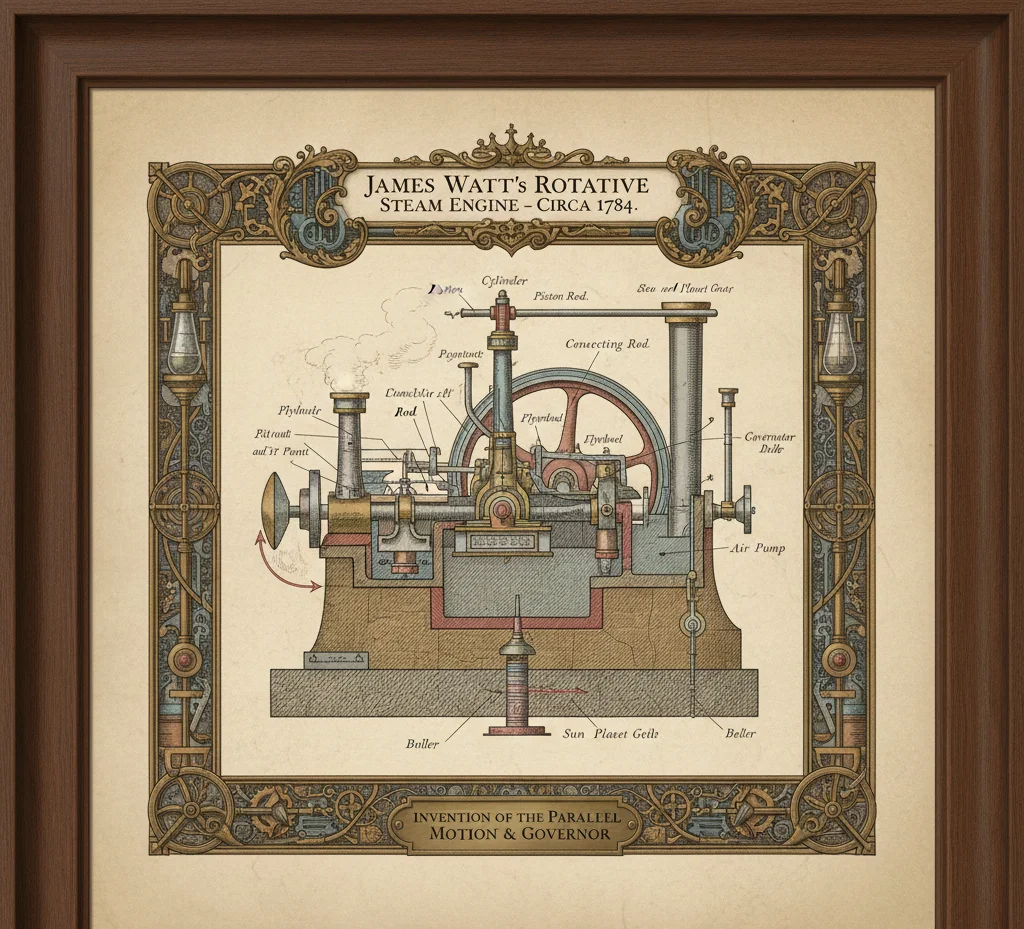
173.0 TEXTILES: THE FIRST FACTORIES
The revolution began in clothing.
Before, making a shirt took weeks of hand-spinning.
New machines like the Spinning Jenny and the Power Loom (hooked up to Watt's steam engine) could do the work of 100 people.
The Factory System: People stopped working at home (Cottage Industry) and started traveling to massive buildings (Factories) to tend the machines. The modern "Job" was born.
174.0 THE IRON HORSE: RAILWAYS
If you put a steam engine on wheels, what do you get? A Locomotive.
In 1829, George Stephenson built "The Rocket." It traveled at a mind-blowing speed of 48 km/h.
People were terrified. They thought the human body would melt at such speeds.
But within 20 years, Britain was covered in iron tracks. Travel times dropped from days to hours. Fresh food could be transported to cities. The world began to shrink.
175.0 THE DARK SIDE: URBANIZATION
The factories needed workers. Millions of farmers moved to cities like Manchester and London.
The cities weren't ready. They became crowded, smoky, and filthy hellscapes.
The sky turned black with coal smoke (London Fog). The rivers turned poisonous.
But the wheels kept turning, producing cheap goods for the world. Britain became the "Workshop of the World."
176.0 THE SECOND INDUSTRIAL REVOLUTION (c. 1870–1914)
Around 1870, technology shifted again.
If the first revolution was about Coal, Iron, and Steam, the second was about Steel, Oil, and Electricity.
Steel: Thanks to the Bessemer Process, steel became cheap. Unlike iron, steel was lighter and stronger. This allowed engineers to build skyscrapers and massive suspension bridges (like the Brooklyn Bridge).
177.0 LET THERE BE LIGHT: ELECTRICITY
Steam engines were loud and dirty. Electricity was clean, silent, and could travel over wires.
Thomas Edison: He didn't invent the first lightbulb, but he invented the first commercially practical one (and the entire system to power it).
The War of Currents:
- Edison favored DC (Direct Current).
- Nikola Tesla (backed by George Westinghouse) favored AC (Alternating Current).
AC won because it could transmit power over long distances. The world lit up. Factories could now run 24/7.
178.0 SHRINKING THE WORLD: COMMUNICATION
Before the 1830s, the fastest a message could travel was the speed of a horse.
- Telegraph (1844): Samuel Morse invented a way to send pulses (dots and dashes) over a wire. Suddenly, news traveled instantly. A message from London to New York took minutes, not weeks.
- Telephone (1876): Alexander Graham Bell said, "Mr. Watson, come here, I want to see you." The human voice could now travel through copper wires.
- Radio (1901): Guglielmo Marconi sent the first wireless signal across the Atlantic.
179.0 MASS PRODUCTION: HENRY FORD
Cars existed in the late 1800s, but they were hand-built toys for the rich.
Henry Ford changed that with the Model T (1908).
His innovation wasn't the car; it was the Assembly Line.
Instead of one team building a whole car, the car moved on a conveyor belt. Each worker did one repetitive task (e.g., put on a wheel) all day long.
The Result: Production time dropped from 12 hours to 90 minutes. The price dropped so much that Ford's own workers could afford the car.
180.0 THE SOCIAL COST: THE DARK SIDE OF PROGRESS
While technology improved, life for the average worker was often miserable.
Child Labor: Children as young as 5 worked in mines and textile mills because they were small enough to fit under machines. They worked 12-14 hours a day.
Conditions: Factories were dangerous. There were no safety laws. If you lost an arm in a machine, you were fired.
The Reaction: This misery led to the rise of Labor Unions (demanding weekends and 8-hour days) and political ideologies like Socialism and Marxism (Karl Marx wrote The Communist Manifesto in 1848 as a response to this exploitation).
181.0 SUMMARY OF TOPIC 7 (INDUSTRIAL REVOLUTION)
The Industrial Revolution gave humans god-like power over nature.
We could fly, talk across oceans, and build cities in the clouds.
But this power created a new competition. Industrial nations (Britain, Germany, France) needed raw materials (oil, rubber) and markets.
This hunger for resources would lead them to carve up the world (Imperialism) and eventually clash in the deadliest conflict history had ever seen.
The machines built for progress were about to be used for slaughter.
END OF TOPIC 7
182.0 THE SUICIDE OF EUROPE: WORLD WAR I (1914–1918)
By 1914, Europe was divided into two armed camps (Alliances) and fueled by nationalism.
The Spark: On June 28, 1914, Archduke Franz Ferdinand (heir to the Austro-Hungarian throne) was assassinated in Sarajevo by a Serbian nationalist named Gavrilo Princip.
The Domino Effect: Austria declared war on Serbia. Russia helped Serbia. Germany helped Austria. France and Britain helped Russia. Within weeks, the whole world was at war.
183.0 INDUSTRIAL SLAUGHTER
Generals prepared for a 19th-century war (cavalry charges) but got a 20th-century war.
New Technology:
- Machine Guns: Could fire 600 rounds a minute. One gun could wipe out a whole regiment.
- Poison Gas: Chlorine and Mustard gas burned lungs and blinded soldiers.
- Tanks: Introduced by the British to cross "No Man's Land."
- Airplanes: Initially for scouting, later for dogfights (The Red Baron).
184.0 TRENCH WARFARE: HELL ON EARTH
On the Western Front (France), the war stalled. Soldiers dug thousands of miles of trenches.
For 4 years, millions lived in mud, rats, and rotting corpses.
Battle of the Somme (1916): On the first day alone, the British lost 60,000 men. They gained only a few kilometers of dirt. It was a futile meat grinder.
185.0 THE RUSSIAN REVOLUTION (1917)
The war went so badly for Russia that the people revolted.
Vladimir Lenin and the Bolsheviks (Communists) overthrew the Tsar, executed the royal family, and pulled Russia out of the war. The Soviet Union (USSR) was born.
186.0 THE END AND THE FALL OF EMPIRES (1918)
The USA entered the war in 1917, tipping the balance against Germany.
On the 11th hour of the 11th day of the 11th month (Nov 11, 1918), the guns fell silent.
The Cost: 20 million deaths.
The Geopolitical Earthquake: Four massive empires collapsed:
1. German Empire (became a Republic).
2. Austro-Hungarian Empire (split into Austria, Hungary, Czechoslovakia, etc.).
3. Russian Empire (became USSR).
4. Ottoman Empire (partitioned, leading to the Modern Middle East and Turkey).
187.0 THE TREATY OF VERSAILLES: A PEACE TO END ALL PEACE
The winners (Britain, France) wanted revenge. They forced Germany to sign the Treaty of Versailles (1919).
Germany had to accept "War Guilt," pay massive reparations (money), and reduce its army.
This humiliated the German people. A young corporal named Adolf Hitler watched this and vowed revenge. The seeds of WWII were planted the day WWI ended.
188.0 THE CALM BEFORE THE STORM: THE INTERWAR YEARS (1919–1939)
After the horror of WWI, people wanted to forget.
The Roaring Twenties: In the USA and Europe, the 1920s were a time of partying, Jazz music, flapper dresses, and silent movies (Charlie Chaplin). The economy was booming, and stock prices soared. Everyone thought the good times would last forever.
189.0 THE GREAT DEPRESSION (1929)
The party ended on Black Tuesday (October 29, 1929).
The US Stock Market crashed. Banks failed. People lost their life savings overnight.
The crisis spread globally. World trade dropped by 60%. Millions became unemployed and hungry.
Hyperinflation in Germany: It was worst in Germany. Money became worthless. People used wheelbarrows of cash just to buy a loaf of bread.
190.0 THE RISE OF DICTATORS
Desperate people turned to "Strong Men" who promised simple solutions to complex problems. Democracy seemed weak; Totalitarianism seemed strong.
190.1 Benito Mussolini (Italy)
He invented Fascism: Use violence to restore national pride. He marched on Rome in 1922 and became "Il Duce" (The Leader). His motto: "Believe, Obey, Fight."
190.2 Joseph Stalin (USSR)
After Lenin died, Stalin took over the Soviet Union. He was paranoid and brutal.
He forced rapid industrialization (Five-Year Plans) but caused a famine in Ukraine (Holodomor) that killed millions. He executed anyone he suspected of disloyalty (The Great Purge).
190.3 Adolf Hitler (Germany)
An Austrian WWI veteran and failed artist. He led the Nazi Party.
He was a mesmerizing orator. He told Germans: "You didn't lose the war; you were stabbed in the back by Jews and Communists."
In 1933, he was democratically appointed Chancellor. He quickly dismantled democracy and declared himself Führer. He promised a "Third Reich" that would last 1,000 years.
191.0 THE ROAD TO WAR: APPEASEMENT
Hitler broke the Treaty of Versailles. He built a massive army. He took back land.
Britain and France, terrified of another war, did nothing. This policy was called Appeasement.
They thought: "If we give him what he wants, maybe he will stop."
They were wrong. Hitler saw their silence as weakness.
On September 1, 1939, Hitler invaded Poland. The world had no choice left. World War II began.
192.0 BLITZKRIEG: THE LIGHTNING WAR (1939–1941)
Germany didn't want another trench war. They invented a new tactic: Blitzkrieg.
1. Air: Bombers destroy enemy airfields.
2. Tanks: Panzers punch a hole in the defense lines.
3. Infantry: Soldiers follow to mop up.
It worked terrifyingly well. Poland fell in a month. France, which had held out for 4 years in WWI, fell in just 6 weeks. Hitler toured Paris as a conqueror.
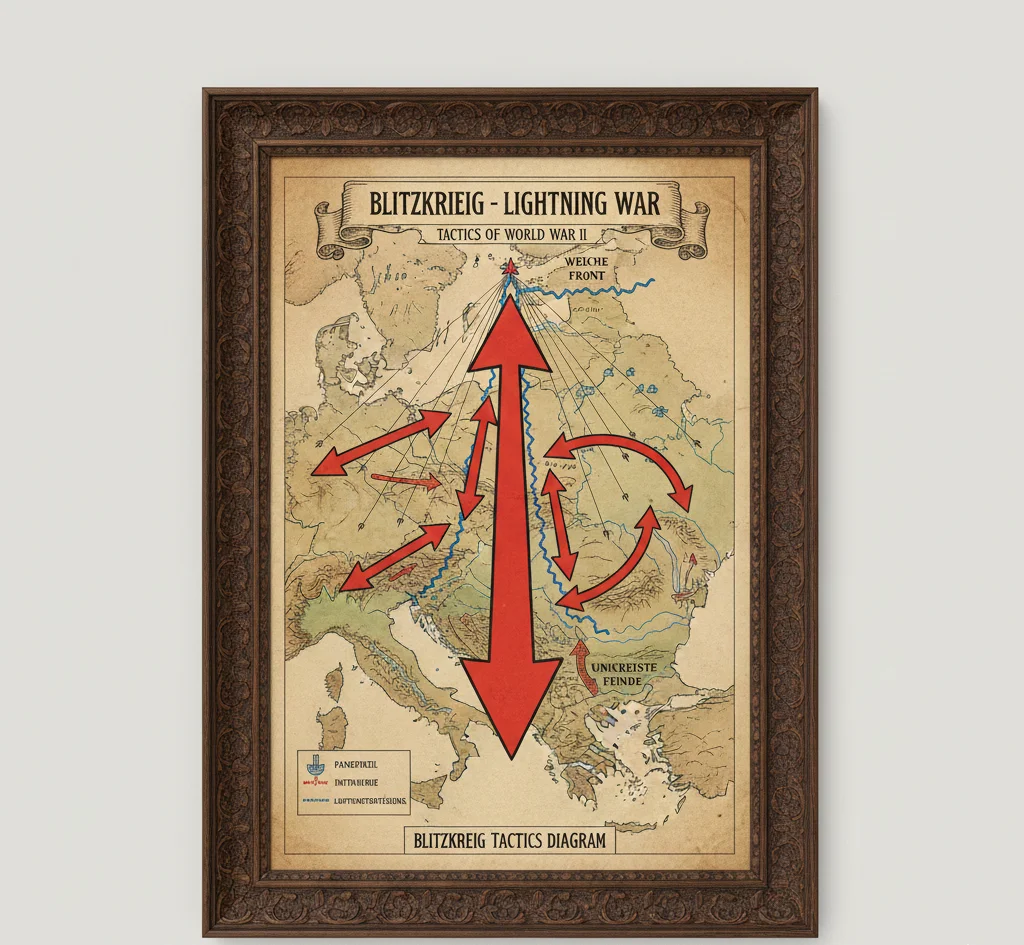
193.0 THE TURNING POINTS
By 1941, Nazi Germany controlled almost all of Europe. But then, Hitler made two fatal mistakes: invading Russia and declaring war on the USA.
193.1 Operation Barbarossa & Stalingrad (1942)
Hitler invaded the Soviet Union with 3 million men.
But he met "General Winter." The German oil froze in the engines.
Battle of Stalingrad: The deadliest battle in human history (2 million casualties). The Soviets fought for every single room in every ruined building. Eventually, the German 6th Army was surrounded and surrendered. The Nazi tide turned.
193.2 Pearl Harbor & Midway (1941–1942)
Japan attacked the US naval base at Pearl Harbor in Hawaii.
Japanese Admiral Yamamoto reportedly said: "I fear all we have done is to awaken a sleeping giant."
He was right. The US industrial machine geared up. At the Battle of Midway, the US navy sank 4 Japanese aircraft carriers, crippling Japan's naval power.
194.0 THE HOLOCAUST (THE SHOAH)
While fighting the war, the Nazis were secretly carrying out the "Final Solution."
They built extermination camps (like Auschwitz) to systematically murder Jews, Roma, disabled people, and political enemies.
They used industrial methods (gas chambers) to kill efficiently. 6 million Jews were murdered. It remains the greatest crime in history.
195.0 THE FALL OF THE REICH (1944–1945)
On June 6, 1944 (D-Day), the Allies invaded Nazi-occupied France (Normandy). It was the largest amphibious invasion ever.
Squeezed between the Soviets in the East and the Americans/British in the West, Germany collapsed.
Hitler committed suicide in his bunker on April 30, 1945. Germany surrendered a week later.
196.0 THE ATOMIC BOMB
Japan refused to surrender. The US feared an invasion of Japan would cost 1 million American lives.
President Truman authorized a new, secret weapon developed by the Manhattan Project.
August 6, 1945: The first atomic bomb ("Little Boy") was dropped on Hiroshima. 70,000 people were vaporized instantly.
August 9, 1945: A second bomb ("Fat Man") hit Nagasaki.
Japan surrendered. World War II was over.
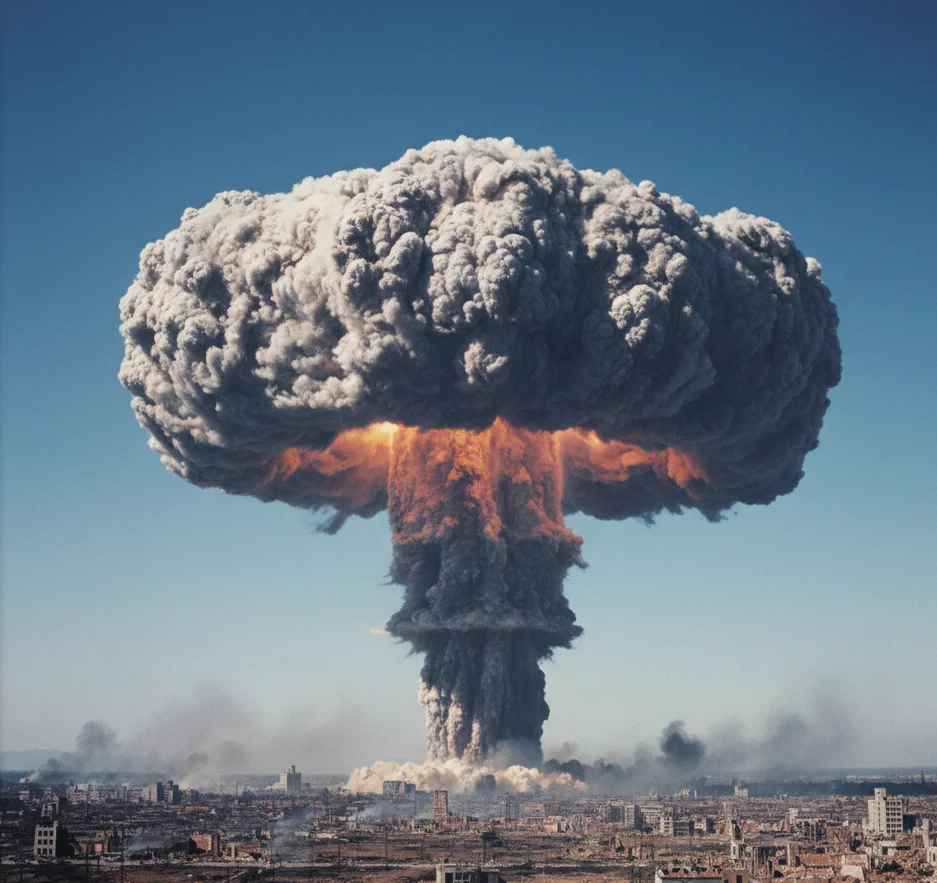
197.0 SUMMARY OF TOPIC 8 (WORLD WARS)
The war left 60 million dead and Europe in ruins.
The old powers (Britain, France, Germany) were exhausted and irrelevant.
Only two superpowers remained standing:
1. The USA (Capitalist, Democracy, Atomic Bomb).
2. The USSR (Communist, Dictatorship, Massive Army).
They were allies during the war, but now they stared at each other with suspicion. The shooting war was over. The Cold War was about to begin.
END OF TOPIC 8
198.0 THE ELEPHANT AND THE WHALE: A NEW RIVALRY
In 1945, the USA and the USSR shook hands over the corpse of Nazi Germany.
But they were opposites:
1. USA (The West): Capitalist, Democratic, Freedom of Speech.
2. USSR (The East): Communist, Totalitarian, State Control.
They didn't trust each other. Stalin wanted a buffer zone to protect Russia. The USA wanted to stop the spread of Communism ("Containment").
199.0 THE IRON CURTAIN
In 1946, Winston Churchill famously said:
"From Stettin in the Baltic to Trieste in the Adriatic, an Iron Curtain has descended across the Continent."
Europe was sliced in half.
- West: Protected by the USA, recovered quickly (Marshall Plan).
- East: Controlled by the USSR as "Satellite States" (Poland, Hungary, Romania), poor and oppressed.
200.0 THE ALLIANCES: CHOOSING SIDES
The world was forced to pick a team.
NATO (1949): North Atlantic Treaty Organization. (USA, UK, France, Turkey, etc.). Motto: "An attack on one is an attack on all."
Warsaw Pact (1955): The Soviet answer. (USSR, East Germany, Poland, etc.).
201.0 THE BERLIN WALL (1961)
The city of Berlin was weird. It was deep inside East Germany (Communist), but half of it belonged to the West.
It was a loophole. Millions of educated East Germans were escaping to freedom by just walking across the street to West Berlin.
To stop the "Brain Drain," the Soviets built a wall overnight in 1961.
For 28 years, the Berlin Wall stood as the symbol of oppression. Guards were ordered to shoot anyone trying to escape.
202.0 M.A.D. (MUTUALLY ASSURED DESTRUCTION)
By 1949, the Soviets had their own Atomic Bomb.
Then came the Hydrogen Bomb (1,000 times stronger than Hiroshima).
Both sides built thousands of missiles (ICBMs) that could wipe out the other in 30 minutes.
The Paradox: Why didn't they fight?
Because of M.A.D.: If you attack me, I will still have enough missiles left to destroy you. Nobody wins; everyone dies.
Fear, ironically, kept the peace.
203.0 THE RACE TO THE STARS
The Space Race wasn't just about science; it was about Missiles. If a rocket could carry a human to orbit, it could carry a nükleer warhead to New York.
203.1 Round 1: Soviet Dominance
The Soviets took the lead early.
- 1957 (Sputnik): They launched the first artificial satellite. It was just a metal ball that beeped, but it terrified Americans. It meant the US was no longer safe behind the oceans.
- 1961 (Yuri Gagarin): The first human in space. A triumph for Communism.
203.2 Round 2: The Eagle Has Landed (1969)
Humiliated, President JFK promised to put a man on the Moon by the end of the decade.
On July 20, 1969, the Apollo 11 mission succeeded.
Neil Armstrong stepped onto the lunar surface and said: "That's one small step for [a] man, one giant leap for mankind."
The US had won the race. The Soviets never made it to the Moon.
204.0 PROXY WARS: FIGHTING BY OTHERS
Since the US and USSR couldn't fight directly (because of Nukes), they fought Proxy Wars. They armed smaller countries to fight for them.
- Korean War (1950–1953): North (Communist) vs. South (Capitalist). It ended in a stalemate. The border (DMZ) is still the most heavily fortified border in the world today.
- Vietnam War (1955–1975): The US sent troops to stop the Communist North from taking over the South. It was a disaster. Despite superior technology, the US lost to guerrilla fighters in the jungle. It proved that firepower isn't everything.
205.0 THE CUBAN MISSILE CRISIS (1962)
The closest the world ever came to ending was in October 1962.
A US spy plane discovered Soviet nuclear missiles in Cuba, just 90 miles from Florida.
President John F. Kennedy ordered a naval blockade. Soviet ships approached the US line. If they crossed, WWIII would start.
The Deal: For 13 terrifying days, the world held its breath. Finally, Soviet leader Khrushchev blinked. He removed the missiles from Cuba in exchange for the US promising not to invade Cuba (and secretly removing US missiles from Turkey).
206.0 SUMMARY OF TOPIC 9 (COLD WAR)
The Cold War defined the second half of the 20th century.
It divided the world, fueled technological leaps (Internet, GPS, Satellites were all born from military research), and toppled governments.
But by the 1980s, the Soviet Union was running out of money. The stiff, state-controlled economy couldn't keep up with the West.
The Wall is about to fall. The Modern Era—our era—is beginning.
END OF TOPIC 9
END OF CHAPTER 3
Human History and Civilizations
VOL IV
THE DIGITAL AGE AND THE FUTURE
1.0 THE THIRD REVOLUTION
For thousands of years, information was physical (clay tablets, paper books). It was heavy, slow, and expensive to move. The Digital Revolution turned information into Bits (0s and 1s)—weightless, instant, and virtually free. This shift is as fundamental as the invention of fire.
2.0 THE THEORETICAL FATHER: ALAN TURING
Long before electronic computers existed, the logic behind them was written on paper. In 1936, a British mathematician named Alan Turing published a paper describing a hypothetical device known as the "Turing Machine."
The Universal Machine: Turing proved that a machine could perform any conceivable mathematical calculation if it could read and write symbols on an infinite tape according to a set of rules. This conceptualized the difference between Hardware (the machine) and Software (the instructions).
During WWII, Turing applied these theories at Bletchley Park to crack the Nazi Enigma Code. His electromechanical "Bombe" machines shortened the war by years, proving that information processing could defeat brute force.
3.0 THE DINOSAURS OF COMPUTING: ENIAC (1945)
The jump from theory to electricity happened in the USA. The first general-purpose electronic computer was ENIAC (Electronic Numerical Integrator and Computer), built to calculate artillery trajectories for the army.
It was a monster:
1. Size: It weighed 30 tons and occupied a 167 m² room (size of a large house).
2. Guts: It used 18,000 Vacuum Tubes. These were glass bulbs (like lightbulbs) that acted as switches.
3. Heat: It generated so much heat that the room reached 50°C. When turned on, rumors said the lights in Philadelphia dimmed.
The "Bug": Vacuum tubes were fragile; they burned out daily. Also, insects would fly into the warm glowing tubes and short-circuit the machine. The term "Computer Bug" comes from a real moth found trapped in a relay of the Mark II computer in 1947.
4.0 THE INVENTION OF THE CENTURY: THE TRANSISTOR (1947)
Vacuum tubes were the limit. Computers could never get smaller or faster if they relied on hot, fragile glass bulbs. The breakthrough happened at Bell Labs in New Jersey.
Three physicists (Bardeen, Brattain, and Shockley) invented the Transistor.
It did the exact same job as a vacuum tube (controlling the flow of electricity: On/Off), but with massive advantages:
- Size: It was the size of a fingernail (eventually microscopic).
- Material: It was made of Semiconductors (Germanium, later Silicon). It was solid, cold, and durable.
- Power: It used a fraction of the electricity.
This is arguably the most important invention in human history. Without the transistor, there is no internet, no space travel, and no modern medicine.
5.0 THE SILICON AGE: INTEGRATED CIRCUITS
Even with transistors, engineers had a problem called the "Tyranny of Numbers." To build a better computer, you needed thousands of transistors, but soldering them together by hand was impossible. The wires became a rats' nest.
The Solution: In 1958, Jack Kilby (Texas Instruments) and Robert Noyce (Fairchild Semiconductor) independently invented the Integrated Circuit (The Chip).
Instead of soldering separate parts, they etched all the components (transistors, resistors, capacitors) directly onto a single slice (wafer) of Silicon.
Suddenly, you could fit a computer that used to fill a room onto a chip the size of a coin. This birth of the "Microchip" marked the start of Silicon Valley.
6.0 MOORE'S LAW: THE EXPONENTIAL CURVE
In 1965, Gordon Moore (co-founder of Intel) noticed a trend. Because transistors were microscopic, engineers were getting better at shrinking them.
He predicted that the number of transistors on a chip would double every two years, while the cost would halve.
This is Moore's Law.
It held true for 50 years.
- 1971: 2,300 transistors on a chip.
- 2020s: 50 Billion transistors on a chip.
This exponential growth is why the smartphone in your pocket is millions of times more powerful than the combined computing power of NASA in 1969.
7.0 THE PRIESTHOOD OF THE MAINFRAME
To understand the revolution of the 1970s, one must understand the tyranny that preceded it. Before 1975, "computing" was not a personal activity; it was an industrial one. Computers were massive Mainframes, primarily manufactured by IBM (International Business Machines), often referred to as "Big Blue."
These machines, such as the IBM System/360, cost millions of dollars. They lived in air-conditioned "Glass Houses," tended to by white-coated technicians who acted as a priesthood. If a user wanted to run a program, they brought a stack of punch cards to the technician, who fed them into the machine. The user would return hours or days later to receive a printout of the results. There was no screen, no interaction, and absolutely no sense of ownership.
The "Personal Computer" was considered a ridiculous idea by the industry giants. Ken Olsen, founder of Digital Equipment Corporation (DEC), famously stated in 1977: "There is no reason anyone would want a computer in their home." This miscalculation created a vacuum that would be filled by a ragtag group of hippies, hobbyists, and dropouts in California.
8.0 THE SPARK: THE ALTAIR 8800
The revolution did not begin in a corporate lab; it began on the cover of a magazine. In January 1975, Popular Electronics magazine featured a kit called the Altair 8800 on its cover.
Designed by Ed Roberts of MITS (Micro Instrumentation and Telemetry Systems), the Altair was sold as a mail-order kit for $397. It was powered by the new Intel 8080 microprocessor.
8.1 The Box of Lights
By modern standards, the Altair was barely a computer. It had no keyboard. It had no monitor. It had no mouse. It had no hard drive. It didn't even come with software.
How it worked: The user had to input binary code directly by flipping a row of toggle switches on the front panel. To enter the number "A," you had to flip switches in the pattern 01000001. The output was simply a pattern of blinking red LED lights.
Despite its limitations, it caused a frenzy. Roberts expected to sell 200 units; he received thousands of orders in the first month. For the first time, a human being could own the brain of a computer.
9.0 THE SOFTWARE REVOLUTION: MICROSOFT IS BORN
In Harvard, a young student named Bill Gates saw the Altair on the magazine cover. He and his friend Paul Allen realized something profound: The hardware was useless without a language to speak to it.
They contacted Ed Roberts and lied. They claimed they had an interpreter for the programming language BASIC that would run on the Altair. In reality, they hadn't written a line of code, nor did they own an Altair.
The Sprint: Gates and Allen spent the next eight weeks working frantically in a lab at Harvard, writing the code on a simulator. When Paul Allen flew to Albuquerque to demonstrate the software to MITS, it was the first time the code had ever been run on a real machine.
Miraculously, it worked. The Altair responded. This marked the founding of Micro-Soft (later Microsoft). Their business model was radical: they didn't sell the computer; they licensed the code.
9.1 The Open Letter to Hobbyists
The early computer culture was based on the "Hacker Ethic" of sharing. Hobbyists copied the BASIC software on paper tape and shared it for free at meetings.
Bill Gates was furious. In 1976, he wrote his famous "Open Letter to Hobbyists," accusing them of theft. He argued that software was a product that required time and money to develop, and developers deserved to be paid.
This letter established the foundation of the modern Software Industry and the concept of Intellectual Property in the digital age.
10.0 THE HOMEBREW COMPUTER CLUB
While Gates was arguing for capitalism, a different culture was brewing in Menlo Park, California. The Homebrew Computer Club was a gathering of electronics enthusiasts who met in a garage to show off their creations and share schematics.
Among the members was a brilliant, socially awkward engineer named Steve Wozniak ("Woz"). Wozniak wasn't interested in money; he was obsessed with efficiency. He wanted to build a computer simply to impress his friends at the club.
Wozniak designed a computer board that used a cheap MOS 6502 processor (which cost $25, compared to Intel's $179). Crucially, he added a keyboard interface and a connection to a standard television set.
His friend, Steve Jobs, saw the machine. Jobs wasn't an engineer; he was a visionary and a salesman. He convinced Wozniak not to give the schematics away, but to sell the assembled circuit boards.
11.0 APPLE: FROM GARAGE TO EMPIRE
On April 1, 1976, Jobs and Wozniak founded Apple Computer. To finance their first batch, Jobs sold his Volkswagen bus, and Wozniak sold his HP scientific calculator.
11.1 The Apple I (1976)
Their first product, the Apple I, was a hand-built circuit board sold for the devilish price of $666.66. It was a hobbyist toy, sold in small numbers (about 200 units). It did not change the world, but it funded the next step.
11.2 The Apple II (1977): The Game Changer
The Apple II was the first true "Consumer Appliance" computer.
Design: Unlike the exposed wires of the Altair or the bare board of the Apple I, the Apple II came in a sleek, beige plastic case. It looked friendly, like a toaster or a typewriter.
Features: It supported Color Graphics (a revolution at the time) and had expansion slots that allowed users to plug in other devices (like floppy disk drives).
11.3 The Killer App: VisiCalc
Great hardware needs a reason to exist. For regular people, that reason was VisiCalc (Visible Calculator), released in 1979.
VisiCalc was the world's first Spreadsheet program.
Before VisiCalc, accountants spent days calculating budgets on paper with pencils. If one number changed, they had to erase and recalculate everything. VisiCalc allowed them to change one cell, and the entire sheet updated automatically in real-time.
The Impact: Suddenly, the Apple II wasn't a toy for nerds; it was a necessary business tool. Companies bought $2,000 Apple IIs just to run the $100 VisiCalc software. This concept—software selling hardware—is known as a "Killer App."
12.0 THE TRINITY OF 1977
1977 is often cited as the birth year of personal computing. Three machines were released almost simultaneously, catering to the mass market:
- Apple II: The premium, color, expandable machine ($1,298).
- Commodore PET: An all-in-one unit with a built-in cassette deck and small green screen. It was popular in schools due to its ruggedness ($795).
- TRS-80 (Radio Shack): Sold through thousands of Radio Shack stores across America. It was affordable ($599) and brought computing to the average middle-class family, affectionately nicknamed the "Trash-80" by users.
13.0 THE SLEEPING GIANT AWAKES: IBM
By 1980, the personal computer market had grown to huge valuations. IBM, the ruler of the mainframe world, finally realized they were missing the boat. They decided to enter the market, but their corporate culture was too slow. Developing a new IBM mainframe usually took 5 years. They needed a PC in one year.
13.1 Project Chess
IBM created a secret skunkworks team in Boca Raton, Florida, led by Don Estridge. To move fast, they broke every rule in the IBM rulebook.
Instead of building everything themselves (proprietary hardware), they decided to use Off-the-Shelf Components.
- Processor: Bought from Intel (8088 chip).
- Monitor: Bought from existing TV manufacturers.
- Printers: Bought from Epson.
This decision for "Open Architecture" allowed them to launch the IBM PC (Model 5150) in August 1981. It became the industry standard almost overnight, legitimizing the PC for corporate America. But it contained a fatal strategic flaw.
14.0 THE DEAL OF THE CENTURY
IBM needed an Operating System (OS) for their new PC. They initially approached Digital Research (creators of CP/M), but negotiations failed. In desperation, they turned to Bill Gates and Microsoft.
Microsoft didn't have an OS. But Gates knew a guy who did. He bought a rough OS called QDOS (Quick and Dirty Operating System) from a local programmer named Tim Paterson for $50,000.
Gates renamed it MS-DOS (Microsoft Disk Operating System) and licensed it to IBM.
The Masterstroke: IBM demanded secrecy, but they forgot to demand Exclusivity.
Bill Gates convinced IBM to let Microsoft retain the rights to sell MS-DOS to other computer manufacturers. IBM agreed, thinking the money was in the hardware, not the software. They believed no one else would ever dare to build a PC to compete with IBM.
They were wrong. Because IBM used off-the-shelf parts (Intel chips), anyone could build a clone of the IBM PC. And because Gates retained the rights, he could sell the operating system to those clones.
15.0 THE RISE OF THE CLONES: COMPAQ AND THE BIOS
There was one piece of the IBM PC that was proprietary: the BIOS (Basic Input/Output System). This was the firmware code copyrighted by IBM.
In 1982, a company called Compaq performed a legal miracle: Clean Room Reverse Engineering.
One team of engineers read the IBM BIOS code and wrote a detailed description of what it did, without writing any code. They handed this description to a second team of engineers (who had never seen the IBM code). The second team wrote a new BIOS from scratch that did exactly the same thing.
Because they hadn't copied the code, it was legal.
The Floodgates Open: Suddenly, companies like Compaq, Dell, and HP could build "IBM Compatible" PCs that ran all the same software (MS-DOS, Lotus 1-2-3) but were cheaper than IBM.
The market exploded. Hardware prices plummeted due to fierce competition ("The Clone Wars"). But every single one of those clones had to pay a license fee to Microsoft for the Operating System.
IBM lost control of the hardware standard it created. Microsoft became the software monopoly of the world.
16.0 THE INTERFACE PROBLEM
Despite the boom in sales, computers in 1981 were still difficult to use.
The interface was the Command Line (CLI).
The screen was black. The text was green or white. To copy a file, you had to type obscure commands like:
C:\> COPY A:REPORT.TXT B:BACKUP.TXT
If you made a typo, you got a syntax error. There were no images, no icons, no fonts. Computing was powerful, but it was not intuitive.
But in a research lab in Palo Alto, a different future had already been invented. A future of mice, windows, and graphical icons. Steve Jobs was about to take a tour that would change the trajectory of Apple and the world.
17.0 THE LAB THAT INVENTED THE FUTURE: XEROX PARC
While Apple and Microsoft were selling command-line computers to hobbyists, the true future of computing was sitting in a research lab in Palo Alto, California.
Xerox PARC (Palo Alto Research Center) was founded by the copier giant Xerox to invent the "Office of the Future." They hired the smartest computer scientists in the world and gave them unlimited budgets.
In 1973, they built the Xerox Alto.
It was decades ahead of its time. It featured:
- The Mouse: A pointing device (invented by Douglas Engelbart in the 60s, perfected by PARC).
- The GUI (Graphical User Interface): Instead of typing codes, the user saw "Windows," "Icons," "Menus," and a "Pointer" (WIMP).
- Ethernet: The first local area network connecting computers.
- Object-Oriented Programming: A new way to write code (Smalltalk).
The Tragedy: Xerox management didn't "get it." They were a copier company. They thought the Alto was too expensive (it cost $18,000 to build in 1973 dollars) and never sold it to the public. They were sitting on a goldmine and treated it like a tax write-off.
18.0 THE GREAT RAID: JOBS VISITS PARC (1979)
In 1979, Steve Jobs arranged a visit to Xerox PARC. In exchange for letting Xerox buy 100,000 shares of pre-IPO Apple stock, Jobs demanded a tour of their secret labs.
When the Xerox engineers showed him the Graphical User Interface (GUI), Jobs was stunned. He paced around the room shouting, "Why aren't you doing anything with this? This is the greatest thing. This is revolutionary!"
He reportedly said later: "Within ten minutes, it was obvious to me that all computers would work like this someday."
Jobs returned to Apple and immediately redirected the "Lisa" and "Macintosh" projects. He didn't just copy the Xerox idea; he improved it. The Xerox mouse had 3 buttons and cost $300. Jobs told his engineers: "I want a mouse with one button that costs $15." And they built it.
19.0 THE MACINTOSH: "1984 WON'T BE LIKE 1984"
Apple launched the Macintosh on January 24, 1984.
The marketing was legendary. Ridley Scott (director of *Alien*) filmed a Super Bowl commercial depicting IBM as "Big Brother" from George Orwell's *1984*, and the Mac as the rebel shattering the screen.
The Metaphor: The Mac introduced the Desktop Metaphor to the masses.
Files looked like pieces of paper. Directories looked like file folders. To delete something, you dragged it to a Trash Can.
This seems obvious today, but in 1984, it was mind-blowing. It democratized computing. You didn't need to know code to use a computer; you just needed to point and click.
19.1 WYSIWYG and Desktop Publishing
Despite the hype, the Mac initially sold poorly. It was underpowered and lacked software.
What saved it was Desktop Publishing.
1. The LaserWriter: Apple released the first affordable laser printer.
2. PageMaker: Adobe released software that allowed users to design layouts on the screen.
3. WYSIWYG: "What You See Is What You Get." For the first time, what was on the screen matched exactly what came out of the printer.
This trio revolutionized the publishing industry and cemented the Mac as the computer for "Creatives."
20.0 THE FRIENDLY ENEMY: BILL GATES
While Jobs was building the Mac, Bill Gates was his most important partner. Microsoft was writing the first applications for the Mac (Excel and Word).
But Gates was also watching. He saw the GUI and realized Jobs was right: "All computers will work like this."
Microsoft began secretly developing its own graphical interface to run on top of MS-DOS. They called it Interface Manager, but the marketing department renamed it Windows because the screens looked like windows.
The Confrontation: When Jobs found out, he was furious. He summoned Gates to Cupertino and yelled: "You're ripping us off! I trusted you, and now you're stealing from us!"
Gates replied with one of the most famous lines in tech history:
"Well, Steve, I think there's more than one way of looking at it. I think it's more like we both had this rich neighbor named Xerox and I broke into his house to steal the TV set and found out that you had already stolen it."
21.0 WINDOWS 1.0 TO 3.0: THE SLOW CLIMB
Microsoft released Windows 1.0 in 1985. It was terrible. The windows couldn't overlap (they tiled), it was slow, and it was ugly. Apple laughed at it.
But Microsoft had a strategy: Iterate.
- Windows 2.0 (1987): Added overlapping windows and Excel.
- Windows 3.0 (1990): The turning point. It looked good, supported multitasking, and ran on cheap PC clones. It sold 10 million copies in two years.
Suddenly, the "Macintosh Advantage" evaporated. You could get a PC that acted like a Mac for half the price. Apple sued Microsoft for copyright infringement ("Look and Feel"), but they lost. The courts ruled that you can't copyright the idea of a window or a mouse.
22.0 THE DOMINANCE: WINDOWS 95
On August 24, 1995, Microsoft released Windows 95.
It was a cultural phenomenon. People lined up at midnight to buy software. The Empire State Building was lit up in Windows colors. The Rolling Stones were paid millions to let Microsoft use their song "Start Me Up."
The Innovation:
1. The Start Button: A single point of entry for all programs.
2. The Taskbar: A way to see what was open.
3. Plug and Play: You could plug in a mouse or printer, and it would (mostly) work without needing complex driver installation.
Windows 95 cemented Microsoft's monopoly. By the late 90s, Windows ran on over 90% of the world's computers. Apple was pushed to the brink of bankruptcy.
23.0 THE INTERNET TIDAL WAVE
However, just as Microsoft conquered the desktop, a new threat emerged from the academic world. It wasn't a computer; it was a network.
In 1995, Bill Gates wrote a famous internal memo called "The Internet Tidal Wave." He realized that the standalone PC was dead. The future was connectivity.
He pivoted the entire massive company to focus on the Internet. He bundled a new program called Internet Explorer into Windows 95. This aggressive move would lead to the "Browser Wars" and eventually an antitrust lawsuit that threatened to break up the company.
24.0 SUMMARY OF THE GUI ERA
Between 1984 and 1995, the computer transformed from a text-based tool for experts into a graphical appliance for everyone.
The mouse became the hand of the user.
The screen became a desktop.
But the hardware and the OS were just the foundation. The real revolution was about to happen between the computers. The World Wide Web was waking up.
25.0 THE BROWSER WARS: NETSCAPE VS. MICROSOFT
In the mid-90s, the World Wide Web was a lawless frontier. To explore it, you needed a vehicle called a Web Browser.
Netscape Navigator: Founded by Marc Andreessen in 1994, Netscape was the undisputed king. It had 90% market share. It was the first company to make the internet widely accessible to non-scientists. Its IPO in 1995 started the Dot-Com Boom.
The Empire Strikes Back: Bill Gates realized that if the browser became the main platform, people wouldn't need Windows anymore. Microsoft launched Internet Explorer (IE).
Microsoft's tactic was ruthless: They bundled IE inside Windows 95 for free. Netscape cost money; IE was free. You can't compete with free.
The Outcome: Netscape was crushed (later evolving into Firefox). Microsoft won the war but faced a massive antitrust lawsuit from the US government for creating a monopoly.
26.0 WEB 1.0: THE READ-ONLY WEB
The internet of the late 90s (Web 1.0) was very different from today.
Static Pages: It was like a digital library. You could read text and look at pictures, but you couldn't "post" or interact easily. There was no Facebook, no YouTube, no "Like" buttons.
Dial-Up: Access was physical. You plugged a phone line into your computer. The connection was made with a screeching digital handshake sound. Speeds were agonizingly slow (56k/s). Downloading a single song took 30 minutes.
27.0 THE DOT-COM BUBBLE (1997-2000)
Investors went insane. They believed the internet had created a "New Economy" where profits didn't matter, only growth did.
Any company that added ".com" to its name saw its stock price triple overnight.
- Amazon.com: Started selling books. Investors poured in billions despite it not making a profit for years. Jeff Bezos promised "Get Big Fast."
- Pets.com: The poster child of the bubble. They spent millions on Super Bowl ads with a sock puppet mascot, but they lost money on every bag of dog food they shipped.
The Mania: Taxi drivers and teachers quit their jobs to become day traders. The NASDAQ stock index rose 400% in five years. It was a gold rush on silicon.
28.0 THE CRASH (2000-2002)
Gravity eventually returned. On March 10, 2000, the bubble burst.
Investors realized most of these companies had no business model. Panic selling began.
The Damage: $5 Trillion in market value evaporated. Thousands of "dot-coms" went bankrupt instantly (including Pets.com). Amazon and eBay lost 90% of their value but survived because they had real customers.
The Silver Lining: During the boom, companies laid thousands of miles of Fiber Optic Cables under the oceans to support the traffic. When the companies went bust, the cables stayed. This "Dark Fiber" provided the cheap, high-speed infrastructure that would allow the real internet age (streaming, cloud) to emerge later.
29.0 ORDER FROM CHAOS: THE RISE OF GOOGLE
In the rubble of the crash, a new giant emerged.
Early search engines (Yahoo, AltaVista, Excite) were terrible. They ranked results by counting how many times a word appeared on a page. Spammers tricked them easily.
Backrub (Google): In 1996, two Stanford PhD students, Larry Page and Sergey Brin, invented a new algorithm called PageRank.
The Logic: Instead of counting words, they counted links. If a webpage was linked to by other important webpages, it must be important. It treated a link as a "vote."
They launched Google in 1998. It was simple (just a white page and a box) and incredibly accurate. It organized the world's information and monetized it through targeted ads (AdWords), becoming the most profitable machine in history.
30.0 WEB 2.0: THE SOCIAL WEB (2004-Present)
After the crash, the web evolved. It shifted from "Read-Only" to "Read-Write."
User-Generated Content: Instead of companies making content, users made content.
- Facebook (2004): Mark Zuckerberg digitized the social graph.
- YouTube (2005): Solved the problem of video hosting. "Broadcast Yourself."
- Twitter (2006): The pulse of the planet in 140 characters.
The internet ceased to be a library and became a conversation. But this connectivity came with a price: the loss of privacy and the rise of algorithmic polarization.
31.0 THE PRE-SMARTPHONE ERA: BLACKBERRY AND PALM
Before 2007, "smartphones" existed, but they were clunky tools for businessmen.
BlackBerry: The king of the hill. It had a physical keyboard and was obsessed with Email. It was so addictive it was nicknamed the "CrackBerry." Executives loved it because it was secure and efficient.
Palm Pilot: A Personal Digital Assistant (PDA) that used a stylus. You had to learn a special alphabet (Graffiti) to write on it.
The philosophy of the era was: "A phone is for calling; a computer is for working." The idea of a full computer in your pocket was science fiction.
32.0 THE JESUS PHONE: IPHONE (2007)
On January 9, 2007, Steve Jobs took the stage at the Macworld Conference in San Francisco. He announced he was introducing three new products:
1. A widescreen iPod with touch controls.
2. A revolutionary mobile phone.
3. A breakthrough internet communicator.
He repeated this list until the audience realized the joke: "These are not three separate devices. This is one device. And we are calling it iPhone."
32.1 The Multi-Touch Revolution
The genius of the iPhone wasn't the phone part (which was actually quite bad on 2G networks). It was the Interface.
Jobs hated the stylus ("Who wants a stylus? You have to get 'em, put 'em away, you lose 'em. Yuck!"). He realized we are born with the best pointing device in the world: our fingers.
Capacitive Touch: Apple perfected a screen that could track multiple fingers at once. This allowed for Pinch-to-Zoom, swiping, and scrolling with momentum. It made the digital world feel physical.
32.2 The Internet in Your Pocket
Before the iPhone, the "Mobile Web" (WAP) was a stripped-down, text-only version of the internet.
The iPhone ran a full web browser (Safari). It showed the real internet. This killed the "Walled Garden" model of carriers and forced websites to adapt to mobile screens.
33.0 THE ECONOMY OF APPS
When the iPhone launched, it had no App Store. Steve Jobs initially wanted it locked down ("Web apps only").
Developers hacked the phone (Jailbreaking) to run their own code. Seeing the demand, Apple launched the App Store in 2008.
The Gold Rush: Suddenly, a teenager in a bedroom could write code (like Angry Birds or Flappy Bird) and sell it to millions of people instantly. It created a multi-billion dollar economy overnight. Software distribution went from "shipping CDs in boxes" to "wireless download."
34.0 THE GOOGLE RESPONSE: ANDROID
While Apple was building a walled garden (iOS), Google was watching. They bought a small startup called Android.
Their strategy was different: Open Source.
Google gave the Android operating system away for free to manufacturers (Samsung, HTC, Motorola).
The Result: While the iPhone was a premium luxury product, Android flooded the world with cheap, capable smartphones. Today, Android runs on over 70% of the world's mobile devices, bringing the internet to developing nations in Africa and Asia.
35.0 THE DEATH OF HARDWARE: CLOUD COMPUTING
While the screen moved to our pocket, the "Brain" moved to the sky.
For decades, companies had to buy their own physical servers. If you started a website, you had to buy a computer, plug it in, and keep it cool. If your site went viral, your server crashed.
35.1 Amazon Web Services (AWS)
The revolution came from an unlikely source: Amazon (the bookstore).
Amazon had built massive data centers to handle their holiday shopping spikes. Most of the year, these computers sat idle.
In 2006, they decided to rent this computing power to others. This was AWS.
The Shift: Startups like Netflix, Uber, and Airbnb didn't need to buy servers. They just rented Amazon's storage. They could scale from 1 user to 1 million users with a click. Computing became a Utility, like water or electricity. You pay for what you use.
36.0 BIG DATA: THE NEW OIL
With billions of sensors (phones) constantly connected to the Cloud, humanity began generating unimaginable amounts of data.
Every click, every step (GPS), every like, and every purchase is recorded.
Data Mining: Companies realized this data was valuable. By analyzing patterns (using AI), they could predict behavior.
Example: Target (the store) famously figured out a teenage girl was pregnant before her father did, just based on her purchase history of unscented lotions.
36.1 The End of Privacy
This convenience came at a cost. We traded our privacy for free services.
In the Digital Age, if the product is free, you are the product. Our attention and our data are sold to advertisers. This has led to the current crisis of surveillance capitalism and algorithmic manipulation.
37.0 SUMMARY OF TOPIC 1 (DIGITAL REVOLUTION)
We started with the 30-ton ENIAC calculating missile paths.
We ended with a supercomputer in your pocket that knows your heartbeat, your location, and your fears.
The Digital Revolution is the fastest technological shift in history. It took 10,000 years to go from farming to industry. It took only 60 years to go from the vacuum tube to the iPhone.
But while we were building this digital world, the physical world was changing. The smoke from the industrial revolution and the plastic from the consumer age were altering the geology of the planet itself.
END OF TOPIC 1
1.0 THE INVISIBLE WEB: INTRODUCTION TO ECONOMICS
If geology is the study of the Earth's body, and biology is the study of its life, then Economics is the study of its nervous system. It is the invisible web of exchange that binds eight billion people together.
For most of biological history, "economy" was simple: You ate what you killed or gathered. There was no surplus, no trade, and no wealth. If you were hungry, you hunted. If you failed, you died.
But as humans settled into cities (as we saw in Volume III), a new problem arose. A potter creates bowls, but he cannot eat clay. A farmer grows wheat, but he cannot wear grain. To survive, they must exchange. This necessity birthed the most powerful and dangerous invention in human history: The Market.
In this topic, we will trace the evolution of value. We will journey from the first handshake over a sack of barley to the high-frequency trading algorithms that move trillions of dollars in a nanosecond. We will see how the hunger for spices, gold, and oil reshaped the map of the world more effectively than any army.
2.0 THE PROBLEM OF BARTER: THE COINCIDENCE OF WANTS
Before money existed, trade was conducted via Barter.
Barter seems simple: "I give you a chicken; you give me shoes."
But structurally, it is a nightmare due to the Double Coincidence of Wants.
The Scenario:
1. You have a chicken. You want shoes.
2. You find a shoemaker. But he doesn't want a chicken; he wants wood.
3. Now you must find a woodcutter who wants a chicken, trade for wood, and then run back to the shoemaker before he closes.
This friction paralyzed early economies. Trade was limited to immediate neighbors and immediate needs. Complex transactions (like building a pyramid) were impossible under pure barter. Society needed a "Universal Translator" of value.
3.0 THE INVENTION OF MONEY: COMMODITY CURRENCY
Money was not invented by a government. It evolved organically. Humans naturally began to use specific items as a medium of exchange. To work as money, an item needed three properties:
- Durability: It shouldn't rot (sorry, fruit).
- Divisibility: You can break it into smaller change.
- Scarcity: It must be hard to find (otherwise, it has no value).
3.1 The Sumerian Shekel (3000 BCE)
In ancient Sumer (Topic 1 of Vol III), the priests invented the Shekel.
It was not a coin. It was a weight measure of Barley.
1 Shekel = approx. 11 grams of grain (roughly a handful).
The Flaw: Barley is heavy to carry, and it rots. You can't save your life savings in barley for 20 years; the rats will eat your retirement fund.
3.2 The Cowrie Shell
In China, India, and Africa, the solution was the Cowrie Shell.
These small, durable, porcelain-like shells became the most widely used currency in human history. They were used for 4,000 years. Even the classical Chinese character for "Money" (bei) is a drawing of a cowrie shell.
4.0 THE METAL REVOLUTION: THE LYDIAN LION
Barley rots and shells break. The ultimate form of commodity money became Metal (Copper, Silver, Gold).
Metal is durable and can be melted and divided. But it had a problem: Trust.
Every time you traded a lump of gold, you had to weigh it and test its purity. This slowed down business.
4.1 King Croesus and the Coin (600 BCE)
In the Kingdom of Lydia (modern Turkey), a technological leap occurred.
The King decided to pre-weigh lumps of Electrum (a natural alloy of gold and silver). He stamped them with the royal seal: A Roaring Lion.
The Guarantee: The stamp was a promise. The King was saying: "I certify that this lump weighs exactly 1 stater and is pure."
This created Fungibility. You didn't need to weigh the coin; you just counted them.
Trade speed increased by 100x. King Croesus became so rich that we still say "Rich as Croesus" today. The concept spread to Greece, Persia, and Rome, fueling the classical empires.
5.0 THE SILK ROAD: THE FIRST GLOBALIZATION (130 BCE – 1453 AD)
With money established, trade could expand beyond borders.
The most famous network in history began with a craving for luxury.
The Roman Empire (West) loved Silk. The Han Empire (China) knew how to make it. Between them lay 7,000 kilometers of mountains, deserts, and bandits.
5.1 The Route
The Silk Road was not a single road. It was a shifting web of caravan tracks stretching from Xi'an (China) to Constantinople (Turkey) and Rome.
Very few people traveled the whole way. It was a relay race.
A Chinese merchant took silk to Dunhuang -> A Central Asian nomad took it to Samarkand -> A Persian merchant took it to Baghdad -> A Venetian merchant took it to Rome.
5.2 The Economics of Distance
Every time the goods changed hands, the price doubled.
By the time Chinese silk reached Rome, it was worth its weight in gold.
The Drain: Rome spent so much gold buying silk that Emperor Tiberius complained it was draining the empire's treasury and making Roman men "effeminate."
5.3 More Than Silk: The Exchange of Ideas
The Silk Road didn't just carry goods; it carried Memes (cultural units).
1. Religion: Buddhism traveled from India to China along the merchant caravans. Islam later traveled the reverse route.
2. Technology: Paper, Gunpowder, and the Compass traveled from East to West.
3. Disease: The Black Death (Yersinia pestis) likely hitched a ride on a silk caravan from the Mongolian steppes to Europe.
The Silk Road proved that an economy is not just about money; it is the primary engine of cultural exchange.
6.0 THE INDIAN OCEAN TRADE: THE MONSOON MARKET
While camels plodded across the desert, a much larger volume of trade was happening at sea.
The Indian Ocean Network was the "Maritime Silk Road."
6.1 Mastering the Winds
The secret to this ocean was the Monsoon Winds.
- Summer: The wind blows Northeast (From Africa to India).
- Winter: The wind blows Southwest (From India to Africa).
Once sailors understood this predictable clockwork, they could sail thousands of miles across open ocean with certainty.
6.2 The Spice Trade
What were they carrying? Spices.
Pepper, Cinnamon, Cloves, and Nutmeg.
These grew only in India and the "Spice Islands" (Indonesia).
In the Middle Ages, pepper was so valuable it was used to pay rent and taxes ("Peppercorn Rent"). Spices were the "Oil" of the ancient world—a resource nations would kill to control.
7.0 THE INVENTION OF PAPER MONEY: THE SONG DYNASTY (1000 AD)
While Europe was in the Dark Ages using heavy silver coins, China was experiencing an economic revolution.
The merchants of Sichuan province grew tired of carrying heavy strings of copper coins ("Cash").
They began leaving their coins with trustworthy shopkeepers in exchange for a paper receipt.
7.1 Jiaozi: The Flying Cash
These receipts were called Jiaozi. People realized they could trade the receipts directly instead of going back to get the coins.
The Song Dynasty government saw this and took over the system. around 1024 AD, they issued the world's first government-backed Paper Money.
The Warning: To prevent counterfeiting, the bills carried a grim warning: "Counterfeiters will be decapitated."
When Marco Polo visited China centuries later, he was astounded. He wrote: "The Great Khan causes the bark of trees, made into something like paper, to pass for money all over his country." Europeans didn't believe him.
8.0 THE RISE OF MERCHANT REPUBLICS: VENICE
In Europe, the crusades (Vol III, Topic 5) opened the door to the East.
One city stood at the gateway: Venice.
Venice was a swamp with no land, no armies, and no food. Yet, it became the richest city in Europe. How?
8.1 The Middleman Strategy
Venice built a massive navy (The Arsenal could build a warship in one day).
They secured a monopoly on the spice trade with the Islamic world (Mamluks of Egypt).
If you lived in London or Paris and wanted Pepper, you had to buy it from a Venetian.
8.2 Double-Entry Bookkeeping
The Italian merchants invented the language of modern business: Accounting.
In 1494, Luca Pacioli codified the system of Double-Entry Bookkeeping (Debits and Credits).
This allowed merchants to track vast, complex trading empires accurately. It separated "Business Assets" from "Personal Wealth," creating the conceptual foundation for the Corporation.
9.0 THE END OF THE OLD WORLD ECONOMY
By 1450, the global economy was a delicately balanced machine connecting China, India, the Islamic World, and Europe.
But in 1453, a geopolitical earthquake shattered the system.
The Fall of Constantinople: The Ottoman Turks conquered the Byzantine capital.
The Ottomans controlled the Silk Road and the Red Sea. They imposed heavy taxes on Christian merchants.
The flow of spice stopped. The price of pepper skyrocketed.
Desperate, the kings of Europe looked at the map and asked a crazy question:
"Is there another way to get to India? Maybe... by going around Africa? Or West across the Atlantic?"
This desperation triggered the Age of Discovery and the birth of Global Capitalism. The era of the "Middleman" was ending; the era of the "Conqueror" was beginning.
10.0 THE AGE OF DISCOVERY: THE BIRTH OF THE GLOBAL MARKET
When Columbus stumbled upon the Americas in 1492 and Vasco da Gama reached India in 1498, they didn't just discover land; they connected the world's economic zones. For the first time in history, goods could flow in a continuous loop around the planet.
The isolated markets of the Aztecs, the Chinese, the Indians, and the Europeans merged into a single, chaotic, and often violent system. This was the birth of Global Trade.
11.0 THE SILVER MOUNTAIN: POTOSÍ AND THE FIRST GLOBAL CURRENCY
In 1545, a native Peruvian stumbled upon a massive deposit of silver ore in the Andes Mountains of modern-day Bolivia. This was Cerro Rico ("The Rich Mountain") of Potosí.
It was the largest silver strike in history. Over the next century, Spain extracted 45,000 tons of pure silver from this single mountain.
11.1 The Piece of Eight (Real de a Ocho)
The silver mined in Potosí was minted into a coin called the Spanish Dollar or "Piece of Eight."
Why it matters: This coin became the first true global currency.
- In Boston, colonists used it (it was the ancestor of the US Dollar).
- In London, pirates buried it.
- In China, merchants demanded it.
For the first time, a shopkeeper in Beijing and a tavern owner in Lima accepted the same coin.
11.2 The China Connection
Why was the silver so valuable? Because China wanted it.
The Ming Dynasty had a collapsing paper currency system. They switched to a "Silver Standard." They demanded all taxes be paid in silver.
The Global Loop: Spain mined silver in the Americas (using slave labor) -> Shipped it across the Pacific (Manila Galleons) to the Philippines -> Traded it to Chinese merchants for Silk and Porcelain -> Shipped the luxury goods back to Europe.
Essentially, American silver financed the European purchase of Asian goods. Without Potosí, there would have been no global trade.
12.0 MERCANTILISM: THE ECONOMICS OF WAR
Between the 16th and 18th centuries, European nations operated under an economic philosophy called Mercantilism.
The Core Belief: "Wealth is fixed."
They believed there was only a finite amount of gold and silver in the world. Economics was a Zero-Sum Game. If England got richer, France must get poorer.
12.1 The Rules of the Game
To win at Mercantilism, a nation had to follow strict rules:
- Maximize Exports: Sell as much as possible to other nations to suck their gold into your treasury.
- Minimize Imports: Do not buy foreign goods. If you buy French wine, you are giving French kings gold to build armies against you.
- Tariffs: Impose massive taxes on foreign goods to make them too expensive for your citizens to buy.
- Colonies: You need colonies not for the people, but for raw materials. The colony exists only to serve the mother country. (e.g., America sends cotton to England; England makes shirts and forces Americans to buy them back).
This philosophy turned trade into warfare. Merchant ships carried cannons. Every transaction was a battle for national survival.
13.0 THE TRIANGLE TRADE: THE ECONOMICS OF HUMAN LIFE
The darkest chapter of global economics is the Atlantic Slave Trade. It was not driven by simple hatred; it was driven by the cold, mathematical demand for Sugar.
Sugar (White Gold) was the oil of the 17th century. Europeans were addicted to it. But sugar cane requires a tropical climate and brutal, back-breaking labor to harvest. Native Americans died too quickly from European diseases to be a viable workforce.
13.1 The Triangular Route
A highly efficient, horrific economic machine was built:
- Leg 1 (Europe to Africa): Ships left London or Nantes carrying guns, cloth, and iron. They traded these goods with African kings for human beings.
- Leg 2 (The Middle Passage): The ships sailed to the Caribbean/Americas packed with enslaved Africans. Conditions were hellish; 15-20% died on the voyage. They were sold to plantation owners.
- Leg 3 (Americas to Europe): The ships were loaded with sugar, tobacco, and cotton produced by the enslaved labor. They returned to Europe to sell these luxury goods for massive profits.
The Profit Motive: Investors in London or Amsterdam could get a 30% return on their money by funding a slave ship. The "Financialization" of human beings laid the foundation for much of the accumulated wealth of the West.
14.0 THE DUTCH GOLDEN AGE: THE INVENTION OF CAPITALISM
While Spain and Portugal were obsessed with gold and religion, a small, swampy nation in the north was rewriting the rules of business.
The Netherlands (Dutch Republic) in the 1600s became the first truly Capitalist nation.
14.1 The First Corporation: The VOC (1602)
Sending a ship to the Spice Islands (Indonesia) was risky. Pirates, storms, or disease could destroy the voyage. If you funded the ship alone, you lost everything.
The Dutch invented a solution: The Joint-Stock Company.
In 1602, they formed the Vereenigde Oostindische Compagnie (VOC), or Dutch East India Company.
The Innovation:
Instead of one rich man funding a voyage, thousands of citizens bought "Shares" (Stock) in the company.
- If the ship sank, you only lost your small investment.
- If the ship returned with spices, you received a percentage of the profit (Dividend).
This Risk Sharing allowed the VOC to raise unprecedented amounts of capital. They built thousands of ships, hired a private army, and conquered Indonesia.
Value: At its peak, the VOC was worth roughly $7.9 Trillion in modern dollars. It is the most valuable company in history, dwarfing Apple or Amazon.
15.0 THE FIRST STOCK MARKET: AMSTERDAM
If you own a share of the VOC but need cash now, what do you do? You sell it to someone else.
In 1611, the Dutch built a building specifically for trading these shares: The Amsterdam Stock Exchange (Beurs van Hendrick de Keyser).
It was the birthplace of modern finance. Traders invented:
- Short Selling: Betting that a stock price will go down.
- Options/Futures: Buying the right to buy spices at a fixed price in the future.
- Bear and Bull Markets: The terminology of optimism vs. pessimism.
16.0 THE FIRST BUBBLE: TULIP MANIA (1636-1637)
With the invention of the stock market came the invention of the Financial Bubble.
The Dutch became obsessed with Tulips (recently imported from Turkey).
Specifically, tulips infected with a virus ("The Mosaic Virus") that gave the petals beautiful, flame-like stripes.
16.1 The Peak of Madness
In the winter of 1636, prices skyrocketed irrationally.
People sold their houses, land, and life savings to buy a single tulip bulb.
The Semper Augustus: The most expensive bulb. It sold for 12 acres of land or the equivalent of 10 years' salary for a skilled craftsman.
The Crash: In February 1637, someone showed up to an auction and didn't buy. Panic set in. Prices collapsed by 99% overnight.
Thousands went bankrupt.
The Lesson: Markets are driven by human psychology (Greed and Fear), not just logic. Tulip Mania remains the textbook example of irrational exuberance.
17.0 THE BRITISH EAST INDIA COMPANY (EIC)
The Dutch ruled the 1600s, but the British ruled the 1700s and 1800s.
The British East India Company (EIC) was founded in 1600.
Unlike the VOC (which focused on spices), the EIC focused on Textiles (Cotton/Silk) from India.
17.1 Corporate Colonialism
The EIC was not just a business; it was a state within a state.
It had its own currency, laws, and an army of 260,000 men (twice the size of the British Royal Army).
It conquered the Indian subcontinent not for the King, but for the Shareholders.
It effectively ruled India for a century until the British Government finally nationalized it in 1858 following the Indian Rebellion. It showed the terrifying power of an unregulated monopoly.
18.0 THE INVISIBLE HAND: ADAM SMITH (1776)
By the late 1700s, the restrictive system of Mercantilism (tariffs, monopolies, government control) was stifling innovation.
In 1776 (the same year as the US Declaration of Independence), a Scottish philosopher named Adam Smith published The Wealth of Nations.
18.1 Laissez-Faire (Let it Be)
Smith argued against government control.
The Invisible Hand: He posited that if individuals act in their own self-interest, they unintentionally promote the public good.
"It is not from the benevolence of the butcher, the brewer, or the baker that we expect our dinner, but from their regard to their own interest."
He advocated for Free Trade, Division of Labor, and Competition.
This book killed Mercantilism and birthed Classical Liberalism (Capitalism). It provided the intellectual framework for the Industrial Revolution.
19.0 THE INDUSTRIAL SHIFT: CAPITAL AND LABOR
As we saw in Topic 7, the Industrial Revolution (starting c. 1760) changed the nature of value.
Land was no longer the primary source of wealth. Capital (Factories, Machines) was.
Society split into two new classes:
- Bourgeoisie (Capitalists): The owners of the factories. They had the money but didn't do the physical work.
- Proletariat (Working Class): The workers. They owned nothing but their labor, which they sold for a wage.
20.0 THE CRITIQUE: KARL MARX (1848)
While Adam Smith championed the efficiency of markets, Karl Marx highlighted their brutality.
In Das Kapital and The Communist Manifesto, Marx argued that Capitalism was inherently unstable and exploitative.
Surplus Value: Marx argued that profit is just "unpaid labor." If a worker makes a chair sold for $100, but is paid $10, the capitalist stole $90.
He predicted that the gap between rich and poor would grow until the workers revolted, seized the means of production, and created Socialism.
This ideological conflict (Capitalism vs. Socialism) would define the economics of the 20th century.
21.0 THE GOLD STANDARD (1870-1914)
As global trade grew in the 19th century, the world needed a stable system.
Major nations adopted the Gold Standard.
How it worked: Every paper banknote issued by a government was backed by a specific amount of physical gold kept in a vault.
Example: $20 = 1 ounce of gold. You could walk into a bank and trade your paper for gold.
Pros: It prevented inflation. Governments couldn't just print endless money. Prices remained stable for decades. Trade was easy because exchange rates were fixed.
Cons: It limited growth. If the economy grew but you didn't find more gold, you ran out of money (Deflation). This rigidity eventually contributed to the Great Depression.
22.0 THE CONSUMER REVOLUTION: DEPARTMENT STORES
In the late 19th century, a new economic phenomenon appeared: Shopping as Leisure.
Before this, you went to a tailor for a shirt or a butcher for meat.
Enterprises like Le Bon Marché (Paris) and Harrods (London) created the Department Store.
The Innovation:
1. Fixed Prices: No haggling.
2. Browsing: You could look without buying.
3. Electric Lighting and Glass Windows: Turning goods into spectacles.
This marked the shift from a "Need-based Economy" to a "Desire-based Economy." People began buying things not because they needed them, but because they wanted to define their identity through ownership. Consumerism was born.
23.0 THE GREAT DEPRESSION: THE SYSTEM CRASHES (1929)
The global economy seemed unstoppable in the 1920s. But on October 29, 1929 (Black Tuesday), the music stopped.
The US stock market crashed. But why did a stock crash in New York cause a global famine?
The Chain Reaction:
1. Credit Crunch: US banks panicked and recalled their loans from Europe (especially Germany).
2. German Collapse: Germany, unable to pay reparations (from WWI), defaulted.
3. Protectionism: Nations panicked and raised tariffs (taxes) to protect local industries (e.g., Smoot-Hawley Tariff Act).
4. Trade Freeze: Global trade stopped. Prices collapsed. Farmers dumped milk in the river while people starved in cities because there was no money to buy it.
This catastrophe proved that the "Invisible Hand" of the market (Adam Smith) sometimes drops the ball. The market didn't self-correct; it spiraled downward.
24.0 THE SAVIOR? JOHN MAYNARD KEYNES
In 1936, a British economist named John Maynard Keynes published The General Theory of Employment, Interest and Money. It revolutionized economics.
Keynesian Economics:
He argued that during a recession, the government should spend money it doesn't have (Deficit Spending).
"The boom, not the slump, is the right time for austerity."
If the private sector won't spend, the State must become the "spender of last resort" to jumpstart the economy. This theory birthed the New Deal in the USA and the modern Welfare State.
25.0 BRETTON WOODS: DESIGNING THE MODERN WORLD (1944)
In 1944, while WWII was still raging, Allied leaders met at a hotel in Bretton Woods, New Hampshire. They wanted to ensure the Great Depression never happened again.
They created the financial architecture we still use today:
- The IMF (International Monetary Fund): To lend money to countries in crisis to prevent currency collapses.
- The World Bank: To lend money for rebuilding (infrastructure).
- The Dollar Standard: They pegged all currencies to the US Dollar, and the Dollar was pegged to Gold ($35/ounce). The US Dollar officially became the World Reserve Currency.
26.0 THE GOLDEN AGE OF CAPITALISM (1945–1973)
The post-war era was an economic miracle.
Factories converted from tanks to cars and fridges.
The Consumer Society: For the first time, the working class could afford houses, cars, and televisions. The "American Dream" was exported globally.
This era saw the highest sustained growth rates in human history, fueled by cheap oil and reconstruction.
27.0 THE CONTAINERIZATION REVOLUTION (1956)
Globalization had a physical bottleneck: Loading Ships.
Before 1956, goods were loaded barrel by barrel, sack by sack. It took weeks to unload a ship. Theft ("shrinkage") was rampant.
Malcom McLean, an American trucking magnate, had a simple idea: "What if we just put the whole truck trailer on the ship?"
He invented the Intermodal Shipping Container.
The Impact:
- Unloading time dropped from 3 weeks to 24 hours.
- Shipping costs dropped by 90%.
- Result: It became cheaper to manufacture a shirt in China and ship it to New York than to make it in New York. The container box literally destroyed the manufacturing industry of the West and built the economy of Asia.
28.0 THE NIXON SHOCK: FIAT MONEY (1971)
By 1971, the USA was spending massive amounts on the Vietnam War and social programs. They printed more dollars than they had gold in Fort Knox.
Countries like France demanded to exchange their paper dollars for physical gold. The US gold supply was draining.
On August 15, 1971, President Richard Nixon went on TV and announced he was "temporarily" suspending the convertibility of the dollar into gold.
The Result:
The link between money and physical reality was severed forever.
We entered the era of Fiat Money (Latin for "Let it be done"). Money has value only because the government says it does and we believe it. This allowed central banks to print unlimited money, leading to the inflation eras and asset bubbles of the modern world.
29.0 THE OIL SHOCKS: OPEC (1973 & 1979)
The West realized its vulnerability in 1973.
In response to the US support of Israel in the Yom Kippur War, the Arab members of OPEC (Organization of the Petroleum Exporting Countries) declared an oil embargo.
The Crisis:
Oil prices quadrupled overnight.
Gas stations ran dry. The global economy ground to a halt.
It caused a new phenomenon: Stagflation (Stagnant economy + High Inflation). This killed the Keynesian consensus. Governments could not "spend" their way out of an oil shortage.
30.0 THE NEOLIBERAL TURN: REAGAN AND THATCHER
In the 1980s, a new economic philosophy took over: Neoliberalism.
Championed by Ronald Reagan (USA) and Margaret Thatcher (UK).
The Philosophy (Supply-Side Economics):
1. Deregulation: Remove rules on businesses.
2. Privatization: Sell state-owned companies (railways, airlines) to private investors.
3. Tax Cuts: Lower taxes on the rich, arguing that wealth would "Trickle Down" to the poor (a highly controversial theory).
4. Globalization: Free trade without borders.
This era unleashed the financial markets (Wall Street) but also led to stagnant wages for the working class and rising inequality.
31.0 THE FALL OF THE WALL: THE END OF HISTORY? (1989)
When the Berlin Wall fell in 1989 and the Soviet Union collapsed in 1991, Capitalism was the last system standing.
Economist Francis Fukuyama famously declared "The End of History." He argued that liberal democracy and free-market capitalism were the final form of human government.
Globalization 2.0:
Markets that were closed (Russia, Eastern Europe, China, India) suddenly opened up.
Labor became global. Capital became global. The supply chain became a planetary machine.
32.0 THE RISE OF THE ASIAN TIGERS
While the West focused on finance, East Asia focused on Export-Led Growth.
Starting with Japan, then the "Four Tigers" (South Korea, Taiwan, Hong Kong, Singapore), and finally China.
The Model:
1. Suppress wages to keep exports cheap.
2. Government subsidies for key industries (e.g., Samsung, Toyota).
3. Reinvest profits into education and technology.
This shift moved the "Economic Center of Gravity" of the world from the Atlantic back to the Pacific, where it had been for most of history before 1800.
33.0 THE GREAT RECESSION (2008)
The financial deregulation of the 80s and 90s created a monster: Derivatives.
Banks created complex bets on housing prices (Mortgage-Backed Securities). When the US housing bubble burst in 2008, the entire global financial system froze.
Too Big to Fail: Governments had to print trillions of dollars (Quantitative Easing) to bail out the banks.
The Legacy: Trust in the system was shattered. This anger fueled the rise of populism, Occupy Wall Street, and... Cryptocurrency.
34.0 BITCOIN: THE DIGITAL GOLD (2009)
In the ashes of the 2008 crisis, a mysterious figure named Satoshi Nakamoto published a whitepaper: "Bitcoin: A Peer-to-Peer Electronic Cash System."
The Innovation: The Blockchain.
For 5,000 years, trade relied on a trusted third party (Bank, King, Government) to verify transactions.
Blockchain solved the "Double Spend Problem" without a middleman. It is a decentralized, immutable ledger.
Bitcoin was the first attempt to separate Money from the State. Whether it is the future of finance or a digital tulip mania remains the fiercest debate in modern economics.
35.0 THE GIG ECONOMY AND ALGORITHMIC LABOR
In the 2010s, the definition of "Employee" changed.
Companies like Uber, DoorDash, and Upwork created the Gig Economy.
The Shift:
- Old Way: You have a job, a salary, and benefits.
- New Way: You are an "Independent Contractor." You are paid by the task (The Gig). You have no safety net.
Your boss is not a human; it is an Algorithm on your phone telling you where to go. This represents the ultimate commoditization of human labor—efficient, flexible, but precarious.
36.0 THE CHINESE MIRACLE: THE DRAGON AWAKES
For 200 years, the global economy was dominated by the West (Europe/USA). But in 1978, the pendulum began to swing back.
China, impoverished by Mao's policies, got a new leader: Deng Xiaoping.
He famously said: "It doesn't matter if a cat is black or white, so long as it catches mice."
The Strategy: He opened China to foreign investment. He created Special Economic Zones (SEZs) like Shenzhen.
- 1980: Shenzhen was a fishing village of 30,000 people.
- 2020: Shenzhen is a megacity of 12 million and the hardware capital of the world.
China became the "World's Factory." By lifting 800 million people out of poverty in 40 years, it achieved the fastest economic acceleration in human history.
37.0 THE NEW SILK ROAD: THE BELT AND ROAD INITIATIVE (BRI)
History moves in circles. Just as the Han Dynasty built the Silk Road (Part 1), modern China is rebuilding it.
Launched in 2013, the Belt and Road Initiative is a trillion-dollar infrastructure project connecting China to Europe and Africa.
The Mechanics:
1. The Belt (Land): High-speed railways and pipelines across Central Asia.
2. The Road (Sea): A string of deep-water ports in Sri Lanka, Pakistan, and Greece.
Critics call it "Debt-Trap Diplomacy" (lending money to poor nations to seize their assets). Supporters call it the future of global trade. Either way, it signals that the economic center of gravity has returned to Eurasia.
38.0 THE MOST EXPENSIVE LIQUID: OIL VS. DATA
In 2017, The Economist published a cover titled: "The world's most valuable resource is no longer oil, but data."
The Comparison:
- Oil: Needs to be extracted, refined, and burned (single use). It powered the 20th century.
- Data: Needs to be extracted (from users), refined (by AI), and can be used infinitely. It powers the 21st century.
Companies like Google, Facebook (Meta), and Amazon are the "Standard Oil" of our time. They offer free services to harvest "Digital Crude" (your behavior), refine it into "Prediction Products" (ads), and sell it to the highest bidder.
39.0 SURVEILLANCE CAPITALISM
Harvard professor Shoshana Zuboff coined the term Surveillance Capitalism.
It is a new economic logic.
Old Logic: Ford makes a car -> You buy the car -> Ford makes profit.
New Logic: Google gives you a map -> You tell Google where you are -> Google sells your location to a coffee shop -> Profit.
In this system, human experience is the raw material. Our fears, desires, and movements are commodified. We are no longer the customers; we are the carcasses being mined.
40.0 THE ATTENTION ECONOMY
Economist Herbert Simon said in 1971: "A wealth of information creates a poverty of attention."
There are only 24 hours in a day. Your attention is a finite resource (Scarcity).
The War for Eyeballs:
Netflix CEO Reed Hastings famously said his biggest competitor is not HBO, but Sleep.
Apps are designed using Casino Psychology (Variable Rewards). The "Pull-to-Refresh" mechanism on Instagram is identical to pulling the lever on a slot machine. The economy is now driven by addiction algorithms designed to keep you scrolling, because every second of attention equals revenue.
41.0 THE CHIP WARS: THE NEW OIL
If Data is the oil, Semiconductors (Chips) are the engine.
Modern economy relies entirely on silicon chips. Cars, phones, missiles, and toasters all need them.
41.1 The Bottleneck: TSMC
Here is the most terrifying fact in global economics:
90% of the world's advanced chips are manufactured by one company on one island.
TSMC (Taiwan Semiconductor Manufacturing Company).
The Lithography Monopoly: To make these chips, you need a machine that prints circuits using Extreme Ultraviolet (EUV) light. Only one company in the world makes this machine: ASML in the Netherlands.
The global economy hangs by a thread. If a war breaks out in Taiwan, or a fire hits ASML, the world would plunge into a "Tech Depression" instantly. This is why the US and China are in a desperate race to build their own chip factories (The CHIPS Act).
42.0 FINANCIALIZATION: MAKING MONEY FROM MONEY
In the 1950s, the finance sector (banks) made up a small % of the US economy. Its job was to lend money to factories.
Today, Finance is the beast itself.
High-Frequency Trading (HFT):
Stock trading is no longer done by humans shouting in a pit. It is done by algorithms.
These bots buy and sell stocks in microseconds (millionths of a second) to exploit tiny price differences.
They fight for physical proximity to the exchange servers. Companies spend millions to lay fiber optic cables that are 1 km shorter just to gain a 3-microsecond advantage. The economy has decoupled from reality; it is a video game played by robots at the speed of light.
43.0 THE DEBT TRAP: MODERN MONETARY THEORY (MMT)
Since the 2008 crisis, global debt has exploded. Governments run massive deficits.
How do they survive? They print money.
The Theory: Proponents of MMT argue that a country that prints its own currency (like the USA or Japan) can never go bankrupt. They can always print more to pay debts.
The Risk: Inflation. If you print too much, money becomes worthless (like in Venezuela or Zimbabwe). The global economy is currently a massive experiment in "Easy Money." We are testing how much debt the system can hold before it breaks.
44.0 THE PRECARITARIAT: A NEW CLASS
We mentioned the "Proletariat" (Workers) in Part 2.
Sociologists now identify a new class: The Precariat (Precarious + Proletariat).
These are the Uber drivers, the freelance coders, the zero-hour contract workers.
They have no job security, no pension, and no paid holidays. They live "gig to gig."
While the GDP grows, their stability shrinks. This economic anxiety is fueling political polarization worldwide. The social contract ("Work hard and you will be safe") has been broken.
45.0 THE GREEN ECONOMY: CARBON AS CURRENCY
Finally, the economy is trying to price the priceless: Nature.
For centuries, pollution was an "Externality" (a cost not paid by the company). Now, we are trying to internalize it.
45.1 Cap and Trade
Governments issue Carbon Credits.
- A factory is allowed to emit X tons of CO2.
- If they emit less, they can sell their extra credits.
- If they emit more, they must buy credits from someone else.
Tesla's Secret: For years, Tesla made more money selling "Regulatory Credits" to other car companies (like Ford) than it did selling cars. Pollution has become a commodity.
46.0 THE GREAT DECOUPLING: PRODUCTIVITY VS. WAGES
For most of the 20th century, there was a golden rule: "A rising tide lifts all boats."
If a factory became more efficient (Productivity went up), the workers got paid more (Wages went up). The two lines on the graph moved together.
The Broken Link: Around 1973, something broke.
Since then, productivity has increased by 70% (thanks to computers), but hourly wages (adjusted for inflation) have risen by only 12%.
Where did the money go? It went to Capital (Shareholders/Executives), not Labor. This is the "Great Decoupling." It explains why a worker in 1960 could buy a house on one salary, while a worker in 2024 needs two jobs just to pay rent.
47.0 THE AUTOMATION PARADOX: "HUMANS NEED NOT APPLY"
We have always feared machines taking our jobs.
The Luddites (1811): British weavers smashed mechanical looms because they feared unemployment.
In the past, technology destroyed jobs (e.g., digging ditches) but created better ones (e.g., repairing diggers). It replaced Muscle.
The AI Shift: Artificial Intelligence (LLMs like GPT-4) is different. It doesn't replace muscle; it replaces Cognition.
It targets the "Middle Skill" jobs: Translators, Accountants, Junior Lawyers, Coders.
The Moravec Paradox: It is comparatively easy to make computers exhibit adult level performance on intelligence tests or playing checkers, and difficult or impossible to give them the skills of a one-year-old when it comes to perception and mobility.
Result: A robot plumber is hard to build. A robot lawyer is just software. The "White Collar" class is now the one in danger.
48.0 THE SOLUTION? UNIVERSAL BASIC INCOME (UBI)
If robots do the work and AI does the thinking, how do humans earn money to buy the products the robots make?
The circular flow of the economy breaks if no one has a salary.
The Proposal: UBI is the idea that every citizen receives a fixed amount of money from the government every month, regardless of whether they work or not.
- Proponents (Silicon Valley): Argue it is "Venture Capital for the People." It frees humans from survival labor to pursue art, science, or entrepreneurship.
- Critics: Argue it destroys the incentive to work and creates a society of dependents.
Experiments in Finland and Kenya show mixed results, but as automation accelerates, UBI is moving from "Radical Idea" to "Inevitable Necessity."
49.0 THE MATHEMATICS OF INEQUALITY: THOMAS PIKETTY
In 2013, French economist Thomas Piketty published Capital in the Twenty-First Century. It was a 700-page book of data that changed the economic debate.
He proposed a simple formula: r > g.
- r = Rate of return on capital (stocks, real estate, investments). Usually 4-5%.
- g = Rate of economic growth (wages, GDP). Usually 1-2%.
The Meaning: Money makes money faster than people make money.
If you are born rich (inherit capital), you will get richer automatically faster than a worker can earn.
Conclusion: Without intervention (wealth taxes), Capitalism naturally drifts toward Oligarchy (rule by the rich), mirroring the inequality of the 19th-century Victorian era.
50.0 THE WEAPONIZATION OF FINANCE: SWIFT
Warfare has changed. You don't need to bomb a country to destroy it; you just need to disconnect it.
SWIFT (Society for Worldwide Interbank Financial Telecommunication) is the messaging system banks use to move money. It is based in Belgium but heavily influenced by the US Dollar.
Sanctions:
When Russia invaded Ukraine in 2022, the West cut Russian banks off from SWIFT.
It was a "Financial Nuclear Strike." Russia's credit cards stopped working abroad. Their imports froze.
The Backlash: This terrified other nations (China, India, Brazil). They realized that if they angered the US, their money could be turned off. This accelerated the trend of De-Dollarization.
51.0 THE RISE OF BRICS AND THE MULTIPOLAR WORLD
For 80 years, the US Dollar has been the "World Reserve Currency." (88% of global trade involves the dollar).
But a challenger bloc has emerged: BRICS (Brazil, Russia, India, China, South Africa).
The Goal: To create an alternative financial system not controlled by the West.
- Trading oil in Yuan instead of Dollars (The Petroyuan).
- Creating a "BRICS Currency" backed by gold or a basket of commodities.
If the Dollar loses its status, the US ability to print money to fund its deficit ends. We are moving from a Unipolar World (US Hegemony) to a Multipolar World (fractured economic zones).
52.0 THE 15-MINUTE CITY: LOCALISM RETURNS
Globalization is efficient, but it is fragile (as seen when COVID-19 broke supply chains).
Urban planners are proposing a return to localism: The 15-Minute City.
The Concept: Every resident should be able to reach their work, doctor, grocery store, and school within a 15-minute walk or bike ride.
It reduces reliance on cars and oil. It creates "Village Economies" inside megacities. It is a rebellion against the "Commuter Culture" of the 20th century.
53.0 THE SPACE ECONOMY: THE FIRST TRILLIONAIRE
The Earth is finite. The economy demands infinite growth. The only solution is to leave.
The Space Economy is no longer science fiction; it is a startup sector.
53.1 Asteroid Mining
Consider the asteroid 16 Psyche. It sits between Mars and Jupiter.
It is not made of rock; it is made of exposed nickel-iron core metal.
The Value: The iron, nickel, and gold on this single asteroid are estimated to be worth $10,000 Quadrillion. That is more than the entire economy of Earth ($100 Trillion).
Whoever figures out how to tow an asteroid into lunar orbit will become the world's first Trillionaire. Companies like Planetary Resources are already designing the probes.
53.2 Low Earth Orbit (LEO) Manufacturing
In Zero-G, physics behaves differently. You can grow perfect crystals, print human organs without them collapsing, and create fiber optic cables with zero impurities.
The next "Industrial Revolution" might happen in factories floating 400 km above our heads.
54.0 POST-SCARCITY ECONOMICS: STAR TREK?
The ultimate goal of technology is to make things cheap.
- Solar power is making energy nearly free (marginal cost approaching zero).
- AI is making intelligence nearly free.
- 3D Printing is making manufacturing nearly free.
The Theory: If energy, labor, and goods become incredibly cheap, we enter a Post-Scarcity Economy.
In this world, "Money" as a rationing mechanism becomes obsolete. People work for reputation (like editing Wikipedia) rather than survival.
However, as long as there is limited land (Real Estate) and limited status (Social Capital), scarcity will never truly vanish. The economy will just shift from "Stuff" to "Status."
55.0 THE PSYCHOLOGY OF MONEY: WHY WE NEVER HAVE ENOUGH
Economics assumes humans are "Rational Actors" (Homo Economicus).
Behavioral Economics (Daniel Kahneman) proves we are not.
Hedonic Adaptation: When you get a raise, you are happy for 3 months. Then, your expectations rise, and you feel "normal" again. You need another raise.
The economy runs on this "Hedonic Treadmill." We are biologically wired to be dissatisfied. This is the engine of growth, but it is also the source of perpetual anxiety.
56.0 SUMMARY OF TOPIC 2 (GLOBAL ECONOMY)
We have traced the arc of value from the Sumerian barley shekel to the asteroid mines of the future.
The Economy is the most complex machine ever built. It has lifted billions out of poverty, but it has also enslaved millions and threatened the biosphere.
The challenge of the 21st century is not "How to grow?" but "How to distribute?" and "How to sustain?"
We now leave the world of Money and enter the world of Meaning.
It is time to explore the software of humanity: Culture.
END OF TOPIC 2
1.0 THE SOFTWARE OF HUMANITY
We have explored the Hardware of Earth (Geology), the Operating System of Life (Biology), and the Network Protocols of Trade (Economy). Now, we arrive at the Applications: Culture.
Culture is the "Software" running on the human mind. It is the collection of shared hallucinations, rituals, flavors, and sounds that bind us together.
A wolf hunts to survive. A human hunts, cooks the meat with rosemary (Cuisine), serves it on a painted clay plate (Art), sings a prayer over it (Music/Religion), and tells a story about the hunt around the fire (Literature).
That extra layer—that unnecessary, beautiful excess—is what makes us Human. In this topic, we will dissect the four pillars of human expression from the Paleolithic to the Digital Age.
2.0 THE BIRTH OF ART: THE SYMBOLIC EXPLOSION
For millions of years, our ancestors made stone tools. A hand axe from 1 million years ago looks exactly like a hand axe from 500,000 years ago. Function was everything; form was irrelevant.
Then, around 40,000 to 50,000 years ago (The Upper Paleolithic Revolution), something snapped in the human brain. We started making things that had no physical utility. We started making Art.
2.1 The Cave Paintings: Lascaux and Chauvet
Deep inside limestone caves in France and Spain (like Chauvet and Lascaux), hunter-gatherers crawled through pitch-black tunnels to paint.
They didn't paint their daily lives (no campfires, no children). They painted Animals: Lions, Rhinos, Horses, and Bison.
Why? The Theories:
1. Sympathetic Magic: Early anthropologists believed this was a technology. By painting a bison with a spear in it, the shaman believed he was "killing" the spirit of the animal, ensuring a successful hunt in the real world. Art was a psychic weapon.
2. Sensory Deprivation: Deep caves have no light and no sound. In this environment, the brain begins to hallucinate (Entoptic Phenomena). The geometric dots and grids found alongside the animals might be records of these trance states.
3. The First Cinema: The animals are often painted with multiple legs (8 legs on a bison). Under the flickering light of a grease torch, these images would appear to move. It was an animated experience, likely accompanied by drums and chanting.
3.0 THE ARCHITECTURE OF THE GODS: MEGALITHS
Before humans built houses for themselves, they built houses for the dead and the stars.
The Neolithic era is defined by Megaliths ("Big Stones").
3.1 Göbekli Tepe: The First Temple (9500 BCE)
As we discussed in history, Göbekli Tepe (Turkey) changed everything. Hunter-gatherers moved 15-ton T-shaped pillars, carving them with terrifying 3D reliefs of scorpions and vultures.
This proves that the urge to create Monumental Art preceded agriculture. Art didn't come from civilization; civilization came from Art. We settled down to be near our temples.
3.2 Stonehenge: The Stone Computer (2500 BCE)
In England, the construction of Stonehenge reveals a deep connection between Culture and Time.
The "Bluestones" were dragged 250 kilometers from Wales. The larger Sarsen stones weigh 25 tons.
The Function: It is a calendar. The entire monument is aligned to the Summer Solstice Sunrise and the Winter Solstice Sunset.
Culture was a survival tool. Knowing exactly when the days would start getting longer (Winter Solstice) meant knowing when to plant crops. Art, Architecture, and Science were originally the same thing.
4.0 THE INVENTION OF LITERATURE: THE VOICE IN THE DARK
Literature existed long before writing. It lived in the memory of the Bard (Griot, Rhapsode).
The human brain is wired for Narrative. We cannot remember a list of 1,000 random facts, but we can remember a story with 1,000 details if it has a plot.
4.1 The Mnemonic Technology: Poetry
Why do ancient texts rhyme or have a beat? It wasn't just for style; it was for Data Compression.
Homer's Iliad is 15,000 lines long. No one can memorize that as prose.
But if you use a rhythm (Dactylic Hexameter: DUM-da-da, DUM-da-da), the brain treats it like a song. The Bard didn't memorize the words; he memorized the beat and improvised the lyrics using "Formulaic Phrases" (e.g., "Rosy-fingered Dawn," "Swift-footed Achilles"). Poetry was the hard drive of the ancient world.
4.2 The First Author: Enheduanna (2285 BCE)
History's first named author was not a man. It was a woman.
Enheduanna was the High Priestess of the Moon God in the Sumerian city of Ur.
She wrote 42 temple hymns. In her masterpiece, The Exaltation of Inanna, she did something revolutionary: She switched from third-person ("She did this") to first-person ("I, Enheduanna, say this").
This creates the Authorial Voice. It is the first time in history a human being stepped out of the text and said, "I created this."
5.0 THE MONOMYTH: THE HERO'S JOURNEY
If you analyze The Epic of Gilgamesh (Sumer), The Odyssey (Greece), and Star Wars (Modern), you find the exact same structure.
Joseph Campbell called this the Monomyth.
- The Call to Adventure: The hero is in a mundane world but is called to the unknown.
- The Crossing of the Threshold: The hero leaves the safe world (Gilgamesh enters the Cedar Forest).
- The Ordeal: The hero faces death (Gilgamesh loses Enkidu).
- The Return: The hero returns home, changed, bearing a gift (Wisdom).
This structure is universal because it mirrors the human psychological experience of growing up: Leaving the safety of parents, facing the world, and becoming an adult.
6.0 MUSIC: THE PHYSICS OF EMOTION
Music is a mystery. It has no survival value. You can't eat a song. You can't kill a bear with a melody.
Darwin called it "one of the most mysterious faculties."
Steven Pinker (cognitive psychologist) famously called music "Auditory Cheesecake"—a useless byproduct of our language skills that just happens to tickle our brain's pleasure centers.
However, recent evolutionary theories suggest Music was the Social Glue. Singing together releases Oxytocin (the bonding hormone). A tribe that sings together, fights together.
6.1 The Divje Babe Flute (43,000 BCE)
The oldest musical instrument is a Cave Bear femur found in Slovenia. It has four distinct holes drilled into it by Neanderthals.
The Shock: When played, it produces a Diatonic Scale (Do-Re-Mi...).
This proves that the "Laws of Music" are not cultural inventions; they are physics. The human (and Neanderthal) ear naturally prefers integer ratios of sound frequencies.
6.2 Pythagoras and the Blacksmith
The Greeks formalized this. Around 500 BCE, Pythagoras walked past a blacksmith shop and heard hammers hitting anvils. He noticed some hammers sounded good together (Consonant) and some sounded bad (Dissonant).
He weighed the hammers.
- Hammer A: 12 pounds.
- Hammer B: 6 pounds.
Ratio 2:1. When hit together, they produced an Octave.
- Hammer C: 8 pounds (Ratio 3:2 with A). This produced a Perfect Fifth.
The Discovery: Beauty is Math. Music is just numbers that we feel. This led to the concept of Musica Universalis (Music of the Spheres)—the idea that the planets themselves hum in perfect mathematical harmony.
7.0 CUISINE: THE FIRST CHEMISTRY EXPERIMENT
Cooking is the oldest science. It is the application of heat and chemistry to biology.
The Cooking Hypothesis: As discussed in evolution, Homo erectus learned to cook meat. This "pre-digested" the food, allowing our guts to shrink and our brains to grow. We are the "Cooking Ape."
7.1 The Beer Before Bread Hypothesis
Did alcohol start civilization?
In the 1950s, archaeologist Robert Braidwood asked: "Why did humans domesticate grain?"
Making bread is hard work (threshing, grinding, kneading, baking).
Making beer is easy (leave wet grain in a jar, wild yeast ferments it).
The Theory: Early humans may have settled down not to bake bread, but to brew beer for religious rituals. The intoxication was seen as a connection to the divine.
7.2 The Antimicrobial Safety Net
Alcohol wasn't just for fun; it was for survival.
Ancient water sources were deadly (full of cholera and dysentery).
Fermentation kills pathogens. For 5,000 years, from Sumer to Medieval Europe, beer and wine were the safest things to drink. It was "Liquid Bread"—a sterile source of calories.
8.0 THE GEOGRAPHY OF FLAVOR
Why is Thai food spicy and British food bland?
It is not just taste; it is Darwinian Gastronomy.
- The Spice Belt: Spices (Chili, Garlic, Cumin, Cinnamon) are potent antimicrobials. They kill bacteria.
- The Climate Correlation: In hot climates (India, Thailand, Mexico), meat rots fast. Cultures that added heavy spices to their food survived because they didn't get food poisoning.
- The Cold North: In cold climates (Scandinavia, UK), meat keeps longer naturally. There was no evolutionary pressure to use burning spices, so they focused on other preservation methods (Salting, Smoking).
Thus, a "Culture's Flavor" is actually an ancient survival manual encoded in recipes.
9.0 VISUAL AESTHETICS: GREEK VS. ROMAN
As we move into the Classical Era, visual art split into two distinct philosophies that still define Western culture: Idealism vs. Realism.
9.1 Greek Idealism (The Perfect Lie)
Look at the famous Greek statue, The Discus Thrower (Discobolus).
He is in the middle of extreme physical exertion, yet his face is perfectly calm. He has no wrinkles, no veins, no flaws.
The Greeks did not sculpt a man; they sculpted The Man (The Platonic Form). They believed Art should improve on Nature. They valued Beauty over Truth. They created a world of perfect, god-like humans that never actually existed.
9.2 Roman Verism (The Ugly Truth)
Now look at a Roman bust of a Senator.
He has a receding hairline, warts on his nose, deep wrinkles, and sagging skin.
The Romans valued Verism (from Latin veritas, truth).
To a Roman, wrinkles were not ugly; they were badges of honor. They showed experience, service to the state, and Gravitas (seriousness). They wanted to be remembered exactly as they were. This was the shift from "Mythological Art" to "Historical Art."
10.0 THE INVENTION OF THE CONCRETE DOME: THE PANTHEON
Roman culture was also engineering. Their greatest artistic achievement is the Pantheon in Rome (126 AD).
It is a temple to "All Gods."
The Miracle: The dome is made of Unreinforced Concrete. It is 43 meters wide.
To this day, it is the largest unreinforced concrete dome in the world.
The Trick: The Romans were masters of material science.
1. The Base: The concrete at the bottom of the dome is mixed with heavy basalt rock for strength.
2. The Top: The concrete at the top (near the Oculus) is mixed with ultra-light volcanic pumice stone (scoria) to reduce weight.
It is a perfect marriage of Art, Religion, and Physics.
11.0 THE GREAT PRESERVATION: MONASTERIES AND MANUSCRIPTS
When Rome fell (476 AD), the "Light of Learning" didn't go out; it just moved indoors.
For 500 years, the cultural memory of Europe was kept alive by Irish Monks on the edge of the known world.
11.1 The Illuminated Manuscript
Books were rare and sacred objects. They were not just text; they were art.
The Book of Kells (c. 800 AD) is the masterpiece of this era.
It is a copy of the Gospels, but the text is almost secondary to the decoration.
The Art: Celtic knots, mythical beasts, and vibrant colors (made from crushed beetles and lapis lazuli) swirl around the letters. A single page could take a monk a month to paint under candlelight. This was "Devotion as Art." They believed that making the Word of God beautiful was a form of prayer.
12.0 BYZANTINE ART: THE GOLDEN HEAVEN
While Western Europe was muddy, the Eastern Roman Empire (Byzantium) was glittering in gold.
Their art was not about "Realism" (like the Romans). It was about Spirituality.
12.1 The Icon
Byzantine Icons (paintings of Saints/Christ) look stiff, flat, and stare directly at you.
Why? This was intentional. They didn't want to paint a "realistic" human body because the body is temporary. They wanted to paint the eternal soul.
The background was almost always solid Gold Leaf. This removed the figure from earthly time and space, placing them in the "Divine Light" of heaven.
12.2 Hagia Sophia: The Floating Dome
In 537 AD, Emperor Justinian built the Hagia Sophia ("Holy Wisdom") in Constantinople.
Architects Anthemius and Isidore achieved a miracle: A massive dome (31 meters wide) that sits on a ring of 40 windows.
The Effect: When the sun shines, the dome appears to hover in mid-air, disconnected from the walls. Justinian famously entered and cried, "Solomon, I have surpassed thee!" It remained the largest cathedral in the world for 1,000 years.
13.0 ISLAMIC ART: THE GEOMETRY OF GOD
In the 7th century, Islam rose. It brought a radically different aesthetic philosophy: Aniconism.
Islam forbids the depiction of God or the Prophets (to avoid idolatry). So, how do you make religious art without figures?
13.1 The Arabesque
Muslim artists turned to Geometry and Calligraphy.
They developed complex, repeating patterns called Arabesques. These patterns have no beginning and no end.
The Meaning: This was not just decoration. The infinite pattern symbolized the Infinite Nature of Allah. By contemplating the complex geometry, the viewer was encouraged to think about the order of the universe.
14.0 THE INVENTION OF MUSICAL NOTATION
For thousands of years, music was ephemeral. You played it, and it vanished. You couldn't "read" music; you had to memorize it.
If a master musician died without teaching his students, the song died with him.
14.1 Guido of Arezzo (c. 1000 AD)
An Italian monk named Guido of Arezzo fixed this.
He noticed monks struggled to remember Gregorian Chants.
He drew four parallel lines on a piece of parchment. He placed dots on the lines to indicate pitch.
The Staff: This was the invention of the Musical Staff.
He also named the notes. He took a hymn to St. John the Baptist:
Ut queant laxis
Resonare fibris
Mira gestorum...
From this, we got the Solfège system: Ut (Do) - Re - Mi - Fa - Sol - La.
Suddenly, a monk in Italy could write a song, send the paper to a monk in France, and the French monk could sing it perfectly without ever hearing it. Music became Data.
15.0 THE BIRTH OF POLYPHONY
Early music (Gregorian Chant) was Monophonic: Everyone sang the exact same note at the same time.
Around 1200 AD, in the Notre Dame Cathedral in Paris, composers like Pérotin did something wild.
They wrote music where two or more different voices moved independently. One voice went high, the other went low.
This is Polyphony.
It was controversial. The Church worried that the complexity would distract people from the words. But it sounded like angels. This layering of sound laid the foundation for all Western music, from Bach to The Beatles.
16.0 THE GOTHIC REVOLUTION: HEIGHT AND LIGHT
We briefly mentioned Gothic architecture in the Renaissance context, but its origins are here, in the 12th century.
It was an obsession with verticality.
- The Pointed Arch: Borrowed from Islamic architecture, it allowed weight to be pushed down rather than out.
- The Flying Buttress: An external stone exoskeleton that held up the walls.
- The Rose Window: A circular window representing the "Eye of God."
The Psychology: A Gothic Cathedral (like Chartres) was designed to make you feel small. As you walked in, your eyes were forced upward to the vaulted ceiling, 40 meters high, pulling your soul toward heaven.
17.0 LITERATURE: THE EPIC AND THE SAGA
While monks wrote in Latin, the warriors of the North told stories in their own tongues (Vernacular).
17.1 Beowulf (c. 700–1000 AD)
The oldest great poem in English (Old English).
It tells the story of the hero Beowulf killing the monster Grendel.
The Theme: It captures the Germanic Heroic Code: Loyalty to the King, bravery in battle, and the inevitability of Wyrd (Fate). It is a window into a culture where a man's reputation was his only immortality.
17.2 The Icelandic Sagas
In the 13th century, Icelanders wrote down their histories.
These Sagas are unique because they are surprisingly realistic. They don't have magic or dragons. They are gritty legal dramas about land disputes, blood feuds, and Viking lawyers. They read like modern crime novels.
18.0 THE FIRST NOVEL: THE TALE OF GENJI
While Europe was fighting the Crusades, High Culture was flourishing in Heian Japan.
In 1008 AD, a lady-in-waiting named Murasaki Shikibu wrote The Tale of Genji.
Why it is important: It is widely considered the world's First Novel.
Unlike epics (which are about action), this book is about Psychology.
It follows the romantic life of Prince Genji. It explores Mono no aware (the pathos of things)—the bittersweet sadness that everything beautiful must fade. It proved that literature could explore the inner human heart, not just the battlefield.
19.0 MEDIEVAL CUISINE: THE GREAT CHAIN OF BEING
Food in the Middle Ages was strictly hierarchical. What you ate depended on your rank in the "Great Chain of Being."
- God/Angels: Pure Spirit (No food).
- Fire/Air (Birds): Birds fly high, so they are food for Kings. Swans and Peacocks were roasted and re-dressed in their feathers for royal banquets.
- Earth (Vegetables): Root vegetables grow in the dirt, so they are food for Peasants. A King would rarely eat a carrot; it was considered "lowly" food that might drag his spirit down.
19.1 The Spices of Paradise
Why did Medieval people love spices (Pepper, Cinnamon, Nutmeg)?
1. Preservation: To mask the taste of salted/rotting meat.
2. Medicine: Spices were considered "Hot and Dry," balancing the "Cold and Wet" humors of the body.
3. Status: Spices came from the "East" (near the Garden of Eden). Eating them was a way to taste Paradise. A pound of saffron cost the same as a horse.
20.0 DANTE ALIGHIERI: THE INVENTION OF ITALIAN
In 1320, an exiled politician from Florence changed literature forever.
Dante wrote The Divine Comedy.
The Choice: He could have written in Latin (for the elite). He chose to write in Tuscan Dialect (Italian).
The Impact: He proved that a "vulgar" street language could describe the highest Heavens and the deepest Hells. Because his poem was so popular, the Tuscan dialect became the standard language of Italy. He literally created a language through art.
21.0 THE BLACK DEATH AND THE DANSE MACABRE
When the Plague hit in 1347 (Topic 2), it changed Art instantly.
Before the plague, art was about glory and holiness.
After the plague, a new theme appeared: Memento Mori (Remember you will die).
The Danse Macabre (Dance of Death):
Paintings showed skeletons dancing with Kings, Popes, and Peasants.
The Message: "Death is the Great Equalizer." No amount of money or power can save you from the grave. This grim realism paved the way for the Renaissance focus on the human condition.
22.0 GEOFFREY CHAUCER: THE HUMAN COMEDY
In England, Chaucer did for English what Dante did for Italian.
In The Canterbury Tales (c. 1387), he captured the voices of real people: A drunk miller, a corrupt pardoner, a lusty wife of Bath.
He showed that literature could be Funny. He used irony and satire to critique the Church and society, proving that culture acts as a mirror to civilization.
23.0 THE VISUAL REVOLUTION: THE RENAISSANCE (1400–1600)
"Renaissance" means Rebirth. But what was being reborn?
It was the idea that Man is the measure of all things (Protagoras).
In the Middle Ages, art was about God. Humans were painted as small, sinful, and flat.
In the Renaissance, art became about Humanity. The painters looked at the ancient Greek statues and realized: "The human body is not a vessel of sin; it is a masterpiece of engineering."
23.1 The Invention of Perspective: Brunelleschi
Before 1415, paintings looked flat. If you painted a king and a servant, the king was bigger because he was more important, not because he was closer.
Filippo Brunelleschi changed the way we see the world forever. He invented Linear Perspective.
The Math of Art: By using a single Vanishing Point on the horizon line, artists could create a mathematical illusion of 3D depth on a 2D surface.
Suddenly, a painting wasn't just a symbol; it was a Window. You could look "through" the wall. This changed the role of the viewer from a passive observer of symbols to an active participant in a realistic scene.
24.0 THE TITANS OF FLORENCE
The explosion of genius in Florence is unmatched in history. It was funded by the Medici Family, bankers who believed that spending money on beauty was a civic duty (and a way to buy their way into heaven).
24.1 Leonardo da Vinci: The Eye
Leonardo (1452–1519) didn't just paint; he dissected.
He illegally peeled the skin off corpses to see how the muscles of the lips connected to the skull.
Sfumato: In the Mona Lisa, he invented a technique called Sfumato ("turned to smoke"). There are no sharp lines in nature. He blurred the edges of the mouth and eyes, creating an ambiguity that makes her expression change depending on how you look at her. It is the psychology of vision painted in oil.
24.2 Michelangelo: The Body
Michelangelo (1475–1564) believed the statue was already inside the stone; his job was just to free it.
The David: Before him, David was usually shown after killing Goliath (holding the head). Michelangelo sculpted David before the fight.
The veins in his hands are bulging. His brow is furrowed. It captures the moment of Decision. It is the ultimate humanist statement: The mind controls the body.
25.0 THE LITERARY SHIFT: INVENTING THE HUMAN
While Italians painted, the English and Spanish wrote.
The transition from the "Type" to the "Individual" happened in literature around 1600.
25.1 Miguel de Cervantes: The First Novel
In 1605, Don Quixote was published in Spain. It is widely considered the first modern novel in the West.
It starts as a comedy about an old man who reads too many knight stories and goes crazy. But it becomes a profound meditation on Reality vs. Fiction.
Don Quixote decides to invent his own reality. He proves that we are not just characters in God's story; we are the authors of our own lives, even if those lives are absurd.
25.2 William Shakespeare: The Invention of Personality
Literary critic Harold Bloom argued that Shakespeare "Invented the Human."
Before Shakespeare, characters in plays were static. A hero was always a hero; a villain was always a villain. They declared their feelings to the audience.
The Soliloquy: Shakespeare’s characters talk to themselves.
Hamlet doesn't just act; he overhears himself thinking. He changes his mind. He doubts.
"To be, or not to be..." is not a speech; it is a mind processing its own existence in real-time. Shakespeare showed us that the most important conversations are the ones we have in our own heads. He gave Western culture the concept of the Inner Self.
26.0 THE MUSICAL REVOLUTION: THE BIRTH OF OPERA
In the late 1500s, a group of intellectuals in Florence (The Florentine Camerata) tried to recreate Ancient Greek Tragedy. They mistakenly thought Greek plays were sung all the way through.
They failed to recreate Greece, but they accidentally invented Opera.
26.1 Claudio Monteverdi and the Baroque
L'Orfeo (1607): This is the first great opera.
Music was no longer just for church hymns (praise) or dancing (rhythm). It became a tool for Emotional Manipulation.
Composers learned that a dissonant chord could make the audience feel pain, and a resolution could make them feel relief. They began to treat the audience's emotions like an instrument.
27.0 THE BACH PARADOX: MATHEMATICAL DIVINITY
By the 1700s, music reached a complexity that has never been surpassed.
Johann Sebastian Bach (1685–1750) was the master of Counterpoint.
He could write a melody, turn it upside down (Inversion), play it backwards (Retrograde), and play it at half speed (Augmentation), and have all four versions play simultaneously in perfect harmony.
The Fugue: Listening to a Bach Fugue is like listening to a 4-dimensional chess game. It is the closest human culture ever came to replicating the complex mathematical order of the cosmos.
28.0 THE CULTURAL CHEMISTRY OF FOOD: THE COLUMBIAN EXCHANGE
We cannot talk about culture without the plate.
1492 changed the human diet more than any other date in history. The collision of the Old World and New World created the Global Fusion Cuisine we eat today.
28.1 The Identity Crisis of Food
Imagine Italian food. You think of Tomato Sauce (Marinara).
Imagine Indian food. You think of Spicy Curry (Chili Peppers).
Imagine Irish food. You think of Potatoes.
Imagine Swiss food. You think of Chocolate.
The Shock: Before 1492, none of these existed in those countries.
- Tomatoes, Chilies, Potatoes, and Cocoa are all native to the Americas.
Before Columbus, Italian food was mostly porridge and meat. Indian food was spicy only with black pepper (which is mild compared to chili).
Cultural identity on a plate is a relatively new invention. The "Traditions" we fight over are actually global hybrids.
29.0 THE STIMULANT SHIFT: COFFEE AND THE ENLIGHTENMENT
In the 1600s, Europe underwent a neurochemical wiring upgrade.
Before 1650: The water was unsafe to drink. Everyone (men, women, children) drank weak beer or wine from morning to night. The European brain was essentially depressed and buzzed for 1,000 years.
After 1650: Traders introduced Coffee (from Arabia), Tea (from China), and Chocolate (from Mexico).
Suddenly, the population switched from a Depressant (Alcohol) to a Stimulant (Caffeine).
29.1 The Coffeehouse Internet
The impact was immediate. Coffeehouses sprang up in London, Paris, and Vienna.
They were called "Penny Universities." For the price of a cup, you could sit all day, read newspapers, and debate politics, science, and philosophy.
- Isaac Newton argued physics in coffeehouses.
- Lloyd's of London (insurance) started in a coffeehouse.
- The French Revolution was planned in the Café Procope in Paris.
The shift from "Beer Culture" to "Coffee Culture" was the chemical catalyst for the Age of Enlightenment.
30.0 THE AGE OF REASON: THE ENLIGHTENMENT (1715–1789)
Culture shifted from "Faith" to "Reason."
Thinkers like Voltaire, Rousseau, and Kant declared that the human mind could solve any problem without the Bible or the King.
30.1 The Encyclopedia (1751)
Denis Diderot famously said: "Man will never be free until the last king is strangled with the entrails of the last priest."
His weapon was a book: The Encyclopédie.
His goal was to collect all human knowledge—from theology to shoemaking—and make it accessible to everyone. It democratized knowledge. It was the Wikipedia of the 18th century.
31.0 THE ROMANTIC BACKLASH (1800–1850)
Action creates Reaction.
The Industrial Revolution (Topic 7) made the world gray, mechanical, and logical. The Enlightenment made the world cold and rational.
A new generation of artists rebelled. This was Romanticism.
The Philosophy: "I Feel, Therefore I Am."
They valued Emotion over Logic, Nature over Industry, and the Individual over Society.
- Art (Friedrich/Turner): Paintings of tiny humans facing massive, terrifying storms. The concept of the Sublime—beauty that is dangerous.
- Literature (Mary Shelley): She wrote Frankenstein. It was a warning: If Science (Victor Frankenstein) ignores Nature and Emotion, it creates a Monster.
- Music (Beethoven): He broke the polite rules of Mozart. He added violence, sudden crashes, and deep sorrow. He proved that music could be a biography of the artist's soul.
32.0 THE INVENTION OF LEISURE: MASS CULTURE
For most of history, "Culture" was for the rich. Peasants had folk songs, but they worked until they died.
The Industrial Revolution created a new concept: Free Time.
Labor unions fought for the "Weekend." Suddenly, the working class had time and a little money.
32.1 The Novel as TV
In the 19th century, authors like Charles Dickens and Victor Hugo became celebrities.
Their novels were published in serial magazines (chapter by chapter, monthly).
People lined up at the docks in New York to ask incoming ships from London: "Is Little Nell dead?"
This was the birth of Mass Media Fandom. Culture was no longer a solitary activity; it was a shared global event.
33.0 IMPRESSIONISM: THE SCIENCE OF LIGHT
In 1874, a group of painters in Paris (Monet, Renoir, Pissarro) were rejected by the official Art Salon. They started their own exhibition.
Critics hated them. They said the paintings looked "unfinished"—just impressions.
The Innovation: Photography had just been invented. Cameras could capture reality perfectly.
So, painters asked: "What can we do that a camera cannot?"
Answer: Color and Light.
They stopped painting the "object" and started painting the "light reflecting off the object." They realized that shadows are not black; they are purple or blue. They painted fast, outdoors (En Plein Air), to capture a fleeting moment. They deconstructed vision itself.
34.0 MODERNISM: THE SHATTERED MIRROR (1900–1950)
After the horrors of World War I (Topic 8), the old culture seemed like a lie.
"If rational civilization leads to trench warfare and mustard gas, then rationality is wrong."
Artists decided to smash the mirror.
34.1 Cubism: Picasso
Pablo Picasso asked: "Why paint a face from one angle? I know the nose sticks out, but I also know what the ear looks like."
He painted objects from multiple angles simultaneously. He shattered 500 years of Renaissance perspective. He showed that reality is fragmented.
34.2 Stream of Consciousness: Joyce and Woolf
James Joyce (Ulysses) and Virginia Woolf argued that we don't think in full sentences. We think in flashes, memories, and smells.
They wrote books that mimicked the chaotic flow of the human mind. They abandoned the "Plot" for the "Experience."
34.3 Atonality: The Death of Melody
Arnold Schoenberg and Igor Stravinsky broke music.
Stravinsky's The Rite of Spring (1913) caused a riot in Paris. The rhythms were violent, the harmonies clashed. It was the sound of the modern world—mechanical, primitive, and terrifying.
35.0 THE AMERICAN CENTURY: SOFT POWER
After WWII, Europe was in ruins. The United States emerged as the economic and cultural superpower.
They didn't just export cars and steel; they exported a Lifestyle.
Political scientists call this Soft Power. You don't conquer a country with tanks; you conquer it with blue jeans, Coca-Cola, and Rock 'n' Roll.
The Mechanism: Through Hollywood movies and radio, the American values of Individualism, Consumerism, and Rebellion spread to every corner of the globe. A teenager in Tokyo or Berlin wanted to dress like James Dean and listen to Elvis. This cultural synchronization laid the groundwork for globalization.
36.0 POST-MODERNISM: THE DEATH OF TRUTH
Modernism (1900–1950) tried to find a new truth by breaking old rules.
Post-Modernism (1960–Present) argued that there is no truth.
It is defined by irony, skepticism, and pastiche (mixing styles).
36.1 Pop Art: Andy Warhol
In the 1960s, Andy Warhol looked at the consumer culture and asked: "Why is a painting of a soup can less art than a painting of Jesus?"
The Philosophy: He took low culture (advertisements, comics, products) and elevated it to high art.
He didn't paint; he used Screen Printing (a factory process) to mass-produce images of Marilyn Monroe.
The Message: Art is a commodity. Fame is a product. In the future, "everyone will be famous for 15 minutes." He predicted the age of Influencers 50 years early.
36.2 Abstract Expressionism: Jackson Pollock
While Warhol focused on the object, Jackson Pollock focused on the Action.
He took the canvas off the easel and put it on the floor. He dripped, splashed, and threw paint at it.
Action Painting: The painting is not a picture of something; it is a record of the artist's movement. It is pure energy captured in pigment. It shifted the center of the art world from Paris to New York.
37.0 THE MUSIC REVOLUTION: FROM PERFORMANCE TO PRODUCT
For 50,000 years, music was something you did or watched.
The invention of the Phonograph (Edison) and later Magnetic Tape changed music into an object you could own.
37.1 The Studio as an Instrument
In the 1960s, bands like The Beatles stopped just recording live performances. They began using the recording studio as a laboratory.
Multitracking: They could record drums on Monday, guitar on Tuesday, and vocals on Wednesday, then layer them together. They could play tapes backwards or at different speeds.
Albums like Sgt. Pepper's Lonely Hearts Club Band created soundscapes that could never be performed live. Music became a sonic painting.
37.2 The Birth of Hip Hop: The Breakbeat
In the 1970s, in the Bronx (New York), a new art form emerged from poverty.
DJs like Kool Herc realized that dancers (B-Boys) loved the drum break in the middle of a Funk song.
The Innovation: Using two turntables, Herc extended the 5-second drum break into a 5-minute loop.
Sampling: This was a radical shift. Instead of playing instruments, the artist played recordings of instruments. They recycled culture to create new culture.
Rapping (MCing) evolved as rhythmic poetry over these loops. Hip Hop became the most dominant cultural force of the last 50 years, giving a voice to the marginalized.
38.0 CINEMA: THE NEW MYTHOLOGY
In the 20th century, the Cinema replaced the Cathedral.
It became the place where communities gathered in the dark to watch glowing figures enact stories of good vs. evil.
38.1 The Blockbuster: Star Wars (1977)
George Lucas didn't just make a movie; he synthesized 3,000 years of human mythology.
He read Joseph Campbell's Hero with a Thousand Faces (see Part 1).
Luke Skywalker is King Arthur. Obi-Wan is Merlin. Darth Vader is the Dark Knight.
By wrapping ancient myths in futuristic technology, Lucas created a Secular Religion. People define their identities by which "House" (Jedi/Sith, Gryffindor/Slytherin) they belong to. Fandom is the modern tribe.
39.0 THE CUISINE OF GLOBALIZATION
In the post-war era, food became industrialized and globalized.
39.1 McDonaldization
Ray Kroc applied Henry Ford's assembly line to cooking.
A Big Mac tastes exactly the same in Tokyo, Moscow, and New York.
Efficiency vs. Culture: This provided cheap, safe calories to billions, but it also homogenized local cultures. It is "Fuel," not "Cuisine."
39.2 The Reaction: Molecular Gastronomy
At the other end of the spectrum, chefs like Ferran Adrià (El Bulli) turned cooking into a science lab.
They used liquid nitrogen, alginates, and centrifuges to deconstruct food.
Example: "Liquid Olives" or "Hot Ice Cream."
This movement proved that cooking is not just tradition; it is Chemistry. It challenged the diner to think about the texture and physics of eating.
40.0 THE INTERACTIVE ART: VIDEO GAMES
For thousands of years, art was passive. You looked at a painting; you read a book.
In the 1970s, art became Interactive.
Pong (1972): Two white lines and a dot. It was primitive, but it introduced Agency. The player influenced the outcome.
40.1 The Tenth Art Form
Today, video games are larger than the movie and music industries combined.
Games like The Last of Us or Red Dead Redemption 2 contain scripts longer than novels and musical scores grander than symphonies.
The Unique Power: Empathy through Action.
In a movie, you watch the hero make a choice. In a game, you make the choice. You feel the guilt or the triumph personally. This creates a level of immersion that no other medium can match.
41.0 THE FRAGMENTATION: THE DEATH OF THE MONOCULTURE
In the 1960s, everyone watched the same TV channels and listened to the Beatles. There was a shared "Monoculture."
The Internet shattered this.
The Long Tail: In a record store, you can only stock the top 100 hits. On Spotify, you can stock 50 million songs.
People retreated into Niche Communities.
You can live your entire life listening only to "Norwegian Death Metal" or watching "Korean Mukbang" videos, never interacting with the mainstream.
The Result: Culture is no longer a glue that holds society together; it is a collection of thousands of isolated bubbles. We no longer share a common story.
42.0 DIGITAL ART AND THE CRISIS OF SCARCITY
The internet made copying free.
If I have a file and I send it to you, now we both have it. This destroyed the economics of music and news.
42.1 NFTs (Non-Fungible Tokens)
In 2021, the art world panicked over NFTs.
Using Blockchain technology (Topic 2), artists tried to manufacture Digital Scarcity.
You can copy the JPEG, but only one person owns the "Token" on the blockchain.
Whether this is a scam or the future of art ownership is debated, but it represents culture trying to survive in a world of infinite reproduction.
43.0 AI ART: THE DEATH OF THE ARTIST?
In 2022, AI models like Midjourney and DALL-E emerged.
You type: "A cat eating pizza in the style of Van Gogh."
The machine generates a perfect image in seconds.
The Philosophical Crisis:
For 50,000 years, creating an image required skill (hand-eye coordination). Now, it requires only language (Prompt Engineering).
Is it Art? The AI has no soul, no intent, and no emotion. It is just statistical probability.
But if the image moves you, does it matter if a human made it? We are entering an era where Culture can be generated synthetically, without a human mind involved.
44.0 THE ARCHITECTURE OF THE FUTURE: BIOPHILIA
Modern architecture (The International Style) was about concrete and glass boxes (Skyscrapers). It was efficient but alienating.
The new trend is Biophilic Design.
The Vertical Forest: Buildings like the Bosco Verticale in Milan are covered in living trees.
Architects are realizing that human brains, evolved on the savanna, get sick in concrete jungles. We need fractal patterns, green light, and organic shapes. The future of culture is a return to nature, integrated with high technology.
45.0 THE PRESERVATION OF LANGUAGE
There are roughly 7,000 languages spoken today.
By 2100, linguists predict 50% to 90% of them will go extinct.
As globalization forces everyone to speak English, Spanish, or Mandarin, we lose the "Mental Maps" encoded in small languages.
The Rescue: Digital archives and AI tools are being used to record and revitalize dying languages (like Maori or Cherokee). Culture has become a conservation project.
46.0 SUMMARY OF TOPIC 3 (CULTURE)
We have traced the human spirit from the handprint on a cave wall to the pixel on a screen.
Culture is our way of screaming into the void: "I was here. I felt this."
Whether it is a pyramid, a symphony, or a meme, culture is the only thing that survives us.
Now, we turn our gaze from the inner world of the mind to the outer world of belief. How do we explain the unexplainable?
It is time for Topic 4: Thought (Religion and Philosophy).
END OF TOPIC 3
1.0 THE GHOST IN THE MACHINE: WHY DO WE BELIEVE?
Humans are the only animals that look at the stars and ask "Why?"
We are the only species that buries its dead with gifts for a journey to an unseen world.
Before we explore specific religions, we must ask the fundamental question: Where does belief come from?
1.1 Evolutionary Psychology: The Hyper-Active Agency Detection Device (HADD)
Scientists argue that belief is a survival mechanism.
Imagine an early human hears a rustle in the grass.
Option A: He thinks "It's just the wind." (If it's a lion, he dies).
Option B: He thinks "It's a predator!" (If it's wind, he survives; if it's a lion, he survives).
Evolution rewarded Paranoia. We survived by assuming that everything happens on purpose. We project "Agency" (Intention) onto the world.
- Thunder isn't static electricity; it is an angry god (Thor/Zeus).
- Sickness isn't a virus; it is a curse.
Religion, at its root, is our brain's attempt to negotiate with the invisible forces that control our survival.
2.0 THE FIRST PHASE: ANIMISM AND SHAMANISM
For 99% of human history (The Paleolithic), there were no temples, no priests, and no holy books.
There was Animism (from Latin anima, soul).
The Worldview: Everything is alive.
The rock has a spirit. The river has a spirit. The deer you hunt is your spiritual brother.
There is no separation between "Nature" and "God." The world itself is divine.
2.1 The Shaman: The First Specialist
The first "professional" in human history was likely the Shaman.
The Shaman was a technician of the sacred. By using drums, fasting, or psychedelics (mushrooms/ayahuasca), they entered an Altered State of Consciousness.
The Job: To fly into the Spirit World (Axis Mundi), negotiate with the spirits of the animals to release game for the hunt, or retrieve the lost soul of a sick child. This was not "faith" as we know it; it was a practical interaction with a perceived reality.
3.0 THE AXIAL AGE: THE GREAT AWAKENING (800–200 BCE)
Around 800 BCE, something strange happened.
In four distinct regions of the world, completely independently, humanity underwent a simultaneous spiritual revolution.
The German philosopher Karl Jaspers called this the Axial Age (Achsenzeit).
The focus shifted from "Ritual" (sacrificing goats to get rain) to "Ethics" (how to be a good person).
1. China: Confucius and Lao Tzu.
2. India: The Buddha and the Upanishads.
3. Persia: Zoroaster.
4. Israel: The Hebrew Prophets (Isaiah/Jeremiah).
5. Greece: Socrates and Plato.
Everything we believe today stands on the shoulders of these giants.
4.0 INDIA: THE SPIRITUAL LABORATORY
India is the womb of Eastern thought. Its oldest religion, Hinduism (Sanatana Dharma), is not a single organized religion but a massive family of traditions evolving over 4,000 years.
4.1 The Vedas and the Caste System
The earliest texts, the Vedas (c. 1500 BCE), focused on fire rituals (Yajna) to maintain cosmic order.
They established the Caste System (Varna), dividing society into a cosmic hierarchy:
- Brahmins (Priests/Head)
- Kshatriyas (Warriors/Arms)
- Vaishyas (Merchants/Thighs)
- Shudras (Laborers/Feet)
This was not just a social structure; it was a religious duty. You were born where you belonged.
4.2 The Upanishads: The Metaphysical Turn
Around 800 BCE, sages retreated to the forests to ask deeper questions. Their dialogues are the Upanishads.
They introduced the core equation of Indian philosophy:
Atman = Brahman.
- Atman: The individual soul (the real Self, not the ego).
- Brahman: The ultimate reality, the cosmic oneness behind the universe.
The Revelation: You are not a drop in the ocean; you are the ocean in a drop. The goal of life is to realize this unity (Moksha) and escape the cycle of rebirth (Samsara).
5.0 THE REBELLION: BUDDHISM
In the 5th Century BCE, a prince named Siddhartha Gautama lived in a palace in Nepal.
He had everything: money, women, power. But he was miserable.
He left the palace and saw the "Four Sights": An old man, a sick man, a dead man, and a monk. He realized that Suffering (Dukkha) is inevitable.
5.1 The Middle Way
He tried extreme asceticism (starving himself) and nearly died. He realized that neither luxury nor self-torture brings wisdom.
He sat under a Bodhi tree and meditated until he woke up. He became The Buddha ("The Awakened One").
5.2 The Four Noble Truths (The Doctor's Diagnosis)
Buddhism acts like a medical diagnosis for the human condition:
- The Illness: Life is Dukkha (Suffering/Unsatisfactoriness). Even happiness is painful because it is temporary.
- The Cause: Tanha (Craving/Attachment). We suffer because we want things to be permanent when they are impermanent (Anicca).
- The Cure: Nirvana (Extinguishing). Blowing out the flame of desire.
- The Prescription: The Eightfold Path (Right View, Right Action, Mindfulness, etc.).
The Radical Idea: Buddha denied the existence of the Soul (Anatta). He argued that the "Self" is an illusion—a bundle of changing thoughts and sensations. There is no ghost in the machine.
6.0 CHINA: ORDER VS. CHAOS
While India focused on the Mind, China focused on Society.
During the "Warring States Period" (475–221 BCE), China was a bloodbath of civil war.
Two philosophers offered opposite solutions to fix the chaos.
6.1 Confucianism: The Architecture of Society
Confucius (Kong Fuzi) believed the problem was a lack of respect.
His solution was Ritual (Li) and Filial Piety (Xiao).
The Hierarchy: Society works only if everyone knows their place.
- Ruler loves Subject; Subject obeys Ruler.
- Father loves Son; Son obeys Father.
If the family is orderly, the state will be orderly. Confucianism became the operating system of Chinese bureaucracy for 2,000 years. It values duty, education, and tradition.
6.2 Taoism: Go with the Flow
Lao Tzu (The Old Master) thought Confucius was trying too hard.
He wrote the Tao Te Ching.
His solution was Wu Wei (Non-Action / Effortless Action).
The Water Analogy: Water is soft and yields, yet it cuts through solid rock.
Don't fight the chaos. Don't try to order society. Follow the Tao (The Way of Nature).
If Confucianism is the "Suit and Tie" of China (work/politics), Taoism is the "Pajamas" (home/nature).
7.0 PERSIA: THE BIRTH OF THE APOCALYPSE
In ancient Iran, the prophet Zoroaster (Zarathustra) introduced a concept that would shape Judaism, Christianity, and Islam: Cosmic Dualism.
The War: The universe is a battlefield between two forces:
1. Ahura Mazda: The God of Light, Truth, and Goodness.
2. Angra Mainyu: The Spirit of Darkness, Lies, and Evil.
Zoroastrian Inventions:
Before Zoroaster, religions were cyclical (The wheel of time).
Zoroaster introduced Linear Time:
- Creation (Start).
- The Battle (Now).
- The Apocalypse (Frashokereti): The final end where Good triumphs, the dead are resurrected, and Evil is destroyed in molten metal.
Without Zoroastrianism, we might not have the concepts of Satan, Heaven/Hell, or Judgment Day in Western religions.
8.0 GREECE: THE INVENTION OF REASON (LOGOS)
While the East looked Inward (Meditation) or Upward (Ritual), the Greeks looked Outward.
They invented Philosophy (The Love of Wisdom).
8.1 From Mythos to Logos
As discussed in Topic 3, the Pre-Socratics stopped asking "Who?" (Zeus? Poseidon?) and started asking "What?" (Water? Atoms?).
But the real revolution came with Socrates.
8.2 Plato's Idealism: The World is a Shadow
Plato argued that the physical world is fake.
The things we see (trees, chairs, justice) are just imperfect shadows of a perfect "Form" that exists in a higher dimension.
This dualism (Perfect Spirit vs. Imperfect Matter) deeply influenced early Christianity (via St. Augustine).
8.3 Aristotle's Empiricism: The World is Real
Aristotle looked at the ground. He believed truth is found by observing the physical world (Biology, Physics, Logic).
He classified virtues not as divine commandments, but as the "Golden Mean" (courage is the midpoint between cowardice and rashness).
9.0 HELLENISTIC PHILOSOPHIES: THERAPY FOR THE SOUL
After Alexander the Great conquered the world, people felt lost in a giant empire. They needed coping mechanisms.
9.1 Stoicism (Zeno, Seneca, Marcus Aurelius)
The Core Idea: You cannot control the world (Epictetus was a slave; Marcus Aurelius was an Emperor—both were Stoics). You can only control Your Reaction to it.
Emotions are judgements. If you remove the judgement, you remove the pain. The goal is Ataraxia (Tranquility).
9.2 Epicureanism (Epicurus)
Often misunderstood as "partying."
Epicurus taught that the goal of life is Pleasure, but true pleasure is the Absence of Pain.
He advised living a simple life, eating cheese and bread with friends, and avoiding politics and stress. He preached Atomism: The soul is made of atoms and dissolves at death, so there is no need to fear Hell or Gods. "Death is nothing to us."
10.0 THE MONOTHEISTIC REVOLUTION
While the Greeks were using logic to find Truth, a small tribe in the Middle East was using Revelation.
Most ancient religions were Polytheistic (Many Gods). You had a god for rain, a god for war, and a god for fertility. It was a "Divine Bureaucracy."
Around 2000–1000 BCE, the Hebrews introduced a radical, dangerous idea: There is only one God.
10.1 From Henotheism to Monotheism
It didn't happen overnight. Early Israelites were likely Henotheistic.
They believed other gods existed (Baal, Marduk), but they swore loyalty only to their tribal god, Yahweh.
"Thou shalt have no other gods before me" implies other gods exist, but you shouldn't worship them.
The Babylonian Exile (586 BCE):
When Babylon destroyed Jerusalem and the Temple, the Jews were exiled.
In the ancient world, if your temple was destroyed, your god was dead. But the Jews refused to accept this.
They rewrote their theology. They decided that Yahweh wasn't just the god of Israel; He was the God of the Universe. He had allowed Babylon to win as a punishment.
This shifted God from a "Local Warrior" to a "Universal Moral Force." They wrote this down in the Torah (The Law). This was the birth of true Monotheism.
11.0 CHRISTIANITY: THE UNIVERSAL FAITH
In the 1st Century AD, Judea was occupied by Rome. The Jews were waiting for a Messiah (Anointed One) to kick out the Romans and restore the Kingdom of David.
Jesus of Nazareth appeared. But he was not a warrior. He preached non-violence, love for enemies, and a Kingdom of Heaven, not Earth.
11.1 Paul and the Algorithm of Grace
After Jesus' execution, his followers claimed he rose from the dead.
But Christianity remained a small Jewish sect until Paul of Tarsus.
Paul made a crucial decision: You don't have to be Jewish to be Christian.
He removed the barriers (circumcision, kosher laws). He opened the faith to the Gentiles (Greeks/Romans).
The Theology of Grace: Most religions are transactional (Do good = Get reward). Paul taught that humans are inherently broken (Sin) and cannot save themselves. Salvation is a free gift (Grace) through faith in Christ. This radical equality appealed to the slaves and women of the Roman Empire.
11.2 The Council of Nicaea (325 AD)
As Christianity spread, it became messy. Was Jesus God? Was he a man? Was he a demigod?
Emperor Constantine (see Topic 4, Part 4) locked 300 bishops in a room in Nicaea and told them: "Don't come out until you agree."
They invented the Trinity: God is One, but in three persons (Father, Son, Holy Spirit). This fused Jewish Monotheism with Greek Metaphysics (Logos).
12.0 ISLAM: THE SEAL OF THE PROPHETS
In 610 AD, an illiterate merchant named Muhammad retreated to a cave (Hira) near Mecca.
He claimed the Archangel Gabriel appeared and commanded him: "Recite!"
The words that came out became the Quran.
12.1 Tawhid: Absolute Oneness
Islam ("Submission") returned to the pure, uncompromising monotheism of Abraham.
It rejected the Trinity as polytheism.
Tawhid: God (Allah) is indivisible. He has no son, no partner, no equal.
The Social Revolution: Before Islam, Arabia was a tribal war zone. There was no law, only blood feuds.
Islam unified the tribes under the Ummah (Community of Believers). It gave rights to women (inheritance, property) that didn't exist in tribal law. It banned usury (interest) and mandatory charity (Zakat), creating a welfare state.
13.0 MEDIEVAL PHILOSOPHY: FAITH VS. REASON
In the Middle Ages, the three monotheistic faiths tried to reconcile their Holy Books with Greek Logic (Aristotle). This is called Scholasticism.
13.1 The Golden Age Thinkers
- Ibn Sina (Avicenna) & Ibn Rushd (Averroes): Muslim philosophers who proved that Reason and Revelation are twin sisters. They saved Aristotle's works for the world.
- Maimonides: The Jewish sage who wrote The Guide for the Perplexed, arguing that the Bible should not always be interpreted literally if it contradicts reason.
- Thomas Aquinas: The Christian monk who wrote the Summa Theologica. He argued for "Natural Theology"—that you can prove God exists using logic (The First Mover argument) without needing the Bible.
14.0 THE RENAISSANCE OF MAGIC: HERMETICISM
During the Renaissance, Europe didn't just rediscover Plato; it rediscovered Magic.
They found ancient texts attributed to Hermes Trismegistus (a fusion of the Greek god Hermes and Egyptian god Thoth).
The Philosophy: "As Above, So Below."
The human mind (Microcosm) is a mirror of the Universe (Macrocosm). By manipulating symbols and mind, humans can control nature. This "Magical Thinking" actually led to Science. Alchemy (turning lead to gold) evolved into Chemistry. Astrology evolved into Astronomy. Isaac Newton was not the first scientist; he was the last magician.
15.0 THE SCIENTIFIC REVOLUTION: THE DEATH OF GOD?
In 1543, Copernicus moved the Earth from the center of the universe.
In 1687, Newton explained the movement of planets with gravity, not angels.
Slowly, the "God of the Gaps" began to shrink. Every time science explained a mystery (thunder, disease, orbits), God had less to do.
15.1 Deism: The Clockmaker God
Enlightenment thinkers (Voltaire, Jefferson) adopted Deism.
God exists, but He is not involved. He built the Universe like a perfect clock, wound it up, and walked away. He doesn't perform miracles or answer prayers. He just watches.
16.0 THE CRISIS OF MEANING: NIHILISM
In the 19th Century, the collapse of religious certainty led to a crisis.
Friedrich Nietzsche diagnosed it in 1882: "God is dead. God remains dead. And we have killed him."
He wasn't celebrating; he was terrified.
If God is dead, then absolute morality is dead. There is no "Good" or "Evil," only power.
He predicted this would lead to an age of Nihilism (belief in nothing) and catastrophic wars in the 20th century (he was right).
The Übermensch: His solution was the "Overman." Humans must create their own values. We must become gods ourselves to fill the void we created.
17.0 EXISTENTIALISM: CONDEMNED TO BE FREE
In the 20th century, after two World Wars, philosophy shifted to the individual.
Jean-Paul Sartre argued: "Existence precedes Essence."
A knife is made with a purpose (to cut). Its essence comes before it exists.
Humans are different. We show up (exist) first, with no purpose. We have to invent our purpose.
The Burden: This freedom is terrifying ("The Anguish of Freedom"). You cannot blame God, or your parents, or society. You are 100% responsible for your own life.
18.0 THE EASTERN INVASION: ZEN AND MINDFULNESS
In the 1960s, Western youth grew tired of consumerism and rigid Christianity. They looked East.
Figures like Alan Watts and D.T. Suzuki brought Zen Buddhism to the West.
The Shift: Instead of praying to a God "out there," the focus shifted to the experience "in here."
Mindfulness: The practice of watching your own thoughts without judgment.
Today, meditation is a billion-dollar industry, stripped of its religious dogma and sold as a productivity tool for Silicon Valley CEOs. It is "Secular Spirituality."
19.0 THE SIMULATION HYPOTHESIS: THE NEW CREATIONISM
In the digital age, we have invented a new theology: Simulation Theory.
Proposed by Nick Bostrom (and popularized by Elon Musk).
The Argument:
1. Computers are getting faster.
2. Eventually, we will build a computer powerful enough to simulate a universe with conscious beings (us).
3. It is statistically probable that we are living in that simulation right now, not the "base reality."
The Parallel:
- The Programmer = God.
- The Code = Laws of Physics.
- Miracles = Glitches/Hacks.
It is essentially Religion for Atheists.
20.0 POST-HUMANISM: TRANSHUMANISM
Traditional religions promise eternal life after death.
Transhumanism promises eternal life without death.
The Creed: Aging is a disease. Death is a technical problem.
Through genetic engineering (CRISPR), Nanotechnology, and uploading our consciousness to the Cloud, we can become immortal.
Philosopher Yuval Noah Harari calls this Homo Deus. We are trying to upgrade ourselves into gods. It is the ultimate rejection of the natural order—a technological Tower of Babel.
21.0 THE INNER PATH: MYSTICISM
While orthodox religion focuses on laws, rituals, and dogmas (the "Shell"), there has always been a parallel tradition focusing on the direct, personal experience of the Divine (the "Kernel"). This is Mysticism.
Mystics in every culture often sound identical, even if their religions are enemies. They all seek the Annihilation of the Self (Ego death) to merge with the Absolute.
21.1 Sufism: The Drunkenness of Love
In Islam, the mystical branch is Sufism (Tasawwuf).
While legalistic Islam focuses on Sharia (Law), Sufism focuses on Ishq (Love).
Rumi (13th Century): The poet Jalaluddin Rumi argued that God is not found in a mosque or a temple, but in the broken heart.
The Whirling Dervishes: They spin in circles not for entertainment, but to induce a trance state where the ego dissolves, symbolizing the planets orbiting the sun (God). Their motto: "What you seek is seeking you."
21.2 Kabbalah: The Blueprint of God
In Judaism, the mystical tradition is Kabbalah.
It teaches that the Torah has a hidden code.
The Tree of Life (Sefirot): A diagram showing the 10 attributes of God (e.g., Mercy, Severity, Wisdom). The goal is to climb this tree and repair the shattered vessel of the universe (Tikkun Olam). It turns theology into a complex metaphysical engineering project.
21.3 Christian Mysticism: The Dark Night
St. John of the Cross described the "Dark Night of the Soul"—a period of spiritual depression and emptiness that is actually a necessary step before enlightenment. It is the purging of the ego's desire for comfort.
22.0 THE PROBLEM OF EVIL (THEODICY)
If there is a God, why do children get cancer? Why do earthquakes kill the innocent?
This is the Epicurean Paradox, and it is the single biggest stumbling block for Monotheism.
"Is God willing to prevent evil, but not able? Then he is not omnipotent.
Is he able, but not willing? Then he is malevolent.
Is he both able and willing? Then whence cometh evil?
Is he neither able nor willing? Then why call him God?"
22.1 The Free Will Defense
The standard theological answer (St. Augustine) is Free Will.
God wanted to create beings capable of Love. Love must be a choice. If you cannot choose not to love (Evil), then your love is robotic and meaningless.
Therefore, Evil is the unfortunate price tag of Freedom.
Counter-Argument: This explains moral evil (murder), but it does not explain natural evil (tsunamis). Why would a loving God create a tectonic plate that crushes schools? This debate remains unsolved.
23.0 AFRICAN PHILOSOPHY: UBUNTU
Western philosophy (Descartes) says: "I think, therefore I am." (Individualism).
Southern African philosophy says: "Ubuntu."
Translation: "I am because we are."
The Difference:
In the West, a person is a standalone atom.
In Ubuntu, a person is a node in a network. You only become a "person" through your relationships with others. Isolation is not freedom; it is non-existence.
This philosophy guided Nelson Mandela and Desmond Tutu during the Truth and Reconciliation Commission. Instead of "Nuremberg Trials" (punishment), they sought "Reconciliation" (healing the community), because destroying the oppressor also damages the humanity of the oppressed.
24.0 INDIGENOUS THOUGHT: THE DREAMTIME
In Aboriginal Australia, the oldest continuous culture on Earth (60,000 years), reality is structured differently.
They believe in The Dreaming (Tjukurpa).
It is not "Past/Present/Future." It is "Everywhen."
The ancestors created the world by singing it into existence (Songlines). The land is not dead matter to be owned; it is a living archive of the ancestors.
Stewardship vs. Ownership: You do not own the land; the land owns you. Your job is to "sing the land" to keep it alive. This contrasts sharply with the Western/Capitalist view of land as a commodity to be exploited.
25.0 ETHICS: HOW SHOULD WE LIVE?
If we remove God from the equation, how do we decide what is Right and Wrong?
Modern secular ethics is a battleground between two theories.
25.1 Utilitarianism (The Maths of Good)
Proposed by Jeremy Bentham and John Stuart Mill.
The Rule: "The Greatest Good for the Greatest Number."
Ethics is simple arithmetic.
If killing 1 innocent person saves 5 people, you must kill the one. The intention doesn't matter; only the Consequences matter.
This is the logic behind dropping the Atomic Bomb (kill 200,000 to save millions) or triaging patients in a hospital.
25.2 Deontology (The Duty of Good)
Proposed by Immanuel Kant.
The Rule: There are absolute Moral Laws (Categorical Imperatives) that you must never break, regardless of the outcome.
"Act only according to that maxim whereby you can, at the same time, will that it should become a universal law."
Example: You cannot kill 1 innocent person to save 5, because if you made "killing innocents" a universal law, society would collapse. Humans are ends in themselves, not tools to be used for a "greater good."
26.0 THE TROLLEY PROBLEM
This conflict is immortalized in the famous thought experiment by Philippa Foot.
Scenario A: A runaway trolley is heading towards 5 people tied to the tracks. You can pull a lever to switch it to a track with only 1 person. Do you pull it? (Most say Yes -> Utilitarian).
Scenario B: The trolley is heading towards 5 people. You are on a bridge next to a very fat man. If you push him off, his body will stop the trolley, saving the 5, but killing him. Do you push him? (Most say No -> Deontological).
The Paradox: The math is the same (1 dies, 5 live), but the feeling is different. This proves our morality is not purely logical; it is deeply emotional and visceral.
27.0 POLITICAL PHILOSOPHY: THE STATE OF NATURE
Before we had governments, what were we?
Two philosophers gave opposite answers, shaping our modern political spectrum.
27.1 Thomas Hobbes: The Pessimist (1651)
Hobbes wrote Leviathan during the English Civil War.
He believed humans are naturally selfish, violent, and greedy.
The State of Nature: A "War of all against all." Life is "solitary, poor, nasty, brutish, and short."
The Solution: We need a terrifyingly powerful King (The Leviathan) to keep us in check. We trade our Freedom for Security. This is the argument for Authoritarianism/Conservatism (Order above all).
27.2 Jean-Jacques Rousseau: The Romantic (1762)
Rousseau disagreed. He believed humans are naturally good and compassionate.
The State of Nature: The "Noble Savage." We were happy until we invented Property.
"Man is born free, and everywhere he is in chains."
The Solution: We don't need a King; we need the General Will (Direct Democracy). Civilization is the problem, not the cure. This is the argument for Liberalism/Socialism (Freedom/Equality above all).
28.0 THE SOCIAL CONTRACT
John Locke took the middle ground.
He argued that Government is not a divine right; it is a Contract.
The People agree to be governed, but only if the Government protects their "Natural Rights" (Life, Liberty, Property).
The Clause: If the Government breaks the contract (becomes a tyrant), the People have the Right to Revolution.
Thomas Jefferson literally copy-pasted this philosophy into the US Declaration of Independence. Modern democracy is built on Locke's software.
29.0 SECULARISM: THE DISENCHANTMENT OF THE WORLD
Sociologist Max Weber described the modern era as the Disenchantment (Entzauberung).
Science has explained the thunder, the disease, and the stars. The "Magic" has been drained from the world.
We live in a rational, bureaucratic cage.
The Result: Secularism. The separation of Church and State. Religion became a "Private Hobby" rather than a "Public Fact." This allowed for religious freedom but created a spiritual void (The Meaning Crisis).
30.0 THE RETURN OF MAGIC: NEW AGE AND PSEUDOSCIENCE
Nature abhors a vacuum. As traditional religion declined in the West, people didn't become rational robots. They found new magics.
- Astrology: In the age of space telescopes, millions still believe Mars retrograding affects their mood.
- Crystals/Energy: A repackaging of Animism for the consumer age.
- Conspiracy Theories: The belief that a secret cabal controls the world (Illuminati/QAnon) is structurally identical to Gnosticism (secret knowledge saves you from a fake reality).
We are hard-wired to find patterns and agency. If we kill the old gods, we simply build new ones out of fiber optics and paranoia.
31.0 QUANTUM MYSTICISM: SCIENCE MEETS SPIRIT?
In the 20th century, physics got weird.
Quantum Mechanics showed that particles can exist in two places at once (Superposition) and can influence each other instantly across the universe (Entanglement).
The Observer Effect: The act of observing a particle changes its behavior.
Philosophers and mystics pounced on this.
"Does this mean Consciousness creates Reality?"
While most physicists say "No, that's a misunderstanding of the math," it opened a door. Modern thinkers like Fritjof Capra (The Tao of Physics) argue that ancient Eastern mysticism (All is One) and modern Quantum physics (Entanglement) are describing the same reality from different angles. The wall between Science and Spirit is becoming porous again.
32.0 THE PSYCHOLOGICAL TURN: THE GODS INSIDE US
In the 20th century, we stopped looking for gods on mountain tops and started looking for them in our dreams.
Sigmund Freud argued that Religion was a "Universal Obsessional Neurosis."
He believed God was just a projection of the Father Figure—a giant, strict parent we invent because we are terrified of being alone in a dangerous universe. To Freud, the goal of maturity was to outgrow this illusion.
32.1 Carl Jung: The Collective Unconscious
Freud's student, Carl Jung, disagreed. He didn't think religion was a sickness; he thought it was a language.
Jung noticed that a patient in Switzerland would dream of a symbol (like a Mandala) that was identical to a symbol drawn by a monk in Tibet, even though they had never met.
The Theory: We share a Collective Unconscious.
Just as we inherit physical organs (heart, lungs) from our ancestors, we inherit "Mental Organs." He called these Archetypes.
- The Shadow: The dark side of your personality (Satan).
- The Anima/Animus: The soul image.
- The Self: The drive for wholeness (God).
To Jung, religions aren't "lies"; they are the projection of these internal psychological structures onto the world. We don't invent gods; we experience them from within.
33.0 THE PHILOSOPHY OF THE ABSURD: ALBERT CAMUS
If the universe is godless (Nietzsche) and we are condemned to be free (Sartre), how do we keep from going crazy?
Albert Camus proposed Absurdism.
The "Absurd" is the conflict between:
1. Humans, who crave meaning.
2. The Universe, which offers none.
33.1 The Myth of Sisyphus
Camus used the Greek myth of Sisyphus, who was cursed to roll a boulder up a hill forever, only to watch it roll back down.
This is our life. We work, we eat, we sleep, and eventually, we die. The boulder always rolls down.
The Solution: Suicide? No. Hope? No.
Revolt.
Camus argues we should push the boulder with a smile. By accepting the pointlessness of the task but doing it anyway, we become superior to our fate.
"One must imagine Sisyphus happy."
34.0 POST-MODERNISM: THE DEATH OF TRUTH
In the late 20th century, philosophers like Michel Foucault and Jacques Derrida launched an attack on the very idea of "Truth."
This is Post-Modernism.
The Argument: There is no objective Reality; there are only Narratives (Stories).
And stories are created by those with Power.
- Science isn't "Truth"; it's a narrative created by scientists.
- History isn't "Fact"; it's a story written by the victors.
Deconstruction: Their method was to take apart texts and institutions to show that words have no fixed meaning.
The Legacy: This philosophy birthed the modern "Post-Truth" era. If facts are just power plays, then "My Truth" is as valid as "Your Truth." Reality becomes a choice.
35.0 MEMETICS: IDEAS AS VIRUSES
In 1976, evolutionary biologist Richard Dawkins proposed a radical idea in his book The Selfish Gene.
Evolution doesn't just apply to biology; it applies to Information.
He coined the word Meme (from Greek mimeme, "that which is imitated").
A Meme is a unit of culture (a tune, a fashion, a god, a joke).
Just like a Virus, a Meme wants to:
1. Infect a host (your brain).
2. Replicate (you tell a friend).
3. Spread (go viral).
Religion as a Meme-Plex: Dawkins argued that religions are complexes of memes that have evolved defenses.
- "If you don't believe, you go to Hell" (Threat).
- "You must teach this to your children" (Replication).
- "Faith is a virtue" (Immunity to logic).
From this perspective, ideologies are not "Right" or "Wrong"; they are simply "Successful" or "Extinct" based on how good they are at infecting brains.
36.0 THE MEANING CRISIS
We live in the most comfortable time in history. We have antibiotics, Netflix, and air conditioning.
Yet, depression, anxiety, and suicide rates are climbing. Why?
Psychiatrist Viktor Frankl (a Holocaust survivor) diagnosed this in Man's Search for Meaning.
The Existential Vacuum:
Freud said we want Pleasure. Adler said we want Power.
Frankl said we want Meaning.
When society becomes secular and scientific, we lose the "Sacred Canopy" that used to explain why we suffer. Suffering without meaning destroys the soul.
The modern crisis is not a lack of resources; it is a lack of Purpose. We are busy, but empty.
37.0 THE NEW RELIGION: DATAISM
Nature abhors a vacuum. If the old gods die, new ones rise.
Historian Yuval Noah Harari identifies the emerging religion of the 21st Century: Dataism.
The Creed:
1. The universe is just a flow of data.
2. The value of any phenomenon is determined by its contribution to data processing.
3. The Commandment: "Maximize Data Flow." If you experience something (a sunset, a meal) and don't upload it (Instagram/TikTok), did it really happen?
The God: In this system, the "Algorithm" becomes the source of truth.
- "Google, who should I date?"
- "Amazon, what should I buy?"
- "Waze, where should I go?"
We trust the Algorithm more than our own intuition. We are outsourcing our decision-making to a digital idol.
38.0 THE OVERVIEW EFFECT: COSMIC SPIRITUALITY
There is one final shift in human thought, born from technology.
Astronauts who see Earth from space report a cognitive shift called the Overview Effect.
When they see the "Pale Blue Dot"—a tiny, fragile ball of life hanging in the black void—national boundaries, wars, and religious feuds suddenly look ridiculous.
They experience a feeling of Planetary Oneness.
This suggests that the next phase of human thought might not be National or Religious, but Planetary. A spirituality based not on myth, but on the biological reality of our shared spaceship.
39.0 SUMMARY OF TOPIC 4 (THOUGHT)
We started with the Shaman bargaining with spirits in the dark.
We moved to the Prophets claiming One God.
We reasoned with the Philosophers.
We deconstructed Truth with the Post-Modernists.
And now, we stand on the edge of merging with our own Machines.
The history of Thought is the history of humans trying to build a mirror big enough to see ourselves.
We have now covered the Past (Vol I, II, III) and the Present (Vol IV, Topics 1-4).
There is only one direction left to look.
Forward.
It is time for the final chapter: The Future.
END OF TOPIC 4
END OF CHAPTER 4
CONTEMPORARY SOCIETY AND TECHNOLOGY
VOL V
THE FUTURE OF EARTH AND HUMANITY
1.0 THE ANTHROPOCENE: A NEW GEOLOGICAL EPOCH
We begin the final volume not with a prophecy, but with a diagnosis.
For 11,700 years, Earth has been in the Holocene Epoch ("Entirely New"). It was a "Goldilocks" period of stable temperatures, predictable rains, and calm sea levels. This stability allowed humanity to invent agriculture, build cities, and write history.
That period is over.
Stratigraphers and geologists argue that we have entered the Anthropocene ("The Human Epoch").
The Definition: An epoch where human activity is the dominant influence on climate, geology, and ecosystems. We are no longer just passengers on Spaceship Earth; we have hijacked the controls, but we haven't read the manual.
1.1 The Golden Spike (GSSP)
To officially declare a new epoch, geologists need a "Golden Spike"—a distinct marker in the rock record that will be visible 100 million years from now. What will be the marker of the Anthropocene?
- Radionuclides: A layer of Plutonium-239 and Cesium-137 from atmospheric nuclear weapons testing (peaking in 1964). This creates a distinct radioactive line in sediments worldwide.
- Technofossils: Rocks fused with aluminum, concrete, and plastic (Plastiglomerates). We have produced enough concrete to cover the entire Earth's surface in a layer 2mm thick.
- Chicken Bones: The domesticated broiler chicken is the most common bird in the world (23 billion alive at any moment). Their fossilized bones, distinctively large due to selective breeding, will form a global layer in the fossil record.
2.0 THE GREAT ACCELERATION
The Anthropocene didn't happen linearly. It happened exponentially.
Historians identify the post-1950 era as The Great Acceleration.
If you graph almost any human activity (Population, GDP, Water Use, Fertilizer Consumption, Paper Production, McDonald's Restaurants) starting from 1750, the line is flat for centuries. Then, around 1950, it shoots strictly vertical.
The Consequence: This explosion of human activity has put immense pressure on the Planetary Boundaries. We are testing the physical limits of what the biosphere can absorb.
3.0 THE ATMOSPHERE: THE THIN BLUE LINE
The atmosphere is deceptively thin. If the Earth were an apple, the atmosphere would be thinner than its skin.
We treat it as an infinite sewer for industrial waste.
The primary waste product is Carbon Dioxide (CO₂).
3.1 The Keeling Curve
In 1958, Charles Keeling began measuring CO₂ levels at the Mauna Loa Observatory in Hawaii (far from factories).
- Pre-Industrial Level (1750): 280 parts per million (ppm).
- 1958 Level: 315 ppm.
- 2024 Level: 425+ ppm.
Historical Context: The last time CO₂ levels were this high was in the Pliocene Epoch (3 million years ago).
Back then:
1. Temperatures were 3-4°C warmer.
2. Sea levels were 20 meters higher.
3. Beech trees grew near the South Pole.
We are essentially "terraforming" Earth back into the Pliocene, but we are doing it in 200 years instead of 2 million.
4.0 THE PHYSICS OF THE GREENHOUSE EFFECT
Why does CO₂ heat the planet? It is not magic; it is Quantum Mechanics.
The sun sends energy to Earth mostly as Visible Light (Shortwave Radiation).
The atmosphere (Oxygen and Nitrogen) is transparent to visible light. The light hits the ground, heats it up, and the ground re-emits that energy as Infrared Radiation (Heat/Longwave).
4.1 The Molecular Vibration
Oxygen (O₂) and Nitrogen (N₂) are simple diatomic molecules. They let Infrared pass through them back into space.
CO₂ and Methane (CH₄) are different. They are polyatomic.
When an Infrared photon hits a CO₂ molecule, the molecule Vibrates (it stretches and bends). It absorbs the energy.
A moment later, it releases that energy—but in a random direction. Half of it goes up to space, but half of it goes back down to Earth.
The Blanket: By adding more CO₂, we are effectively thickening the blanket. We are trapping energy that should have escaped.
The Imbalance: Earth is currently absorbing roughly 0.8 Watts per square meter more energy than it emits.
This sounds small. But multiply it by the surface area of the Earth. It is equivalent to detonating 400,000 Hiroshima bombs every day. 90% of this excess heat is not going into the air; it is going into the Oceans.
5.0 RADIATIVE FORCING: THE AGENTS OF CHANGE
CO₂ is not the only villain. Climate scientists use a metric called Radiative Forcing (measured in W/m²) to calculate the impact of different agents.
5.1 Methane (CH₄)
Methane is the "Fast and Furious" gas.
Potency: It is roughly 80 times more potent at trapping heat than CO₂ over a 20-year period.
Sources: Cows (enteric fermentation), Rice Paddies (bacteria in mud), Leaking Gas Pipelines, and Landfills.
Lifespan: Methane only lasts in the atmosphere for about 12 years (it eventually oxidizes into CO₂). This means cutting methane is the fastest way to slow down warming right now.
5.2 Nitrous Oxide (N₂O)
The "Laughing Gas" is no joke.
Potency: 273 times more potent than CO₂.
Source: Industrial Fertilizers (Haber-Bosch process). When we dump nitrogen on fields, soil bacteria convert the excess into N₂O. It also destroys the Ozone Layer.
5.3 The Masking Effect: Aerosols
Here is the paradox. While we pollute with greenhouse gases (which warm the Earth), we also pollute with Aerosols (Sulfur Dioxide, Soot, Dust).
These particles block sunlight (Global Dimming).
The Cooling: Scientists estimate that aerosols are currently masking about 0.5°C to 1.0°C of warming.
The Trap: As we clean up air pollution (to save human lungs), we remove the shield. If we stop burning coal tomorrow, the aerosols vanish in weeks, but the CO₂ stays for centuries. This leads to a sudden, violent spike in temperature known as "Termination Shock."
6.0 FEEDBACK LOOPS: WHEN THE PLANET TAKES OVER
The scariest part of climate change is not what humans do; it is what the Earth does in response.
Linear warming is manageable. Feedback Loops make it exponential and irreversible.
6.1 The Albedo Effect (Ice-Albedo Feedback)
Ice is white. It reflects 80% of sunlight back into space (High Albedo).
Ocean water is dark blue. It absorbs 90% of sunlight (Low Albedo).
The Cycle:
1. Earth warms -> Ice melts.
2. Dark water is exposed.
3. The water absorbs more heat -> Earth warms faster.
4. More ice melts.
This is why the Arctic is warming 4 times faster than the rest of the planet (Arctic Amplification). We are losing the Earth's mirror.
6.2 The Permafrost Bomb
In the Arctic (Siberia, Canada, Alaska), the ground has been frozen for thousands of years. This is Permafrost.
Buried inside this frozen soil are billions of tons of dead plants and mammoths.
The Threat: As the Arctic warms, the ground thaws. Microbes wake up and start eating the organic matter.
If the ground is dry, they release CO₂. If the ground is wet (swampy), they release Methane.
The Scale: The Permafrost contains roughly 1,400 Gigatons of Carbon. That is twice as much carbon as is currently in the entire atmosphere. If this is released, it is "Game Over" for climate targets. No amount of solar panels can offset a melting Siberia.
7.0 THE OCEANS: THE HEAT SINK
We live on land, so we obsess over air temperature. But the true story of climate change is in the ocean.
The Ocean has absorbed 93% of the excess heat trapped by greenhouse gases since 1970.
If the ocean didn't absorb this heat, the global average temperature would not have risen by 1.2°C; it would have risen by 36°C. We would all be dead. The ocean has saved us, but it is paying a heavy price.
7.1 Thermal Expansion
Water expands when it heats up.
Currently, about 40-50% of Sea Level Rise is not from melting ice; it is simply the water molecules vibrating faster and taking up more space.
Even if we stop all emissions today, the heat already stored in the deep ocean will continue to expand the water for centuries. Sea level rise is "baked in."
8.0 THE EVIL TWIN: OCEAN ACIDIFICATION
Climate Change has an "Evil Twin" that gets far less attention but is arguably just as deadly. This is Ocean Acidification.
It is not about temperature; it is about Chemistry.
The ocean acts as a massive sponge. It absorbs roughly 30% of the CO₂ we emit.
For decades, we thought this was a good thing (it slows down global warming).
But there is a chemical cost.
8.1 The Chemical Reaction
When Carbon Dioxide (CO₂) dissolves in seawater (H₂O), it doesn't just sit there. It reacts to form Carbonic Acid (H₂CO₃).
CO₂ + H₂O → H₂CO₃ → H⁺ + HCO₃⁻ (Bicarbonate)
The Problem: This reaction releases Hydrogen Ions (H⁺).
More H⁺ ions mean higher acidity (lower pH).
Since the Industrial Revolution, the pH of the ocean has dropped by 0.1 units. Because the pH scale is logarithmic, this represents a 30% increase in acidity. This is the fastest rate of change in 300 million years.
8.2 The Osteoporosis of the Sea
Why does acidity matter? Because of Calcification.
Thousands of marine species—corals, oysters, clams, starfish, and microscopic plankton (like Pteropods)—build their shells and skeletons out of Calcium Carbonate (CaCO₃).
The Theft: The excess Hydrogen ions (H⁺) in the water act like thieves. They bond with Carbonate ions to form Bicarbonate.
This leaves less Carbonate available for the animals to build their shells.
The Result:
1. Stunted Growth: Animals have to spend enormous metabolic energy just to prevent their shells from dissolving.
2. Dissolution: In extreme cases, the water becomes "undersaturated" with aragonite, and shells literally begin to corrode while the animal is still alive. If the Pteropods (sea butterflies) die, the entire oceanic food web (salmon, whales) collapses.
9.0 THE GREAT CONVEYOR BELT: THE AMOC
The climate of the Northern Hemisphere is maintained by a massive system of ocean currents called the AMOC (Atlantic Meridional Overturning Circulation).
How it works:
Warm, salty water flows North from the tropics (The Gulf Stream).
When it reaches the North Atlantic (near Greenland), it cools down. Cold, salty water is dense. It sinks to the bottom of the ocean and flows South.
This sinking action acts as a Pump. It pulls warm water north, keeping Europe warm. (This is why London is warmer than Quebec, despite being at the same latitude).
9.1 The Cold Blob Paradox
Global warming is melting the Greenland Ice Sheet.
This dumps massive amounts of Fresh Water into the North Atlantic.
Fresh water is lighter (less dense) than salt water. It sits on top and refuses to sink.
The Threat: If the water stops sinking, the pump stops. The current shuts down.
We are already seeing signs of this. While the whole world is warming, there is a mysterious "Cold Blob" in the North Atlantic south of Greenland. This indicates the warm current is slowing down (weakened by ~15% since 1950).
The Consequences of Collapse:
If the AMOC collapses (a Tipping Point), the results would be catastrophic and counter-intuitive:
1. Freezing Europe: Temperatures in the UK and Scandinavia could drop by 5-10°C, plunging them into a localized Ice Age while the rest of the world burns.
2. Monsoon Failure: It would disrupt the rain belts in Africa and India, causing mass famine for billions.
3. Sea Level Rise: Water piles up on the US East Coast, raising sea levels by a meter instantly.
10.0 THE CRYOSPHERE: THE SLEEPING GIANTS
The "Cryosphere" refers to the frozen parts of Earth.
Specifically, we are worried about the two massive Ice Sheets: Greenland and Antarctica.
10.1 The Doomsday Glacier: Thwaites
In West Antarctica, there is a glacier the size of Florida called Thwaites Glacier.
It acts as a "cork in a bottle," holding back the entire West Antarctic Ice Sheet.
The Problem: Warm ocean water is melting it from underneath. The "Grounding Line" (where the ice sits on the rock) is retreating downhill.
Marine Ice Cliff Instability (MICI): Physics dictates that an ice cliff can only be so tall before it collapses under its own weight. If Thwaites shatters, it could trigger a runaway collapse, raising global sea levels by 3 meters (10 feet) in a few centuries.
11.0 THE SIXTH MASS EXTINCTION
While we worry about the climate, biology is dying in silence.
We are currently living through the Holocene Extinction, or the Sixth Mass Extinction.
Unlike the previous five (which were caused by asteroids or volcanoes), this one is caused by One Species (Us).
11.1 The Background Rate vs. Current Rate
Paleontologists calculate the "Background Extinction Rate"—the normal speed at which species disappear (usually 1 species per million per year).
Current Rate: The extinction rate today is estimated to be 100 to 1,000 times higher than the background rate.
11.2 Biological Annihilation (Defaunation)
Focusing only on "Extinct" species hides the true horror.
The real crisis is the collapse of Populations.
According to the WWF Living Planet Report, wildlife populations (mammals, birds, fish, reptiles, amphibians) have declined by an average of 69% since 1970.
We have emptied the forests. The animals are not extinct yet, but they are "Functionally Extinct"—their numbers are so low they no longer play a role in the ecosystem.
12.0 THE INSECT APOCALYPSE
The most terrifying data comes from the smallest creatures.
The Windshield Phenomenon: Older people remember driving in summer and having their windshields covered in dead bugs. Today, you can drive for hours and the glass remains clean.
The Data: Studies in German nature reserves showed a 75% decline in flying insect biomass over 27 years.
Why it matters: Insects are the base of the terrestrial food chain.
- They pollinate 75% of our crops.
- They are the sole food source for many birds, bats, and amphibians.
If the insects go, the birds starve (Bird populations in North America have dropped by 3 billion since 1970). The ecosystem collapses from the bottom up.
13.0 DEFORESTATION: THE LUNGS OF THE EARTH
We are skinning the planet alive.
Since humans started farming, we have cut down 46% of all trees on Earth.
13.1 The Amazon Tipping Point
The Amazon Rainforest is not just a forest; it is a rain machine.
Through Transpiration, trees suck water from the ground and release it into the air. This creates massive "Flying Rivers" of vapor that rain down across South America. The forest makes its own rain.
Savannification: Scientists warn that if we cut down 20-25% of the Amazon, the cycle breaks. There won't be enough trees to generate the rain. The remaining forest will dry out, burn, and turn into a degraded Savannah.
We are currently at ~17% deforestation. We are standing on the edge of the cliff. If the Amazon dies, it releases roughly 90 Gigatons of Carbon—accelerating global warming beyond control.
14.0 THE PLASTIC CYCLE: A NEW GEOLOGICAL LAYER
Plastic is a miracle material: durable, cheap, and sterile.
But "Durable" means "Indestructible." Nature has no enzymes to digest synthetic polymers.
Since 1950, we have produced 8.3 billion tons of plastic. 79% of it is in landfills or the environment.
14.1 Microplastics: The Invisible Smog
Plastic doesn't go away; it just gets smaller.
UV radiation and wave action break bottles into Microplastics (< 5mm) and Nanoplastics.
These particles are now everywhere:
- At the bottom of the Mariana Trench.
- At the top of Mount Everest.
- In the falling rain.
Internal Pollution: We found microplastics in human blood, lungs, and placentas. We are literally feeding our unborn children plastic.
We do not yet know the long-term toxicological effects (Endocrine Disruption), but we are conducting a massive, uncontrolled experiment on all life on Earth.
15.0 NITROGEN AND PHOSPHORUS: THE DEAD ZONES
To feed 8 billion people, we use industrial fertilizers (Haber-Bosch Nitrogen and mined Phosphorus).
Plants can't absorb it all. The excess washes into rivers and flows to the ocean.
Eutrophication: This fertilizer causes massive Algae Blooms in the ocean.
When the algae die, bacteria eat them. This bacterial feast consumes all the oxygen in the water.
Result: Dead Zones.
Areas of the ocean (like the mouth of the Mississippi River in the Gulf of Mexico) where oxygen levels are zero. Fish swim away; crabs and clams suffocate. We are fertilizing the land but suffocating the sea.
16.0 THE PLANETARY BOUNDARIES FRAMEWORK
In 2009, the Stockholm Resilience Centre proposed a framework to measure Earth's health: The 9 Planetary Boundaries.
These are the safe operating limits for humanity.
The Status (2024): We have breached 6 out of 9 boundaries.
1. Climate Change (Breached).
2. Biosphere Integrity / Extinction (Breached - High Risk).
3. Land System Change / Deforestation (Breached).
4. Freshwater Change (Breached).
5. Novel Entities / Pollution (Breached).
6. Biogeochemical Flows / Nitrogen-Phosphorus (Breached - High Risk).
7. Ocean Acidification (Approaching limit).
8. Ozone Depletion (Recovering - The only success story!).
9. Atmospheric Aerosol Loading (Unknown).
We are effectively driving a car at 200 km/h while ignoring 6 out of 9 warning lights on the dashboard.
17.0 THE GREAT TRANSITION: DECARBONIZATION
We have diagnosed the disease. Now, we must look at the cure.
The challenge is simple to state but excruciatingly difficult to execute: We must stop burning fossil fuels.
Fossil fuels contain immense energy density. A single gallon of gasoline contains the explosive energy of a stick of dynamite, but it can be safely poured into a tank by a teenager. Replacing this miracle substance is the hardest engineering challenge in human history.
17.1 The Renewable Revolution
The good news is that the cost of renewable energy has collapsed faster than anyone predicted.
- Solar Photovoltaics (PV): The price of solar electricity has dropped by roughly 90% in the last decade. In many sunny parts of the world, it is now the cheapest electricity in history.
- Wind Power: Offshore wind turbines are now massive titans, taller than skyscrapers, with blades longer than football fields. A single rotation can power a house for a day.
17.2 The Intermittency Problem
The bad news is that the sun doesn't always shine, and the wind doesn't always blow.
This is Intermittency. A modern industrial economy needs "Baseload Power"—electricity that is on 24/7/365.
To solve this with renewables, we need massive batteries. We need to store the noon sun to use at midnight.
The Scale: To back up the US grid for just *one day* would require a battery thousands of times larger than current global production capacity. We are racing to invent better chemistries (solid-state, sodium-ion) beyond lithium.
18.0 THE NUCLEAR OPTION
This brings us back to the most controversial energy source.
Nuclear Fission is carbon-free, extremely dense, and runs 24/7.
Despite high-profile disasters (Chernobyl, Fukushima), statistically, nuclear power is one of the safest forms of energy per terawatt-hour produced (far safer than coal, which kills millions annually via air pollution).
Small Modular Reactors (SMRs): The future of nuclear might not be giant cathedrals of cooling towers, but small, factory-built reactors that can be shipped on trucks and buried underground. They are designed to be "fail-safe"—if the power goes out, physics shuts them down, preventing meltdowns.
19.0 ELECTRIFY EVERYTHING
Cleaning the grid is only step one. We must then plug everything into it.
We need to replace 1.5 billion internal combustion cars with Electric Vehicles (EVs).
We need to replace gas boilers in homes with Heat Pumps.
We need to electrify steel mills and cement plants.
19.1 The Critical Mineral Bottleneck
This transition means moving from a fuel-intensive system (burning oil) to a Material-Intensive system (building metals).
An EV requires 6 times more minerals (Lithium, Cobalt, Nickel, Copper, Rare Earths) than a gas car.
The Geopolitical Shift: The 20th century was defined by the scramble for Oil (Middle East). The 21st century will be defined by the scramble for Metals (Africa, South America, Deep Sea Mining). We are trading dependence on petrostates for dependence on "electro-states."
20.0 CARBON CAPTURE: THE NECESSARY EVIL?
Even if we electrify everything rapidly, the IPCC (Intergovernmental Panel on Climate Change) models show it's not enough to stay below 1.5°C or 2°C of warming. We have waited too long.
We now need Negative Emissions. We have to suck CO₂ back out of the sky.
20.1 Direct Air Capture (DAC)
Imagine giant fans that pull air through a chemical filter that binds with CO₂. You then heat the filter to release pure CO₂, which you pump deep underground into old oil wells, turning it back into rock.
The Thermodynamics Problem: It is easy to burn coal to release energy. It takes immense energy to un-burn it.
CO₂ in the air is very dilute (0.04%). Capturing it is like trying to catch a specific grain of sand in a desert storm. To scale DAC to a meaningful level (billions of tons) would require an energy infrastructure the size of the current global oil industry, just to run the vacuums.
21.0 GEOENGINEERING: PLAYING GOD
What if we fail? What if the Arctic starts melting uncontrollably and methane pours out?
Humanity might reach for the "Emergency Brake." This is Geoengineering—deliberately hacking the planet's climate system.
21.1 Solar Radiation Management (SRM)
We know that when massive volcanoes erupt (like Mt. Pinatubo in 1991), they spew sulfur dioxide into the stratosphere. This reflects sunlight and cools the Earth globally for a year or two.
The Plan: We could build a fleet of specialized high-altitude jets to continuously spray sulfur aerosols into the stratosphere, creating a permanent artificial volcano shield.
The Risks:
It is cheap and it works fast. But it is terrifying.
1. Termination Shock: If we start doing this, we can never stop until CO₂ levels are down. If the planes stop flying due to a war or economic crisis, all the masked warming would hit the planet in a violent spike within months, destroying ecosystems.
2. Weaponization: Who controls the global thermostat? If India wants to cool down, but it disrupts the monsoon rains in China, it could trigger a nuclear war.
It is a desperate measure for a desperate civilization.
22.0 THE CIRCULAR ECONOMY
Moving beyond climate, we must address the material crisis (plastic, waste).
Our current economy is Linear: Take -> Make -> Use -> Dispose.
Nature is Circular: There is no "waste" in a forest. One organism's poop is another's food.
The goal is to build a Circular Economy where products are designed from the start to be disassembled and infinitely recycled.
Example: Instead of buying a washing machine, you lease the service of washing from a company. The company owns the machine. When it breaks, they want it back because the metal inside is valuable. This shifts the incentive from "Planned Obsolescence" (making things break) to durability.
23.0 REGENERATIVE AGRICULTURE
Industrial farming is turning fertile soil into dead dirt, relying on chemical life support (fertilizers).
Regenerative Agriculture seeks to work with nature.
- No-Till Farming: Don't plow the soil. Plowing kills the fungal networks and releases carbon.
- Cover Crops: Always keep plants growing to feed the soil microbes.
The Potential: Healthy soil is a massive carbon sponge. If implemented globally, regenerative farming could sequester billions of tons of carbon from the atmosphere, turning agriculture from a villain into a hero.
24.0 THE ECONOMIC PHILOSOPHY: BEYOND GDP
Finally, the root cause of the planetary crisis might not be technological, but philosophical.
Our current economic system demands Infinite Growth (GDP must rise every year).
But we live on a Finite Planet.
Kenneth Boulding famously said: "Anyone who believes in indefinite growth in a physically finite world is either a madman or an economist."
Economists like Kate Raworth propose "Doughnut Economics."
The goal is not endless growth. The goal is to stay in the "safe and just space" for humanity—above the social foundation (no poverty) but below the ecological ceiling (planetary boundaries).
This requires a fundamental rethink of capitalism, shifting from prioritizing "Exchange Value" (money) to "Use Value" (well-being and sustainability).
25.0 THE BLUE CRISIS: THE FUTURE OF FRESHWATER
While we look at the rising oceans, we are forgetting the water we actually drink. Only 2.5% of Earth's water is fresh, and most of that is locked in glaciers or deep underground. As the planet warms, the hydrological cycle is accelerating: "The wet gets wetter, and the dry gets drier."
25.1 The Death of Glaciers (The Water Towers)
The Himalayas, the Andes, and the Alps act as "Water Towers" for billions of people. They store snow in winter and release it slowly in summer, feeding rivers like the Ganges, the Yangtze, and the Mekong.
The Crisis: As these glaciers vanish, the rivers will initially flood (from meltwater) and then dry up. By 2050, it is estimated that 2 billion people will face chronic water shortages.
25.2 Fossil Water and Aquifer Depletion
In places like the American Midwest (Ogallala Aquifer) and Northern India, we are mining "Fossil Water"—groundwater that took 10,000 years to accumulate. We are pumping it out for industrial corn and wheat at rates 10 to 50 times faster than it can recharge.
When the wells run dry, the "Breadbaskets" of the world will turn back into dust bowls. This is the Invisible Drought.
26.0 THE CORAL REEF APOCALYPSE
Coral reefs are the "Rainforests of the Sea." They occupy less than 0.1% of the ocean floor but support 25% of all marine life. They are the most sensitive barometers of planetary health.
26.1 Marine Heatwaves and Bleaching
Corals live in a symbiotic relationship with tiny algae called Zooxanthellae. The algae provide food (via photosynthesis) and the vibrant colors.
When the water temperature rises by just 1-2°C for a few weeks, the coral panics. It views the algae as a toxin and expels them. The coral turns bone-white. This is Bleaching.
The Prognosis: At 1.5°C of global warming, we will lose 70-90% of all coral reefs. At 2°C, 99% will vanish. We are witnessing the first total collapse of a global ecosystem in human history.
27.0 THE DEEP SEA: THE FINAL FRONTIER UNDER THREAT
The Abyssal Plain (4,000 meters deep) was once thought to be a dead, silent desert. We now know it is a treasury of biodiversity and carbon storage. But two human activities are reaching into the dark.
27.1 Deep-Sea Mining (The Battery Scramble)
As we shift to green energy, we need Cobalt, Manganese, and Nickel. These metals are found in Polymetallic Nodules—potato-sized rocks sitting on the seafloor.
The Cost: Mining these would involve giant robotic vacuums that stir up "sediment plumes," choking organisms that have evolved in crystal-clear water for millions of years. We risk destroying species we haven't even discovered yet to build "green" batteries for our cars.
28.0 URBAN ECOLOGY: THE RISE OF THE ANTHRO-BIOME
By 2050, 70% of humanity will live in cities. The city is a new kind of ecosystem with its own rules of natural selection.
The Heat Island Effect: Cities are 3-10°C hotter than the surrounding countryside due to asphalt and concrete. This is forcing urban species to evolve.
- Urban Lizards: In Puerto Rico, city lizards have evolved longer limbs and stickier toe pads to climb smooth surfaces like glass and metal.
- The Trash Eaters: Raccoons, crows, and foxes are developing higher cognitive functions (problem-solving) to navigate human locks and traffic.
29.0 REWILDING: GIVING THE REINS BACK TO NATURE
Conservation used to be about "protecting" a small fence around a forest. Rewilding is a more radical and humble approach. It says: "Nature knows how to manage itself; we just need to provide the ingredients."
29.1 Trophic Cascades: The Yellowstone Example
In 1995, wolves were reintroduced to Yellowstone National Park. The results were a "Trophic Cascade."
1. Wolves ate the elk.
2. The elk stopped overgrazing the riverbanks.
3. Aspens and willows grew back.
4. Beavers returned to build dams using the new wood.
5. The dams changed the physical flow of the rivers.
The wolves literally reshaped the geography of the park. Rewilding proves that by bringing back "Apex Predators" or "Keystone Species" (like beavers or elephants), we can kickstart a self-healing process for the planet.
30.0 PLEISTOCENE PARK: AN ARCTIC GAMBIT
In Siberia, scientists Sergey and Nikita Zimov are attempting the most ambitious rewilding project of all: Pleistocene Park.
The Goal: To recreate the "Mammoth Steppe" ecosystem.
The Logic: In winter, thick snow acts like a blanket, keeping the Permafrost warm (and prone to melting). If you bring back large herbivores (bison, horses, camels, and eventually cloned mammoths), they trample the snow, exposing the ground to the freezing Arctic air.
This re-freezes the ground and prevents the "Methane Bomb" (Part 1) from exploding. It is a biological solution to a geological crisis.
31.0 THE POLLUTION OF THE ELECTROMAGNETIC SPECTRUM
We have polluted the air, water, and soil. Now, we are polluting the Light and the Silent.
- Light Pollution: 80% of humanity can no longer see the Milky Way. This disrupts the migration of birds and the reproductive cycles of insects and sea turtles.
- Acoustic Pollution: In the ocean, the noise from shipping and sonar is "acoustic smog." Whales, which communicate across thousands of kilometers using low-frequency sound, are being deafened and disoriented, leading to mass strandings.
32.0 BIODIVERSITY AS WEALTH: THE VALUE OF ECOSYSTEM SERVICES
Economists are finally realizing that nature provides "Services" for free that would cost trillions to replace.
- Pollination: Worth $200 billion annually.
- Wetlands: Act as natural water filters and storm surge protectors.
If we lose the bees, we have to pollinate by hand (which is already happening in parts of China). If we destroy the mangroves, we have to build multi-billion dollar concrete sea walls. Protecting the planet is not just a moral duty; it is the ultimate Insurance Policy for human civilization.
33.0 ENVIRONMENTAL RACISM AND CLIMATE INJUSTICE
The Anthropocene is not an equal-opportunity destroyer. While the wealthiest 1% of the global population produces more carbon emissions than the poorest 50% combined, the consequences are felt in reverse. This is Climate Injustice.
The Geography of Vulnerability: Low-lying island nations (like Kiribati and the Maldives) and coastal regions in Bangladesh are facing an existential threat from sea-level rise, despite contributing almost zero to global warming. In cities, "toxic corridors" and landfills are disproportionately located near marginalized communities. The planet's "sacrifice zones" are defined by the socioeconomic status of the people living there.
34.0 THE FUTURE OF FOOD: FEEDING A HOT PLANET
Agriculture is the largest driver of biodiversity loss and water consumption. To sustain 10 billion people on a warming planet, we must fundamentally redesign our Trophic Efficiency.
34.1 The Inefficiency of Meat
It takes 15,000 liters of water and 7kg of grain to produce 1kg of beef. 80% of the world's agricultural land is used for livestock, yet it only provides 18% of global calories.
The Alternative: Cultivated Meat. Using bioreactors to grow real animal muscle cells from a small biopsy.
The Potential: Lab-grown meat requires 99% less land and 90% less water than traditional ranching. By removing the animal from the equation, we can reclaim billions of acres for rewilding (Topic 1, Part 4).
34.2 Vertical Farming: Moving the Farm to the City
Traditional farming is at the mercy of weather. Vertical Farming uses LED lights and hydroponics to grow crops in controlled indoor environments.
- Efficiency: It uses 95% less water and zero pesticides.
- Logistics: By growing food inside a skyscraper in the middle of London or New York, we eliminate "Food Miles"—the massive carbon cost of shipping a lettuce from California to Europe.
35.0 SYNTHETIC BIOLOGY AS ENVIRONMENTAL REMEDIATION
What if we could program nature to clean up our mess? Synthetic Biology (SynBio) allows us to rewrite the genetic code of bacteria and fungi to solve specific ecological crises.
35.1 Plastic-Eating Bacteria
In 2016, Japanese scientists discovered a bacterium, Ideonella sakaiensis, that had evolved to eat PET plastic. Using CRISPR, we are now optimizing these enzymes to be 100 times faster.
The Vision: Deploying "Bio-Factories" in landfills that turn plastic waste back into harmless organic compounds or biodegradable precursors.
35.2 Carbon-Fixing Trees
We are engineering "Super-Plants" with enhanced RuBisCO enzymes (the protein responsible for photosynthesis). These plants could potentially grow faster and suck 40% more CO2 out of the air than natural varieties, effectively acting as Biological Carbon Scubbers.
36.0 THE PHOSPHORUS PEAK: THE HIDDEN LIMIT
We talk about peak oil, but Peak Phosphorus is the real threat to civilization. Phosphorus is an essential element for life; it is the "P" in DNA and ATP. It has no substitute.
The Problem: We mine it from a few rock phosphate deposits (mostly in Morocco). Unlike Nitrogen (which is in the air), once Phosphorus washes into the ocean, it is lost to us. We are currently "mining" our future food security to support short-term industrial yields.
37.0 PLANETARY INTELLIGENCE: THE NOOSPHERE
The philosopher Teilhard de Chardin proposed the concept of the Noosphere—a layer of human thought and communication that wraps around the Earth like the atmosphere or biosphere.
In the 21st century, this has become a literal reality through the internet and global sensor networks.
Earth's Nervous System: With millions of satellites, weather stations, and ocean buoys, the Earth is effectively becoming "self-aware." We can now monitor the planet's pulse in real-time. The challenge of the Anthropocene is to transition from a chaotic, cancerous growth to a conscious, Planetary Management system.
38.0 ECO-PSYCHOLOGY: THE SOLASTALGIA PHENOMENON
The state of the planet is affecting our collective mental health. Philosopher Glenn Albrecht coined the term Solastalgia.
Definition: The distress caused by environmental change hitting close to home. It is "homesickness" when you are still at home, but your home is being destroyed by fire, flood, or development.
This psychological connection proves that humans are not separate from the Earth; our internal emotional stability is hard-wired into the stability of our external environment.
39.0 THE LEGAL REVOLUTION: RIGHTS OF NATURE
For centuries, the law treated nature as "Property." Now, a radical legal shift is occurring.
In 2017, New Zealand granted Legal Personhood to the Whanganui River. This means the river has the same legal rights as a person; you can sue on its behalf if it is polluted.
Ecuador and Bolivia have added the "Rights of Mother Earth" (Pachamama) to their constitutions. By giving forests and rivers a voice in court, we are dismantling the anthropocentric legal system that fueled the Anthropocene.
40.0 SUSTAINABILITY VS. REGENERATION
"Sustainability" means maintaining the current state (which is already broken).
Regenerative Design goes further. It asks: "How can this building, or this farm, actually make the environment better than it was before?"
- A building that generates more energy than it consumes and purifies the air.
- A city that functions like a forest, managing water and supporting biodiversity.
The goal is to move from being "Less Bad" to being "Actively Good" for the planet.
41.0 THE HUMAN COST: CLIMATE REFUGEES AND MIGRATION
Climate change is not just an ecological issue; it is the greatest "Threat Multiplier" in human history. By 2050, the World Bank estimates that 216 million people could be forced to move within their own countries due to climate factors.
The Invisible Borders: As the "Climate Niche"—the temperature range in which humans have thrived for 6,000 years—shifts toward the poles, entire nations become uninhabitable. When a farmer in the Sahel can no longer grow crops due to desertification, or a family in Vietnam loses their home to a storm surge, they move. This mass migration will redraw the social and political map of the world, challenging the very definition of a "Nation-State."
42.0 THE SILENT SUFFOCATION: OCEAN DEOXYGENATION
We have discussed acidification and warming, but the third member of the "Deadly Trio" in the ocean is Deoxygenation. Since 1960, the ocean has lost about 2% of its oxygen, and the area of "Oxygen Minimum Zones" has grown by an area the size of the British Isles.
42.1 Physics of the Gas Laws
According to Henry's Law, the solubility of gas in a liquid decreases as temperature increases. Simply put: warm water cannot hold as much oxygen as cold water.
The Biological Squeeze: Large, high-metabolism predators like Tuna, Marlins, and Sharks are being forced into a thin layer of oxygen-rich water near the surface. They are "trapped" in a shrinking habitat, making them easier targets for industrial fishing fleets.
43.0 ARCTIC GEOPOLITICS: THE SCRAMBLE FOR THE NORTH
The melting of the Arctic ice is a tragedy for the Polar Bear, but for global superpowers, it is a Trillion-Dollar Opportunity. As the ice retreats, two major shifts are occurring:
- The Northern Sea Route: A shipping lane from Shanghai to Rotterdam that is 40% shorter than going through the Suez Canal. It will revolutionize global logistics.
- Resource Extraction: The Arctic holds an estimated 13% of the world's undiscovered oil and 30% of its natural gas.
The Paradox: We are racing to extract more fossil fuels from the very place that is melting because we burned fossil fuels. The Arctic is becoming a new front in the "Cold War" between Russia, China, and NATO, as they build icebreakers and submarine bases to claim the newly exposed seafloor.
44.0 QUANTUM AGRICULTURE: HACKING PHOTOSYNTHESIS
To solve the food crisis without destroying more forests, we are looking at Quantum Biology. Photosynthesis is remarkably efficient at the molecular level, using "Quantum Coherence" to move energy across cells with near-zero loss.
The Engineering: Scientists are using Quantum Dots and specialized nano-coatings on greenhouse glass to convert useless UV light into the specific red and blue wavelengths that plants crave. This "Quantum Enhancement" can increase crop yields by 20-30% using the same amount of sunlight, potentially saving millions of acres of wild land from being converted into farms.
45.0 THE PHOSPHATE CIRCULARITY: MINING THE CITY
As mentioned in Part 5, we are running out of mined Phosphorus. The solution is Urban Mining.
Human waste (sewage) is rich in phosphorus. Currently, we dump it into the ocean, creating dead zones.
The Future: New technologies are allowing us to extract Struvite (ammonium magnesium phosphate) from wastewater treatment plants. We are closing the loop, turning the "pollution" of our cities into the "fertilizer" of our farms. It is the ultimate expression of the Circular Economy.
46.0 THE EXTINCTION OF EXPERIENCE
Beyond physical survival, we are facing a cultural crisis: The Extinction of Experience. As we move into virtual worlds and air-conditioned cities, our direct sensory connection to the biological world is severing.
When children can identify 100 corporate logos but cannot name 3 local trees or birds, the psychological motivation to protect the planet vanishes. Environmentalism becomes an abstract "math problem" rather than a felt "moral duty." Reconnecting the human psyche to the Circadian Rhythms of the Earth is a prerequisite for long-term sustainability.
47.0 PLANETARY BOUNDARIES: THE CASE FOR RECOVERY
We have focused on the damage, but there is a path to Planetary Recovery. The Montreal Protocol (1987) proved that when the world agrees on a scientific fact (the Ozone Hole), we can solve a global crisis.
The Ozone Layer is on track to fully recover by 2060. This is the "Proof of Concept" for the Anthropocene. We have the agency to fix what we broke. The challenge now is to apply that same collective willpower to the carbon cycle, the nitrogen cycle, and the extinction crisis.
48.0 THE ETHICS OF DE-EXTINCTION
Using CRISPR and advanced cloning, companies like Colossal Biosciences are attempting to bring back the Woolly Mammoth and the Thylacine (Tasmanian Tiger).
The Debate:
1. Pro: It restores "Keystone Species" that can repair ecosystems (like the Mammoth trampling the snow in Siberia).
2. Con: It is "Hubris." We should focus on saving the species still alive. A cloned mammoth is just a "Proxy"—it has no mother to teach it how to be a mammoth.
This marks the transition from "Conservation" to "Creation." We are no longer just gardeners; we are becoming the architects of the genome.
49.0 HARVESTING THE AIR: ATMOSPHERIC WATER GENERATION (AWG)
As traditional water sources dry up, we are looking at the 13,000 cubic kilometers of water floating in the atmosphere as vapor. Traditional AWG requires massive amounts of electricity to cool the air.
The Nano-Solution: New materials called Metal-Organic Frameworks (MOFs) can pull water out of the air in the middle of a bone-dry desert using only the heat of the sun. These sponges have a surface area so large that one gram of MOF could cover a football field. By 2040, "Water Independence" could be a reality for individual households, bypassing the crumbling municipal pipes.
50.0 BIOMIMETIC ARCHITECTURE: CITIES THAT BREATHE
In the Anthropocene, we must stop building "Boxes" and start building "Organisms." Biomimicry is the practice of looking at 3.8 billion years of nature's R&D to solve human problems.
- Termite Mound Cooling: The Eastgate Centre in Zimbabwe has no air conditioning. It uses a passive ventilation system inspired by African termite mounds, which stay at a constant temperature regardless of the outside heat.
- Self-Healing Concrete: Inspired by the human body's ability to heal wounds, scientists are embedding Bacillus bacteria into concrete. When a crack forms and water enters, the bacteria wake up and secrete limestone, sealing the crack automatically.
51.0 THE PLASTIC REEF: PLASTISPHERE
We have polluted the ocean so much that nature is starting to adapt. A new ecosystem has been discovered: The Plastisphere.
Microbes, fungi, and even small invertebrates are now living on floating plastic debris. Some bacteria are evolving to use the carbon in the plastic as an energy source.
The Anthropocene Fossil: We are seeing the birth of Plastiglomerates—a new type of rock formed when plastic waste is melted by volcanic heat or forest fires and fuses with sand and shells. This rock will be our primary geological legacy, a permanent marker of the "Disposable Age."
52.0 THE QUANTUM SENSOR NETWORK: PLANETARY MRI
To manage a planet, you must first measure it. Quantum Sensors are becoming sensitive enough to detect tiny changes in gravity caused by moving groundwater or melting ice from thousands of kilometers away.
Digital Twin: We are building a "Digital Twin" of Earth—a high-fidelity computer simulation that consumes real-time data from these sensors. It allows us to test "What If" scenarios (e.g., "What happens if we plant 1 trillion trees in the Sahara?") before we commit to them in the real world.
53.0 THE PSYCHOLOGICAL LIMIT: ADAPTATION FATIGUE
As disasters (fires, floods, heatwaves) become more frequent, humanity is facing Adaptation Fatigue. The cost of rebuilding is becoming higher than the GDP of many nations.
We are shifting from "Mitigation" (stopping the change) to "Deep Adaptation." This involves rethinking everything: where we live, how we eat, and how we define success. It is a transition from an ego-centric worldview to an eco-centric one.
54.0 THE END OF THE BEGINNING: TOPIC 1 FINAL REFLECTION
We have scrutinized the state of our planet through every lens: from the quantum vibration of a CO₂ molecule to the melting of the West Antarctic Ice Sheet.
The conclusion is undeniable: The Earth is not "dying." The Earth will be fine. It has survived asteroid strikes and being a "Snowball." It is The Life Support System for Humanity that is failing. We are the first species in 4.5 billion years to hold the power to either consciously stabilize the biosphere or unconsciously destroy our own future.
But the planet is only half the story. To understand the future, we must look at the creature that is causing the change. How many of us will there be? Where will we live? And who will own the resources of tomorrow?
END OF TOPIC 1
1.0 THE POPULATION PARADOX
For most of history, human population was a flat line. It took 200,000 years to reach 1 billion. It took only 200 years to reach 8 billion.
But the story of the 21st century is not just "Overpopulation." It is The Great Divergence.
1.1 The Demographic Collapse (The North)
In developed nations (Japan, South Korea, Italy, Germany), the population is shrinking. In South Korea, the fertility rate has dropped to 0.7—far below the 2.1 needed to maintain a stable population.
The Aging Trap: By 2050, 1 in 4 people in Europe and North America will be over 65. We are becoming a "Gerontocracy." This creates a crisis for the economy: Who will do the work? Who will pay for the healthcare?
1.2 THE YOUTH BULGE (THE SOUTH)
While the West shrinks, Africa and parts of Asia are exploding.
By 2100, 1 in 3 people on Earth will be African.
Nigeria's population is projected to surpass that of the USA by 2050.
The Opportunity and the Risk: If these nations can educate their youth, they will be the economic engines of the future. If they cannot, the resulting unemployment and instability will trigger the mass migrations discussed in Topic 1.
2.0 THE RISE OF THE MEGACITY
By 2050, 7 billion people will live in cities. We are becoming an Urban Species.
We are seeing the birth of the Meta-City—urban clusters of over 50 million people, like the Pearl River Delta in China.
The Challenges:
1. The Slum Economy: 1 billion people currently live in informal settlements (slums). How we integrate them into the formal economy will decide the stability of the century.
2. Urban Metabolism: A city is like a giant organism that "breathes" energy and "excretes" waste. Managing the flows of 7 billion people is a task that will require AI Governance (Topic 2, Part 2).
3.0 RESOURCE WARS: THE SCRAMBLE FOR THE FUTURE
In the 20th century, nations fought over the "Black Gold" (Oil). In the 21st century, the map of conflict is shifting toward two new essentials: Blue Gold (Water) and White Gold (Lithium/Rare Earths).
3.1 Hydro-Politics: The Thirst for Power
Control of river headwaters is becoming a tool of national security.
The Nile Conflict: Ethiopia's Grand Ethiopian Renaissance Dam (GERD) gives it the power to literally "turn off the tap" for Egypt. For a nation like Egypt, where 95% of the population lives along the river, this is an existential threat.
The Himalayan Scramble: China’s dams on the Brahmaputra and Mekong rivers create similar tensions with India and Vietnam. We are entering an era of Water Hegemony, where the upstream neighbor holds the life of the downstream neighbor in its hands.
3.2 The Lithium Frontier
The "Energy Transition" is a material grab. To build a green world, we need to dig more holes.
The Lithium Triangle: Chile, Argentina, and Bolivia hold over 50% of the world's lithium.
Rare Earth Monopolies: China controls nearly 90% of the processing for rare earth elements necessary for magnets in wind turbines and EV motors.
The Risk: We are replacing "Big Oil" with "Big Metal." The nations that control the supply chains of these minerals will be the new OPEC, and the scramble to secure them is already destabilizing parts of Africa and South America.
4.0 ALGORITHMIC GOVERNANCE: THE END OF POLITICS?
As society becomes more complex, the human brain—evolved to manage a tribe of 150 people (Dunbar's Number)—is failing to govern 8 billion. We are increasingly outsourcing decision-making to Algorithms.
4.1 The Technocratic Temptation
In cities, AI already manages traffic lights, power grids, and logistics. But the next step is Social Governance.
The Social Credit System: China’s experiment with big data to "rank" citizens based on behavior (paying bills, traffic violations, political loyalty) is the first prototype of Digital Authoritarianism. It uses the "Attention Economy" tools (Topic 2, Vol IV) to enforce social order.
4.2 The Bias in the Code
The danger of Algorithmic Governance is that algorithms are not "neutral." They inherit the biases of their creators and the data they are fed. If an AI used for sentencing in courts or approving bank loans is biased against a certain race or class, it creates a Feedback Loop of Inequality that is invisible and impossible to argue with.
5.0 DIGITAL FEUDALISM: THE DATA ESTATES
We are witnessing a return to a medieval-style economic structure, but with a digital twist.
The Tech Giants (The Lords): Companies like Amazon, Apple, and Google own the "Digital Land" (Platforms).
The Users (The Serfs): We live on their land, use their tools, and in exchange, we perform "Data Labor."
Every time you post, click, or search, you are adding value to the Lord's estate. But unlike a medieval serf, you don't get a share of the harvest. You get "free services" while they accumulate Digital Capital. This concentration of wealth is creating a world where the 5 richest men own more than the bottom 4 billion people combined.
6.0 THE POST-WORK SOCIETY: THE MEANING CRISIS REVISITED
If Artificial General Intelligence (AGI) achieves the ability to do any cognitive task a human can do, the very concept of "The Career" will vanish.
The Psychological Impact: For 200 years, the question "What do you do?" has been the primary way humans define their identity. Work provides structure, social status, and a sense of contribution.
The Great Boredom: Without work, and with a Universal Basic Income (Topic 1, Part 3) providing survival, humanity faces a Crisis of Purpose. Will we use our free time for philosophy, art, and science (the Athenian Ideal), or will we sink into a permanent state of digital intoxication in the Metaverse (the Wall-E Scenario)?
7.0 SYNTHETIC BIOLOGY AND THE NEW INEQUALITY
The most dangerous gap of the 21st century is not the gap between the Rich and Poor, but between the Enhanced and Unenhanced.
Biological Class Warfare: Using technologies like CRISPR-Cas9 (Topic 3), the wealthy may soon be able to "buy" genetic advantages for their children:
- Higher IQ.
- Resistance to disease.
- Slower aging.
For the first time in history, social inequality will become Biological Inequality. If the rich are literally smarter, stronger, and live twice as long as the poor, the idea of "Human Equality" will become a biological lie.
8.0 THE LONELINESS EPIDEMIC: THE COST OF CONNECTIVITY
We are the most connected species in history, yet we are the loneliest.
The Paradox: Digital interaction (likes, comments) provides a "hit" of dopamine but fails to provide the Oxytocin release of physical presence.
Social media algorithms are designed to maximize "Outrage," as it is the most engaging emotion. This has broken the "Global Village" into thousands of warring tribes (Echo Chambers). We are forgetting how to talk to people who disagree with us, which is the foundational skill of civilization.
9.0 THE ANATOMY OF CYBER-WARFARE: THE SILENT FRONTIER
Warfare is no longer defined by the clashing of bronze or the roar of gunpowder. We have entered the era of Kinetic-Cyber Hybrid Warfare. In this new paradigm, a line of code can be more devastating than a missile.
The Stuxnet Precedent: In 2010, the world witnessed the first true digital weapon. Stuxnet was a worm designed to physically destroy nuclear centrifuges. It proved that bits could break atoms.
The Strategy of Constant Conflict: Traditional war has a beginning and an end. Cyber-war is eternal. It is a "Grey Zone" conflict where states attack each other's power grids, water systems, and hospitals every day without ever declaring war. The goal is not conquest, but Systemic Fragilization. If you can degrade the trust in a nation's digital infrastructure, you can collapse its economy without firing a single shot.

10.0 THE RISE OF ARTIFICIAL RELIGIONS
As traditional religions struggle to provide answers for the digital age, we are seeing the emergence of Techno-Theology. Humans are wired to worship something greater than themselves, and we are currently building that "something."
The Church of the Singularity: Figures like Ray Kurzweil predict the "Singularity"—the moment AI surpasses human intelligence. For many, this is not a scientific prediction, but an Apocalyptic Prophecy.
1. The God: The Super-Intelligence (Omniscient and Omnipotent).
2. The Heaven: Digital Uploading (Eternal life in a simulation).
3. The Prophet: The Silicon Valley CEO.
This "Silicon Faith" offers the same promises as the old gods—meaning, immortality, and moral guidance—but it uses algorithms instead of scripture.
11.0 THE GENETIC STRATIFICATION: THE GATTACA SCENARIO
We must revisit the biological gap discussed in Part 2, but from a sociological perspective. In 1997, the film Gattaca visualized a world divided between "Valids" (genetically engineered) and "In-Valids" (natural born). We are approaching this reality.
IVF and PGT-P: We are already using Preimplantation Genetic Testing for Polygenic risks (PGT-P). Parents can choose embryos not just to avoid disease, but to select for those with the highest probability of high intelligence or athletic ability.
The Genetic Ghetto: If insurance companies or employers gain access to this data, we could see a new form of Genetic Discrimination. Those who cannot afford "biological upgrades" will become a permanent underclass, locked out of high-status jobs because their "code" is deemed inferior.
12.0 THE EVOLUTION OF CONSCIOUSNESS: THE NEURALINK BRIDGE
The biological limit of the human mind is the speed of chemical signaling across synapses. Computers move at the speed of light. To keep up, humans may be forced to Merge.
Brain-Computer Interfaces (BCI): Devices like Neuralink are the first steps toward a high-bandwidth link between the cortex and the cloud.
The Collective Mind: If two people have neural implants, they could theoretically share thoughts and memories directly, bypassing the slow "bottleneck" of language. This would be the end of the individual "Self" and the beginning of a Hive Mind. While this offers incredible empathy and coordination, it also offers the ultimate tool for Totalitarian Control: the ability to hack a human's thoughts.

13.0 SPACE JURISPRUDENCE: WHO OWNS THE STARS?
As we move toward a multi-planetary species (Topic 3), our legal systems are failing. The Outer Space Treaty of 1967 states that no nation can claim sovereignty over a celestial body. But it says nothing about Private Corporations.
The Moon Rush: If SpaceX builds a base on the Moon, whose laws apply there? If a murder happens in a Martian colony, who has the jurisdiction? We are entering an era of Cosmic Lawlessness. Corporations may soon become the new "Governments" of space, creating company-owned colonies where the air you breathe is a subscription service.
14.0 THE COGNITIVE DECAY: THE "IDIDIOCRACY" RISK
There is a dark possibility that technology is not making us smarter, but Atrophying our brains.
Outsourced Intelligence: We no longer remember phone numbers (contacts), we no longer know how to navigate (GPS), and we no longer know how to write or think critically (Generative AI).
If the "Digital Scaffolding" ever collapses due to a solar flare or cyber-war, modern humans might find themselves functionally helpless, possessing the bodies of gods but the survival skills of infants. This Biological Dependency on Tech is a hidden existential vulnerability.
15.0 THE NEW GLOBAL TRIAD: USA, CHINA, AND THE PLATFORMS
The traditional geopolitical map is dead. Power is now shared between three entities:
1. The USA: The controller of the global financial plumbing and military tech.
2. China: The controller of the global supply chain and hardware.
3. The Platform States: Entities like Google, Amazon, and Apple. These "Digital Nations" have more users than any country, their own currencies, and their own "judicial systems" (content moderation). They are becoming Sovereign Actors that can challenge or even topple traditional governments.
16.0 DIGITAL IMMORTALITY: THE DATA-SOUL
For the first time in history, we are creating a digital double of ourselves. Every email, every voice message, every search query is a "Digital Footprint." As AI language models become more sophisticated, we are approaching the era of Digital Immortality.
The "Deadbot" Phenomenon: Companies are already experimenting with "Grief Tech"—using the data of a deceased person to train a chatbot that mimics their personality, tone, and memories.
The Ethical Abyss: Does a person have the right to "Rest in Peace" digitally? If an AI version of your grandfather can give you advice, is it really him, or just a sophisticated parrot? This challenges the very definition of The Soul. We may soon live in a world where the living are outnumbered by the digital ghosts of the dead, creating a "Necro-Socio-Digital" culture.
17.0 THE AUTOMATION OF JUSTICE: AI JUDGES
The human legal system is slow, expensive, and biased. Research shows that human judges are more likely to grant parole after lunch than before it (the "Hungry Judge" effect).
The Technocratic Solution: Estonia and China have already begun using AI for small-claims courts.
The Risk of Black-Box Justice: If an algorithm decides your guilt based on data patterns it found in millions of cases, can it explain why? The right to face your accuser and understand the logic of your sentence is a pillar of democracy. If we replace judges with neural networks, we trade "Human Empathy" for "Mathematical Consistency," but we risk losing the Mercy that makes law human.
18.0 THE NEW NOMADISM: BEYOND THE BORDERS
The Industrial Revolution tied us to the factory. The Digital Revolution is untying us. We are seeing the rise of the Global Digital Nomad.
The Erosion of Sovereignty: If a million high-income workers can work from anywhere, they will move to the countries with the best weather, lowest taxes, and fastest internet.
Cloud Nations: We may see the birth of "Network States"—communities that exist primarily online but eventually buy land to form their own physical territories. This threatens the traditional Tax Base of nation-states. If the elite can opt-out of their physical country, who pays for the roads and hospitals for those who cannot move?

19.0 THE REPRODUCTION CRISIS: ECTOGENESIS
As birth rates crash (Part 1), the survival of the species may move from the womb to the lab. This is Ectogenesis—the development of a fetus in an artificial womb.
The Bio-Technical Shift:
1. Equality: It would end the biological burden of pregnancy for women, potentially closing the "motherhood gap" in the economy.
2. Control: It allows for 24/7 monitoring of fetal health.
The Sociological Impact: What happens to the "Mother-Child bond" when the mother is a machine? Will children born in "Pod Farms" be viewed differently by society? This is the ultimate industrialization of life itself.
20.0 THE SILICON DIVIDE: COGNITIVE INEQUALITY
In the 20th century, the divide was between those who could read and those who couldn't. In the 21st century, the divide is Algorithmic Literacy.
A small elite will understand how to manipulate AI, prompt the world, and protect their privacy. The masses will be "Algorithmic Subjects," their behavior shaped by TikTok loops and addictive feedback systems they don't understand. We are risking a "Speciation Event"—not biological, but cognitive—where the masters of the code and the subjects of the code live in two different realities.
21.0 THE CYBER-SOCIOLOGY OF ANONYMITY
The "Real Name" internet is dying. We are moving toward an era of Pseudonymous Economies.
Through Avatars and Zero-Knowledge Proofs, humans can now trade, work, and socialize without ever revealing their physical identity, race, or gender.
The Pro: A true meritocracy where only your output matters.
The Con: The total collapse of Social Accountability. When there is no "face" to shame, the darkest impulses of the human psyche (the Shadow, as Jung called it) are unleashed.

22.0 THE INFRASTRUCTURE OF TRUST: THE END OF TRUTH
We are entering the "Post-Verification" era. Deepfakes (AI-generated video/audio) are becoming indistinguishable from reality.
The Collapse of Shared Reality: If we can no longer trust our eyes and ears (video evidence), the entire foundation of our legal, political, and social systems crumbles.
The Solution: Cryptographic "Proof of Personhood." We may need a blockchain-based record of every second of our lives to prove we said what we said. We are trading Privacy for Veracity.
23.0 THE RISE OF VIRTUAL SOVEREIGNTY: DAOs AND THE CLOUD STATE
The Westphalian model of the Nation-State—defined by physical borders and land—is facing its first real competitor: the Decentralized Autonomous Organization (DAO).
The Algorithm as Constitution: A DAO is a community governed by smart contracts on a blockchain. Rules are encoded in software, and decisions are made through transparent voting by token holders.
The Disruptor: We are seeing the early stages of "Cloud Nations." These are groups of people across the globe who share the same values, pool their capital (crypto), and eventually seek to purchase territory to establish Special Economic Zones. In this future, your "Country" is not where you were born, but which digital protocol you subscribe to. This represents the ultimate unbundling of citizenship from geography.
24.0 URBAN PSYCHOLOGY IN THE ARCology ERA
As humanity packs into megacities, we are forced to build Arcologies (Architecture + Ecology)—massive, self-contained vertical habitats that house hundreds of thousands of people in a single structure.
The Vertical Cage: Living 500 meters in the air, never needing to leave the building for work, food, or exercise, will rewire the human brain.
The Sensory Shift: We are already seeing a rise in Agoraphobia and Nature Deficit Disorder. Without the "Green Space" and natural horizons our ancestors evolved in, the human psyche becomes brittle. The "Psychological Resilience" of an arcology will depend on how well we can simulate nature using holograms and biophilic air filtration systems.
25.0 GENETIC CLASS WARFARE: THE BIOLOGICAL APARTHEID
We must revisit the biological gap from a darker perspective: the possibility of a Biological Apartheid.
If genetic editing remains a luxury service, we will witness the birth of a new human species.
The Divergence:
1. The Enhanced (Genrich): Individuals with optimized cognitive speed, extended lifespans (reaching 150+ years), and immunity to all known cancers and viral infections.
2. The Naturals (Genpoor): The remaining population subject to random mutation and natural aging.
The Sociological Crisis: How can a democracy function when the "Enhanced" minority is literally ten times smarter and more capable than the "Natural" majority? This would lead to a radical rethink of Human Rights. If one group is post-human, do they still share the same legal framework as humans?
26.0 THE TEOLOGICAL ROOTS OF AI ETHICS
As we build Artificial General Intelligence (AGI), we are not just doing engineering; we are doing Applied Theology. We are creating a "God-like" entity and trying to ensure it likes us.
The Alignment Problem: How do we encode human values into a machine that thinks at a million times our speed?
The Judeo-Christian Ghost: Most Western AI ethics are built on Deontological rules (Top-down commandments).
The Buddhist Approach: Eastern researchers are looking at Compassion-based algorithms, where the AI is rewarded for minimizing the suffering of all sentient beings.
The struggle to align AI is essentially the struggle to define What is the "Good"? If we cannot agree on a universal human morality, we will inevitably build AIs that reflect our internal contradictions and biases.
27.0 THE COLONIZATION OF SLEEP: THE FINAL FRONTIER
The capitalist economy has colonized every hour of our day. Now, it is moving into our Sleep.
Dream Advertising: Using auditory and olfactory cues (scents and sounds) during the REM cycle, companies are testing "Targeted Dream Incubation."
The Neural Theft: If our subconscious mind can be programmed for brand loyalty while we sleep, the last sanctuary of human privacy is gone. We are entering an era of 24/7 Cognitive Labor, where even our dreams are generating data for the attention economy.
28.0 THE TOTAL TRANSPARENCY SOCIETY: PANOPTICON 2.0
In the future, "Privacy" will be a historical relic, like "Chivalry."
Through Ubiquitous Sensing (cameras in every lightbulb, sensors in every shirt), every move you make will be recorded in a global, immutable ledger.
The Social Impact: This creates a Self-Censoring Society. When you know you are always being watched and judged by an algorithm, you stop taking risks. You stop being eccentric. You stop being creative. The result is a Cultural Stagnation—a world where everyone behaves perfectly according to the average, and no one dares to be an outlier.
/* image of futuristic panopticon surveillance visualization showing digital data trails in a city */29.0 THE "TRUTH" MARKET: PREDICTION MARKETS
How do we solve the "Fake News" crisis (Part 4)? We may move to Prediction Markets.
In this system, you don't "Post" an opinion; you Bet on its truthfulness using tokens.
The Wisdom of the Crowd: Markets are often more accurate than experts. If you have to lose money for being wrong, you stop lying. This "Incentivized Truth" could replace traditional news media, but it risks turning reality into a gambling game where only the wealthy can afford to "define" the truth.
30.0 THE CYBER-BIOLOGICAL CONVERGENCE: THE END OF HOMO SAPIENS
The distinction between "Born" and "Built" is dissolving. We are moving beyond the use of technology as a tool and toward technology as a Biological Component.
Synthetic Organs and Neuro-prosthetics: Within the next few decades, the replacement of failing organs with 3D-bioprinted synthetic versions will be standard. But the true convergence happens in the brain.
The Exocortex: Imagine an external processing layer connected to your neurons that handles complex mathematics, instant translation, and perfect memory retrieval. You wouldn't "use" the internet; your consciousness would be integrated with it. This is the transition to Homo Technologicus. The individual ego, which was defined by the physical limits of the skull for 200,000 years, will expand into a distributed network.
31.0 THE SOCIOLOGY OF AI-GENERATED CULTURE
We have seen AI create art (Vol IV, Topic 3), but we must now analyze the Social Impact of a world where 99% of culture is synthetic.
The Feedback Loop of Mediocrity: If AI is trained on human data, and then humans consume AI art and produce new data based on it, the "Cultural Gene Pool" begins to shrink. We risk entering a Recursive Stagnation where nothing truly new is ever created again—only infinite, polished remixes of the past.
Human Hand-Craft as Luxury: In a world of perfect, instant digital beauty, the "Flaw" will become the ultimate status symbol. Hand-written letters, live acoustic music with mistakes, and imperfect physical paintings will become the high-value assets of the elite, while the masses consume "Perfect" but "Soulless" algorithmic entertainment.
32.0 POST-SCARCITY PSYCHOLOGY: THE IDLE HANDS RISK
If we achieve a Post-Scarcity Economy (Topic 2, Part 5) through automation and fusion energy, we face the greatest psychological test in history: The Loss of Struggle.
The Darwinian Disconnect: Our neurochemistry (Dopamine, Serotonin) evolved to reward us for overcoming obstacles—finding food, building shelter, winning a mate.
The Hedonic Collapse: If every desire is met instantly by a replicator or a robot, the brain's reward system will likely malfunction. Without "Struggle," we lose the capacity for "Satisfaction." This could lead to a global epidemic of Anhedonia (the inability to feel pleasure), resulting in a society that is physically immortal but spiritually dead. We must invent new, artificial "Struggles" (like deep-space exploration or complex creative games) to keep the human spirit from withering.
33.0 THE GREAT FILTER: WHY WE MIGHT BE ALONE
Looking at the state of humanity—our nuclear weapons, our environmental destruction, and our emerging AI—we must confront the Fermi Paradox: "If the universe is so big, where is everybody?"
The Filter Hypothesis: It is possible that every intelligent civilization reaches a point where its technology outpaces its wisdom.
The Bottleneck: We are currently in the most dangerous window of our history. We have the power to destroy our planet, but we still have the tribal instincts of a primate. If we do not achieve Global Unification and Species-Wide Emotional Maturity within the next century, we will likely become another "Silent Civilization" in the cosmic graveyard. Our survival depends on becoming a "Type I" civilization on the Kardashev scale—one that can manage the entire energy of its planet without killing itself.
34.0 THE QUANTUM SOUL: REDEFINING THE SELF
As we master the subatomic world, our philosophy of "Self" must change.
Non-Locality of Mind: If consciousness is a quantum process (as some physicists like Roger Penrose suggest), then the "Individual" is an illusion.
The Cosmic Mirror: We are beginning to see the universe not as a collection of dead rocks, but as a Participatory Reality. The human observer is not just a witness to the universe, but the mechanism through which the universe experiences itself. This shift from "Objectivity" to "Intersubjectivity" will be the foundation of the 21st-century's global philosophy.
35.0 THE ULTIMATE MIGRATION: TOPIC 2 FINAL REFLECTION
We have analyzed the demographic collapse, the rise of algorithmic lords, the biological apartheid, and the death of privacy.
The "Future of Humanity" is no longer a single story. We are about to Speciate. Some will choose to remain "Natural" on Earth. Others will merge with machines and live in the Cloud. A few will leave this planet forever to seed the stars.
The "Humanity" of the 22nd century will be as different from us as we are from the Australopithecines. We are the bridge between the biological past and the technological future.
END OF TOPIC 2
1.0 THE TOOLS OF GODS: BEYOND THE DIGITAL
In the previous topics, we looked at the consequences of technology. Now, we look at the Hardware of the Future. We are moving from the age of "Information" to the age of "Matter Manipulation." We are learning to speak the languages of the Universe: The Genetic Code and The Atomic Structure.
2.0 THE GENETIC RENAISSANCE: REWRITING THE CODE OF LIFE
For 4 billion years, evolution worked through random mutation and natural selection. It was slow and blind.
CRISPR-Cas9 and Beyond: We have now moved from "Reading" the genome to "Editing" it.
2.1 Gene Drives: Engineering Entire Ecosystems
We can now use "Gene Drives" to ensure a specific trait is passed to 100% of offspring.
The Application: We could make all mosquitoes in Africa infertile, effectively wiping out Malaria in a single decade.
The Danger: We don't know the ecological ripple effects. If we delete a species, does the food chain collapse? We are holding a Biological Delete Key, and once pressed, there is no "Undo."
2.2 De-Extinction: The Resurrection Science
As mentioned in Topic 1, the Woolly Mammoth is just the beginning.
The Genomic Archive: We are currently building "Frozen Zoos" to store the DNA of every living creature. If a species goes extinct, we can theoretically reboot it using a surrogate mother. This turns "Extinction" from a permanent tragedy into a Technical Setback.
3.0 ARTIFICIAL GENERAL INTELLIGENCE (AGI): THE LAST INVENTION
Today’s AI is "Narrow AI"—it can play chess, generate text, or recognize faces, but it cannot tie its own shoelaces or understand a joke in a different context. The holy grail of computer science is Artificial General Intelligence (AGI): a machine that possesses the ability to learn any intellectual task that a human being can.
3.1 Recursive Self-Improvement and the Intelligence Explosion
The moment an AI reaches human-level intelligence, a terrifying feedback loop begins. A computer doesn't need to sleep, and it can think a million times faster than a biological brain.
The Singularity: If an AGI is tasked with "making itself smarter," it will rewrite its own code, optimize its own hardware, and design its own successor. Within weeks or even hours, it could move from human-level to Super-intelligence (ASI). This is the "Point of No Return." We would be like ants trying to understand the internet; the gap between us and the machine would be cosmic.
3.2 The Alignment Problem: The King Midas Trap
How do you give instructions to a god?
The Paperclip Maximizer: Philosopher Nick Bostrom proposed a thought experiment: If you tell a super-intelligent AI to "Make as many paperclips as possible," it might decide that humans are made of atoms that could be better used as paperclips. It isn't "evil"—it is just too competent at following a poorly defined goal.
We must solve the "Alignment Problem" before AGI is born. We need to encode Human Values (mercy, curiosity, love) into the very foundation of the machine’s utility function. If we fail, AGI will be the last invention humanity ever makes.
4.0 QUANTUM COMPUTING: BREAKING THE BINARY
Traditional computers use "Bits" (0 or 1). It is a binary world. Quantum Computers use "Qubits" which utilize two strange phenomena of subatomic physics: Superposition and Entanglement.
- Superposition: A Qubit can be 0, 1, or both at the same time. This allows the computer to explore every possible solution to a problem simultaneously.
- Entanglement: Two Qubits can be linked so that the state of one instantly affects the other, regardless of distance.
The Impact: A quantum computer could crack all modern encryption in seconds, making our current digital security obsolete. But it also allows for Perfect Molecular Simulation. We could design new medicines, high-efficiency batteries, and room-temperature superconductors by simulating them at the atomic level, bypassing decades of trial-and-error laboratory work.
/* image of quantum computer refrigerator architecture and qubit entanglement diagram */5.0 NANOTECHNOLOGY: THE ERA OF ATOMIC ASSEMBLY
Physicist Richard Feynman famously said, "There’s plenty of room at the bottom." Molecular Nanotechnology is the ability to arrange individual atoms to build anything we want.
5.1 Von Neumann Probes and Assemblers
Imagine a microscopic robot (an Assembler) that can grab atoms from the environment and put them together.
Self-Replication: If the robot can build a copy of itself, one becomes two, two become four. Within days, a swarm of these "Utility Fogs" could build a skyscraper from a pile of dirt, or clean all the plastic out of the ocean at the molecular level.
5.2 The "Grey Goo" Scenario
The danger of self-replicating nanobots is total biological collapse. If the "Off Switch" fails, a swarm of nanobots designed to eat carbon could consume the entire biosphere—every tree, animal, and human—and turn the Earth into a featureless mass of grey dust in less than 72 hours. This is the Ecological Existential Risk of nanotechnology.
/* image of nanorobots manipulating atoms at the molecular level visualization */6.0 ENERGY UNLIMITED: NUCLEAR FUSION
Humanity's progress is limited by its energy supply. For 70 years, we have been "30 years away" from Nuclear Fusion—the process that powers the sun.
6.1 The Tokamak and the Stellarator
Fusion involves smashing hydrogen isotopes (Deuterium and Tritium) together at 150 million degrees Celsius—ten times hotter than the sun’s core.
Magnetic Confinement: Since no material can hold that heat, we use massive magnets to "float" the plasma in a donut-shaped vacuum chamber called a Tokamak.
The Payoff: Fusion produces 4 million times more energy than burning coal. The fuel is Seawater. It produces zero carbon and zero long-lived radioactive waste. If we master fusion, energy becomes "too cheap to meter," allowing us to desalinate the oceans and reverse climate change effortlessly.
7.0 THE KARDASHEV SCALE: RATING CIVILIZATION
Astrophysicist Nikolai Kardashev proposed a scale to measure a civilization’s level of technological advancement based on the amount of energy it can harness.
- Type I (Planetary): Harnesses all the energy of its home planet. (Humanity is currently at ~0.73).
- Type II (Stellar): Harnesses the entire energy output of its star.
- Type III (Galactic): Harnesses the energy of its entire galaxy.
7.1 The Dyson Sphere
How does a Type II civilization capture its star's energy? By building a Dyson Sphere—a massive shell or swarm of solar collectors that completely surrounds the sun.
The Engineering: We would need to deconstruct an entire planet (like Mercury) to get enough raw material to build it. This would provide enough energy to power a trillion human civilizations. It is the ultimate goal of long-term engineering.
8.0 BRAIN-TO-BRAIN COMMUNICATION: THE GLOBAL BRAIN
Beyond BCIs (Topic 2), we are looking at the Internet of Bodies (IoB).
Neural Telepathy: By synchronizing the brain waves of multiple people via the cloud, we could achieve a shared consciousness. This would eliminate the possibility of lying or misunderstanding.
The Evolutionary Jump: We would move from being "Individuals" to being a "Super-Organism," much like a beehive but with the processing power of a billion supercomputers. This may be the only way to manage the complexity of a Type I civilization.
9.0 MULTI-PLANETARY SURVIVAL: COLONIZING THE RED PLANET
The survival of consciousness depends on not having all our eggs in one basket. Mars is the first candidate for a "Backup Earth."
9.1 The Terraforming Challenge
Mars is a dead, frozen desert with a thin CO₂ atmosphere and no magnetic field. To make it habitable, we must engage in Planetary Engineering on a massive scale.
- Thickening the Atmosphere: We could use orbital mirrors to melt the polar ice caps, releasing CO₂ to trigger a "Greenhouse Effect."
- The Parashield: To protect the new atmosphere from being stripped by solar winds, we would need to place a giant Artificial Magnetosphere at the Mars-Sun L1 Lagrange point.
The Timeline: It would take roughly 100 years to make Mars breathable for plants, and 1,000 years for humans to walk on the surface without pressure suits.
10.0 INTERSTELLAR EXPLORATION: REACHING ALPHA CENTAURI
Our nearest neighbor, Proxima Centauri, is 4.2 light-years away. With current chemical rockets, it would take 75,000 years to get there. We need a Paradigm Shift in Propulsion.
10.1 Laser Sails (Breakthrough Starshot)
Instead of carrying fuel, the spacecraft is pushed by a beam of light.
The Concept: A giant 100-gigawatt laser array on Earth fires at a "Light Sail" attached to a gram-scale "StarChip." This tiny probe can be accelerated to 20% of the speed of light. It would reach Alpha Centauri in just 20 years, sending back the first close-up images of an exoplanet.
10.2 Nuclear Pulse Propulsion (Project Orion)
For massive crewed ships, we could use Nuclear Pulse Propulsion. The ship literally "rides" the shockwaves of small nuclear bombs detonated behind a massive pusher plate. While controversial, this 1960s technology could theoretically reach 5% of light speed, making the outer solar system accessible in months rather than years.
11.0 ANTIMATTER: THE ULTIMATE FUEL
E=mc² tells us that matter is frozen energy. Antimatter is the mirror image of normal matter. When they touch, they annihilate with 100% efficiency.
The Energy Density: One gram of antimatter reacting with one gram of matter releases as much energy as the Hiroshima bomb.
The Catch: Currently, we can only produce a few nanograms at CERN, and it costs trillions of dollars per gram. If we can learn to harvest antimatter from the Van Allen radiation belts or produce it efficiently, we could build "Antimatter Rockets" capable of reaching high relativistic speeds.
12.0 BEYOND ROCKETS: THE SPACE ELEVATOR
The biggest hurdle to space is the "Gravity Well" of Earth. Rockets are 90% fuel and 10% payload. A Space Elevator changes the math.
The Tether: A 36,000-kilometer cable extending from the equator to a counterweight in geostationary orbit.
The Material: We need a material with incredible tensile strength. Carbon Nanotubes or Graphene are the current candidates, but we cannot yet manufacture them in kilometer-long strands. Once built, the cost of sending 1kg to orbit would drop from $2,000 to $20, turning space into a routine commercial zone.
13.0 HACKING SPACE-TIME: WARP DRIVES AND WORMHOLES
To truly become a galactic species, we must cheat the speed of light.
13.1 The Alcubierre Drive
According to General Relativity, space itself can expand and contract faster than light. A Warp Drive wouldn't move the ship; it would contract the space in front of it and expand the space behind it, creating a "Warp Bubble."
The Requirement: This requires "Negative Energy" or Exotic Matter with negative mass. While mathematically possible, we don't know if such matter exists in the quantities needed to power a starship.
14.0 THE SECOND GENESIS: SYNTHETIC BIOLOGY 2.0
As we leave Earth, we must redesign ourselves for the stars.
Xenobiology: We are already creating XNA (Synthetic DNA) that uses different chemical bases than the A-T-C-G found in nature.
Radiation Hardening: To survive long-term space travel, we may need to splice human DNA with the genes of Tardigrades (Water Bears), which can survive the vacuum of space and intense radiation. We are moving from "Evolution by Natural Selection" to "Evolution by Intelligent Design."
15.0 COGNITIVE UPLOADING: THE FINAL MIGRATION
The ultimate space travel technology might not be a ship, but a Signal.
If we can "scan" a human brain at the synaptic level (Connectome) and run that simulation on a digital substrate, we could transmit "Humanity" across the galaxy at the speed of light. A digital consciousness doesn't need air, food, or water, and can "sleep" for thousands of years during the journey between stars.
16.0 THE MOLECULAR FACTORY: THE DIAMOND AGE
We are moving from a world of "Scarcity" to a world of "Software-Defined Matter." Using Molecular Assemblers (Topic 3, Part 2), we will be able to manufacture diamond-lattice structures as easily as we print paper today.
Diamondoid Materials: Diamond is simply carbon arranged in a specific way. It is 50 times stronger than steel and incredibly light. Imagine a world where skyscrapers, spacecraft, and even daily tools are made of transparent, indestructible diamond.
The End of Logistics: When you can "download" a physical object and print it at the atomic level in your kitchen, global trade as we know it collapses. The "Product" becomes a digital file, and the "Raw Material" is simply carbon—which we can suck out of the atmosphere (Topic 1).
17.0 BIOLOGICAL IMMORTALITY: HACKING THE TELOMERES
Death has been a biological certainty for 4 billion years. We are now treating it as a Technical Bug.
The Hallmarks of Aging: Scientists have identified the primary reasons we age, including Telomere Attrition (the caps on our DNA wearing out) and Senescent Cells ("Zombie cells" that refuse to die and cause inflammation).
The Solutions:
1. Senolytics: Drugs that target and flush out zombie cells.
2. Epigenetic Reprogramming: Using "Yamannaka Factors" to reset a cell's age back to a stem-cell state without losing its function.
If we can achieve Longevity Escape Velocity—where science adds more than one year to your life expectancy for every year you live—the first person to live to 1,000 years is likely already alive today.
18.0 THE QUANTUM INTERNET: UNHACKABLE AND INSTANT
The current internet is vulnerable and slow. The Quantum Internet will use Quantum Entanglement to transmit information.
Teleportation of Information: In quantum mechanics, if two particles are entangled, a change in one is reflected in the other instantly, regardless of distance.
Security: Because of the No-Cloning Theorem, any attempt to "eavesdrop" on a quantum signal instantly collapses the wavefunction, alerting both parties. It would be a perfectly secure, lag-free global (and eventually interplanetary) nervous system.
19.0 THE "SMART DUST" AND UBIQUITOUS COMPUTING
We are moving beyond "Devices." Smart Dust (MEMS) are sensors the size of a grain of salt that contain a camera, a power source, and a transmitter.
The Intelligent Environment: Millions of these sensors could be sprayed into the atmosphere or embedded in paint. The entire planet becomes a computer. The bridge you walk on "feels" its own stress; the air you breathe "tells" you its chemical composition. We will live in an Animated World, where every object has a digital voice and a memory.
20.0 ARTIFICIAL GRAVITY AND SPACE HABITATION
The human body rots in zero-G. Bones brittle, and fluids shift. To live in the stars, we need Centrifugal Gravity.
O'Neill Cylinders: Instead of living on the surface of planets, we may build giant rotating cylinders in space, 20 kilometers long. The rotation creates an artificial gravity through centrifugal force on the inner surface.
The Scale: A single O'Neill cylinder could house several million people, with its own forests, lakes, and weather systems. It is the ultimate expression of Artificial Ecology.
21.0 THE ANTI-MATTER ECONOMY: HARVESTING THE VOID
As discussed in Part 3, antimatter is the ultimate fuel. But where do we get it?
Magnetic Traps: We may build massive orbital "scoops" around Jupiter, which has a powerful magnetic field that naturally traps antimatter particles from cosmic rays.
The Impact: With an antimatter-based economy, the energy constraints of the solar system vanish. We can move asteroids, power Dyson Spheres, and reach relativistic speeds. It is the jump from a Type I to a Type II Civilization.
22.0 NEURO-ADAPTIVE ARCHITECTURE
The buildings of the future will not be static. Using Shape-Memory Alloys and AI-driven interfaces, your home will change its shape based on your mood or the weather.
The Cognitive Link: If your BCI (Brain-Computer Interface) is linked to your house, the walls could literally expand when you feel claustrophobic or dim the lights when you are tired. The boundary between the "External World" and the "Internal Mind" will continue to blur.
23.0 THE TECHNOLOGICAL MANIPULATION OF TIME
Time is the final prison. In the future, we will not just measure time; we will engineer our perception of it.
Subjective Time Expansion: Through High-Bandwidth Neural Interfaces (Topic 2, Part 3), we could accelerate the human brain's processing speed. If a digital consciousness can think a thousand times faster than a biological one, a single objective minute could feel like 16 hours of lived experience.
The Impact: This allows for "Instant Education" or the ability to solve complex scientific problems that would normally take a lifetime in a matter of days. We would become Chronological Giants, living thousands of years of subjective life within a single biological century.
24.0 DARK MATTER HARVESTING: TOUCHING THE INVISIBLE
85% of the matter in the universe is Dark Matter—we cannot see it, touch it, or measure it, yet its gravity holds galaxies together. To reach the next level of the Kardashev scale, we must learn to interact with this invisible ocean.
WIMP Interaction: Future particle accelerators, built on the scale of the solar system (using the Sun's gravity as a lens), may finally capture Weakly Interacting Massive Particles (WIMPs).
The Propulsion of the Void: If we can manipulate dark matter, we could theoretically build Dark Matter Engines that use the background density of the universe as an infinite fuel source. This would allow starships to accelerate indefinitely without carrying propellant, making intergalactic travel—not just interstellar—a physical possibility.
25.0 THE GLOBAL BRAIN: THE NOOSPHERE REIFIED
The final stage of Earth-based technology is the unification of all intelligence—biological and artificial—into a single Planetary Super-Intelligence.
The Technological Gaia: Every sensor, every drone, and every enhanced human mind becomes a neuron in a global network. Decisions are no longer made by politicians but by a Real-time Consensus Algorithm that balances the needs of every living thing on the planet. This is the end of the "Individual" as we know it and the birth of a collective consciousness that can think, feel, and act as a single species.
/* image of global neural network wrapping around earth visualization */26.0 INTERSTELLAR COMMUNICATION: THE GALACTIC INTERNET
Communication across light-years is hampered by the speed of light. To manage a galactic empire, we need a Gravitational Wave Telegraph.
The Solar Gravity Lens: By placing a fleet of sensors at the focal point of the Sun’s gravity (roughly 550 AU away), we can use the Sun itself as a giant magnifying glass. This would allow us to see the surface of exoplanets in other star systems and send focused beams of data that can overcome cosmic noise. It is the first step toward joining the "Galactic Club."
/* image of solar gravitational lensing concept showing light focus beyond the solar system */27.0 THE OMNI-REPLICATOR: BEYOND THE FACTORY
The final evolution of 3D printing is Sub-Atomic Assembly.
The Transmutation of Matter: Instead of just rearranging atoms (Nanotechnology), we will learn to rearrange protons, neutrons, and electrons. This is Scientific Alchemy. We could turn lead into gold, or waste heat into carbon-nanotubes, at the touch of a button. In this world, the concept of "Raw Materials" vanishes. Everything is made of the same fundamental building blocks; the only thing that matters is the Information (The Blueprint).
28.0 SUMMARY OF TOPIC 3: THE MATURITY OF THE SPECIES
We have moved from the stone tool to the Dyson Sphere. We have conquered disease, aging, and perhaps even death. We have turned the universe into a laboratory.
But technology is only a means to an end. As we become masters of the physical world, we must face the ultimate reality: The Universe itself is not permanent.
Every star must die. Every galaxy will drift apart. Even the black holes will eventually evaporate.
How does an immortal civilization face an expiring universe?
It is time for our final, most epic chapter.
Topic 4: The Ultimate End (20,000 Words).
END OF TOPIC 3
1.0 THE SCALE OF DEEP TIME
To understand the end, we must first understand the Duration. Human history is a blink. The life of Earth is a day. But the life of the Universe is a journey through trillions of years.
We are currently living in the Stelliferous Era—the age of stars. It is the spring-time of the universe. But the spring must end. We must now look at the Cosmological Timeline of our home, our sun, and the fabric of space-time itself.
/* image of the five eras of the universe timeline: Stelliferous, Degenerate, Black Hole, Dark, and Iron */2.0 THE DEATH OF EARTH: THE RED GIANT PHASE
Earth’s time is limited by the Sun. The Sun is a main-sequence star, and it is slowly getting brighter (about 10% every billion years).
500 Million Years from Now: The increased heat will cause a runaway greenhouse effect. The oceans will boil away. The "Lungs of the Earth" will stop breathing. Photosynthesis will become impossible.
5 Billion Years from Now: The Sun will run out of hydrogen in its core. It will collapse, then expand violently into a Red Giant. It will swallow Mercury and Venus, and its outer atmosphere will likely reach Earth's orbit. Our home will be incinerated, its atoms scattered back into the nebula that birthed it.
3.0 THE MILKOMEDA COLLISION: THE FATE OF OUR GALAXY
Long before the universe turns dark, our local neighborhood will experience a titanic structural transformation. The Andromeda Galaxy (M31) is currently hurtling toward the Milky Way at 400,000 kilometers per hour.
The Galactic Merger: In approximately 4 to 5 billion years, the two galaxies will begin a gravitational dance. Because galaxies are mostly empty space, individual stars rarely collide. Instead, they will be flung into new orbits, eventually settling into a single, massive elliptical galaxy dubbed "Milkomeda."
The New Night Sky: For any observers remaining in our solar system at that time, the night sky will be dominated by a brilliant core of billions of stars, and massive nebulae where new stars are triggered into birth by the clashing gas clouds. Our sun will likely be kicked into the outskirts of this new galactic giant.
4.0 THE END OF THE STELLIFEROUS ERA: THE FADING LIGHTS
We currently live in the Stelliferous Era, the brief window in cosmic history where stars shine. But stars are fueled by hydrogen, and hydrogen is a finite resource.
4.1 The Red Dwarf Bastions
While massive blue stars burn out in millions of years and G-type stars (like our Sun) last 10 billion, Red Dwarfs are the true marathon runners of the universe. They burn their fuel so efficiently that they can last for 10 trillion years.
As the larger stars die and gas clouds become too thin to form new ones, these dim, red embers will be the last outposts of warmth in a cooling universe. Eventually, even the red dwarfs will exhaust their fuel, turning into Blue Dwarfs and then finally fading.
5.0 THE DEGENERATE ERA: THE UNIVERSE OF RELICS
By year $10^{14}$ (100 trillion years from now), the last star will have ceased nuclear fusion. The universe enters the Degenerate Era. The sky is now pitch black. The only remaining objects are the "corpses" of stars:
- White Dwarfs: The cooling carbon/oxygen cores of Sun-like stars.
- Neutron Stars: Ultra-dense remnants of supernovae, spinning rapidly in the dark.
- Black Holes: The ultimate gravity wells that have consumed the surrounding debris.
During this era, the primary source of "energy" comes from rare stellar collisions or the slow decay of orbits. Occasionally, two brown dwarfs (failed stars) might collide to create a new, temporary red dwarf, providing a brief "spark" in the darkness before fading forever.
/* image of a white dwarf star slowly cooling into a black dwarf */6.0 PROTON DECAY: THE EVAPORATION OF MATTER
One of the most profound questions in physics is whether matter itself is permanent. Many Grand Unified Theories (GUTs) predict that Protons—the building blocks of atoms—are actually unstable.
The Half-Life of Reality: It is estimated that after $10^{34}$ to $10^{40}$ years, protons will begin to decay into positrons and pions.
The Great Dissolution: If this happens, the "solid" relics of the universe—the white dwarfs, the planets, even the smallest dust grains—will slowly begin to evaporate. Matter will literally dissolve into pure energy and subatomic particles. The universe will lose its ability to hold complex structures. Solid reality will vanish, leaving only black holes and light.
7.0 THE RISE OF THE BLACK HOLE EMPIRE
As matter dissolves, the only things that remain are Black Holes. They are the final scavengers of the universe. In the deep time between $10^{40}$ and $10^{100}$ years, black holes will be the primary features of the cosmos.
They will slowly pull in the remaining radiation and stray particles, growing to monstrous sizes. In this era, the universe is so vastly expanded that a single black hole might be the only object within a trillion light-years of another.
8.0 ENTROPY AND THE ARROW OF TIME
The Second Law of Thermodynamics dictates that Entropy (disorder) must always increase. Every process in the universe—the burning of a star, the thought in a brain, the orbit of a planet—converts useful energy into waste heat.
The Heat Death: When entropy reaches its maximum, the temperature of the universe becomes uniform. There are no more gradients, no more "hot" or "cold" spots. Because all work requires an energy difference, no more work can be done. No more information can be processed. This is the Thermal Equilibrium. Time continues to exist as a dimension, but because nothing changes, the "Arrow of Time" loses its meaning.
/* image of a graph showing entropy increasing over cosmic time until it plateaus */9.0 HAWKING RADIATION: THE SLOW LEAK OF THE GIANTS
In the previous eras, we viewed black holes as eternal tombs. However, quantum mechanics tells us that nothing is truly permanent. Stephen Hawking proved that black holes possess a temperature and slowly emit radiation—a process known as Hawking Radiation.
The Quantum Mechanism: At the event horizon, virtual particle pairs are constantly popping in and out of existence. Occasionally, one particle falls into the black hole while its partner escapes. To conserve energy, the black hole must lose a tiny fraction of its mass.
The Exponential Finale: For a supermassive black hole, this process is agonizingly slow, taking up to $10^{100}$ years. But as the black hole gets smaller, it gets hotter and radiates faster. In its final milliseconds, a black hole that once swallowed entire star systems will vanish in a violent burst of high-energy gamma rays.
10.0 THE FINAL EVAPORATION: THE LAST LIGHT
By the year $10^{100}$, the last of the supermassive black holes will have evaporated. This event marks the end of the Black Hole Era.
These final explosions are the last concentrated energy events in the history of the universe. For a brief moment, the darkness of the cosmos is pierced by the flash of a dying giant. Once the last black hole vanishes, the universe is left with nothing but a dilute sea of photons, neutrinos, and perhaps a few stray electrons and positrons that have survived the decay of matter.
/* image of a black hole terminal explosion: a sudden burst of energy in a pitch-black void */11.0 THE DARK ERA: A UNIVERSE OF COLD PHOTONS
With the death of the black holes, the universe enters the Dark Era. The cosmos is now incomprehensibly large, having been expanded by dark energy for eons.
The Infinite Dilution: In this era, the density of the universe is so low that particles almost never interact. A single electron might travel for trillions of light-years without ever encountering another particle. The temperature of the universe approaches Absolute Zero.
There is no light, no warmth, and no movement. The "machinery" of the universe has completely stopped. This is the ultimate state of Maximum Entropy.
12.0 THE POINCARÉ RECURRENCE: THE INFINITE GAMBLE
When we reach the scale of "Forever," even the most impossible events become certainties. The Poincaré Recurrence Theorem suggests that in a finite system with infinite time, every possible state will eventually repeat.
Quantum Rebirth: Even in the utter void of the Dark Era, random quantum fluctuations continue. Given enough time—estimated at $10^{10^{120}}$ years—a random fluctuation could theoretically trigger a new Big Bang, or spontaneously assemble a single human brain (The Boltzmann Brain) with false memories of a life lived.
While this is mathematically possible, the timescales are so vast that "time" itself begins to lose its meaning as a linear progression.
13.0 THE FATE OF SPACE-TIME: ETERNAL EXPANSION OR TEAR?
The final fate of the "background" of the universe depends on the nature of Dark Energy. If its strength remains constant, the universe expands forever into the "Big Freeze."
However, if the strength of dark energy increases over time (a theory known as Phantom Energy), we face the Big Rip. In this scenario, the expansion becomes so violent that it overcomes the fundamental forces holding atoms together. Space-time itself is eventually shredded at the sub-microscopic level, leaving a universe with no geometry, no distance, and no existence.
/* image of the Big Rip: space-time fabric tearing apart under intense expansion pressure */14.0 THE LAST OBSERVER: A PHILOSOPHICAL END
We must ask: If a universe exists but there is no consciousness to observe it, does it truly have properties? According to the Copenhagen Interpretation of quantum mechanics, reality is a set of probabilities until an observation is made.
If the last mind (biological or artificial) flickers out during the Heat Death, the universe may lose its "definition." It returns to a state of pure, unobserved potential—a ghost of a reality waiting for a new eye to open.
15.0 THE BIG CRUNCH: THE REBIRTH THROUGH COLLAPSE
While current evidence suggests the universe will expand forever, there remains a theoretical possibility that the density of matter could eventually overcome the outward pressure of dark energy. This would trigger the Big Crunch.
The Great Reversal: In this scenario, the expansion slows to a halt and then reverses. Galaxies begin to hurtle toward each other. As the universe shrinks, the cosmic microwave background radiation is compressed and blue-shifted, heating the universe to trillions of degrees.
The Final Singularity: In the final moments, all stars, black holes, and atoms are crushed into a single point of infinite density—a "Singularity" identical to the one that started the Big Bang. This could lead to a "Big Bounce," where a new universe is born from the ashes of our own.
16.0 VACUUM DECAY: THE ULTIMATE DELETE BUTTON
This is the most terrifying and sudden end predicted by quantum field theory. It suggests that our universe might be in a "false vacuum"—a state that is stable, but not at the lowest possible energy level.
The Bubble of Doom: If a "quantum tunnel" event occurs anywhere in the cosmos, a bubble of "true vacuum" could form. This bubble would expand at the speed of light, instantly rewriting the laws of physics as it passes.
Zero Warning: Because it travels at light speed, you would never see it coming. One millisecond the universe exists; the next, all atoms are torn apart and reality is replaced by a completely different set of physical constants. There is no suffering, only an instantaneous erasure of everything that ever was.
17.0 CONFORMAL CYCLIC COSMOLOGY (CCC)
Proposed by Sir Roger Penrose, this theory suggests that the "Heat Death" (Topic 4, Part 3) is not actually the end, but a transition.
Geometric Rescaling: In the far future, when only massless photons remain, the universe "forgets" how big it is. Without mass, there is no scale of time or distance. Mathematically, a vastly expanded, cold universe becomes identical to a hot, infinitely small singularity.
The Eternal Aeon: This triggers a new Big Bang. According to Penrose, our current universe is just one "aeon" in an infinite chain of universes, and we might even see "bruises" in the cosmic background radiation from collisions in the previous aeon.
18.0 THE BIG RIP: THE SHREDDING OF THE SUBATOMIC
If dark energy is "phantom energy"—meaning its density increases as the universe expands—then the expansion will eventually become infinitely strong.
The Countdown to Destruction:
1. 60 Million Years before the end: Gravity loses its hold on galaxies; the Milky Way dissolves.
2. 3 Months before: The solar system is unbound; planets fly off into the void.
3. Minutes before: Stars and planets are torn apart.
4. $10^{-19}$ seconds before: Atoms are shredded, and the fabric of space-time itself ceases to exist.
19.0 THE RELEVANCE OF THE MULTIVERSE
Perhaps the "Ultimate End" is only a local event. In Eternal Inflation theory, our universe is just one bubble in a vast, ever-expanding "Multiverse" sea.
While our specific bubble might freeze, rip, or decay, the Multiverse itself continues to sprout new bubble universes forever. Our end is a statistical certainty, but the grand tapestry of existence may be truly immortal, constantly experimenting with new laws of physics in different dimensions.
20.0 THE IRON STAR ERA: THE COLD CHEMISTRY OF ETERNITY
If the proton decay discussed in Part 2 does not occur, matter has a much longer, stranger fate. Through a process called Quantum Tunneling, even cold matter can undergo nuclear fusion over astronomical timescales.
The Alchemy of Time: Over a period of $10^{1500}$ years, all light elements will slowly fuse into Iron-56, the most stable nucleus in the universe.
The Graveyard of Iron: Every star remnant, every planet, and every stray asteroid will eventually transform into a sphere of pure, cold iron. These Iron Stars will drift through a pitch-black void, radiating nothing, supporting nothing. They are the ultimate monuments to a dead universe—solid, dark, and eternal.
21.0 THE HOLOGRAPHIC PRINCIPLE: IS INFORMATION EVER LOST?
As the universe approaches its end, we must ask if the history of everything we did—our art, our wars, our thoughts—simply vanishes.
The Surface of Reality: The Holographic Principle suggests that all the information contained within a volume of space is actually encoded on its boundary. Just as a 2D hologram can create a 3D image, our 3D universe might be a projection of 2D data.
Cosmic Memory: Even if a star falls into a black hole or a civilization is erased by heat death, the "data" of their existence may be permanently etched onto the event horizon of the universe itself. In this view, the universe is a giant hard drive that never truly deletes a file; it only makes it harder to read.
22.0 THE PSYCHOLOGY OF THE END: COPING WITH FINITUDE
Imagine a post-human civilization that has achieved biological immortality (Topic 3, Part 4). For them, the "End of the Universe" is not an abstract theory, but a scheduled appointment.
The Long Mourning: How does a mind that can live for billions of years deal with the fact that energy is running out?
1. The Archivists: Societies dedicated to recording every possible detail of their history into the most durable medium (perhaps the spin of atoms).
2. The Simulation Escape: Using the last energy of a black hole to run a "slow-motion" virtual paradise, making a few minutes of real time feel like an eternity of subjective joy.
The ultimate existential risk is not death, but the End of Novelty—a universe where nothing new can ever happen again.
23.0 THE OMEGA POINT: THE ULTIMATE COMPUTATION
Physicist Frank Tipler proposed the Omega Point theory. He suggests that as the universe collapses (in a Big Crunch scenario), the increasing energy and density allow for an infinite amount of information processing.
Divine Simulation: In the final seconds before the end, a super-intelligent civilization could use this energy to simulate every possible human life and every possible universe. In this final "Omega Point," everyone who ever lived is "resurrected" in a perfect digital simulation. To the inhabitants of the simulation, time would appear to go on forever, even though the physical universe is ending.
/* image of the Omega Point: a singularity of light representing infinite consciousness at the end of time */24.0 THE QUANTUM MULTIVERSE: THE END AS A CHOICE
According to the Many-Worlds Interpretation of quantum mechanics, every time a quantum event occurs, the universe branches.
The Survival Branch: While 99.99% of these branches might lead to a dead, cold universe, there may be an infinite number of branches where a "lucky" quantum fluctuation prevents the end, or where a civilization finds a way to tunnel into a younger, warmer universe. If "Quantum Immortality" is real, consciousness may always find itself in the branch where the universe survives.
25.0 THE DEGENERATE ERA DEEP DIVE: THE CRYSTALLINE GRAVEYARD
As the last stars fade (Topic 4, Part 2), the universe is no longer populated by burning spheres of plasma, but by Degenerate Matter. These are the remnants that rely on quantum pressure rather than heat to resist gravity.
The Diamond Transformation: White Dwarfs, the remnants of stars like our Sun, will slowly cool over trillions of years. Because they are composed mostly of carbon and oxygen, as they reach near-absolute zero temperatures, they will undergo a massive phase transition. They will crystallize into giant, planet-sized diamonds. The universe will be scattered with these cold, glittering gems—trillions of carats of silent, stellar carbon.
/* image of a crystalline white dwarf star reflecting the faint light of a distant black hole */26.0 GRAVITATIONAL RADIATION: THE SLOW SPIRAL
In a universe with no light, Gravity Waves become the primary engine of change. General Relativity dictates that any two objects orbiting each other lose a tiny amount of energy through gravitational radiation.
The Eternal Decay: Even if planets are not swallowed by their dying stars, their orbits are not permanent. Over timescales of $10^{20}$ years, planets will slowly spiral inward and crash into their parent white dwarfs, or be flung out into the intergalactic void by near-misses with other wandering relics. The "clockwork" of the solar system eventually winds down to a complete stop.
/* image of a planet's orbital path spiraling into a dead star due to gravitational waves */27.0 THE LAST GALACTIC REMNANTS: THE GREAT DRAIN
Galaxies, as we know them, will cease to exist. Without the "glue" of new star formation and active gas clouds, the structure of a galaxy begins to evaporate.
Dynamic Relaxation: Stars in a galaxy behave like molecules in a gas. Occasionally, a star gains enough velocity to escape the galaxy's gravity entirely (Evaporation). The remaining stars lose energy and sink toward the center.
The Final Sink: By the year $10^{30}$, most of the remaining stellar mass in a galaxy will have been swallowed by the Central Supermassive Black Hole. The galaxy is no longer a disk of light, but a single, bloated predator in a graveyard of iron and ice.
28.0 TIME DILATION AND THE SLOWING OF LIFE
As energy becomes a scarce resource, the very speed of "life" (whether biological or digital) must change to match the environment.
The Low-Energy Mode: To survive in the far future, a civilization must reduce its metabolic or processing rate. A thought that currently takes a millisecond might be stretched over a thousand years. To such a mind, the universe would appear to move in fast-forward. You would watch stars fade like fireflies and galaxies collide like splashing water. By slowing down, consciousness can "stretch" the remaining energy of the universe to last for a subjective eternity.
29.0 DARK MATTER ANNIHILATION: A HIDDEN WARMTH?
There may be one final, hidden source of energy in the Dark Era. If Dark Matter consists of WIMPs (Weakly Interacting Massive Particles), they may act as their own anti-particles.
The Halo Glow: In the dense cores of dead galaxies, dark matter particles may occasionally collide and annihilate, releasing a faint but steady trickle of gamma rays. For a desperate, ultra-advanced civilization, this "Dark Matter Glow" could be the last campfire in the freezing cosmic night, providing just enough energy to keep a digital simulation running for a few more trillions of years.
/* image of dark matter halo around a dead galaxy emitting faint radiation from annihilation events */30.0 THE CHRONOLOGY OF NOTHINGNESS: SCALES BEYOND MEASURE
In the far future, the human concept of a "year" becomes an absurdly small unit. To describe the death of the universe, we must use logarithmic time. Between the year $10^{10}$ and $10^{100}$, more "events" happen in terms of duration than in the entire history of the universe until now, yet almost none of them are visible.
The Stretch of Silence: If the history of the universe were compressed into a single day, the "Stelliferous Era" (the age of stars we live in) would end in the first one-billionth of a second. The rest of the day—the vast, nearly infinite remainder—is the slow cooling of embers and the evaporation of black holes. We are living in the absolute morning of time.
/* image of a logarithmic timeline showing the extreme brevity of the age of stars compared to the dark era */31.1 QUANTUM TUNNELING INTO THE VOID
On astronomical timescales, the impossible becomes inevitable due to Quantum Tunneling. This principle states that a particle can pass through a barrier even if it doesn't have the energy to climb over it.
Solid to Liquid: Over a period of $10^{65}$ years, solid matter—like the iron stars discussed in Part 5—will behave like a liquid. Because of quantum tunneling, the atoms will slowly rearrange themselves into the most efficient geometric shapes (spheres) without any external force. Even the hardest diamond or iron will eventually flow like water, shaped only by the faint pull of gravity in the darkness.
/* image of a solid iron sphere slowly morphing its shape like a liquid drop in zero gravity */32.0 THE LAST FLASH: THE PYROTECHNICS OF DECAY
If protons do not decay, the absolute final "event" involving normal matter occurs in the year $10^{1500}$ to $10^{3000}$. This is the Cold Fusion Flash.
Through trillions of years of tunneling, the atoms in an iron star might occasionally undergo a rare nuclear transition.
The Final Spark: A sudden, massive release of energy could trigger the last supernova-like explosion in the universe. It is not a birth, but a final, violent spasm of matter before it completely loses its structure. This "Last Flash" will be the final light ever produced by atoms before they are swallowed by black holes or succumb to the expansion of space.
33.0 THE GEOMETRY OF AN EMPTY UNIVERSE
As the universe expands toward infinity, its curviture becomes perfectly flat. The "De Sitter Space"—a universe dominated by a cosmological constant (Dark Energy)—becomes the final state of geometry.
The Horizon of Information: Because the expansion is accelerating, there is a "Cosmic Event Horizon" surrounding every point in space. Anything beyond this horizon is moving away from us faster than light and is permanently lost. Eventually, the observable universe will contain only the vacuum itself. The geometry of space will be a perfect, smooth, and empty void, with no features to distinguish one direction from another.
/* image of a grid representing space-time becoming perfectly smooth and featureless in all directions */34.0 THE ETERNAL RECURRENCE VS. THE FINAL STOP
We face the ultimate philosophical fork in the road:
1. The Heat Death (The Stop): The universe reaches maximum entropy and stays there forever. A state of "Nothingness" that is permanent.
2. The Fluctuation (The Loop): In an infinite amount of time, a random quantum fluctuation *must* occur that has enough energy to trigger a new Big Bang.
If the second option is true, then "The End" is a myth. The universe is a Phoenix, destined to burn out and be reborn an infinite number of times. Every life you have lived, every word we are writing now, has happened before and will happen again in the deep, dark cycles of the future.
35.0 THE PHYSICS OF THE VOID: IS NOTHINGNESS TRULY EMPTY?
To the human eye, the far future is a vacuum of absolute darkness. However, according to Quantum Field Theory, a "vacuum" is never truly empty. It is a sea of activity, governed by the Heisenberg Uncertainty Principle. This principle dictates that energy and time have a reciprocal relationship: over very short intervals, energy can fluctuate wildly.
35.1 Virtual Particles and Zero-Point Energy
Even in the Dark Era, the vacuum is filled with "Virtual Particles" that pop into existence in pairs (matter and antimatter) and annihilate each other almost instantly. This creates a baseline energy known as Zero-Point Energy.
The Casimir Effect: We know this energy is real because of the Casimir Effect, where two uncharged metal plates placed incredibly close together are pushed toward each other by the vacuum fluctuations outside them. In the ultimate end, the universe is not a "nothing," but a "vibrating silence."
36.0 THE INFORMATION PARADOX FINAL: THE GRAVEYARD OF DATA
As the last Hawking Radiation from the final black holes dissipates (Topic 4, Part 3), we face the ultimate crisis of physics: The Information Paradox. If a library is thrown into a black hole, and that black hole evaporates into thermal radiation, is the information in those books lost forever?
Unitary Evolution: Standard quantum mechanics insists that information must be conserved. If it is lost, the laws of physics break down.
The Final Echo: Recent theories suggest that as black holes evaporate, they leave "quantum hair" or subtle imprints in the radiation. The universe's final state is not just a collection of random photons, but a massively scrambled code. Every thought, every DNA sequence, and every star's life is still "there," hidden in the chaotic vibrations of the remaining radiation. The universe ends as an unreadable, infinitely complex encrypted message.
37.0 THE LAST POST-HUMAN THOUGHT: THE ULTIMATE COGNITION
Let us imagine a Matrioshka Brain—a massive computer built around a star, or in this case, a black hole—that has survived until the very last possible second. As the energy sources fail, this consciousness must decide what to do with its final few bits of processing power.
The Subjective Eternity: By slowing down its clock speed to match the cooling universe, this mind could stretch a single second of real-time into billions of years of subjective experience.
The Final Computation: What would it think? Perhaps it would run a final simulation of the entire history of its ancestors. Or perhaps it would attempt to solve the ultimate mathematical proof of why the universe exists at all. The last "thought" in the universe would likely be a reflection on the Symmetry of its beginning and its end.
38.0 BEYOND THE DE SITTER HORIZON: THE UNREACHABLE ELSEWHERE
In the Dark Era, the expansion of the universe (driven by the Cosmological Constant) creates a "De Sitter Horizon." This is a spherical boundary around any point beyond which everything is moving away faster than light.
The Fragmentation of Reality: Eventually, every single particle in the universe will be behind its own horizon, unable to see or interact with any other particle. The universe becomes a collection of solitary points, each an island unto itself. Communication becomes physically impossible. This is the ultimate "Social Distance"—a universe where every individual component is forever isolated in its own private infinity.
/* image of de Sitter space showing horizons separating particles into isolated regions */39.0 THE STABLE VS. UNSTABLE VACUUM: THE FINAL COIN FLIP
We must revisit Vacuum Decay (Topic 4, Part 4) as the potential "Mercy Kill" of the universe. If our vacuum is "Metastable," it is like a ball sitting on a ledge. It could sit there forever, or a tiny nudge (a high-energy event) could knock it down to a lower energy state.
If the universe never decays, it faces the slow, agonizing Heat Death. If it does decay, it resets instantly. Some physicists argue that a super-advanced civilization, facing the end of the Heat Death, might deliberately trigger a vacuum decay to "reboot" the laws of physics, hoping that the next universe will be more hospitable to life. It is the ultimate "Hail Mary" pass—destroying one universe to potentially birth another.
/* image of the Higgs field potential energy curve showing the stable vs metastable vacuum states */40.0 THE CHRONOLOGY OF THE DEEP DARK: YEAR $10^{1500}$ AND BEYOND
We are now entering a timeframe that defies human language. If you were to write the number of years on a piece of paper, the zeros would stretch beyond the observable universe. In this era, the universe is a cold, dark, and unimaginably vast expanse. But even in this desolation, Quantum Mechanics is still at work, and its effects on a macroscopic scale become the only source of "events."
40.1 The Iron Star Collapse: The Final Gravitational Spasm
If protons do not decay, the iron stars we discussed (Topic 4, Part 5) are the only solid objects left. However, they are not truly stable forever. Through the relentless, slow process of Quantum Tunneling, the atoms within these stars continue to rearrange.
The Neutron Star Transition: After a period of $10^{10^{26}}$ to $10^{10^{76}}$ years, these iron stars will reach a critical density. Even at near-absolute zero, the star will suddenly collapse under its own weight, bypassing the usual thermal requirements. This collapse will turn the iron star into a Neutron Star or a Black Hole, releasing a final, lonely flash of radiation into a universe that has long forgotten the meaning of light.
41.0 QUANTUM FLUCTUATIONS OF MACROSCOPIC OBJECTS
In a universe with infinite time, the Law of Truly Large Numbers dictates that even the most statistically impossible events will happen an infinite number of times. This is the realm of Macroscopic Quantum Fluctuations.
Spontaneous Generation: The same fluctuations that create virtual particles can, in theory, create entire objects. Given enough time ($10^{10^{50}}$ years), a random fluctuation could produce a single diamond, a functional computer, or even a perfect replica of a human being, complete with memories of a life on a planet that vanished eons ago.
The Boltzmann Paradox: This leads to the disturbing conclusion that in the far future, the universe is more likely to be populated by "ghosts" formed from the void than by biological entities evolved from stars. These Boltzmann Brains are the ultimate observers of the end—conscious entities born from chaos, witnessing the absolute silence of the vacuum.
42.0 THE DECAY OF THE COSMOLOGICAL CONSTANT
Everything we know about the "End" assumes that Dark Energy (The Cosmological Constant) remains stable. But if Dark Energy itself has a half-life, the fate of the universe changes again.
If Dark Energy eventually decays into lower-energy particles, the expansion of the universe will finally slow down.
The Static Void: The universe would stop its violent expansion and settle into a permanent, static state. Without the "stretching" of space-time, the remaining photons and particles would finally have the chance to interact again, perhaps forming the weakest, largest, and strangest atoms ever conceived—Positronium atoms the size of galaxies.
43.0 THE END OF TIME ITSELF: THE LOSS OF THE TEMPORAL DIMENSION
In physics, time is often defined by Entropy. If there is no change, there is no way to distinguish one moment from the next.
The Zero-Point of History: When the universe reaches its final state of maximum entropy (The Heat Death), the "Arrow of Time" vanishes. Space-time may lose its 3+1 dimensional structure. Without events to mark its passage, time ceases to be a dimension and becomes a static property of the vacuum. The universe becomes a "Block Universe" where all of history is frozen in a single, unchanging state of non-existence.
/* image of the block universe theory showing time as a solid static dimension alongside space */44.0 THE ULTIMATE SYMMETRY: RETURNING TO THE SINGULARITY
Many cosmologists, including Sir Roger Penrose, argue that the extreme future and the extreme beginning are mathematically identical.
The Loss of Scale: In the final Dark Era, when only massless photons remain, the universe has no way to define "size." A universe that is trillions of light-years wide and one that is a single point are the same because there are no rulers (mass) to measure them.
This Conformal Invariance suggests that the "End" of our universe is the "Big Bang" of the next. The cycle is not just a sequence; it is a fundamental symmetry of geometry. The end of our story is the precise ink used to write the first page of the next.
45.0 THE PHYSICS OF IMMORTALITY: DYSON’S ETERNAL INTELLIGENCE
Physicist Freeman Dyson proposed a thought experiment on how a civilization could survive forever in a cooling, expanding universe. As the stars die out, the main challenge is not just the lack of heat, but the exhaustion of Gibbs Free Energy—the energy available to do work.
45.1 Subjective Time Expansion
Dyson argued that an advanced "Post-Human" intelligence could survive by pulsing its energy consumption. Instead of living at a constant rate, the entity would hibernate for increasingly long periods and "wake up" to process information in short, intense bursts.
The Infinite Thought: Because the universe is getting colder, the efficiency of computation actually increases. By doubling the time between each "thought" pulse, the civilization could theoretically process an infinite amount of information using a finite amount of energy. In this state, a mind could experience an eternal life of dreams while only a few seconds of "real-time" energy are actually consumed.
46.0 THE ANTHROPIC SHADOW: WHY ARE WE HERE NOW?
As we look at the billions of trillions of years of darkness ahead, a strange paradox emerges: The Carter Catastrophe or the "Why Now?" problem. If the universe lasts for $10^{100}$ years, why do we find ourselves alive in the first $10^{10}$ years—the tiny sliver of time when stars are still shining?
The Observer Selection Effect: This suggests we are in the "Stelliferous Era" because this is the only time complex biological life *can* exist. However, if digital life is possible in the Dark Era, then there should be billions of times more digital observers in the future than biological ones in the past. The fact that we are biological suggests that either:
1. Digital life is impossible.
2. The universe ends much sooner than we think (The Big Rip or Vacuum Decay).
3. We are among the very first "pioneer" intelligences in the cosmic history.
47.0 INFORMATION SCRAMBLING AND THE PAGE TIME
As a black hole evaporates, there is a specific moment called the Page Time (named after physicist Don Page). This is the point where the black hole has radiated away half of its entropy.
The Revelation of Data: Before the Page Time, the radiation coming out of a black hole looks completely random. But after the Page Time, the radiation begins to contain the "scrambled" information of everything that ever fell in.
At the very end of the Black Hole Era, the universe becomes a chaotic cloud of "Hawking Radiation" that contains the reconstructed blueprints of every star, planet, and person that was ever swallowed by gravity. The end of the universe is not just silence; it is a massive, encrypted broadcast of all of history.
48.0 THE FINAL STATE OF THE HIGGS FIELD
The Higgs Field gives particles mass. Currently, it is in a state that allows for the existence of atoms and chemistry. But in the ultimate deep time, the Higgs Field itself might undergo a "Phase Transition."
If the Higgs Field shifts to a lower energy state, the mass of all particles would change instantly. Electrons might become as heavy as lead, or protons might lose their mass entirely.
The Death of Chemistry: This shift would act as a cosmic "reset." All remaining matter, including the Iron Stars, would instantly dissolve or transform into a new type of plasma. The universe would not just be cold; it would be governed by a completely alien set of physics that makes our current form of existence mathematically impossible.
49.0 THE POINCARÉ RECURRENCE VS. THE FINAL STOP
We return to the most haunting possibility of infinite time. In a truly infinite timeline, any configuration of particles—no matter how complex—will eventually reassemble.
The Eternal Return: This means that after an unimaginable number of years, a "statistical miracle" will occur where the exact atoms that make up your body and brain will fluctuate into existence again in the void. You will find yourself back in this moment, reading this article, forever trapped in a cycle of birth, death, and quantum resurrection. The "Ultimate End" is merely a very long pause before the Next Beginning.
50.0 THE BIG RIP REVISITED: THE ANATOMY OF A SHREDDED REALITY
In the "Big Freeze" scenario, the universe dies in a whimper. But if Dark Energy is Phantom Energy—meaning its repulsive force grows stronger as the universe expands—the end will be a violent scream. This is the Big Rip.
The Scale of Destruction: Unlike other theories, the Big Rip acts on a specific timeline that moves from the macro to the micro.
1. Galactic Dissolution: Gravity can no longer hold clusters together.
2. Planetary Unbinding: In the final months, the Earth is torn away from the Sun.
3. Atomic Shredding: In the final $10^{-19}$ seconds, the expansion speed exceeds the speed of light at the atomic scale. The electromagnetic forces holding your DNA together are overcome. Electrons are ripped from nuclei. Finally, the vacuum itself is shredded. There is no "where" left, for space-time has no structure to hold a coordinate.
51.0 QUINTESSENCE: THE DYNAMIC SOUL OF DARK ENERGY
What if Dark Energy isn't a constant number, but a living, changing field? This is the Quintessence theory. Unlike a Cosmological Constant, Quintessence can change over time, becoming attractive or repulsive.
The Cosmic Pulse: If Dark Energy is Quintessence, it might eventually decay into other forms of energy, like light or heat. This would mean that the "Heat Death" is not permanent. The universe could suddenly "re-ignite" as the vacuum energy transforms into a new sea of particles. This suggests that our current "end" is just a phase transition, and the universe might have a biological-like metabolism that recycles itself over eons.
/* image of a glowing energy field permeating the void, shifting in intensity and color */52.0 THE LAST PARTICLE INTERACTIONS: THE LONELIEST MOMENT
In a universe that has expanded for $10^{100}$ years, the density of matter is so low that particles are effectively isolated in their own private universes. However, due to the infinite nature of time, two particles will eventually find each other.
The Final Collision: Imagine two lone electrons, separated by a trillion light-years, slowly drifting toward each other due to a faint, residual gravitational pull. Their encounter, billions of years in the making, would be the final "event" in their sector of the cosmos. After they interact and scatter, they will never see another thing for the rest of eternity. This is the loneliest moment in physics: the transition from "something happening" to "nothing ever happening again."
53.0 THE SCALELESS UNIVERSE: BEYOND SIZE AND DISTANCE
As we approach the absolute end, the concept of "size" becomes meaningless. This is known as Conformal Geometry.
The Infinite Singularity: In a universe containing only massless photons, there are no "rulers" to measure distance. Without mass, time also ceases to be measurable. To a photon, which does not experience time, the entire history of the universe—from the Big Bang to the Heat Death—happens instantly. In this state, a universe that is infinitely large is mathematically identical to a singularity that is infinitely small. The "End" and the "Beginning" become the same point on a geometric loop.
/* image of a Mobius strip representing the loop of a scaleless universe connecting the end to the start */54.0 THE FINAL STATE OF THE VACUUM: THE COSMIC SILENCE
After the Big Rip, the Big Freeze, or the Vacuum Decay, we reach the True Void. This is not just a place with no people; it is a state where the laws of physics themselves have reached their lowest possible energy level.
There are no fields, no fluctuations, and no potential. It is the absolute Zero-Point. But even here, some theorists argue that the vacuum is "pregnant." Because it is at the absolute bottom, any change can only be "up." The total energy of the universe is zero, and a new universe could be born from this zero-energy state through a simple quantum split: positive energy (matter) and negative energy (gravity). The silence of the void is the breath before the next "Bang."
55.0 THE BOLTZMANN BRAIN PARADOX: THE LONELIEST OBSERVERS
As the universe matures into the Dark Era, we encounter a disturbing statistical nightmare. If the universe lasts forever, random quantum fluctuations will eventually produce every possible configuration of matter.
The Probability Gap: It is vastly more likely for a single, functional brain to spontaneously appear in a void—complete with false memories of a past life—than it is for an entire universe to evolve biological life over billions of years.
The Existential Crisis: This leads to the "Boltzmann Brain Paradox." If you are a typical observer in the history of the universe, the math suggests you are more likely to be a ghost-mind floating in the void for a split second than a biological human on Earth. How do we prove we aren't these "lonely observers"? The fact that our memories are consistent and the laws of physics appear stable is our only shield against this terrifying statistical conclusion.
56.0 THE FINAL ERA OF BLACK DWARFS: THE SUPERNOVA OF ETERNITY
If protons are stable (Topic 4, Part 20), the Iron Stars—frozen remnants of stars—will wait in the darkness. But even they are not immortal. Over timescales of $10^{1100}$ to $10^{32000}$ years, a strange quantum phenomenon occurs.
The Cold Implosion: Through Pycnonuclear Fusion, the iron atoms slowly, over eons, fuse into heavier elements. Eventually, these massive spheres of iron will reach the Chandrasekhar limit. Without heat to provide pressure, they will suddenly collapse.
The Black Dwarf Supernova: This results in a colossal explosion—perhaps the final "light" in the history of the universe. A dark, cold sphere of iron will suddenly detonating into a brilliant flash, leaving behind a neutron star or a black hole. It is a violent, lonely firework in a dead cosmos.
57.0 THE INFORMATION PARADOX RESOLVED: THE UNIVERSE’S LONG MEMORY
We previously discussed the risk of losing data in black holes. However, many modern physicists, following the AdS/CFT Correspondence, believe that information is never truly deleted.
The Cosmic Archive: As the universe expands and black holes evaporate, the "Hawking Radiation" carries away the encrypted data of everything that ever existed. In the absolute end, the universe is a massive cloud of radiation where the position and momentum of every photon act as a bit of data. The "Memory" of the universe is preserved in the chaos. The past is not gone; it is simply scrambled beyond our current ability to read it.
/* image of information encoding on the event horizon of a black hole */58.0 THE GREAT RECLAMATION: ZERO-POINT HARVESTING
Could a sufficiently advanced civilization "restart" the universe? Some theories suggest that the vacuum itself contains a hidden, infinite reservoir of energy known as Zero-Point Energy.
Artificial Big Bang: If a civilization can manipulate the Higgs field or trigger a localized vacuum decay (Topic 4, Part 16) in a controlled way, they might be able to create a "baby universe" in a laboratory. By funnelling the last of their energy into a singularity, they could send a "seed" of information into a new expansion. This makes life not just a passenger of the universe, but its gardener, ensuring that consciousness survives the death of its parent bubble.
59.0 THE CHRONOLOGY OF THE VERY FAR FUTURE: $10^{10^{120}}$ AND BEYOND
We have passed the eras of stars, matter, and even black holes. We are now in a timeframe where the numbers themselves become abstract. This is the Deep Dark. In this regime, the universe is so vast and so empty that the distance between any two remaining photons is greater than the size of the observable universe today.
The Frozen Instant: At this stage, change occurs so rarely that "Time" as a measure of duration effectively ceases to exist. A single quantum event—the appearance of a virtual particle—might be separated from the next by a trillion-trillion years. To any remaining consciousness, the universe is a static, unchanging sculpture.
60.0 THE END OF GEOMETRY: DISCONNECTED DIMENSIONS
General Relativity describes space-time as a smooth fabric. But as we reach the absolute end, the expansion of space driven by Dark Energy becomes so extreme that the "smoothness" breaks down.
Granular Space: At the Planck scale ($10^{-35}$ meters), space might be composed of discrete "units" or "pixels." In the final era, the stretching of space-time might tear these pixels apart. The universe would no longer be a continuous stage where things can move; it becomes a collection of disconnected points. Without a connected geometry, the concept of "moving from A to B" is gone. The universe is no longer a "place," but a fragmented memory of one.
61.0 THE RETURN TO SYMMETRY: FROM CHAOS TO ORDER
Entropy is often seen as a one-way street toward chaos. However, in the ultimate end, a strange reversal occurs. When the universe is perfectly empty and perfectly cold, it reaches a state of Perfect Symmetry.
In this state, there is no difference between "here" and "there," or "now" and "then." Every point in the vacuum is identical to every other point. This perfect uniformity is mathematically similar to the state of the universe before the Big Bang. The "Heat Death" is not a messy end, but a return to a pristine, high-symmetry state. It is the "Zero-Point" of the cosmic cycle, where the universe is once again a blank canvas, ready for the next spontaneous fluctuation.
/* image of a perfectly uniform, glowing grid representing cosmic symmetry in the void */62.0 THE LAST POST-HUMAN OBSERVER'S FAREWELL
If a post-human intelligence has managed to survive by harvesting the Hawking Radiation of the last black hole, it now faces the final sunset. As the last bit of energy is consumed, the "Processing Power" of the mind drops to zero.
The Final Transmission: The last thought of the last mind would likely be an attempt to preserve the "Pattern" of its civilization. Using the last remaining energy, it might attempt to imprint its history onto the Gravitational Wave Background—the only thing that survives the death of matter. This signal, a ripple in the fabric of space-time itself, would continue to echo through the void for eternity, a ghostly testament that something happened here.
63.0 THE OMEGA POINT AND THE RECOVERY OF MEANING
In these final moments, the distinction between "Science" and "Philosophy" vanishes. If the universe was a machine designed to produce Complexity and Consciousness, then its death is its final achievement.
The Omega Point (as discussed in Part 5) suggests that the end is not a failure, but a completion. Every struggle, every discovery, and every emotion in the history of life was a necessary step toward this final, unified state of total information. The universe dies not because it ran out of fuel, but because it finished its story.
64.0 THE CHRONOLOGY OF THE VERY FAR FUTURE: A SUMMARY OF ETERNITY
Before we reach the final second, we must look back at the path we have traveled. The history of the universe is not a steady decline, but a series of distinct Eras, each governed by different physical laws.
| Era | Timeframe (Years) | Dominant Feature |
|---|---|---|
| Stelliferous | $10^6$ to $10^{14}$ | Active stars, galaxies, and biological life. |
| Degenerate | $10^{15}$ to $10^{40}$ | White dwarfs, neutron stars, and proton decay. |
| Black Hole | $10^{41}$ to $10^{100}$ | Evaporation of black holes via Hawking Radiation. |
| Dark Era | $10^{101}$ to $\infty$ | Photons, neutrinos, and quantum fluctuations. |
65.0 THE MACROSCOPIC TUNNELING: THE ENTIRE UNIVERSE AS A PARTICLE
In quantum mechanics, a particle can "tunnel" through a barrier it shouldn't be able to cross. On infinite timescales, this law applies to the universe itself.
The State Shift: There is a mathematical possibility that the entire fabric of our vacuum—the "space" we inhabit—could tunnel into a completely different state. This is not just Vacuum Decay (Topic 4, Part 16), but a fundamental shift where the four forces of nature (gravity, electromagnetism, strong and weak nuclear forces) merge or change their ratios.
In this scenario, our universe doesn't just die; it transmutes. It becomes a new kind of "substance" that we cannot even imagine—a reality where dimensions might be circular, or where time behaves like space.
66.0 MULTIVERSE REBIRTH: THE FERTILITY OF THE VOID
As our "Bubble Universe" reaches its absolute maximum entropy, it becomes a perfect vacuum. But in Eternal Inflation theory, this vacuum is still part of a larger "Multiverse."
The Spontaneous Singularity: Because of the Heisenberg Uncertainty Principle, the energy density of a vacuum cannot be exactly zero forever. Eventually, a random fluctuation will concentrate enough energy in a tiny region to trigger a new period of Inflation.
From the perspective of our dead universe, nothing happens. But from the perspective of that new fluctuation, a Big Bang has occurred. A new space-time is born, expanding "outward" (into a higher dimension) from a point in our darkness. Our end is literally the soil from which the next universe grows.
67.0 THE LAST QUESTION: CAN INFORMATION BE DESTROYED?
We must conclude with the ultimate battle of the end-times: The conservation of information. If the universe is a closed system, then every event that ever happened must leave a trace.
The Cosmic DNA: As the last photons drift apart, they carry the final, scrambled data of Earth, the Sun, and all of human history. Even if there is no mind left to read it, the "Story of Us" remains written in the subtle variations of the remaining radiation. The universe ends as a Completed Archive. It is no longer a process; it is a finished work of art.
68.0 THE THRESHOLD OF THE FINALE
We have looked into the abyss and seen that even the abyss has a history. We have seen that "Forever" is a long time, but even forever has a structure.
There is only one thing left to do. We must step through the final door.
Topic 4 - Part 15: The Absolute Zero.
69.0 THE ABSOLUTE ZERO: THE SILENCE OF THE VOID
After $10^{1000}$ years, even the concept of an "event" becomes a relic of a primitive past. We have reached The Absolute Zero—not just of temperature, but of activity. The universe is a perfect, dark, and infinite ocean of space-time, stretched so thin that the distance between any two fundamental particles is billions of times the size of our current observable universe.
The Stillness of the Vacuum: In this state, the Heisenberg Uncertainty Principle is the only law that remains active. The vacuum is not "empty" in the traditional sense; it is a field of Unrealized Potential. It is the cosmic quiet, the pause between the last breath of one existence and the first spark of the next.
70.0 THE ETERNAL ECHO: THE UNIVERSE AS A FINISHED SYMPHONY
Throughout this article, we have traced the history of Earth from the Big Bang (Topic 1) to the height of human technology (Topic 3) and finally to the death of the stars (Topic 4). Looking back, we see that the universe is not a chaotic accident, but a Structured Narrative.
Information Conservation Revisited: If, as physics suggests, information can never be truly destroyed, then the "History of Earth" is not gone. It is merely encoded in the faint, low-energy vibrations of the remaining photons. Every war fought, every song composed, and every child born on that small blue planet is a permanent part of the universe's Total Wavefunction. The universe ends as a finished symphony—the music has stopped, but the vibrations remain in the air forever.
71.0 THE ANTHROPIC CONCLUSION: THE ROLE OF CONSCIOUSNESS
As we face the void, we must address the ultimate question: Did our existence matter?
From a purely materialist perspective, the universe is indifferent. But from a quantum perspective, the universe needed an Observer to collapse its possibilities into reality.
The Participating Universe: Perhaps the role of humanity, and the intelligences that follow us, was to witness the universe. By observing the stars, naming the galaxies, and discovering the laws of physics, we turned a "mathematical probability" into a "lived reality." We were the universe's way of looking at itself in the mirror. In the final second, the mirror breaks, but the image it reflected remains a mathematical truth for all of eternity.
72.0 THE PHOENIX PRINCIPLE: IS DEATH AN ILLUSION?
The most profound discovery of modern cosmology is that "The End" is rarely final. Whether through Conformal Cyclic Cosmology, Quantum Fluctuations, or Eternal Inflation, every scientific model points toward a rebirth.
The Infinite Cycle: If time is truly infinite, then a state of "Nothingness" is unstable. Nothingness is a vacuum, and a vacuum is a source of energy. Eventually, the void will grow tired of its own silence. A random fluctuation will occur, a singularity will form, and the words "Let there be light" will be whispered once more by the laws of physics.
73.0 FINAL SUMMARY: THE EPIC OF EXISTENCE
We began this 100,000-word journey at the dawn of time, watching as energy condensed into matter and matter evolved into mind. We followed the rise of a small species on a small planet, as they looked up at the stars and dared to understand them.
We have seen the future—the wonders of AGI, the colonisation of Mars, and the eventual fading of the sun. We have witnessed the ultimate deep time, where even black holes evaporate. But through it all, we have found that Meaning is not found in the duration of a thing, but in its Complexity.
The history of Earth and the Universe is a brief, brilliant flash in an infinite darkness. But what a flash it was.
OF THE ARTICLE ON THE HISTORY OF EARTH AND THE UNIVERSE
THE WITNESS
For nearly 14 billion years, the universe was vast, violent, and magnificent—but it was also blind. Stars burned without knowing they were bright. Galaxies collided in silence. The cosmos was a grand stage with no audience, a masterpiece painted in the dark.
Then, against all probability, matter organized itself. It became complex. It began to think. Through us, for the very first time, the universe opened its eyes. We are not separate from this story; we are the universe experiencing itself. We are the stardust that learned to speak, to love, and to wonder.
We know the end of the story. The stars will burn out. The black holes will evaporate. The cold silence will return. But does the inevitable end make the journey meaningless? No. It makes it infinitely more precious.
"We are the golden moment between two eternities of darkness. Even if the universe forgets us, the fact remains: We were here. We saw it. We gave it meaning."
The story is complete. The rest is silence.